
What reverse line movement means
Definition
Reverse line movement, often shortened to RLM, describes a situation where a sportsbook adjusts a price away from the side receiving the most bets and toward the opposite side; this pattern reflects money and risk exposure rather than the simple count of tickets, and it is used by analysts to flag wagers that may be larger or more consequential than the public split suggests Action Network and OddsIndex.
Reverse Line Movement Explained
At its core, the concept rewards attention to handle, the dollar amount wagered, as opposed to tickets, the number of individual bets; understanding that handle can move a line even when tickets favor the other side helps explain why lines sometimes move in counterintuitive directions TheLines.
When reading RLM you should expect a signal that is suggestive, not definitive: lines that move in reverse may indicate large, sharp stakes, but they do not guarantee that the price implies a more accurate prediction of the event itself, and context is essential when interpreting the move VSiN.
Practically speaking, the difference between tickets and handle matters because a single high-dollar wager can create exposure that forces a book to rebalance its line even when most smaller bettors are on the other side; recognizing that distinction helps avoid mistaking popular opinion for where the real money sits Action Network.
RLM is a market signal, not a miracle predictor; treat it as one piece of evidence in a wider process that includes news checks, cross-book monitoring, and later verification against closing prices.
Learn how to detect RLM and validate signals
Read on for a practical checklist that walks through how to identify RLM in live markets and when it may be worth following.
The simplest working definition is useful: reverse line movement is when the line moves away from the side with the majority of tickets toward the side carrying the heavier handle; that movement can imply larger or sharper action but requires verification before you change your betting stance TheLines.
How bookmakers and markets cause RLM
Market-making behavior and leader books
Sportsbooks act as market makers, managing exposure across many markets and adjusting prices to balance risk; some books lead screens and set visible prices that others copy or react to, so a leader book changing its price can prompt wider movement that looks like RLM even without a torrent of retail bets behind it Pinnacle Betting Resources.
Think of a book like a trader: if too much money is concentrated on one side, the book will nudge the price to encourage action on the other side and reduce its potential loss, and that balancing act explains many routine line shifts.
Sharp money versus public money
Sharp money typically refers to larger, professional wagers or bets placed by market participants whose stakes and limits differ from individual recreational bettors; when a sharp wager is handle-weighted it can push a book to move the market even if the majority of tickets still show public preference VSiN.
Because books focus on dollar exposure, a few large tickets can outweigh many small ones in practical risk terms; this is why scanning both ticket counts and handle is necessary to separate public enthusiasm from money that changes a book's risk profile Action Network.
Limits and risk management
Operational levers like limits, liability caps, and risk rules can force price changes that resemble RLM without revealing new predictive information; a book hitting its exposure threshold may shift the price or lower limits on one side simply to protect itself, and such moves are about risk control rather than signaling superior insight Pinnacle Betting Resources.
Similarly, market-making books sometimes lead to screen-driven adjustments where a single operator recalibrates price to manage in-play exposures or correlated positions, and competing books then follow, amplifying a move that began for internal reasons rather than because of public or sharp wisdom VSiN.
How to spot reverse line movement step by step
Compare tickets versus handle
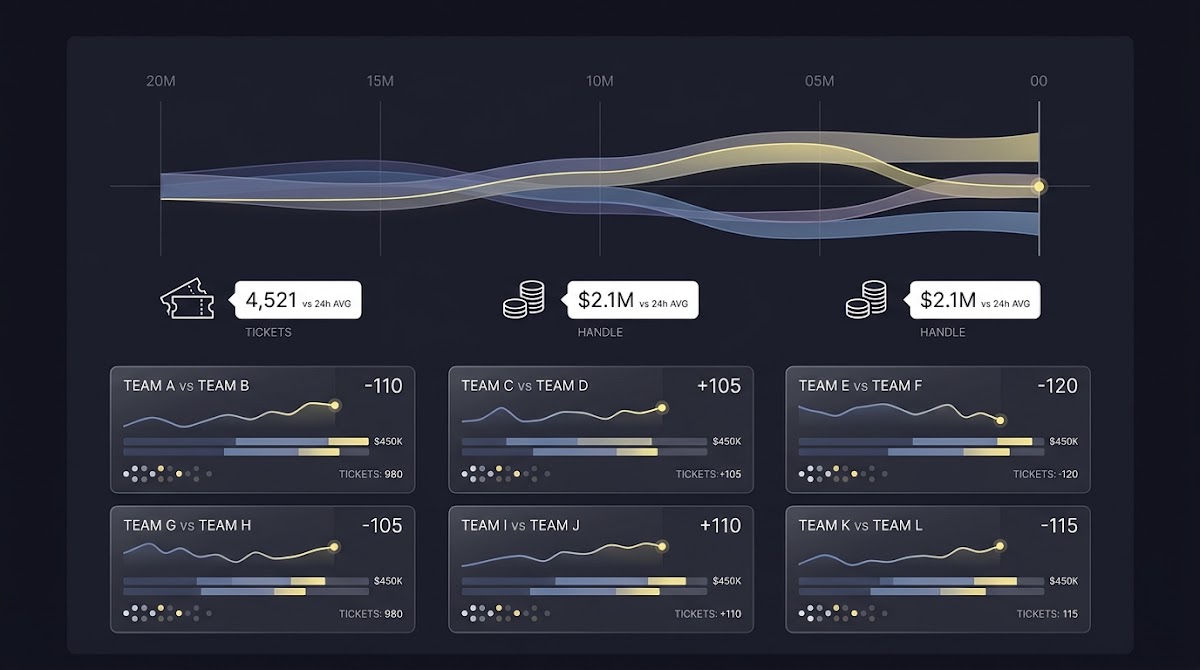
Start by collecting the public splits available: identify which side has the majority of tickets and which side carries the larger portion of the handle; RLM shows up when the line moves toward the side with greater handle despite tickets favoring the other side Action Network.
Capture snapshots early, midway, and late in the market so you can see whether handle-weighted activity preceded the reverse move or whether the shift came without supporting money; timestamped records make later validation possible.
Watch price moves across multiple books
Monitoring several books helps you tell a single-book quirk from a market-wide RLM signal; if multiple reputable books adjust in the same direction after handle-weighted action appears, that multi-book movement strengthens the case that the move reflects money-weighted pressure rather than ticket bias TheLines.
Be cautious when one book moves alone; isolated adjustments are often driven by that operator's limits or internal rules and have less informational value than coordinated movement across leaders and followers.
Use RLM as an informative market signal but not as proof of predictive accuracy; confirm handle-weighted action, check multiple books, and validate any advantage by tracking closing line value across many bets.
Timing and context checklist
Check for correlated events: late injury reports, lineup news, or reliable market-moving information frequently explains price shifts that might otherwise look like RLM; when such news coincides with a reverse move, treat the move as information-driven rather than as a pure sharp-money signal VSiN.
Use a short checklist in live markets: confirm handle-weight vs ticket split, scan leader books for synchronous changes, timestamp the earliest handle spike, and search for news in the same window; this sequence helps separate true reverse line movement from non-sharp operational shifts TheLines.
RLM versus Closing Line Value: what matters
Why CLV is a stronger skill metric
Closing line value, or CLV, measures how often your prices beat the market's final closing price, and consistently outperforming the close is a measurable signal of predictive skill that outperforms reliance on one-off RLM observations Unabated.
CLV is attractive as a benchmark because the closing price aggregates all available public information and market-making adjustments; tracking CLV over many bets gives a repeatable performance metric that helps separate skill from luck.
When RLM adds useful signal
That said, RLM can serve as an early alert to where sharp money landed before the close; if a reverse move is followed by a closing price that further supports the late handle-weighted shift, the RLM event becomes a useful part of a validated pattern rather than an isolated observation Action Network.
Combine RLM flags with CLV tracking: note RLM events in your log, then compare the decision outcome to the closing price over time; if RLM events consistently lead to better-than-close entries, they may have predictive value for your approach, but only persistent CLV gains demonstrate skill Unabated.
Decision criteria: when to trust and when to ignore RLM
Before tailing any reverse move, run a short checklist: confirm that handle favored the side the line moved toward, verify there is no clear injury or lineup news explaining the change, check multiple books for coordinated movement, and ensure that limits or exposure caps were not the apparent cause VSiN.
Consider timing: late sharp activity that appears in multiple books with no conflicting public news is more persuasive than an early isolated adjustment made by a single operator for internal limit reasons.

FundedPlays is a funded sports prediction challenge platform where users complete structured evaluation programs using virtual bankrolls to demonstrate forecasting consistency; information on challenge rules and progression is available through the platform's challenge page.
Context signals that strengthen an RLM read include repeated multi-book shifts, late-market handle spikes without matching ticket surges, and absence of public information explaining the move; these patterns together lower the chance that the movement is purely an operational or limit-driven change TheLines.
When to step back: ignore reverse movement that aligns with obvious injury reports, single-book limit responses, or conflicting cross-book prices, because these conditions indicate the move is likely non-informational and could mislead a tailing strategy Pinnacle Betting Resources.
Common mistakes and traps with RLM
One frequent error is blindly tailing reverse moves without verifying whether the action was handle-weighted; ticket-driven public pressure can look compelling but often lacks the stake size needed to influence a book's real exposure and so should not be equated with sharp money Action Network.
Confusing ticket counts for handle leads many bettors to misread the market; rely on split data when it is available and treat ticket-only snapshots as incomplete evidence.

Overweighting a single-book signal is another trap: a lone operator may move lines for operational reasons, and following that move without cross-book confirmation or context can turn an apparent edge into a losing pattern TheLines.
Keep a disciplined log of RLM events and outcomes; record the ticket and handle split, the time of movement, the books involved, and the closing price so you can later evaluate whether the RLM signals you followed produced positive CLV outcomes.
Practical examples and scenarios
Example 1: late sharp move into a favorited underdog. Imagine most tickets sit on Team A, but a sudden handle spike on Team B pushes several books to shift the price toward Team B late in the market; if multiple books move and there is no injury news, the scenario fits classical RLM driven by larger wagers and may warrant attention if your rules allow late entries Action Network.
Example 2: injury-related reverse move. Suppose a line drifts against the public followed immediately by reliable reports of a key player's absence; that reverse move is information-driven and should be treated differently from a sharp-money RLM, as the causal news explains the change and changes implied value Pinnacle Betting Resources.
timestamped snapshot tracker for price and public splits
Keep short notes on news and limits
Example 3: divergent multi-book movement. When several leader books move in the same direction after an observable handle surge and the closing prices end up supporting the late move, that pattern strengthens the inference that sharp money influenced the market and increases the chance the RLM event was meaningful for future CLV checks TheLines.
For each scenario, the recommended action is simple: document the ticker and handle split, watch cross-book activity, and avoid one-off judgments; only after tracking outcomes against the closing price over many instances should you adjust your rules to treat similar RLM patterns as actionable Unabated.
Remember these examples are illustrative; they show how context and cross-book confirmation alter the reading of the same surface pattern and why disciplined CLV tracking matters for long-term validation Action Network.
Tools, data and tracking RLM in 2026
What data to collect
Collect timestamped price snapshots, ticket versus handle splits, the books you monitored, and the closing price so you can compare entry prices to the market close; this set of fields gives you the minimum data needed to evaluate whether RLM events you observed led to better-than-close entries over time TheLines.
Include a short note field for any correlated news or limit observations so you can later separate informational moves from limit- or liability-driven adjustments.
Books and feeds to watch

Be mindful that different books report public splits and handle differently; document which methodology each book uses and avoid treating raw splits as directly comparable without adjustment.
Basic automation and tracking tips
Start with simple automation: timestamp price snapshots with screen grabs or API pulls, log tickets and handle when available, and compute closing line deltas to measure CLV for each bet; even a spreadsheet with consistent fields will support useful long-term analysis TheLines and OddsJam.
Quality matters more than quantity: ensure your timestamps are accurate, note the source of each split, and be conservative about drawing conclusions from a small sample of RLM events.
Conclusion: using RLM as one signal among many
Reverse line movement is a useful market concept: it flags situations where money-weighted pressure moves a line against the ticket majority, but it is not a standalone predictor and must be combined with closing line value and disciplined tracking to evaluate predictive value reliably Unabated.
Use RLM as an input to a broader process: log events, compare entry prices to closing prices, and only change your approach when consistent CLV gains appear; keep expectations realistic and prioritize responsible participation when testing any new method on our blog VSiN.
Reverse line movement happens when a sportsbook moves the line away from the side with most bets toward the side carrying larger dollar exposure; it signals money-weighted pressure rather than ticket majority.
RLM is a pattern in prices; sharp betting refers to larger, professional wagers that often cause handle-weighted moves, but RLM can also arise from limits or operational changes and is not identical to sharp action.
RLM can be informative, but you should validate its value by tracking closing line value over many bets; one-off RLM events are not a reliable way to predict outcomes.
References
- https://www.actionnetwork.com/education/what-is-reverse-line-movement
- https://oddsindex.com/guides/reverse-line-movement-guide
- https://www.thelines.com/reverse-line-movement/
- https://www.vsin.com/betting-101/what-is-reverse-line-movement/
- https://www.pinnacle.com/en/betting-articles/betting-strategy/why-betting-odds-change/
- https://unabated.com/articles/closing-line-value/
- https://www.fundedplays.com/challenges
- https://www.fundedplays.com
- https://www.fundedplays.com/blogs
- https://www.americangaming.org/resources/state-of-the-states-2025/
- https://oddsjam.com/betting-education/reverse-line-movement
- https://www.covers.com/guides/what-line-moves-can-tell-us