
What a bet return calculator does and when to use one
Purpose and typical inputs, return on bet calculator
A return on bet calculator converts a stake and an odds quote into the numbers most people want to see: the total payout, the profit and an implied probability that helps compare offers. For beginners, the difference between total return and profit is the first practical distinction to learn: total return is the full amount you receive if the selection wins, while profit is the return minus the original stake.
Typical inputs for a simple calculator are stake, the odds in their given format and, where relevant, the number of legs for a parlay. Standard outputs usually include total payout, profit, the implied probability and an optional expected value estimate when the user supplies a probability estimate. The calculator workflow normalizes odds to a single internal format, commonly decimal, before computing final numbers to avoid mistakes; this follows the standard approach used for decimal odds calculators and documentation decimal odds reference, and many online odds converter tools are available such as AceOdds odds converter.
When to reach for a calculator depends on the decision: use one to check a quick payout, to compare alternatives across odds formats, or to compute a parlay payout where multiplication increases the risk of human error. A calculator also helps maintain consistent reporting of profit versus total return when tracking results over many selections, which is especially useful for disciplined, challenge-based play.
Try the FundedPlays challenge walkthrough to test payouts and EV
Try the step-by-step walkthrough below or plug numbers into a simple calculator to see how stake, odds and leg count change profit and total payout.
Who benefits from using a calculator
Beginners benefit from a calculator to learn the difference between stake, profit and total return without manual arithmetic, while experienced handicappers use calculators to speed up scenario testing and to compute EV for many candidate bets. A reliable calculator reduces errors when converting fractional or American odds to a common format before combining legs in a parlay.
Users building spreadsheets or lightweight web tools will find the same formulas repeated across implementations: normalize to decimal odds, compute the return and profit, and then apply any EV logic if probability estimates are available. That sequence is the backbone of most bet payout calculators and keeps calculations transparent and auditable.

Core formulas: decimal, fractional and American moneyline odds
Decimal odds formula
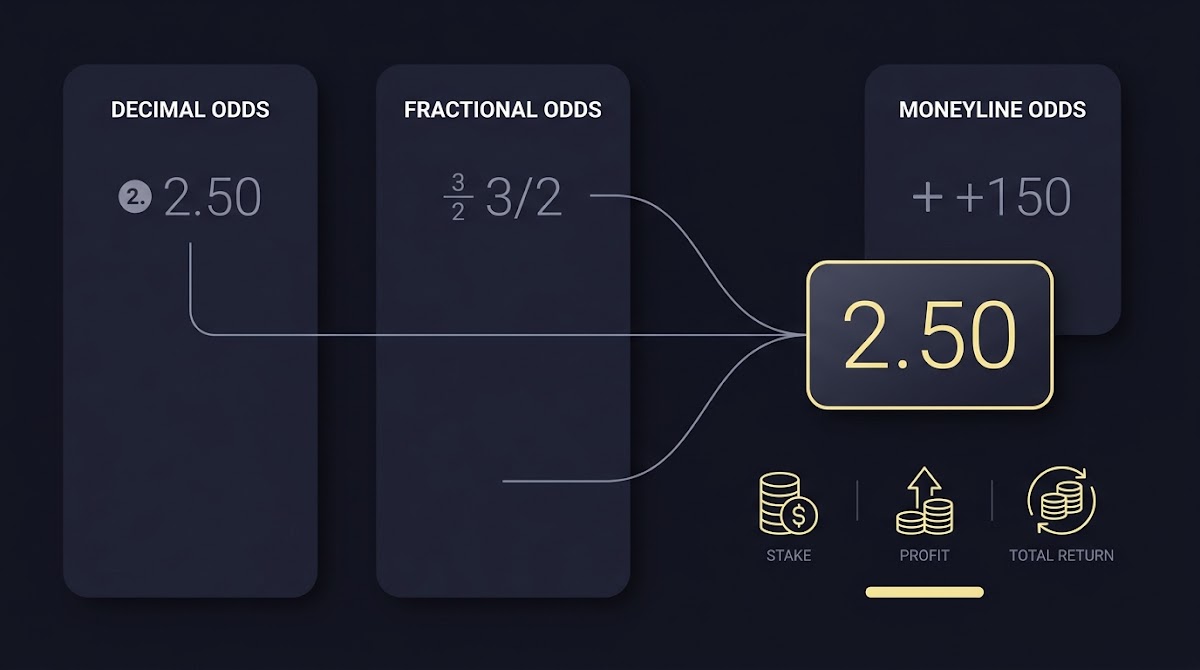
Decimal odds are the simplest to work with because the total return equals stake multiplied by the decimal number and profit is that return minus the stake; put plainly, return = stake × decimal odds, profit = return − stake. This formula is the standard for decimal formats and is commonly used in calculators that normalize different odds types to decimal first decimal odds reference.
Example shorthand: with a $10 stake at decimal odds 2.50, total return = 10 × 2.50 = 25 and profit = 25 − 10 = 15. That same arithmetic scales directly to larger stakes or to decimal odds with more precise decimals.
Fractional odds formula
Fractional odds express profit relative to the stake using a numerator and denominator. The profit formula is profit = stake × (numerator/denominator), and total return adds the stake back: return = stake + profit. This fractional-to-profit relationship is the conventional representation used in markets that quote fractional odds fractional odds.
For example, at 5/2 fractional odds with a $20 stake, profit = 20 × (5/2) = 20 × 2.5 = 50, so total return = 20 + 50 = 70. Many calculators convert fractional quotes to decimal internally before presenting results to avoid repeated fraction arithmetic.
American odds formula
American, or moneyline, odds use positive or negative integers and require different formulas depending on the sign. For positive moneyline odds, profit = stake × (odds/100); for negative moneyline odds, profit = stake × (100/|odds|). After computing profit, return = profit + stake. These moneyline payout rules are the standard way to interpret American odds moneyline odds guide.
Concrete example: with a $50 stake at +150, profit = 50 × (150/100) = 75 and return = 125. At −150 with the same stake, profit = 50 × (100/150) ≈ 33.33 and return ≈ 83.33. Calculator implementations must parse the sign and apply the correct branch to avoid incorrect profits.
Converting odds to implied probability and why it matters
Formulas for each format
Implied probability converts a quoted set of odds into the market's probability estimate for the outcome, which makes different formats comparable. For decimal odds implied probability = 1 / decimal odds; for fractional odds implied probability = denominator / (numerator + denominator); moneyline uses 100 / (odds + 100) for positive prices and |odds| / (|odds| + 100) for negative prices. These conversion formulas are standard for comparing offers across formats implied probability explanation.
Conceptually, implied probability tells you the break-even chance the market prices into the odds: if your independent estimate of the chance is higher than the implied probability, the selection may have value after accounting for margin. Calculators that report implied probability alongside payout numbers make apples-to-apples comparisons easier and more transparent.
Normalize odds to decimal, compute total return = stake × decimal odds and profit = return − stake, convert to implied probability if needed, and apply EV = p × profit − (1 − p) × stake to assess long-run value.
When estimating your own probability, contrast your assessed chance with the implied probability to decide whether the quoted payout creates a favorable proposition. Keep in mind that margins and vigorish mean the sum of implied probabilities across mutually exclusive outcomes can exceed 100 percent, so adjust comparisons accordingly.
Parlays and multiple bets: how returns multiply
Decimal-product approach
Parlays multiply the payout factors of each leg, so the total parlay return equals stake multiplied by the product of each leg's decimal odds. The standard implementation is to convert each leg to decimal odds first, then compute total return = stake × ∏(decimal odds of each leg). This multiplication principle is the core rule for parlay payouts and is used in parlay calculators and documentation parlay payout rules.
Practical implication: a parlay of three legs at decimals 1.80, 2.10 and 1.50 with a $10 stake yields total return = 10 × 1.80 × 2.10 × 1.50. The product compounds quickly, which is why small stakes can produce large advertised totals, but the risk also compounds because a single losing leg zeroes the payout.
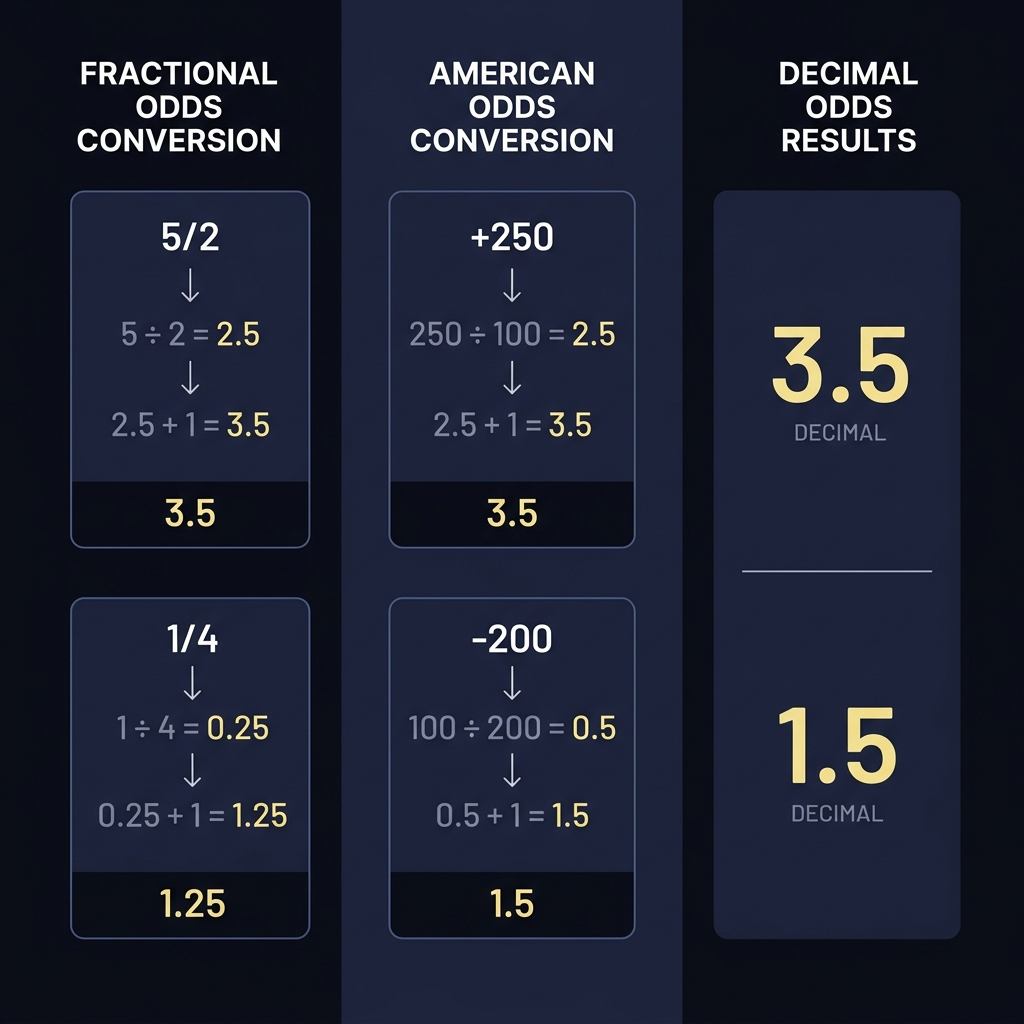
When combining legs quoted in fractional or American formats, convert each to decimal before multiplying to avoid arithmetic mistakes. Many bet payout calculators do this conversion automatically so users can mix inputs but still get the correct parlay product.
What happens when a leg loses
The all-or-nothing nature of parlays means any losing leg produces a zero payout for the ticket, unless the leg is a push. Pushes (ties) are typically handled by dropping the leg and computing the parlay with the remaining legs, effectively treating the leg as decimal odds 1.0. Clear handling of pushes is essential to match user expectations and to compute accurate returns.
When combining legs quoted in fractional or American formats, convert each to decimal before multiplying to avoid arithmetic mistakes. Many bet payout calculators do this conversion automatically so users can mix inputs but still get the correct parlay product.
Expected value: the math for deciding whether a bet is worth it
EV formula and interpretation
Expected value provides a disciplined decision rule by combining an estimated probability with the payout structure. The EV formula is EV = p × profit − (1 − p) × stake, where p is the assessed probability, profit is the payout minus stake if the bet wins, and stake is the amount risked. This EV formulation is a standard decision-analysis tool in betting and forecasting contexts expected value reference.
Interpretation is straightforward: a positive EV suggests a favorable long-run proposition given your probability estimate, while a negative EV suggests the opposite. EV is not a certainty for any single outcome, but it is the correct lever for comparing long-run expectations across candidate plays.

Using EV with implied or estimated probability
You can compute EV using the market's implied probability as a baseline or use an independently estimated probability when you believe the market misprices the event. If you plug the implied probability into the EV formula, the result will often be negative after accounting for margin, which highlights the difference between theoretical break-even and realistic opportunities.
Practical users track EV across many selections to see whether their forecasting approach produces a consistently positive edge. In skill-based challenge contexts, EV helps compare competing predictions and informs stake sizing when combined with variance considerations and drawdown rules.
Step-by-step calculator walkthrough: manual, spreadsheet and simple web tool
Manual calculation steps
Manual workflow checklist: first normalize odds to decimal; second compute total return and profit for single-leg bets; third for parlays multiply decimal odds then compute return; fourth compute implied probability if needed; fifth compute EV using your estimated probability. Following this ordered sequence avoids common mistakes like multiplying fractions or misapplying moneyline signs decimal odds reference.
A clear step-by-step approach ensures every calculation is auditable. For manual checks, write down the intermediate decimal conversions before multiplying for parlays and keep full precision until the final result to avoid rounding artifacts.
Spreadsheet formulas to paste
Use spreadsheet formulas to automate conversions and computations. For decimal return put =stake*decimal_odds. For fractional odds parsed as numerator and denominator, decimal conversion is =1+(numerator/denominator). For positive American odds use =1+(odds/100) and for negative =1+(100/ABS(odds)) to get decimal equivalents that match the return = stake*decimal conversion approach. These formulas let you treat all inputs uniformly and avoid branching logic in payout cells fractional odds guide.
Validation tips: test the spreadsheet with known examples such as a $10 stake at decimal 2.5, a fractional 5/2 and a moneyline +150 to ensure each formula produces identical total returns once properly converted. Keep internal precision and round only the final display value.
What to validate in a web tool
When evaluating a web calculator, validate outputs by comparing manual spreadsheet results for several single-leg and parlay examples. Confirm the tool labels outputs clearly as profit versus total return, and check how it handles pushes and mixed-odds parlays. Good tools will present the decimal equivalent and implied probability alongside payouts so you can audit the conversion. See other online calculators such as the Covers betting odds calculator for comparison Covers odds converter.
Security and transparency matters: a trustworthy tool shows intermediate steps or offers a toggle to display the decimal equivalents it used internally. That makes it easier to match against manual calculations and reduce surprises during challenge evaluations or performance tracking.
Worked examples: single bets and parlays with numbers
Single-decimal example
Example 1: single decimal bet. Stake $10, decimal odds 2.50. Step 1 compute total return = 10 × 2.50 = 25. Step 2 compute profit = 25 − 10 = 15. Step 3 compute implied probability = 1 / 2.50 = 0.40 or 40 percent. These steps illustrate how a return on bet calculator reports the same three numbers for single-leg decimal bets and make manual checking straightforward decimal odds reference.
To compute EV for the same example using an independent probability estimate of 45 percent, profit is 15 and EV = 0.45 × 15 − 0.55 × 10 = 6.75 − 5.5 = 1.25, a modest positive EV when measured in the same currency units as the stake.
Fractional example
Example 2: fractional odds 5/2 with a $20 stake. Step 1 compute profit = 20 × (5/2) = 50. Step 2 compute total return = 20 + 50 = 70. Step 3 implied probability = denominator/(numerator+denominator) = 2/(5+2) ≈ 0.2857 or 28.57 percent. Converting to decimal for alternate representation gives decimal odds = 1 + (5/2) = 3.5 so return = 20 × 3.5 = 70, which matches the fractional arithmetic fractional odds.
When computing EV with your own probability, use profit = 50 and stake = 20 in EV = p × profit − (1 − p) × stake to get a consistent long-run metric.
compute return profit and EV from stake decimal odds and probability
formula uses fields exactly as named
Three-leg parlay example
Example 3: three-leg parlay with decimals 1.80, 2.10 and 1.50 and a $10 stake. Step 1 ensure all legs are decimal; Step 2 compute product = 1.80 × 2.10 × 1.50 ≈ 5.67; Step 3 compute total return = 10 × 5.67 ≈ 56.70; Step 4 compute profit ≈ 46.70. This sequence emphasizes converting non-decimal inputs before multiplication and keeping internal precision to avoid rounding errors in the product calculation parlay math.
If any leg loses, the parlay return is zero, whereas a push typically removes that leg from the multiplication, effectively treating it as 1.00 in the product. For mixed-format legs, first convert each to decimal and then multiply to get the exact payout.
How to interpret profit, total return and return on investment (ROI)
Differences between profit and total return
Profit is the gain above your original stake; total return is the entire amount returned to you if the bet wins. Calculators must label these outputs distinctly to avoid confusion when users track performance across many selections. Displaying both numbers side by side prevents misinterpretation when people compare outcomes across different stake sizes or bet formats.
Example contrast: a $100 stake that returns $200 has profit $100 and a total return $200; the ROI is profit divided by stake, which in that example equals 100/100 = 1.0 or 100 percent. That ROI clarifies the efficiency of the stake independent of ticket size.
Calculating simple ROI for a bet
ROI formula for a single bet is ROI = profit / stake, often expressed as a percentage. Use ROI when comparing two bets where one has a larger total return but also required a much larger stake; ROI reveals which bet produced the better percentage gain per dollar risked. This framing helps compare bets across bankrolls and challenges.
When reporting results over many bets, use average ROI or cumulative profit divided by cumulative stake as consistent metrics, and label which metric you present so peers or reviewers can interpret your performance accurately.
Decision criteria: when a calculated return is attractive
Edge, variance and stake sizing
Use EV as the primary long-run decision metric: require a positive EV for considered plays while recognizing estimation error. EV measures the expected monetary advantage given your probability estimates and payout, and it is the proper basis for disciplined selection in skill-based challenge contexts.
Variance matters because high expected return with high variance can produce long losing runs; consider your bankroll and drawdown limits when sizing stakes. Practical stake-sizing rules balance estimated edge with risk tolerance and the scale of your bankroll, and they should be framed as general guidance rather than financial advice.
Role of EV and probability estimates
Comparing implied probability to your estimated probability is the first step: if your estimate exceeds the implied probability by a margin that covers estimation uncertainty and market margin, the bet may be worth considering. Track EV across many bets to see whether your method produces a persistent positive edge before increasing stake sizes.
In structured evaluation challenges, rules and drawdown limits may favor conservative stake sizing even with positive EV, because eligibility often depends on consistent performance rather than single large wins. Use calculators to test different stake rules against simulated sequences to find a disciplined approach that fits challenge rules. For details on how evaluation challenges work on platforms like Funded Plays, see platform documentation.
Common mistakes and rounding pitfalls to avoid
Rounding errors and display traps
A frequent mistake is rounding too early in chained calculations, especially for parlays where each multiplication magnifies rounding error. Keep at least four decimal places internally and round only the final displayed result to avoid material divergence from expected payouts; this precision rule is a common best practice in payout calculators.
Another trap is confusing profit and total return in displays; label fields clearly and avoid labels like "payout" without qualification. Transparency about whether a displayed number includes the stake prevents tracking errors during challenge reporting or personal record keeping.
Mixing odds formats without conversion
Never multiply fractional or American odds directly when computing a parlay; always convert each leg to decimal first, then multiply. Mixing formats in a single calculation is a leading source of errors and will produce incorrect parlay totals unless conversions are applied consistently decimal odds reference.
Also verify the moneyline sign when parsing American odds; applying the positive formula to a negative moneyline or vice versa will flip profit estimates and produce wrong results, so add validation checks in spreadsheets or tools.
Display, precision and odds-conversion best practices for calculators
What to show by default
Recommended default outputs: stake, decimal odds used internally, total return, profit, implied probability and EV when a probability is supplied. Showing the decimal equivalent for any non-decimal input helps users audit results and reduces confusion when mixing formats, and it is standard in quality bet payout calculators.
Offer toggles to present results in the original odds format or to show only totals for quick reads, but keep a clear label explaining whether displayed numbers include the stake to avoid ambiguity.
How to label outputs for clarity
Label the returned amount explicitly as "total return (stake included)" and label the other value as "profit (stake excluded)". For EV show the sign and the numeric value in currency units with an optional percentage equivalent so readers can quickly compare opportunities.
Internally preserve at least four decimal places for conversions and chained multiplications and round only the final display. That combination of internal precision and clear labeling prevents many calculation disagreements during challenge evaluation or when reporting performance.
Practical scenarios for skill-based prediction platforms and challenges
Using calculators in evaluation challenges
The same formulas used by public sportsbooks also apply in skill-based prediction platforms and evaluation challenges; calculators help participants model potential payouts and test stake-sizing strategies under platform rules. Calculators cannot predict qualification or rewards because those depend on performance and compliance with rules, but they do provide consistent payout math for scenario testing.
Track profit, ROI and EV across rounds to measure whether your forecasting method produces an edge in the environment of a challenge. Consistent, positive EV across many selections is the performance signal that matters more than occasional headline wins.
Reporting and tracking performance
When reporting performance, keep a clear ledger that records stake, odds format, decimal conversion, total return and profit for every selection. That allows you to recompute ROI and EV reliably, to reproduce past calculations, and to meet the transparency expectations of peer reviews or platform-required reporting. For more resources and posts see our blog.
Remember that platform rules like drawdown limits or order-of-play constraints affect how much you can stake and when; integrate those rules into your stake-sizing simulations rather than assuming every positive EV bet is permissible under challenge rules.
Closing summary: key takeaways and next steps
Key formulas recap
Recap the essentials: decimal return = stake × decimal odds and profit = return − stake; fractional profit = stake × (numerator/denominator) with return adding the stake back; American profit uses different formulas for positive and negative moneylines with return = profit + stake; parlays multiply decimal factors; EV = p × profit − (1 − p) × stake. These are the building blocks for any return on bet calculator and should be validated against authoritative references decimal odds reference.
Suggested next steps
Validate any calculator by reproducing the worked examples in this guide, track EV and ROI across many selections, and use conservative stake-sizing rules while you refine probability estimates. Calculators increase transparency and speed, but disciplined testing and careful tracking are the keys to measuring real skill in challenge-based environments.
Further reading and references
For authoritative descriptions of the formulas and the underlying concepts consult reputable sources on implied probability, moneyline rules, fractional and decimal formats, parlays and expected value. Prefer financial references and encyclopedic entries when verifying formulas to avoid ambiguous interpretations.
Core sources include Investopedia for implied probability and EV, and encyclopedic entries for fractional and decimal odds and for parlay rules. Use those references to cross-check the formulas presented here and to dig deeper into conversion edge cases. Also consider additional calculator tools such as the Action Network betting odds calculator for practical examples Action Network betting calculator.
Total return is the full amount you receive if a bet wins, including the original stake; profit is the return minus the stake.
Convert fractional by decimal = 1 + numerator/denominator; convert American by using the positive or negative formula then adding 1 to get decimal equivalents.
A positive EV indicates a favorable long-run expectation given your probability estimate, but it does not guarantee short-term results and should be combined with risk management.
References
- https://en.wikipedia.org/wiki/Decimal_odds
- https://www.aceodds.com/bet-calculator/odds-converter.html
- https://www.fundedplays.com/blogs/how-fundedplays-evaluations-work
- https://www.investopedia.com/terms/m/moneyline.asp
- https://www.investopedia.com/terms/i/implied-probability.asp
- https://en.wikipedia.org/wiki/Fractional_odds
- https://en.wikipedia.org/wiki/Parlay_(gambling)
- https://www.investopedia.com/terms/e/expectedvalue.asp
- https://www.fundedplays.com/challenges
- https://www.covers.com/tools/odds-converter
- https://www.fundedplays.com
- https://www.fundedplays.com/blogs
- https://www.actionnetwork.com/betting-calculators/betting-odds-calculator