
What 'return on bet' means and why it matters
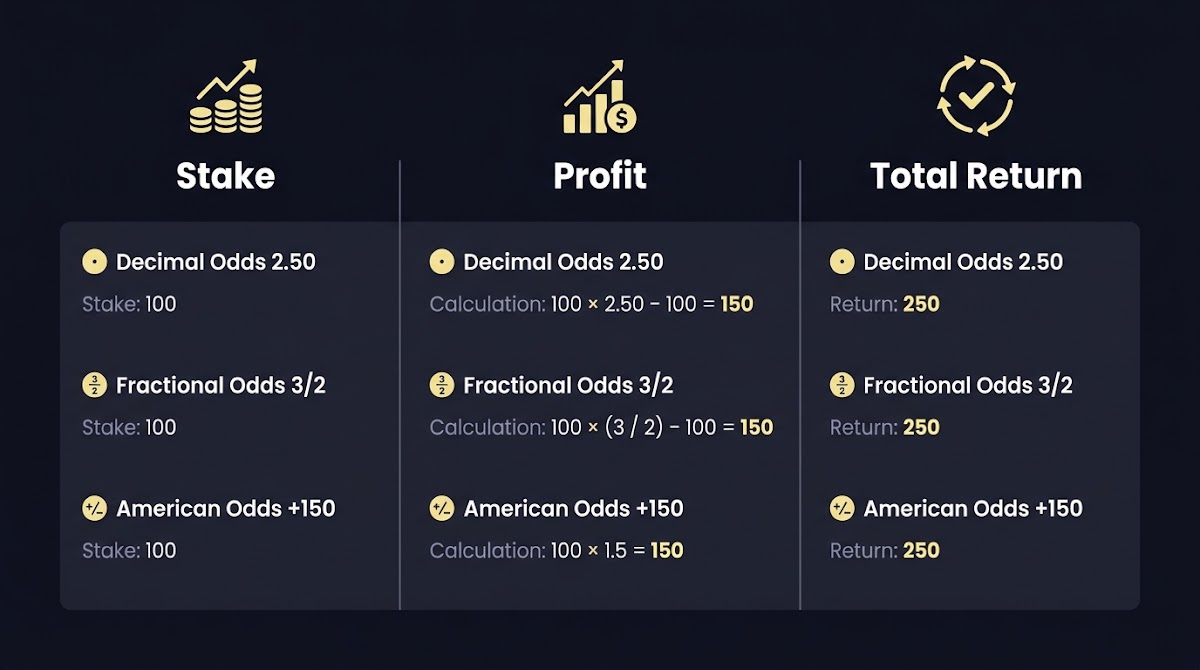
The phrase return on bet refers to the total money you receive when a wager wins, and it matters because it separates the amount risked from the amount earned. In plain terms, return equals stake plus profit, and profit equals return minus stake; a losing bet usually returns nothing and the loss is limited to the stake, a point often stressed by regulators and industry explainers and relevant when you use a return on bet calculator.
Quick inputs for a demo inline calculator
Enter stake and odds to see profit and total return
Start by thinking of three simple labels. Stake is the amount you put at risk. Profit is the extra money you receive when a bet wins. Return is the total you get back, which always includes the original stake. This naming keeps arithmetic clear and reduces mistakes when reading calculator output, and it echoes standard public explanations about settlements and payout structure American Gaming Association.
Because return includes the stake, calculators built to show potential winnings must be explicit about which number the site shows. Some tools present profit only, some show total return only, and a few display both. Knowing the difference up front prevents misreading a positive outcome as net gain when the stake was not included.

Core formulas: fractional, decimal and American odds
Three common odds formats require three precise formula sets. Fractional odds calculate profit as stake times the fraction numerator over denominator, with total return equal to stake plus that profit. This direct formula is the basis for most fractional-odds calculators and examples that explain profit and return Investopedia fractional odds definition. See an online odds converter at AceOdds.
Decimal odds express the total payout for each unit staked as a single decimal number. The total return equals stake multiplied by the decimal figure; profit is the return minus the stake. That design makes decimal-format calculators easy to implement since one multiplication gives the full payout and a simple subtraction yields profit Investopedia decimal odds definition.
American, or moneyline, odds use positive and negative integers that require two cases. For positive American odds the profit equals stake multiplied by odds divided by 100. For negative American odds the profit equals stake multiplied by 100 divided by the absolute value of the odds. In every case the total return equals stake plus profit, and the standard conversions between moneyline and implied probability are well documented for calculator implementations Investopedia moneyline definition.
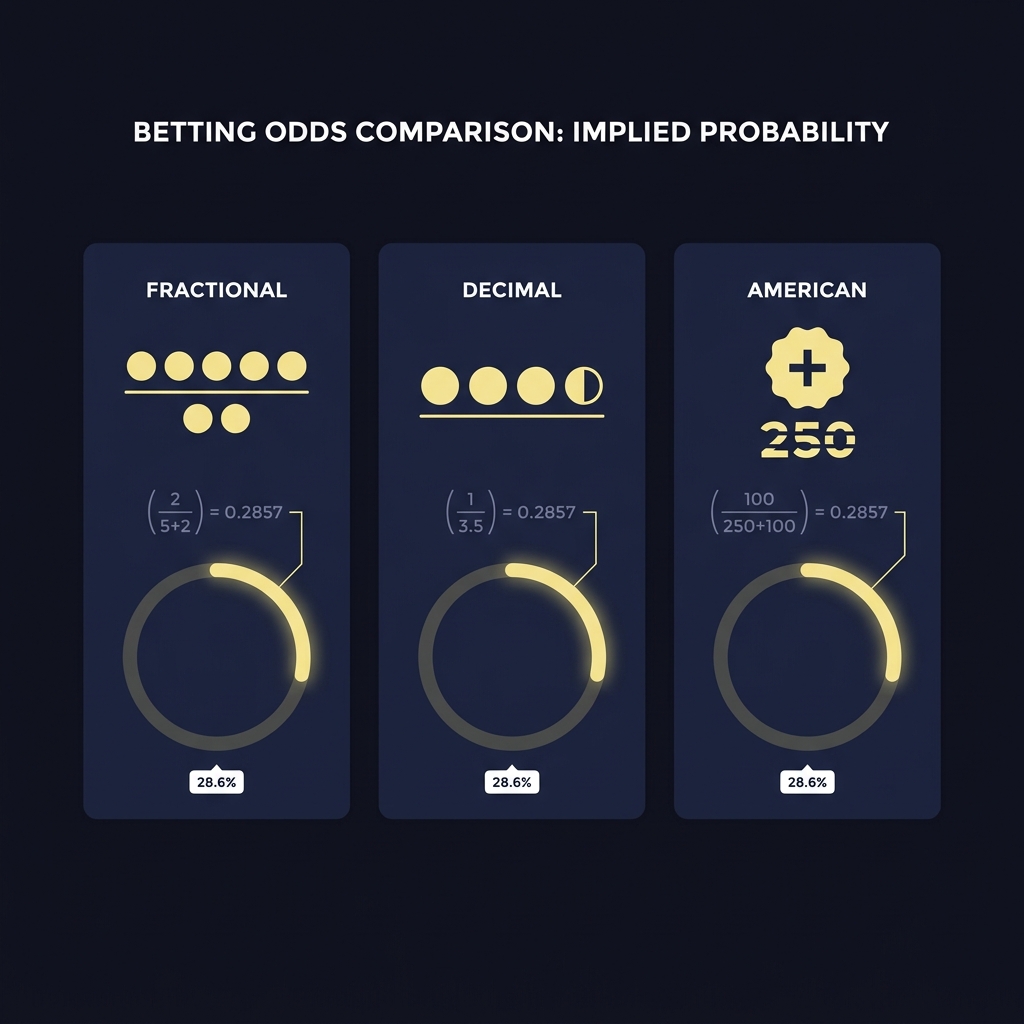
For calculators that also return implied probability, use the standard conversions: fractional implied probability equals denominator divided by numerator plus denominator; decimal implied probability equals one divided by the decimal odds; American positive implied probability equals 100 divided by odds plus 100; American negative implied probability equals the absolute odds divided by the absolute odds plus 100. These conversions are stable across recent industry explainers and are essential when a tool must show whether an offered price implies value GambleAware.
How a return on bet calculator works: inputs, outputs and conversions
A return on bet calculator needs a short, well defined input set to be reliable. The mandatory inputs are stake, odds format, and odds value. Optional inputs commonly include the currency or unit for the stake, the number of decimal places for output, and whether the user prefers profit or total return as the primary display.
Processing follows a predictable sequence. First the tool parses the chosen odds format. Second it applies the format-specific formula to produce profit. Third it adds the stake to produce total return. Fourth it computes implied probability using the standard conversion for that format, and finally it applies rounding rules for display. When a calculator documents this exact sequence users can reproduce results manually for verification Investopedia decimal odds definition.
Common edge cases must be handled explicitly. If an odds string cannot be parsed the tool should show an input error rather than guessing. Voided bets often return the original stake in many systems and should be modeled separately. Losing outcomes should be displayed as zero return with a clear note that the loss equals the original stake, matching settlement practices summarized by regulators Massachusetts Gaming Commission.
A bet return is the stake plus any profit from a winning bet; decimal odds give total return as stake times decimal, fractional odds give profit as stake times numerator over denominator then add stake, and American odds use separate formulas for positive and negative prices but always add stake for total return.
Rounding rules affect displayed totals when fractional stakes or complex combinations are involved. A calculator should let users choose rounding precision and should document whether internal calculations use full precision and only round at display time. That reduces confusion when a small rounding difference shows up between the calculator and an operator settlement.
Step-by-step worked examples for common odds
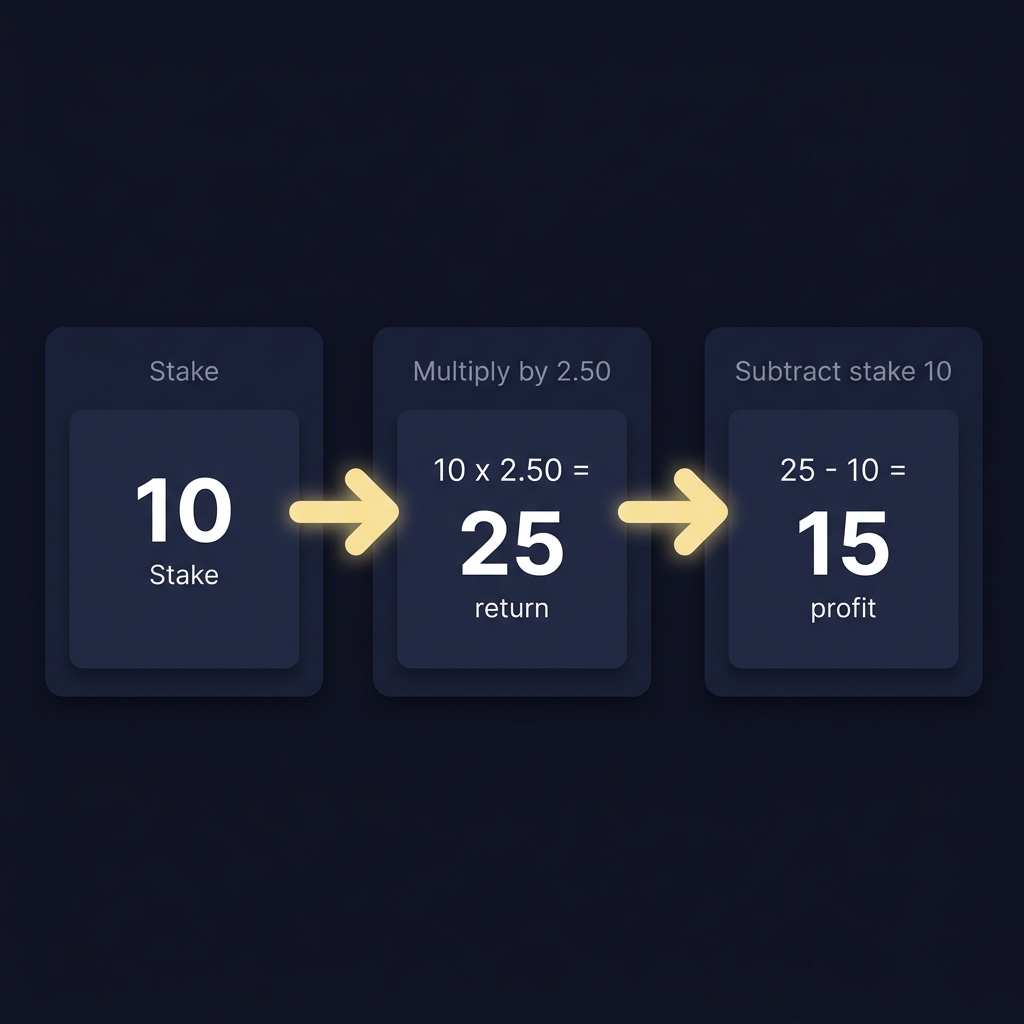
Decimal example. Suppose decimal odds are 2.50 and the stake is 10. The total return is stake times decimal, so 10 times 2.50 equals 25. The profit is the return minus stake, so 25 minus 10 equals 15. This sequence is the typical decimal calculation shown in educational explainers and is easy to reproduce on any return on bet calculator Investopedia decimal odds definition.
Write the steps in the calculator log or on paper to confirm. Multiply the stake by the decimal to get total payout. Subtract the stake from that number to see net gain. If the tool shows only profit, add the stake to confirm total return matches the operator payout rules.
Fractional example. Take fractional odds 5/2 and a 10 stake. Profit equals stake times numerator divided by denominator, so 10 times 5 divided by 2 equals 25. Total return equals stake plus profit, so 10 plus 25 equals 35. That pattern where fractional odds pay profit proportionally and then return the stake is the standard fractional payout model Investopedia fractional odds definition.
When fractional odds produce integer profits the numbers are straightforward. If the arithmetic yields a noninteger, display rounding rules should be clear so a user knows whether a platform would round at settlement or pay fractional cents when allowed.
American examples. For a positive American price, say +150 with a 100 stake, profit equals stake times odds divided by 100, so 100 times 150 divided by 100 equals 150 profit, and total return is 100 plus 150 equals 250. For negative American odds, say -200 with a 100 stake, profit equals stake times 100 divided by the absolute odds, so 100 times 100 divided by 200 equals 50 profit, and total return is 100 plus 50 equals 150. These two cases are what moneyline calculators must implement to handle both signs correctly Investopedia moneyline definition. See additional converter implementations such as Covers.
How a return on bet calculator works: inputs, outputs and conversions continued
Practical UI fields map directly to the processing steps. A clean interface lists stake first, then an odds format selector, and then an odds value input. Labels should show examples, for example decimal 2.50, fractional 5/2, or American +150, so users know what to type. A small help icon can explain whether the tool expects a leading plus sign for positive moneyline entries.
Outputs commonly displayed are profit, total return, and implied probability. Profit and total return cover financial outcomes. Implied probability helps users decide whether a price represents value based on their own estimated chance of winning. Implement the probability conversions described earlier and label them clearly so readers do not confuse implied probability with personal win likelihood GambleAware. See conversion notes at TheRundown.
Calculator developers should also handle ties and pushes. Many systems treat a push as returning the stake and producing zero profit. Document whether a push is modeled and how a voided selection is treated. That transparency prevents users from assuming the tool follows a different settlement rule and avoids common disputes when comparing tool output to platform statements American Gaming Association.
Choosing the right calculator and inputs: features to look for
When evaluating a calculator, require multi-format odds support so you can input decimal, fractional, or American prices and see consistent conversions. A reliable tool will show both profit and total return and will let you toggle which is shown first for clarity. Good documentation of rounding and settlement rules is part of trust and safety guidance that public bodies recommend GambleAware.

Precision matters. Look for an option to set display decimal places or currency cents. If you simulate series of bets for bankroll planning, small rounding differences can compound. Tools that keep full internal precision and only round for display reduce surprises when you reconcile totals with account statements.
Trust signals include visible methodology notes, links to authoritative explainers about formulas, and a clear risk disclosure that wagering can lose money. Tools aimed at serious users often surface implied probability and let you convert back and forth between formats so you can compare market prices.
Common errors and pitfalls to avoid
One frequent mistake is treating decimal odds as profit rather than total return. If you see decimal 2.50 and assume that equals 2.50 profit on a 1 stake, you will understate how much you get back. Remember that decimal expresses total return per unit staked; profit is the excess over the stake Investopedia decimal odds definition.
Another common error is misreading American odds signs. A negative number like -200 indicates how much you must risk to win 100 units, while a positive number like +150 shows how much you win on a 100 unit risk. Mixups happen when users forget the sign rule and apply the wrong formula, so build a quick sign check into your calculator UI.
Fractional odds can be misapplied when users reverse numerator and denominator. For example treating 5/2 as 2/5 changes profit expectations dramatically. A clear fractional input widget that splits numerator and denominator or validates a single string reduces reversal mistakes.
Always remember calculators show potential returns and not guaranteed outcomes. Regulators and charities stress the risk involved in wagering and recommend responsible participation; a calculator should include a short risk reminder near results rather than hide it in small print GambleAware.
Practical scenarios: bankroll planning and evaluation challenges
Single-bet sizing starts with the stake. Use the calculator to see how much a single bet will return at your chosen odds and then decide whether that potential gain justifies the risk relative to your bankroll. Many experienced players set maximum stake percentages of their total bankroll to limit exposure. See Funded Plays for platform details.
Check payout math with a demo calculator
Try a demo calculator to confirm payout math and compare profit and total return for different odds. Remember that calculators show potential outcomes and that participation carries risk.
To simulate a series of bets, run multiple lines through the calculator and keep a ledger of stake, odds, profit, and cumulative bankroll. This lets you visualize drawdown patterns and see how consecutive losses affect capital. Simulation clarifies that consistent edge over time matters more than one-off large wins when you plan for sustained performance in evaluation challenges.
In evaluation-style simulations similar to those used by funded challenge platforms, limit position size, enforce drawdown constraints, and log each result. Use calculator outputs to check whether your sizing rules keep likely drawdowns within tolerances set by challenge rules. Using clear, repeatable calculations helps when you later compare simulated performance to platform rules and requirements American Gaming Association. For more on how evaluations work see Funded Plays evaluations.
Choosing the right calculator and inputs: features to look for continued
If you are testing a calculator for repeated workflows, consider export features so you can save logs and reconcile them with live account statements. CSV export or a simple copy function helps verify that internal rounding and per-bet math match expectations across many entries.
Security and transparency are also part of trust. Tools that display the exact formula used for each calculation allow you to double check arithmetic and prevent subtle errors in internal logic. Favor calculators that let you select how pushes and voids are treated so results align with the platform you intend to use.
Common errors and pitfalls to avoid continued
A final pitfall is ignoring implied probability. Knowing the implied probability that a market embeds helps you compare that number to your own estimated chance of success. If your estimate exceeds the implied probability by a margin that covers fees and expected variance, you may have a theoretical edge; otherwise the bet is unlikely to be profitable in the long run GambleAware.
Be careful when calculators accept ambiguous inputs. For example a user entering 150 into an American odds field might mean +150 or 1.50 decimal depending on the UI. Clear labels and input validation remove this ambiguity and stop common mistakes.
Practical scenarios: bankroll planning and evaluation challenges continued
When sizing single stakes for a run of evaluation bets, choose a simple rule such as a fixed percentage of starting bankroll. Use the calculator to see how wins at your target odds grow the bankroll and how losses shrink it. This practice helps set realistic targets for required winning rates and risk limits.
For drawdown planning, simulate sequences of losing bets to see worst case outcomes for a given stake size. Reducing stake size lowers the depth of a potential drawdown and increases the number of wins needed to recover. This tradeoff between volatility and growth is central to challenge-style evaluations and to disciplined bankroll management American Gaming Association.
When using results in a structured challenge, document every assumption. Note whether totals are profit or return, state rounding rules used, and keep screenshots or logs. Clear records make it easier to learn from simulations and to align your behavior with platform rules if you move from practice to formal evaluation challenges.
Wrap-up: checklist and where to learn more
Quick checklist to validate a calculator: confirm stake input, confirm odds format, check arithmetic for profit and total return, verify implied probability conversion, and confirm rounding policy. Use this checklist as a short cross-check before acting on any displayed result.
Remember that calculators compute potential returns and that regulators and public bodies advise that wagering carries risk and offers no guarantees. Keep records, use sensible sizing rules, and treat tools as helpers for disciplined decision making rather than as guarantees of future success GambleAware.
For authoritative reading on odds, payouts and safer play, consult major public explainers listed near the end of this article. Those sources provide stable formulas and the responsible-play context you should consider when interpreting calculator output, or see our blog.
Multiply the stake by the decimal odds to get total return, then subtract the stake; the difference is the profit.
A negative moneyline shows how much you must risk to win 100 units; use the formula stake times 100 divided by the absolute odds to compute profit.
No, calculators show potential outcomes for winning bets only and regulators advise that wagering involves risk and no guaranteed returns.
References
- https://www.americangaming.org/resource/sports-betting-101/
- https://www.investopedia.com/terms/f/fractional-odds.asp
- https://www.investopedia.com/terms/d/decimal-odds.asp
- https://www.investopedia.com/terms/m/moneyline-bet.asp
- https://www.begambleaware.org/safer-gambling/understanding-the-odds
- https://massgaming.com/sports-wagering/sports-wagering-101/
- https://www.fundedplays.com/challenges
- https://www.aceodds.com/bet-calculator/odds-converter.html
- https://www.covers.com/tools/odds-converter
- https://therundown.io/betting-calculators/odds-converter-calculator
- https://www.fundedplays.com
- https://www.fundedplays.com/blogs
- https://www.fundedplays.com/blogs/how-fundedplays-evaluations-work