

What a return-on-bet calculator does and why it matters
A return on bet calculator translates an odds price and your stake into the numbers you need to compare outcomes: the payout, the net profit, and the percent return on investment. A clear calculator applies the standard payout conventions for each odds format so you can compare results across decimal, fractional and American quotes and understand how much you stand to gain or lose on a given stake. The return on bet calculator also helps when you are tracking results over time or testing strategies in simulations.
Why that standardization matters is simple: the same price can be written three ways but represents the same economic payoff only when converted consistently. That lets you compare bets side by side, add up results across a string of wagers, and report ROI in a way that is comparable to other investment or performance measures.
When should you use a return on bet calculator? Use it any time you need an exact payout, when you are summarizing a session of multiple bets, or when you want to translate odds into an implied probability to feed an expected value or edge calculation. It is also useful in simulated or funded-account exercises where consistent math helps track qualification progress and performance against rules. You can also try a free odds converter such as AceOdds for quick conversions.
Core formula: payout and net profit (the math you always apply)
Decimal odds formula
Decimal odds pay out as payout = stake × decimal, so net profit is stake × (decimal - 1). For example, a 10 stake at 2.50 decimal returns 10 × 2.50 = 25 total, for a net profit of 25 - 10 = 15. This decimal convention is standard across sports betting education and reference materials Investopedia odds guide.
Fractional odds formula
Fractional odds pay profit = stake × (numerator/denominator), with total return equal to stake + profit. To convert to decimal, add one to the fraction. For example, a 10 stake at 3/2 yields profit 10 × (3/2) = 15 and total payout 25. The fractional-to-decimal relationship and the same payout logic are documented in general odds references Encyclopaedia Britannica on odds.
American (moneyline) formula
American odds compute profit differently depending on sign. For positive moneyline +A, profit = stake × (A/100). For negative moneyline -A, profit = stake × (100/A). In either case total return equals stake + profit. For example, a 10 stake on +150 returns a profit of 10 × 150/100 = 15 and a total payout of 25. These moneyline conventions are widely used and explained in modern betting references Investopedia odds guide.

How to convert odds to implied probability
Converting odds into implied probability standardizes different formats on the same scale so you can reason about expected value and ROI. For decimal odds the implied probability is probability = 1 / decimal. For fractional odds it is probability = denominator / (numerator + denominator). For American odds the usual conversions standardize positive and negative lines to the same probability scale. These standard conversions are described in odds references and statistical summaries Encyclopaedia Britannica on odds. Tools such as OddsJam also provide quick converters.
As a concrete example, the same price can be shown three ways. A decimal 2.50 equals fractional 3/2 and equals American +150; converting each to implied probability yields the same approximate chance once you use the formulas above. Work through a recent price you saw to make the idea concrete.
Use payout formulas specific to the odds format to compute total payout and net profit, convert prices to implied probability for comparison, and compute ROI as net profit divided by stake for single bets or total net profit over total stakes for a series.
Calculating ROI for a single bet and for a series
Single-bet ROI formula
ROI for one bet is net profit divided by stake, expressed as a percent: ROI = (net profit / stake) × 100. Using the earlier decimal example, a net profit of 15 on a 10 stake gives ROI = (15 / 10) × 100 = 150%. Standard ROI definitions in finance help keep presentation consistent when reporting performance over time Investor.gov ROI reference.
ROI across multiple bets and percent expression
For a series of bets use total net profit divided by total stakes: Series ROI = (sum of net profits / sum of stakes) × 100. The formula treats equal-stake sequences and variable-stake sequences differently: equal-stake sequences reduce compounding complexity and make per-bet averages easier to interpret, while variable stakes require summing actual capital deployed for a correct percentage. This series definition follows common ROI presentation used in accounting and performance reporting CFI ROI guide.
How bookmaker margin (vig/overround) affects expected returns
What vig/overround is
Bookmaker margin, often called vigorish or overround, is how bookmakers build a commission into prices so the implied probabilities across outcomes sum to more than one. That extra amount reduces the fair payout you would receive if odds were true probabilities. The concept and its role in pricing are described in bookmaker and betting-margin discussions Investopedia vigorish definition.
How it reduces implied fair returns
In practice vig raises the implied probabilities above fair values so a bettor who accepts posted prices without an edge faces lower expected ROI than the simple payout math suggests. A quick check is to convert all outcomes to implied probability and sum them; a total above 1 indicates overround. Understanding vig is essential when interpreting calculator outputs or modeling expected returns in simulations Encyclopaedia Britannica on bookmaking.
Step-by-step: using a return on bet calculator (what inputs and outputs to use)
Required inputs (stake, odds format, stake currency)
Minimal inputs are stake, odds expressed with a format indicator, and currency or unit for reporting. Optionally include a field for vig-adjusted probability if you want fair-probability estimates. With these inputs the calculator can show payout, net profit, ROI percent and implied probability, which are the most commonly useful outputs for decision-making.
Typical outputs and how to read them
Typical outputs should include total payout, net profit, implied probability, and ROI percentage. For clarity present absolute values with currency formatting and ROI as a percent with sensible rounding. The payout and net profit equations you use should match the odds format conventions to avoid confusion in reporting Investopedia odds guide. Many free online converters are available, for example Covers' odds converter.
Minimal calculator inputs and default outputs
Use for quick templates
Putting the calculator into a funded challenge or simulated account context
The math used by a return on bet calculator is format-agnostic and applies equally in simulated funded-account environments and challenge-based evaluation programs. Payout and ROI conventions do not change just because a balance is virtual; the numbers tell you how a decision would have affected your simulated bankroll. For details on how funded evaluations work see how funded plays evaluations work.
When you track performance under challenge rules, use the calculator to report session ROI, run-rate estimates, and consistency metrics that match the challenge requirements. For example, monitor total net profit relative to total stakes to detect drift in returns over time, and compare implied probabilities to your internal forecasts to spot where you may lack an edge Investopedia odds guide. You can also link these checks back to your account on Funded Plays if you run simulated challenges there.

Common mistakes and troubleshooting when calculating returns
Mixing formats without conversion is common: entering a fractional or American price into a decimal-only calculator will produce wrong payouts. Always tag the odds format with your input and, as a quick test, recalculate one example by hand to confirm the tool.
Other frequent errors include forgetting to subtract the stake for net profit, misreading American signs, and inconsistent rounding that accumulates over many rows. Troubleshooting checks are simple: verify the format, run a simple worked example, and document assumptions about currency and fees so results are reproducible.
Simple spreadsheet example: build a return on bet calculator in three formulas
Columns to include: Stake, Odds Input, Format, Decimal Equivalent, Payout, Net Profit, ROI %.
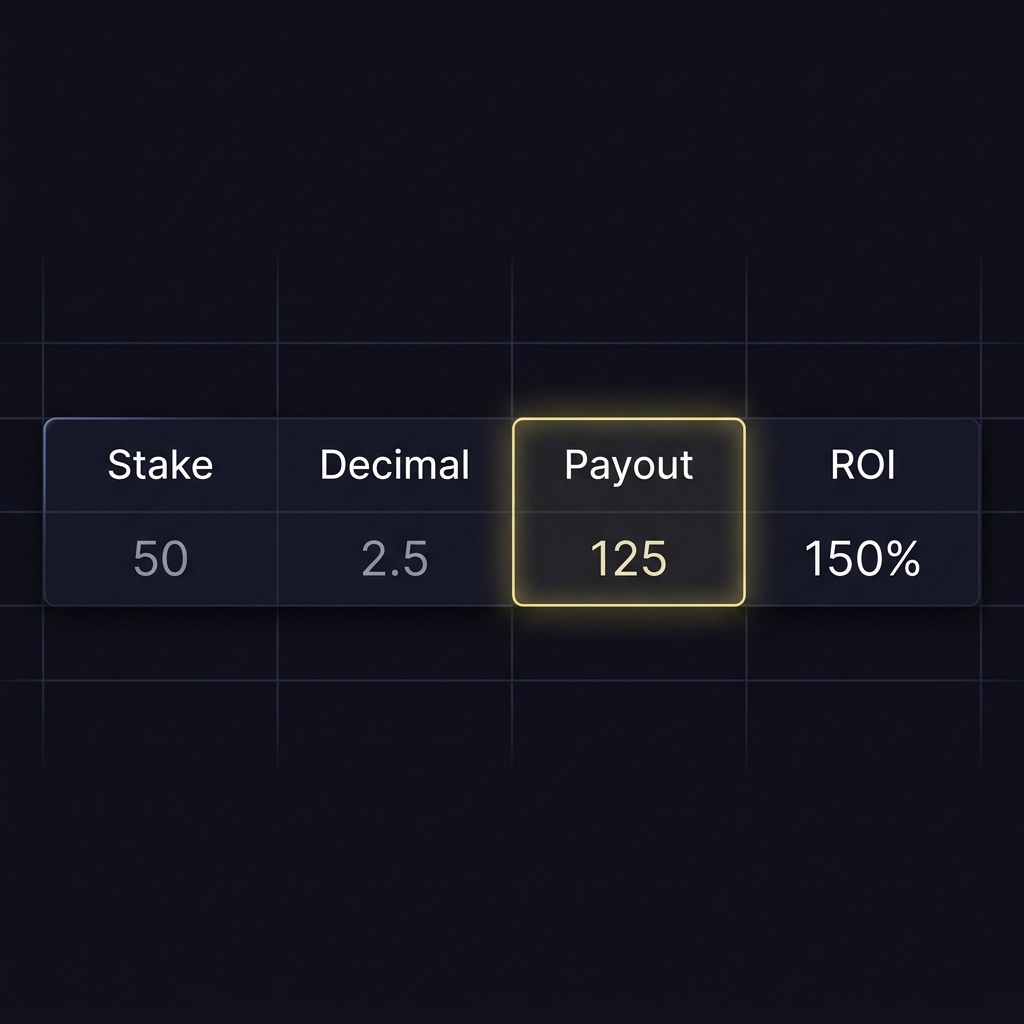
Spreadsheet-ready formulas (assume stake in A2, odds in B2, format in C2): for decimal format set Decimal Equivalent =IF(C2="decimal",B2,IF(C2="fractional",VALUE(LEFT(B2,FIND("/",B2)-1))/VALUE(RIGHT(B2,LEN(B2)-FIND("/",B2)))+1,IF(C2="american",IF(LEFT(B2,1)="-",1+100/ABS(VALUE(B2)),1+VALUE(B2)/100)))) . Payout = A2 * Decimal Equivalent. Net Profit = Payout - A2. ROI % = (Net Profit / A2) * 100. The conversion logic follows the standard conversion rules for odds formats and can be tuned to your spreadsheet software.
Sample row: stake 10, decimal 2.50, decimal equivalent 2.50, payout 25, net profit 15, ROI 150%. Use the same formulas for fractional and American inputs after converting to the decimal equivalent.
Decision criteria: when to trust calculator outputs and how to set realistic ROI targets

Decision criteria: when to trust calculator outputs and how to set realistic ROI targets
Validity checks to apply to outputs include verifying the incoming odds format, checking that the decimal conversion matches a hand calculation, and confirming whether you are using posted prices or vig-adjusted fair prices. Without correct inputs a calculator can give precise but incorrect answers.
Translating ROI targets into stake sizing or challenge goals depends on variance and personal risk tolerance. High target ROI often implies higher variance and a need for conservative stake sizing. Rather than prescribing a single approach, use the calculator to test scenarios under different stake rules and measure how goal ROI behaves across sample runs Investor.gov ROI reference.
Three practical scenarios with step-by-step calculations
Single high-odds bet
Scenario: stake 10 on decimal 6.00. Payout = 10 × 6.00 = 60. Net profit = 60 - 10 = 50. ROI = (50 / 10) × 100 = 500%. These are the raw payout numbers; a high decimal gives high ROI but usually a low implied probability, so treat results with appropriate skepticism Investopedia odds guide.
If a bookmaker applied vig by shifting the fair decimal down, the expected payout adjusted for true probability would be lower. Always check whether posted prices include a margin when interpreting high-ROI results.
Series of small bets with equal stakes
Scenario: five equal stakes of 10 at decimal prices that return net profits of 5, -3, 10, 0, and 7. Total net profit = 19. Total stakes = 50. Series ROI = (19 / 50) × 100 = 38%. This series method shows how mixed results average out when stakes are equal and is the correct percent measure to compare against other strategies CFI ROI guide.
When stakes vary, sum actual stakes and actual net profits to get the series ROI, and avoid averaging per-bet ROIs which can mislead if stake sizes differ.
Simulated challenge run-rate example
Scenario: in a simulated funded challenge you place ten equal virtual stakes of 20 and record total net profit of 120. Total stakes = 200 so period ROI = (120 / 200) × 100 = 60%. Use the calculator to project run-rates by scaling observed ROI to the challenge duration, but keep in mind variance and sample size when interpreting short-run results.
In challenge settings bookmaker margin still affects expectations because posted prices influence outcomes. Use implied probability checks and vig-aware adjustments when you want fair-probability estimates rather than raw posted-outcome reporting Investopedia vigorish definition.
Quick reference: formulas and conversions cheat sheet
Decimal payout = stake × decimal. Decimal net profit = stake × (decimal - 1).
Fractional profit = stake × (numerator/denominator). Fractional total = stake + profit. Convert to decimal by adding 1 to the fraction numerator/denominator. American profit = stake × (A/100) for +A or stake × (100/A) for -A. Convert each format to implied probability using the standard rules documented in odds references Encyclopaedia Britannica on odds.
Wrap-up: how to apply calculator outputs responsibly
Key takeaways: use the standard payout formulas for each odds format, convert prices to implied probability to compare across formats, report ROI as net profit over stake for single bets and total net profit over total stakes for series, and always account for bookmaker margin when interpreting expected returns.
Test the spreadsheet or run a short simulated challenge
Try the example spreadsheet or run a short simulated challenge to verify the math and see how ROI behaves in practice.
Next practical steps: copy the spreadsheet blueprint, run historical tests on a sample of past prices, and use simulated challenges to validate your assumptions before applying stake rules in higher-stakes or live environments. To start, run historical tests on our blog and adapt the spreadsheet to your needs.
Multiply stake by the decimal odds to get total payout; subtract the stake to get net profit.
Add all net profits, add all stakes, then divide total net profit by total stakes and multiply by 100 to get percent ROI.
No, payout formulas remain the same, but bookmaker margin raises implied probabilities and lowers expected ROI versus fair prices.
References
- https://www.aceodds.com/bet-calculator/odds-converter.html
- https://www.covers.com/tools/odds-converter
- https://oddsjam.com/betting-calculators/odds-converter
- https://www.investopedia.com/sports-betting-odds-explained-4689746
- https://www.britannica.com/science/odds-statistics
- https://www.investor.gov/introduction-investing/investing-basics/compound-interest-and-true-cost-borrowing/what-rate-return
- https://corporatefinanceinstitute.com/resources/accounting/return-on-investment-roi/
- https://www.investopedia.com/terms/v/vigorish.asp
- https://www.britannica.com/topic/bookmaking
- https://www.fundedplays.com/challenges
- https://www.fundedplays.com
- https://www.fundedplays.com/blogs
- https://www.fundedplays.com/blogs/how-fundedplays-evaluations-work