

What responsible sports analytics means: definition and context
Responsible Use of Sports Analytics Tools is a practical approach that combines risk management, clear data governance, logging and human oversight to ensure analytics support decisions without creating avoidable legal, reputational or fairness harms. Begin with a working definition that treats models and data as organisational assets needing the same stewardship as player health records or scouting reports.
Regulators and standards bodies are converging on the same core obligations: identify high‑risk systems, document how they work, test for quality and bias, and keep human checkpoints. For example, the EU Artificial Intelligence Act establishes harmonised duties for high‑risk AI systems, including risk management and transparency, with obligations phasing in through 2025 and 2026 EU AI Act.
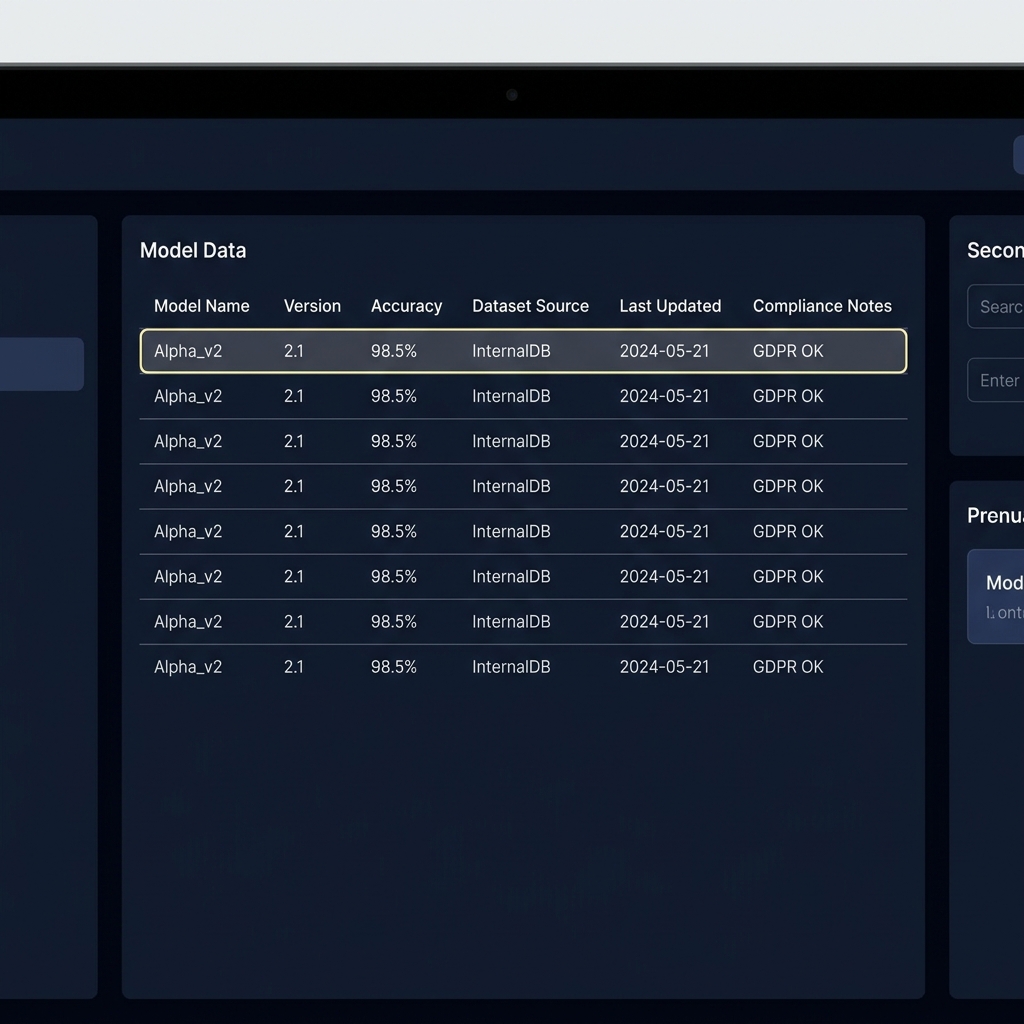
a simple model inventory to track key models and datasets
start with current projects and expand
Responsible Use of Sports Analytics Tools
In everyday team operations this means naming owners for each model, keeping a clear dataset inventory, running basic accuracy checks, and making trace logs available for review. Those practical steps reduce ambiguity when a decision is questioned during selection, injury prevention work, or public communications.
Typical analytics use cases that trigger governance concerns include profiling players or fans, biometric processing from wearables, and automated selection or substitution recommendations. Each of those can affect rights, privacy and fairness and therefore should be treated as higher risk from the start.
New legal and policy frameworks move teams from optional good practice to documented duties for certain analytics activities. The EU AI Act, for instance, sets out requirements for high‑risk systems such as documented risk management, data quality controls, logging and human oversight, creating phased compliance obligations teams should track into 2025 and 2026 EU AI Act.
In the United States, federal guidance like M‑24‑10 pushes organisations to maintain inventories of AI uses, conduct impact assessments, perform testing and red‑teaming, and assign accountable oversight-practices that translate well to sport organisations looking to demonstrate responsible operational control OMB M-24-10.
NIST supplements these expectations with operational controls that teams can adopt: lifecycle governance, evaluation plans, documentation practices and incident playbooks that turn high‑level duties into concrete tasks during development, deployment and monitoring NIST Generative AI Profile. See the NIST AI Risk Management Framework AI RMF.
Adopt a short list of principles as the backbone of your governance program: documented risk management, data quality and lineage, logging and traceability, human oversight, transparency and purpose limitation. Each principle reduces a set of common operational failures and aligns directly with current regulatory guidance.

Map principles to sources so priorities are clear: risk management and transparency are central under the EU AI Act EU AI Act, NIST provides lifecycle controls for documentation and testing NIST Generative AI Profile, and OMB guidance emphasises inventories and accountable oversight OMB M-24-10.
For privacy and purpose limitation, lean on regional rules such as California’s CPRA and the ICO biometric guidance when deciding whether a project needs a full DPIA or extra safeguards. CPRA highlights notice, minimisation and user rights; ICO guidance stresses necessity and proportionality for biometric processing CPRA regulations.
Get the governance checklist for your next analytics project
Copy or download the checklist in the next section to start a basic governance program for your team.
Start with these must‑have documents and processes that small teams can scale: a model and dataset inventory, a documented risk assessment or DPIA equivalent, data quality tests, logging and traceability rules, human oversight criteria and a monitoring plan. These items create a minimum defensible posture before deployment. (templates at Funded Plays)
Checklist items to implement now:
- Inventory of models and datasets with owner and purpose
- Documented risk assessment or DPIA for projects that profile individuals
- Data quality and bias checks integrated into preprocessing
- Logging and traceability for inputs, model versions and decisions
- Human oversight rules for when automated outputs require review
- Monitoring plan with drift and fairness metrics
Define team roles and accountable owners clearly. Assign a model risk owner who tracks performance and a data protection owner who manages notices and user rights. Have a named incident owner for any production issues so remediation is timely and auditable.
Before deployment produce three minimum artefacts: a test report showing accuracy and bias checks, an operational runbook that explains how humans will review outputs, and a retention schedule that explains how long raw and derived data will be kept. These documents align with recommended controls from NIST and regulatory expectations in the EU and US NIST Generative AI Profile. See also the NIST companion PDF NIST PDF.

Manage models across a lifecycle: requirements, data selection, model building, validation, deployment, monitoring and retirement. Treat each stage as an opportunity to identify and reduce risk rather than an afterthought.
Red‑teaming and stress tests belong in validation and ongoing monitoring. OMB guidance encourages testing and adversarial approaches to find failure modes early, while NIST provides practical directions for how testing should fit into an overall lifecycle OMB M-24-10.
Teams apply modern AI and privacy rules by creating an inventory, running risk assessments, implementing data quality and logging controls, assigning accountable owners, and testing models through validation and red‑teaming.
Guidelines for documentation are straightforward: maintain versioned model artifacts, data lineage records, test logs and human review checklists. Store these in an accessible repository so audits and post‑incident reviews can reconstruct decisions and retraining triggers.
When analytics profiles individuals or makes automated recommendations, privacy rules like the CPRA can apply. Teams operating in or serving residents of California should ensure notices, purpose limitation and minimisation are respected, and be prepared to respond to consumer rights requests CPRA regulations.
For athlete or participant data, rely on lawful bases for processing and keep retention tight. WADA’s International Standard underscores lawful basis, retention limits and secure handling for sensitive athlete information in anti‑doping contexts, which is a useful baseline for sports organisations handling health or biometric records WADA ISPPPI.
Practical steps include explicit notices for participants, purpose‑bound data use, clear opt‑out or consent flows where appropriate, and a documented process to respond to data subject rights requests. Minimisation is often the simplest way to reduce risk: collect only what you need and delete what you do not.
Biometric and other sensitive athlete data deserve a higher bar. The UK ICO’s biometric guidance requires necessity and proportionality assessments, DPIAs, accuracy and bias testing, and strict purpose limitation before deploying recognition or profiling systems ICO biometric guidance.

WADA’s privacy standard is directly relevant for anti‑doping and other athlete health records: ensure a lawful basis, set retention limits and implement role‑based access for sensitive datasets WADA ISPPPI.
Testing suggestions before deployment: set accuracy benchmarks for biometric matches, run bias metrics across demographic groups, and require independent review of necessity. Document results and set strict retention and access controls to limit exposure.
Testing should be multi‑layered: unit tests for code, performance validation for predictive quality, fairness evaluations for disparate impacts, and adversarial or red‑team tests to find unexpected failure modes. Put these tests into both pre‑deployment and continuous monitoring plans.
NIST and OMB guidance both call out red‑teaming and systematic evaluation as part of a governance program; teams can apply a simple red‑team routine to simulate edge cases, input tampering and scenario drift to discover weaknesses before they affect real decisions NIST Generative AI Profile. See commentary from Cleary Gottlieb analysis.
Design a minimal red‑team exercise: define objectives, choose scenarios that reflect real operational risks, set measurable metrics for success or failure, run attacks or manipulations, and produce a post‑mortem with clear remediation steps. Keep the scope small for early iterations and expand as systems mature.
External data and hosted model services introduce supply‑chain risk: unknown training data, opaque model updates, inadequate access controls and cross‑border data transfers. Treat third‑party models as you would a vendor handling sensitive personal data.
Include contract clauses that require data provenance disclosure, audit rights, security standards, timely breach notification, and responsibilities for model updates and bias mitigation. Contracts should also clarify who owns logs and who must support audits or investigations, aligning procurement with legal and compliance teams.
During vendor selection, use a simple checklist: verify provenance, request sample evaluation reports, confirm access controls and ensure contracts include audit and remediation clauses. Monitor suppliers periodically rather than treating selection as a one‑time event EU AI Act.
Frequent errors include missing model inventories, undocumented datasets, insufficient bias and accuracy testing, and weak logging that prevents traceability. These gaps are often the root cause of regulatory and reputational incidents.
Other blind spots are assuming consent covers secondary uses, lax vendor oversight, and applying the same controls to biometric data as to non‑sensitive analytics. When in doubt, run a DPIA, tighten logging and initiate targeted red‑teaming to surface hidden problems NIST Generative AI Profile.
Corrective steps are pragmatic: update the inventory, add versioning and lineage records, schedule bias/accuracy re‑tests, and close contractual gaps with suppliers. Small, timely fixes often prevent larger downstream remediation costs.
Scenario 1: a team uses player tracking to support selection decisions. Governance needs here include clear purpose statements, accuracy checks against ground truth, and owner assignment so decisions are explainable. A DPIA or equivalent will help identify data minimisation and retention requirements early.
Scenario 2: biometric sensors for recovery monitoring provide health‑adjacent data. These systems need necessity assessments and strict role‑based access. WADA guidance on retention and secure handling is a useful baseline when athletes are involved WADA ISPPPI.
Scenario 3: fan profiling for personalised content is lower risk than biometric work but still triggers notice and opt‑out rules under laws like CPRA. Keep profiles minimal, provide clear notices and offer straightforward opt‑out mechanisms to respect consumer rights CPRA regulations.
Monitor performance drift, fairness metrics, data distribution shifts and logging completeness as part of your production signal set. These indicators show when retraining or a governance review is necessary.
An incident playbook should define detection, containment, root cause analysis, notifications and remediation steps. Include clear notification triggers for legal and privacy teams and document every step so post‑incident reviews can improve controls.
Closing the loop matters: after incidents or near misses, update the inventory, adjust tests, retrain models if needed, and revise contracts with vendors. A regular retraining cadence and periodic red‑teaming ensure systems stay aligned with changing data and rules NIST Generative AI Profile.
Three actions to start today: create a model and data inventory, run a simple DPIA for high‑impact projects, and assign an accountable owner for analytics governance. These steps provide immediate risk reduction and a foundation to scale controls as projects grow. (See Funded Plays.)
For deeper reading, consult primary sources such as the EU AI Act and the NIST Generative AI Profile, and adapt the checklists on our blog to your jurisdictional needs. Iterative adoption-start small, document decisions and expand controls-keeps analytics useful while managing legal and ethical risk NIST Generative AI Profile.
Small teams should apply scaled controls: start with a basic inventory, document key risks and assign an accountable owner, then expand testing and monitoring as projects grow.
Biometric and health‑adjacent data require necessity and proportionality assessments, DPIAs and tighter access and retention controls compared with non‑sensitive data.
Test regularly and after material data shifts; a cadence could be monthly for critical models and quarterly for lower‑risk systems, with immediate tests after significant incidents.