
What puckline means in NHL betting
The puckline is the NHL equivalent of a point spread and is almost always expressed as plus or minus 1.5 goals, meaning a favorite listed at -1.5 must win by two or more goals while an underdog at +1.5 covers with a one-goal loss or a win. This simple structure is the defining feature that separates the puckline from typical moneyline bets and makes it the functional point spread for hockey bettors, and it is explained in mainstream betting explainers and sportsbook help pages Action Network explainer.
Because the number is usually fixed at 1.5, understanding the puckline is mainly about reading odds and implied pricing rather than anticipating frequent line shifts. In practice you will see the notation clearly in NHL markets and the example -1.5 or +1.5 is the standard shorthand you should expect when comparing markets across books.
One clear example: a favorite at -1.5 must win by two goals. If the final score after any included periods shows the favorite up by two or more, the -1.5 bet wins. If the favorite wins by a single goal, the -1.5 bet loses while the +1.5 bet covers. This outcome rule is the common baseline for how most puckline markets behave.
Review puckline markets and house rules before betting
Check the market label and recent odds movement before you commit to a puckline wager; it affects whether you are buying goal cushion through price or taking a tighter line.
How the puckline compares to a point spread
Conceptually, the puckline is the point spread for hockey. Like point spreads in other sports it applies a handicap to the favorite and a head start to the underdog so that the two sides can trade with balanced risk. That parallel helps bettors translate familiarity with football or basketball spreads into the NHL context quickly.
Where terminology can differ is in market naming and the availability of alternates. Sportsbooks often present the standard puckline at 1.5 but will also list alternate puck lines and separate 3-way or regulation-only spreads that grade differently, and those alternate labels are why some menus call a market a spread while others call it a puckline TheLines overview.
quick odds comparison between a moneyline and a puckline
Use for rough payout comparison
This practical overlap means that when someone asks whether the puckline is the same as a spread, the short answer is yes in functional terms, though the menu names and alternate markets can create the impression of different instruments.
How puckline bets are settled: regulation, overtime and shootouts
One key operational difference bettors must watch is how a puckline market is graded for the final result. Most standard puckline bets at major U.S. books include overtime and shootouts in grading unless a market is explicitly labeled regulation-only or 3-way. That means if a game is tied after 60 minutes but decided in overtime or a shootout, a standard puckline will usually be settled on the final winner inclusive of those extra moments DraftKings help page and bet365 hockey rules.
Regulation-only markets, often shown as 60 minutes or 3-way, grade on the score after the standard three periods and will ignore overtime and shootouts. Because these markets settle differently, the same numeric line can produce opposite results across a standard puckline and a 3-way market, so confirm the market label before placing a bet.
Yes, in practical terms the puckline is the NHL point spread, typically set at plus or minus 1.5 goals, but alternate and regulation-only markets can grade and price differently so always check labels and odds.
Before you bet, check whether the market explicitly says 60 minutes, regulation-only or 3-way to know which set of rules will apply to grading, and consult the sportsbook house rules for any special clarifications.
Alternate puck lines and 3-way markets explained
Books provide alternate puck lines to give bettors more choice in risk and reward. An alternate puck line might shift the goal margin to values such as -2.5 or +0.5; those lines change both the required outcome and the available odds so you can trade a larger cushion for shorter odds or a smaller cushion for bigger payout potential TheLines overview.
For example, a -2.5 puckline requires a favorite to win by three or more goals to cover, while a +0.5 gives an underdog half a goal of cushion so the underdog wins the wager if the final difference is a draw or an underdog victory. Those alternates are useful when you want to fine tune riskier or more conservative positions compared with the standard 1.5 market.
Three-way or regulation-only spreads appear separately because they resolve after 60 minutes. That matters in low-scoring or tightly matched games where a late overtime winner would flip the result for a standard puckline but not for a regulation-only market. Always read the market label and odds table for exact grading rules before agreeing to a price Overtime and Shootouts Explained.

Why the puckline usually stays at 1.5: pricing, vig and totals
Unlike many point spreads in other sports that move in response to money flow, the puckline tends to be sticky at 1.5 and books adjust pricing instead of shifting the line frequently. As a result, the critical lever for value is the odds, not the line itself. Analysts and betting education outlets note that you will often see the price move more than you see the numeric puckline shift, so understanding vig and implied probability is essential when assessing a puckline wager VSiN explanation.
The relationship between totals and puckline pricing is also notable. Lower projected scoring games tend to push +1.5 prices higher and make -1.5 cheaper, because bookmakers balance the perceived likelihood of a close low-scoring game versus a multi-goal favorite win. Conversely, in higher-total games you may find -1.5 priced more attractively relative to the moneyline, as the chance of two or more goals from a favorite increases with open scoring conditions Pinnacle pricing guide.

Understanding that books default to the 1.5 line and tune odds gives you a clearer framework for where real edge might appear: not in expecting the numeric line to change, but in spotting priced discrepancies or favorable vig between the puckline and alternative markets.
Decision criteria: when to choose puckline -1.5, +1.5 or the moneyline
Choosing between a puckline and a moneyline is a judgment call that depends on price, matchup context and your risk appetite. Bettors often prefer a -1.5 puckline when a favorite is priced steeply on the moneyline because -1.5 can offer a better expected return if the favorite is likely to win by multiple goals; in other situations a moneyline wager at a fair price is the cleaner way to back a favorite VSiN guidance.
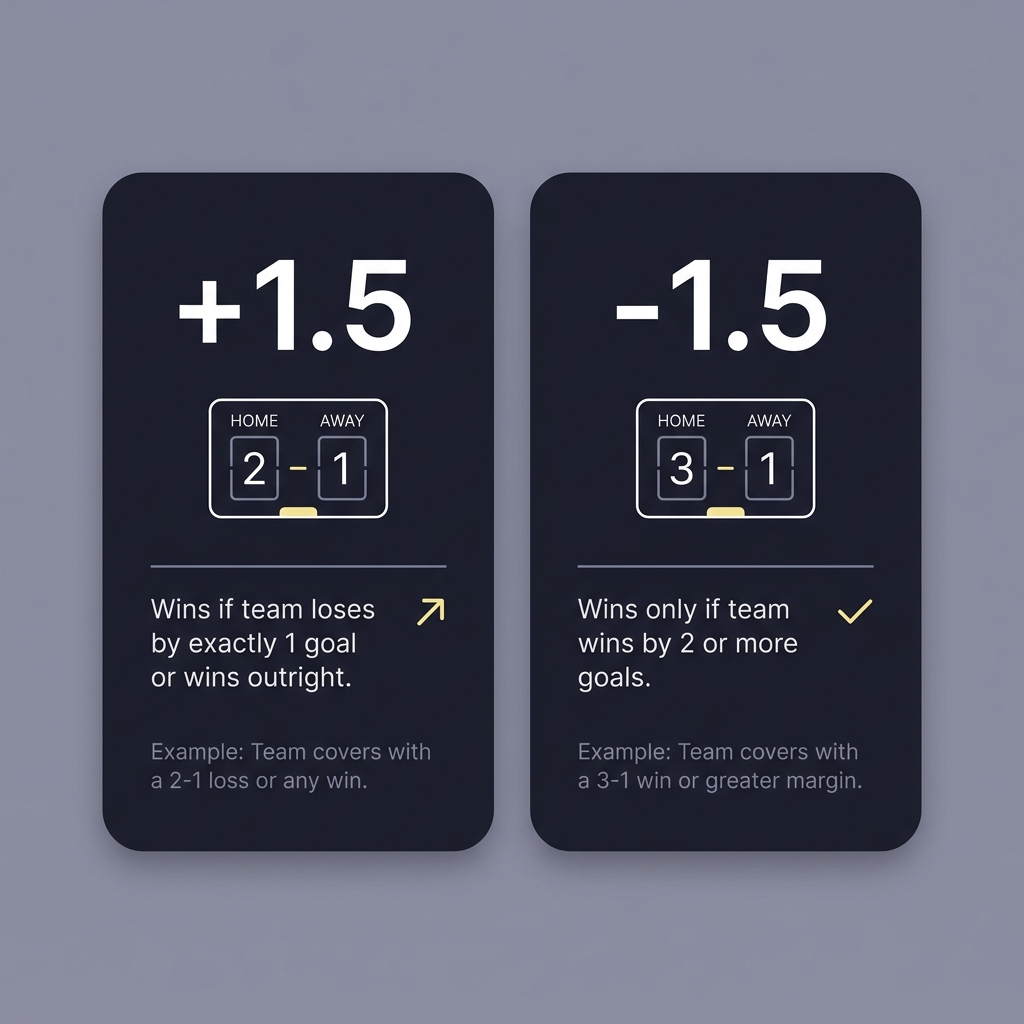
On the other side, +1.5 is attractive when you expect a close game or when live circumstances shift toward a tighter contest. If a starter leaves early or a matchup trend suggests a one-goal game, +1.5 often gives built-in insurance that a straight moneyline does not, but the deciding factor should be the price you can get for that cushion rather than the label alone.
Rule-of-thumb approach: if the puckline price implies value compared with a moneyline after adjusting for vig and match context, take it; otherwise prefer the simpler moneyline. That heuristic keeps the decision tied to math and circumstance, not a fixed preference for one market type.
Live betting and +1.5: practical in-play strategies
In-play situations commonly make +1.5 more attractive. For example, if a goal is scored early and you expect a defensive second period or a conservative strategy from the trailing team, the live +1.5 price can become a low-cost way to keep exposure while waiting for clearer signals. Many bettors use +1.5 as a hedge for earlier pregame moneyline exposure or to take advantage of a sudden shift in the probable margin after an injury or goalie change BetMGM examples.
Simple live strategy: watch price and context. If the live +1.5 is offered at meaningfully better odds than the pregame market implied after an in-game event, it can reduce downside with limited cost. Avoid assuming live markets follow identical grading rules and verify the market label for in-play wagers before committing funds.

Common mistakes and settlement traps
A frequent mistake is assuming every puckline listed grades on regulation only. That error can flip your expected outcome because a standard puckline often includes overtime and shootouts while a 3-way market does not, so always check the market label and house rules for grading before placing a wager DraftKings help page and see additional sportsbook rules at Sky Bet.
Another trap is treating alternate puckline odds as if they used identical math to the standard line without accounting for different vig. Alternate lines change the required margin and the price structure, so assuming the same payout dynamics can produce unexpected losses if you do not calculate the implied probability and potential payout precisely.
Finally, some bettors forget to verify whether a particular book settles on the final result inclusive of overtime and shootouts. The difference between a regulation-only result and an inclusive one is material in close games and in cups with high overtime frequency; double check the house rules on grading to avoid surprises.
Examples and payout math for puckline bets
American odds math is the standard illustration method used by sportsbook guides. For a negative moneyline such as -200, a bettor risks 200 to win 100. For a positive line such as +180, a 100 stake wins 180. These examples are commonly used to explain how puckline payouts relate to moneyline payouts and to show how value changes when you trade margin for odds BetMGM examples.
Worked example 1: You place a puckline bet on a favorite at -1.5 with odds of -150. That price means risking 150 to win 100. If the favorite wins by two or more, the bet wins and returns 250 total on that stake. If the favorite wins by one, the -1.5 loses and you lose the stake.
Worked example 2: You take an underdog at +1.5 priced at +120 with a 100 stake. A final one-goal loss or any underdog win results in a winning ticket, paying 220 total on a 100 stake. If the favorite wins by two or more, the +1.5 loses. These simple arithmetic illustrations show why bettors compare implied probabilities and choose the market that best fits their forecast and bankroll plan.
Quick pre-bet checklist for puckline decisions
1. Confirm the market label: standard puckline or regulation-only. 2. Check current odds and implied vig. 3. Compare alternate puck lines and moneyline prices. 4. Review matchup context: starters, injuries, recent form. 5. Size the stake relative to your bankroll and logging plan. These five quick steps help reduce avoidable errors before you place a puckline wager Action Network explainer. Read more on our blog for examples.
As a habit, log each puckline bet and the market label used so you can later audit whether you are consistently profitable on standard puckline markets versus regulation-only or alternate lines. Discipline in tracking turns intuition into repeatable evidence. Learn more about evaluations here.
Final take: is puckline the same as spread?
For most practical purposes the puckline is the NHL point spread. It functions as a handicap, is most often set at plus or minus 1.5 goals, and tells bettors that -1.5 needs a two-goal favorite win while +1.5 covers with a one-goal loss or a win. Many guides present the puckline as the hockey spread equivalent and that practical equivalence is reliable for bettors translating spread knowledge between sports Action Network explainer.
What matters in application is understanding the variants: alternate puck lines and regulation-only 3-way markets can grade differently and the puckline is often sticky at 1.5 while price moves through vig. That means your edge will usually come from comparing prices, market labels and matchup context rather than expecting the numeric line itself to move dramatically. Visit Funded Plays for more resources.
Most standard puckline bets include overtime and shootouts unless the market explicitly states regulation-only or 60 minutes; always confirm the market label and house rules.
Yes, the puckline is functionally the NHL point spread, usually set at plus or minus 1.5 goals, though alternate and 3-way markets can differ in grading and pricing.
Take +1.5 when you expect a close game or want built-in insurance after live events that shorten the likely margin, provided the offered price offers acceptable value.
References
- https://www.actionnetwork.com/nhl/what-is-the-puck-line
- https://www.thelines.com/nhl/puck-line/
- https://help.draftkings.com/hc/en-us/articles/360000105234-Hockey-Rules
- https://help.bet365.com/s/en-us/sportsrules/ice-hockey
- https://www.wbspenguins.com/blog/overtime-and-shootouts-explained/
- https://www.vsin.com/nhl/nhl-betting-101-moneyline-puck-line-totals/
- https://www.pinnacle.com/en/betting-articles/hockey/nhl-puck-line-explained/
- https://www.fundedplays.com/challenges
- https://sports.betmgm.com/en/blog/nhl/what-is-the-puck-line-in-hockey-betting-examples/
- https://support.skybet.com/app/answers/detail/ice-hockey-rules/
- https://www.fundedplays.com
- https://www.fundedplays.com/blogs
- https://www.fundedplays.com/blogs/how-fundedplays-evaluations-work