

What the puck line is and what +2.5 means
The puck line is hockey's point spread, and understanding it starts with the basic idea that one team is given a goals cushion before play affects the result. In most markets a puck line turns a straight winner-loser outcome into a goal-differential contest, and the common purpose is to balance a favorite against an underdog so bettors can choose relative margins rather than a simple moneyline result. For a focused definition and clear examples, see the Action Network explanation of the puck line: Action Network article on the puck line.
When you see +2.5 on the puck line attached to an underdog, that team effectively starts the game with a 2.5-goal advantage; the +2.5 bet wins unless the underdog loses by 3 or more goals. Conversely, a favorite listed at -2.5 must win by 3 or more goals to cover the spread and produce a winning puck line bet. This framing - head start for the underdog, margin requirement for the favorite - is the core rule bettors use to decide between moneyline and spread instruments. For a concise explanation of the +2.5 threshold, consult FanDuel Research's breakdown of puck line grading and examples: FanDuel Research on puck line grading.
The standard puck line that most casual bettors first encounter is ±1.5 goals, where the favorite must win by at least two goals to cover and the underdog can lose by one and still cover. Alternate puck lines, such as +2.5, trade a larger goal cushion for a smaller payout because the bet is easier to win; you give up upside to buy protection. Covers explains how alternate lines mean lower returns in exchange for reduced risk, and why books price those cushions differently: Covers on alternate puck lines.
Confirm market rules before you wager
Before you place a +2.5 puck line bet, check the market label and any footnotes about grading so you know whether overtime or shootouts count toward the outcome.
In practice, calling a bet a "+2.5 puck line" signals a clearly different instrument than a moneyline or a -1.5 puck line. It is frequently used when bettors want to limit variance or when books offer a smaller price on the favorite that makes the alternate cushion attractive. Later sections walk through payout math and scenarios so you can evaluate whether the smaller payout is worth the extra goal buffer.
How books grade puck line bets: full-game versus regulation-only
One important source of variation in puck line outcomes is whether a market is graded for the full game or only regulation. Many full-game puck line markets include overtime and shootouts when determining whether a bet covered the spread, which can flip an outcome after 60 minutes. FanDuel Research notes the common distinction between full-game and regulation markets and explains why labeling matters: FanDuel Research on puck line grading. See Fox Sports for another overview.
A separate market type often called "60-minute" or "regulation only" explicitly excludes overtime and shootout results; under that rule the scoreboard at the end of the third period is final for grading puck line bets. Because the presence or absence of OT and shootout goals changes which side covers in close contests, bettors should confirm the market type before accepting a price. BetMGM's overview of spread rules highlights how regulation-only markets differ in practice and why operators must label them clearly: BetMGM on puck line market rules.

To see the difference in a single example, imagine a regulation tie that goes to overtime and a goal in the extra period gives the favorite a one-goal victory. In a full-game market that extra goal can convert a losing puck line bet into a winner for one side, while a regulation-only market would have graded the position differently at the final whistle. Because books do not all use identical naming conventions, adopting the habit of reading the market label and the house rules is a simple step that eliminates this source of avoidable mistakes. OddsJam also discusses how overtime interacts with puck-line grading: OddsJam on puck-line grading.
Practical advice: before wagering on any +2.5 market, look for explicit phrasing such as "Regulation Only" or "Full Game" in the market name or the operator's rules. If you cannot find that label quickly, do not assume overtime inclusion or exclusion; verify with the operator's help text or support documentation.
How American odds and payouts work for a +2.5 puck line
American odds describe payout relationships and remain the standard format for showing how much you stake or win on a listed price. Negative odds show how much you must stake to win 100, while positive odds show the profit on a 100 stake. For a clear primer on moneyline and American odds definitions, see Investopedia's moneyline overview: Investopedia moneyline definition. Caesars also provides a betting basics guide that covers formats: Caesars how to bet on hockey.
Converting American odds to implied probability and applying those conversions to expected returns uses standard formulas. Odds converters and explanation pages give step-by-step calculators that translate -180 or +140 style prices into decimal or percentage probabilities so you can compare alternatives consistently. TheLines provides a practical odds converter and implied probability guide useful for these conversions: TheLines odds converter.
Worked example 1: negative price. Suppose the +2.5 puck line has a price of -180 and you contemplate staking 90. The usual payout math says that a -180 price requires 180 staked to win 100, so staking 90 is half of that, which produces a 50 profit and a 140 total return. That computation follows standard American-odds formulas and is the same math applied to moneyline entries across markets; see Investopedia for the reference method: Investopedia on payout math.
Worked example 2: positive price. If the +2.5 line is priced at +140 and you stake 100, a +140 price returns 140 profit and 240 total, because positive odds show the profit on a 100 stake. Using the odds-conversion approach makes it straightforward to compare the two offers side by side and decide which represents better expected value: refer to TheLines for conversion steps and implied probability examples: TheLines odds and conversion guide.

Because American-odds math is consistent, you can always reduce any puck line price to the same units and then compare it to the probability you estimate for the underlying event. That comparison is the basis of value-based decision-making rather than choosing instruments based only on headline payout. When you evaluate a +2.5 price, run the odds through a converter, compare implied probability to your model or estimate, and then size stakes according to bankroll rules and expected return.
When to consider using a +2.5 puck line: strategy and trade-offs
The primary strategic rationale for choosing a +2.5 puck line is variance reduction. In tight matchups or low-total games where you expect a close score but want to protect against a one-goal defeat, a +2.5 cushion reduces the chance of a losing result while also lowering the payout compared with narrower spreads or moneyline alternatives. Action Network's guidance on when alternate puck lines can be useful emphasizes this practical trade-off: Action Network guidance on alternate lines.
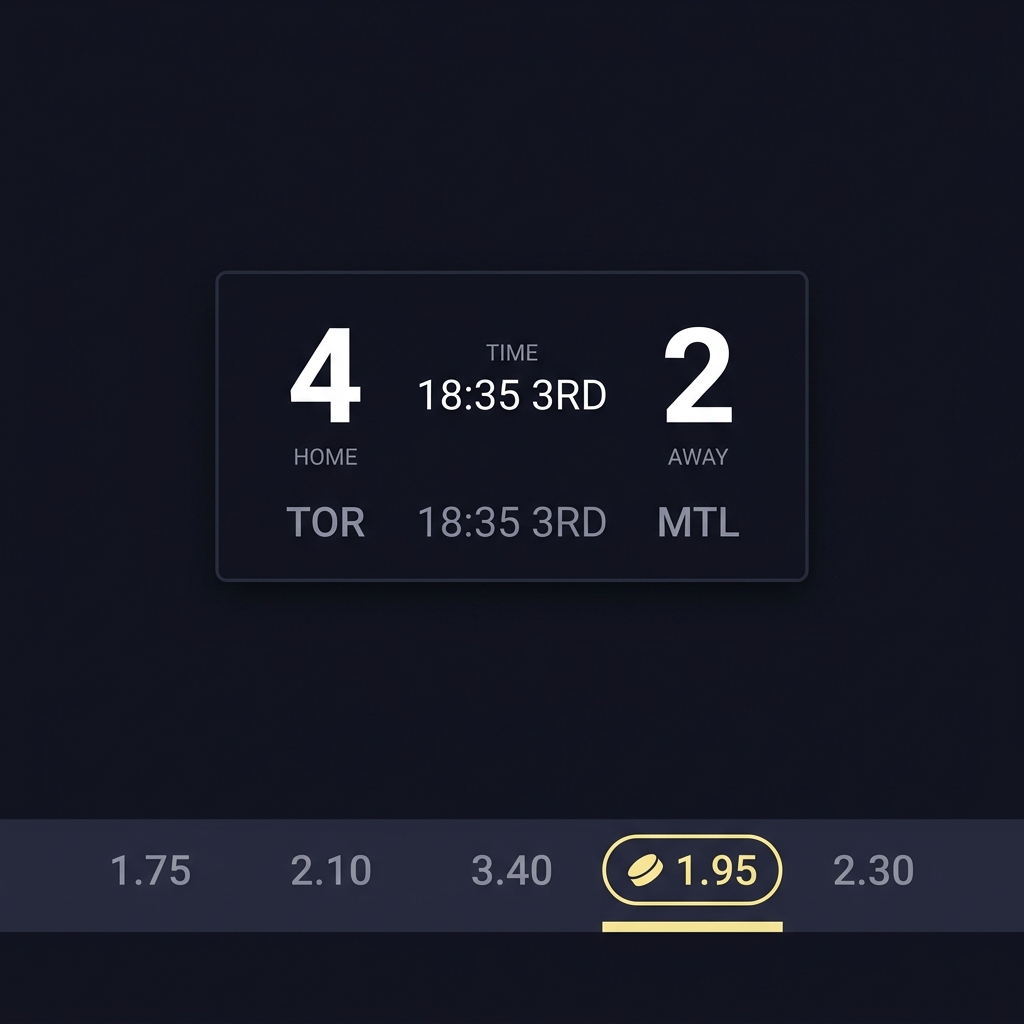
That trade-off is mechanical: the larger the goal cushion you accept, the easier it is for the underdog to 'cover,' and the smaller the book's payout becomes. Covers' treatment of alternate puck lines shows how pricing moves as you buy extra margin, which means you should only select +2.5 when the reduced payout still offers acceptable expected return relative to your model or estimate: Covers on alternate line pricing.
Comparing +2.5 to the moneyline highlights another decision factor. A moneyline lets you capture full upside when the underdog wins outright but provides no cushion for a narrow loss. If your projection gives an underdog a decent chance to win outright and the moneyline price is fair, the moneyline can be preferable; if you expect the underdog to lose narrowly or want to limit variance for account stability, +2.5 may fit your risk profile better. For clear thinking about instruments and stake sizing, convert both offered prices into implied probabilities and expected returns before you pick one.
How to calculate implied probability and expected return for a +2.5 price
Converting American odds to implied probability is a repeatable step you should run for every price. For positive odds, implied probability is 100 divided by (odds plus 100). For negative odds, implied probability is the absolute value of the odds divided by (absolute value plus 100). An odds-converter reference provides these formulas and worked examples: TheLines odds converter.
Once you have implied probability, expected return for a stake equals implied probability times net profit on the stake minus the complement probability times the stake you lose. That arithmetic turns prices into comparable expected-value numbers so you can rank several +2.5 offers accurately. Investopedia's moneyline discussion describes the payout elements you use in that expected-return calculation: Investopedia on payout components.
Quick converter for American odds to profit estimate
Paste into a spreadsheet cell
Practical quick-converter steps you can paste into a spreadsheet: enter the American odds and stake in two cells, apply the formula above to compute profit, then compute implied probability using the positive or negative formula and compare the implied probability to your own forecast for the event. That workflow turns a raw +2.5 price into a decision metric rather than a gut call.
A short checklist of inputs you need for a complete evaluation: the exact market labeling (full game or regulation-only), the American odds, your estimated probability for the underdog covering the +2.5 margin, and a stake amount that fits your bankroll plan. Verifying those four items prevents common errors and makes a transparent choice possible.
Common mistakes and pitfalls when betting a +2.5 puck line
A frequent mistake is misreading the market grading and assuming overtime or shootouts are treated the same across operators. Because some markets are full game and others are regulation only, failing to confirm grading rules can change a winning position into a loser, or vice versa. FanDuel Research and BetMGM both document how grading labels affect outcomes and stress the need to read the market name closely: FanDuel Research on grading.
Another error is treating a larger cushion as equivalent to guaranteed safety. While +2.5 lowers variance relative to narrower spreads, it also pays less. That smaller payout does not make the wager risk-free, and you should not confuse lower volatility with positive expected return. Covers' explanation of alternate line pricing warns bettors to compare implied probability rather than assuming a cushion always offers value: Covers on pricing and value.
Failing to compare implied probabilities across options is a third common pitfall. Oddsmakers price alternate lines to reflect lower risk, and without converting each price into implied probability you cannot tell whether you are overpaying for the cushion. An odds-conversion reference is a simple tool for this comparison and should be part of your pre-bet routine: TheLines odds converter.
Finally, ignore house rules and you risk being surprised by settlement outcomes. If a book has unusual rules about goalie changes, timing nuances, or late-game scoring, those can affect close puck line settlements. Always confirm the operator's house rules in the market description before placing any +2.5 wager.

Practical scenarios: worked examples and quick decision guide
Scenario A: underdog wins outright. If the underdog scores more goals than the favorite at the final grading moment, a +2.5 bet obviously wins because the underdog's raw victory also satisfies the goal-cushion requirement. This simple case is the baseline and is easy to check against the scoreboard.
Scenario B: underdog loses by two goals. A typical use case for +2.5 is when you expect the underdog to be competitive but not necessarily win. If the final margin is two goals, a +2.5 wager still covers because the cushion absorbs a two-goal defeat. FanDuel Research and Action Network both use similar scenario illustrations to show how the 2.5 barrier functions in practice: FanDuel Research examples.
A +2.5 puck line gives the underdog a 2.5-goal advantage and wins unless they lose by 3 or more; use it when you want to reduce variance in close matchups, but always verify market grading and convert odds to implied probability to ensure value.
Scenario C: underdog loses by three or more goals. In that case the +2.5 bet loses, because the cushion is insufficient to overcome a three-goal deficit. That outcome highlights why a 2.5 cushion is meaningful: it turns one-goal and two-goal losses into winning bets for the underdog side but not larger defeats. Action Network describes this threshold effect clearly in its explanation of puck line rules: Action Network on puck line thresholds.
Worked payout comparison. Use the negative and positive examples from the odds section to compare outcomes. At -180 a 90 stake yields 50 profit and a 140 total return; at +140 a 100 stake yields 140 profit and a 240 total return. Running both numbers through implied-probability conversions lets you see which price the market assigns and whether your own estimate indicates value. See Investopedia and TheLines for the reference calculations used in these worked payouts: Investopedia payout math.
Pre-bet checklist for any live +2.5 decision: confirm market labeling (full game versus regulation), convert the offered price to implied probability, compare that implied number to your estimate, size the stake according to your bankroll rules, and only place the bet if the expected return justifies the exposure. Those five steps reduce emotion-driven choices and make your decisions repeatable.
Quick checklist and final takeaways
To recap in one paragraph: a +2.5 puck line gives the underdog a 2.5-goal advantage and wins unless the underdog loses by 3 or more, while a favorite at -2.5 must win by 3 or more to cover. That simple rule underpins why bettors choose alternate puck lines as a variance-management tool rather than a way to capture maximum upside. For the concise rule set and examples, see Action Network's puck line guide and FanDuel Research on market grading: Action Network guide.
Five-step pre-bet checklist: 1) Verify market label for OT and shootout inclusion. 2) Convert American odds to implied probability. 3) Compare implied probability to your model or edge estimate. 4) Size your stake consistent with bankroll rules and expected return. 5) Confirm any house rules that might affect settlement. TheLines and Investopedia are useful reference tools for steps 2 and 3: TheLines odds guide.
Final note on responsible participation: choosing +2.5 is a tactical choice that reduces variance in many scenarios, but it is not a substitute for discipline, model testing, and bankroll control. Outcomes depend on performance and operator rules, and no outcome is guaranteed. Use the checklist above to keep decisions systematic and measured.
Not always. Whether a +2.5 market includes overtime and shootouts depends on the market label; check if it is labeled full-game or regulation only before betting.
Plus 2.5 reduces variance compared with a moneyline because it gives the underdog a goals cushion, but it also usually pays less and is not risk free.
Convert American odds to implied probability, compare that probability to your own estimate, and size stakes by bankroll rules to determine which option offers better expected value.
References
- https://www.actionnetwork.com/education/what-is-the-puck-line
- https://www.fanduel.com/research/nhl-puck-line-betting-explained
- https://www.covers.com/betting/nhl/puck-line
- https://sports.betmgm.com/en/blog/nhl/puck-line-betting-explained-bm10/
- https://www.investopedia.com/terms/m/moneyline.asp
- https://www.thelines.com/odds-converter/
- https://www.fundedplays.com/challenges
- https://www.fundedplays.com/blogs
- https://www.fundedplays.com/blogs/how-fundedplays-evaluations-work
- https://www.fundedplays.com/
- https://www.foxsports.com/stories/betting/puck-line-betting
- https://oddsjam.com/betting-education/puck-line
- https://caesars.com/sportsbook-and-casino/how-to-bet/hockey/