
Quick overview: what this guide covers and why a pick 6 horse racing calculator matters
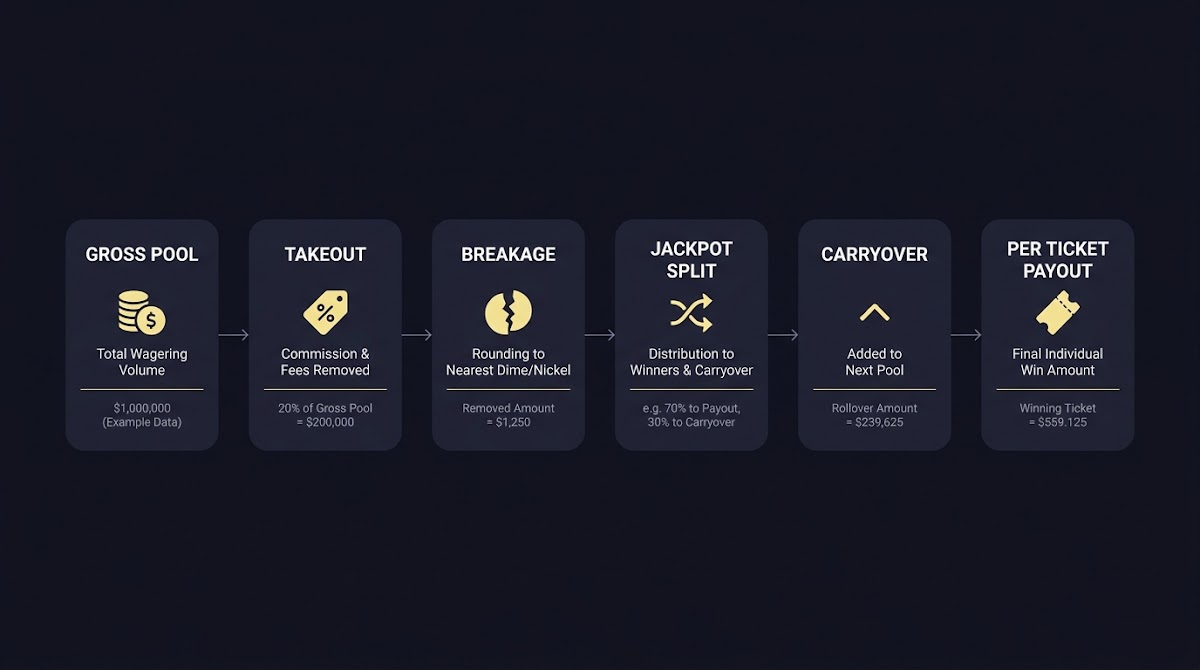
Pick 6 payouts are calculated under pari-mutuel mechanics that start with the gross pool, deduct a statutory takeout and any breakage, and then distribute the resulting net pool according to the wagering rules in effect for the meet. This guide focuses on how a pick 6 horse racing calculator models those steps so users and developers can estimate likely per-ticket payouts while recognizing that final official payoffs come from track notices.
small net pool estimator for high-level checks
Use for quick validation only
Readers will find two worked examples, one for a traditional Pick 6 without carryover and one for a jackpot-style pool that shows carryover and consolation handling. The practical focus is on the parameters you must supply and the precise arithmetic a calculator must perform to be consistent with published rules.
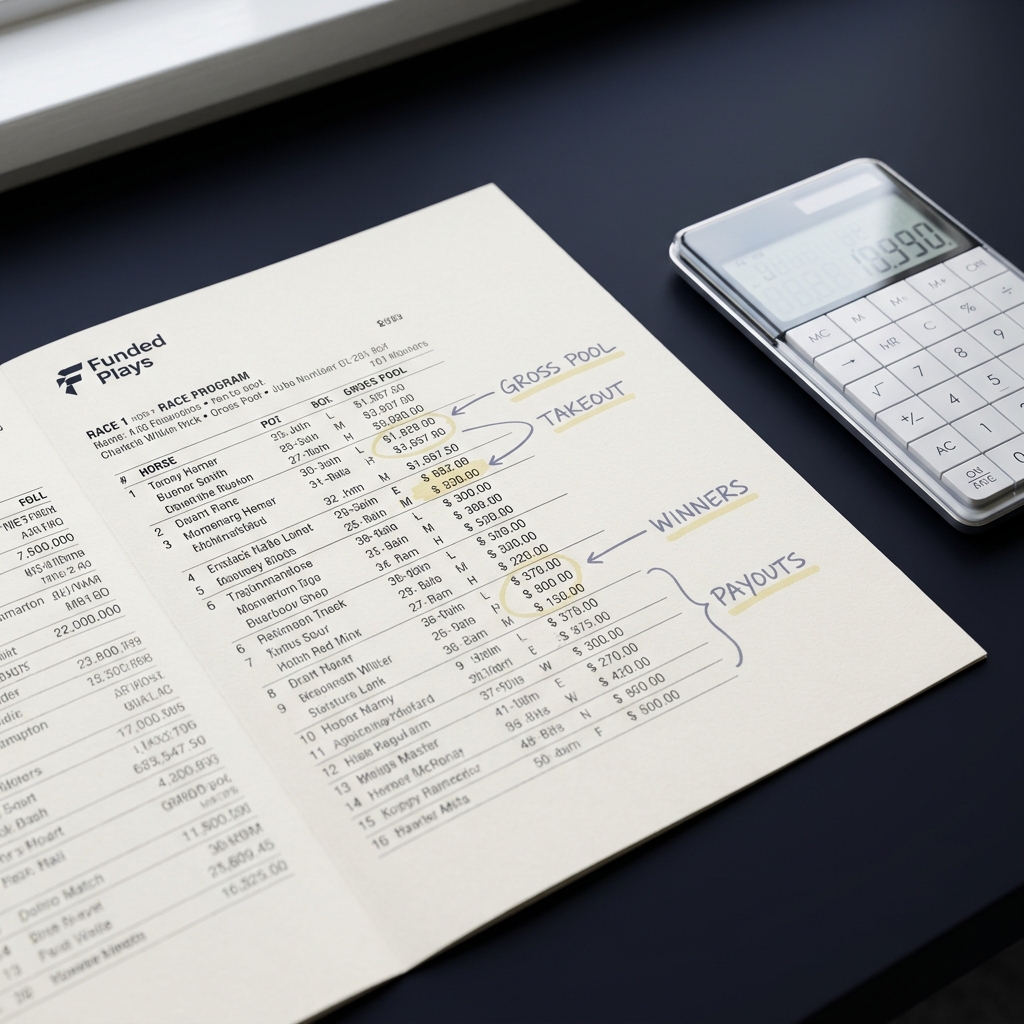
This overview is useful whether you want to understand a payoff notice, validate a third-party calculator, or build a simple tool that produces per-ticket estimates based on local takeout and split rules.
Who should read this
Sports bettors, race analysts, and developers building a pick 6 horse racing calculator will benefit from the step-by-step logic and worked examples. The guide assumes basic familiarity with pari-mutuel betting terms but explains each concept so beginners can follow along.
What you will be able to do after reading
After reading, you should be able to list the inputs needed for a reliable estimator, perform the arithmetic that converts gross pool to per-ticket payouts, and validate results against official track payoffs using regulator and house rules as the source of truth.

Definition and context: how Pick 6 payouts are governed
In pari-mutuel wagering, all wagers for a particular pool are combined into a gross pool, from which the operator deducts a statutory takeout and applies any breakage rounding before distributing the net pool to winning tickets; calculators model that flow explicitly in their formulas. Regulatory model rules and supervision guidance are the primary sources for this sequence, and a reliable calculator maps its inputs to those published rule elements ARCI model rules.
State commissions and track house rules fill in jurisdictional details such as takeout percentages, whether the Pick 6 is jackpot-style, and how mandatory-payout days are handled; these local policies can change how a net pool is split or carried forward, so a calculator must accept those variables as parameters. See applicable administrative regulations for payout calculation administrative regulation and national supervision guidance such as the Canadian regulations for supervised pari-mutuel systems Pari-Mutuel Betting Supervision Regulations.
Because house rules can differ from regulator model rules in implementation details like denomination and rounding, the safest developer approach is to parameterize takeout, breakage method, jackpot split rules, and mandatory-payout flags rather than hard-coding assumptions.
What pari-mutuel means in this context
Pari-mutuel means each wager contributes to a collective pool whose net proceeds are shared among winning tickets after authorized deductions. That single-pool philosophy contrasts with fixed-odds wagers and is why the number of winning tickets and pool size directly determine payouts (see Pick 6).
Where official rules come from
Authoritative guidance comes from a mix of regulator model rules such as those published by ARCI and the specific statutes or codes administered by state racing commissions that set takeout rates and jackpot provisions for each jurisdiction ARCI model rules.
Step-by-step: how a pick 6 horse racing calculator models the pari-mutuel payout
Below is the canonical flow a pick 6 horse racing calculator should implement. The header here contains the focus keyword to mark the calculator topic clearly for users and indexers.
Step 1, assemble the gross pool: sum all Pick 6 wagers collected for the pool on race day. This is the primary numeric input and often reported by the track when closing the card.
Step 2, apply takeout and breakage: subtract the published takeout percentage and apply breakage rounding rules to produce the net pool available for distribution. Takeout is a statutory or published percentage and must be an input to the calculator track takeout pages.

Try the estimator or save a sample input template
Use a simple template to enter gross pool, takeout, breakage rule, carryover, and winning-ticket counts for a quick per-ticket estimate.
Step 3, split the net pool per payout rules: if the pool is a jackpot-style Pick 6, split the net pool between the jackpot portion and the minor or consolation portion according to the published jackpot split percentage; if the Pick 6 is a traditional format, the whole net pool is allocated to 6-of-6 winners subject to any authorized consolation distributions.
Step 4, divide among winning tickets: compute the per-ticket payout by dividing the relevant pool portion by the number of winning tickets for that payout level, after applying any minimum denomination or share-size rules specified by the house.
Assemble the gross pool
The gross pool is simply the sum of all Pick 6 wagers for that pool; a calculator usually accepts this number directly as an input or computes it from a list of ticket sales if integrated with a sales feed. Many tracks publish the day s gross pools when the race card closes, which helps with validation.
Apply takeout and breakage
Takeout is the percentage withheld for taxes, operational costs, and purses. Subtract this percentage from the gross pool, then apply breakage rules that round minor fractions to the nearest permitted currency unit before allocating the net pool ARCI model rules.
Split net pool and divide among winners
How the calculator splits the net pool depends on whether the format is jackpot or traditional. After allocating the correct portion to the jackpot or to the full net for traditional play, divide each pool slice by the count of eligible tickets at that level and apply any minimum payout denomination to reach final per-ticket figures.
Jackpot versus traditional Pick 6 formats and how each affects calculator logic
Jackpot-style Pick 6 pools commonly reserve a specified percentage of the net pool to grow or pay a jackpot, with the remainder funding minor or consolation payouts; the exact split and carryover rules are set by house rules and state regulations, so a calculator needs a jackpot_split_pct parameter. When a single unique ticket has all selections correct, the rules allow paying the full jackpot that day without carrying funds forward California jackpot wager rule.
On a non-mandatory day when no ticket completes the full sequence, the jackpot portion commonly carries forward to the next corresponding pool while consolation payments are made from the minor pool; the carryover is therefore an input that a calculator must combine with that day s allocated jackpot portion to form the next pool s starting balance Maryland jackpot-style pool rules.
Traditional Pick 6 formats allocate the entire net pool pari-mutuelly to 6-of-6 winners; some jurisdictions allow consolation distributions such as 5-of-6 from the same net pool if specified in the wagering rules, which means the calculator must support multi-level payout allocations when required ARCI model rules.
How jackpot-style pools split net pool
Common implementations reserve a jackpot percentage and place the remainder into a minor pool for consolation and other specified payouts. The split percentage is a rule input and can affect whether small ticket counts lead to larger per-ticket payouts for consolation winners.
What happens on non-mandatory days with no 6-of-6 winner
If no ticket hits all six races on a non-mandatory day, the designated jackpot portion typically carries forward and is combined with the next day s allocated jackpot portion until a maximum or mandatory trigger is reached.
Traditional format payout flow
In traditional pools the net pool is paid only to 6-of-6 winners, so per-ticket payout is simply net_pool divided by number_of_6_of_6_winners, after breakage rounding and any per-ticket denomination adjustments are applied.
Required inputs for a practical pick 6 horse racing calculator
A practical tool must accept numeric inputs and rule flags so it can model both jackpot and traditional behaviors accurately. Required numeric inputs include the gross pool, takeout rate, breakage or rounding rule, current carryover amount if applicable, and counts of winning tickets by payout level.
Rule and policy inputs are equally important: is the pool jackpot-style or traditional, what is the published jackpot split percentage, are there mandatory-payout days, and what is the minimum payout denomination. These policy items are typically documented in track wagering pages or commission orders and should be editable in the calculator interface NYRA wagering information.

Optional user-friendly settings make the tool practical: default currency, rounding display options, the ability to show results as per-ticket and per-share payouts, and an exportable input template for record-keeping. The calculator should warn users that official payoffs reported by the track prevail and that the tool provides estimates only.
Essential numeric inputs
Minimal numeric inputs are: gross_pool, takeout_pct, breakage_rule, carryover_amt, and winners_by_level. For clarity, make these field names explicit in the data model and allow the user to enter counts for 6-of-6 and any consolation levels your jurisdiction supports.
Rule and policy inputs
Policy inputs should include a boolean flag for jackpot-style, jackpot_split_pct, mandatory_payout flag, minimum_denomination, and any special rounding rules. Making these configurable ensures the calculator adapts to different jurisdictions and track house rules.
Worked example A: traditional Pick 6 calculation (no carryover)
Given inputs and assumptions: assume a gross pool of 100,000, a takeout rate of 20 percent, no carryover, and five distinct 6-of-6 winning tickets. The following arithmetic shows how to move from gross pool to per-ticket payoff under a traditional format.
Step 1: compute takeout amount. With a 20 percent takeout, takeout_amount = gross_pool * takeout_pct = 100,000 * 0.20 = 20,000. Subtract that from the gross pool to get a preliminary pool of 80,000. This step mirrors the statutory takeout deduction used in pari-mutuel pools ARCI model rules.
Step 2: apply breakage rounding. If currency rounding rules require rounding down to the nearest dollar across the pool or per-ticket, apply those rules now. For simplicity assume breakage effects are negligible in this example and the net pool remains 80,000.
Step 3: allocate the net pool. In a traditional Pick 6, the net pool is paid solely to 6-of-6 winners, so per_ticket_payout = net_pool / number_of_6_of_6_winners = 80,000 / 5 = 16,000. Each winning ticket receives 16,000 subject to any minimum denomination adjustments and final rounding by the track.
Result interpretation and edge cases: if the track enforces a minimum payout denomination or pro-rates payouts by share size, adjust the computed per_ticket_payout accordingly. Also verify the published payoff notice for breakage adjustments that may reduce each check slightly.
Worked example B: jackpot Pick 6 with carryover and consolation payouts
Inputs including carryover and split rules: suppose gross_pool is 200,000, published takeout is 22 percent, existing carryover is 50,000, and the house rule allocates 70 percent of the net pool to the jackpot portion and 30 percent to the minor pool for consolation. Counts of winning combinations today are: zero 6-of-6 winners, four 5-of-6 winners eligible for consolation, and ten 4-of-6 winners that receive no payout under this house example.
How the jackpot portion is handled when no single 6-of-6 winner exists: the jackpot-designated portion of the net pool is combined with the carryover and then typically carried forward if no ticket completes the full sequence on a non-mandatory day. A calculator must therefore compute the day s jackpot allocation and then add it to the existing carryover to form the rollover amount California jackpot rule.
A Pick 6 payout starts with the gross pool, subtracts the takeout and applies breakage rules, then distributes the net pool according to whether the pool is jackpot-style or traditional, dividing the appropriate pool portion among eligible winning tickets and applying carryover rules where required.
How consolation payments are funded: the minor pool portion of the net pool funds consolation payouts such as 5-of-6 winners; the calculator divides the minor_pool by the number of eligible consolation tickets to produce a per-ticket consolation amount, and any leftover shortfall or remaining jackpot funds are handled per the local carryover policy Maryland jackpot-style pool rules.
Numeric walkthrough. Step 1, compute net pool after takeout: takeout_amount = 200,000 * 0.22 = 44,000. Net pool before carryover logic = 156,000.
Step 2, split net pool per the jackpot split: jackpot_alloc = net_pool * 0.70 = 156,000 * 0.70 = 109,200. minor_pool = net_pool * 0.30 = 46,800. Combine the jackpot_alloc with the existing carryover to form the available jackpot balance for the next pay period if no winner is found: new_jackpot_balance = carryover_amt + jackpot_alloc = 50,000 + 109,200 = 159,200.
Step 3, distribute the minor pool to consolation winners: if there are four eligible 5-of-6 tickets, per_ticket_consolation = minor_pool / 4 = 46,800 / 4 = 11,700, subject to breakage rounding by the track. These payouts are made from the minor pool on the day and do not reduce the carried jackpot portion if no 6-of-6 winners exist.
Step 4, handle carryover on a non-mandatory day: since there are zero 6-of-6 winners in this scenario and this is not a mandatory-payout day, the new_jackpot_balance of 159,200 remains as the starting carryover for the next corresponding Pick 6 pool. The calculator should output both the per-ticket consolation payout and the updated carryover amount for record keeping.
Mandatory-payout days would change this arithmetic by requiring distribution of some or all of the carryover even if no 6-of-6 winner exists, so your calculator must allow a mandatory_payout flag to reroute the new_jackpot_balance into that day s payout allocation when the jurisdiction demands it.
Mandatory-payout days: rules and calculator adjustments
Mandatory-payout rules require that the carryover plus the current day s net pool be distributed on a declared payout day; these rules are set by the regulator or the track and are non-negotiable, so a calculator must accept a mandatory_payout boolean and apply alternative allocation logic when true California jackpot rule.
If no 6-of-6 winner exists on a mandatory day, many house rules direct that the full available jackpot be allocated to the highest eligible level of correct selections, which could mean larger 5-of-6 payouts that exhaust the carryover. The calculator should therefore include code paths that, when mandatory_payout is true, allocate the combined balance to consolation levels per the published priority order.
Practical advice for implementers: include unit tests that simulate mandatory days with zero top-level winners so the code path that redistributes carryover is exercised and verified against the jurisdiction s published examples.
Takeout, breakage, rounding and jurisdictional variation
Takeout is the percentage deducted from the gross pool for authorized purposes and is typically published by the track or commission; because takeout directly scales the net pool, it is one of the most important inputs for accurate payout estimates. Always source the current takeout percent from the track s wagering information when available NYRA wagering information.
Breakage refers to how fractional currency amounts are rounded before payout. Rounding rules can be applied to the per-ticket share or to the aggregate payout and can produce small differences between an estimator s output and the final official payoff. A calculator should allow selecting common breakage methods so users can match the track s practice.
Tracks and state commissions can publish different denominational rules and favored formats. Because of this variation, calculators must expose the policy inputs such as minimum denominations, rounding direction, and whether certain consolation levels are supported.
Common mistakes and troubleshooting when estimating Pick 6 payouts
Mismatched inputs are a leading cause of discrepancies. Make sure the gross pool, takeout percent, and carryover amount you enter correspond to the same closing period and meet; using published numbers from a different date or meet will produce incorrect estimates.
Rounding and share-size errors can create consistent small errors. If you model per-ticket payout but the track reports per-share amounts after accounting for syndicated tickets, your numbers will differ. Keep clear definitions for ticket and share size in the calculator s data model.
Interpreting partial and consolation payouts often trips up users. Confirm whether the house pays consolation levels and from which pool portion; some jurisdictions pay 5-of-6 only from a minor pool while others can reallocate carryover on mandatory days to fund larger consolation checks.
Validating calculator outputs against official rules and published payoffs
After estimating a payout, immediately compare your result to the official payoff notice and the track s takeout page. If the difference is small, it is likely due to breakage or denomination rounding; if large, re-check inputs such as whether the pool is jackpot-style and whether a mandatory-payout rule applied ARCI model rules. See related posts on our blog.
Implementation notes for developers building a pick 6 horse racing calculator
Suggested minimal data model: gross_pool, takeout_pct, breakage_rule, carryover_amt, jackpot_split_pct, winners_by_level. Keep field types explicit and validate ranges such as 0 to 100 for percentages.
Edge-case handling and unit tests: include tests for zero-winner carryover, mandatory-payout redistribution, and rounding differences by breakage method. Test vectors drawn from published track examples make it easier to confirm correctness.
User interface considerations: show both per-ticket and per-share outputs, make rule inputs editable, and display a clear disclaimer that official payoffs published by the track prevail. Offer an exportable input template for record keeping and dispute resolution.
Practical tips for players using a pick 6 horse racing calculator
Understand per-ticket versus per-share payouts. If you buy a ticket with multiple combinations or participate in a pool with shared tickets, the per-ticket payout must be adjusted for the number of lines or shares you own to get your expected return.
Factor carryovers into risk decisions cautiously. A rising carryover increases potential payouts but does not guarantee value; always verify the official payoff after the race and do not assume the calculator s estimate is exact.
Keep records. Save the input template or a screenshot of your calculation so you can compare later with the track s payoff notice and explain differences confidently. For a practical example of evaluation workflows see how Funded Plays evaluations work.
Conclusion: key takeaways and next steps
Pick 6 payouts are pari-mutuel: they depend on the gross pool, takeout, breakage, carryover, and the number of winning tickets. A robust pick 6 horse racing calculator parameterizes these inputs and models jackpot split, mandatory-payout rules, and rounding methods to produce realistic estimates.
When in doubt, consult the ARCI model rules and the relevant state commission or track wagering pages for the meet you are analyzing, and always validate calculator outputs against the official payoff notice after races. See the ARCI Model Rules & Standards resource and consider community tools on Funded Plays at Funded Plays.
Core inputs are gross pool, takeout percent, breakage/rounding rule, carryover amount, jackpot split if applicable, and counts of winning tickets by level.
No. Calculators provide estimates; the track s official payoff notice and published rules determine actual payouts.
On mandatory days the carryover plus that day's net pool must be distributed according to jurisdictional rules, which may redirect funds to consolation levels if no full winners exist.
References
- https://www.arci.com/model-rules/
- https://laws-lois.justice.gc.ca/eng/regulations/SOR-91-365/
- https://apps.legislature.ky.gov/law/kar/titles/810/006/020/10769/
- https://www.nyra.com/saratoga/racing/wagering-information
- https://law.justia.com/codes/california/code-of-regulations/title-4/division-4/article-20/section-1979-1/
- https://dsd.maryland.gov/COMAR/ComarHome.html?comar=09.10.03.12-1
- https://en.wikipedia.org/wiki/Pick_6_(horse_racing)
- https://www.arci.com/model_rules_standards.php
- https://www.fundedplays.com/challenges
- https://www.fundedplays.com
- https://www.fundedplays.com/blogs
- https://www.fundedplays.com/blogs/how-fundedplays-evaluations-work