
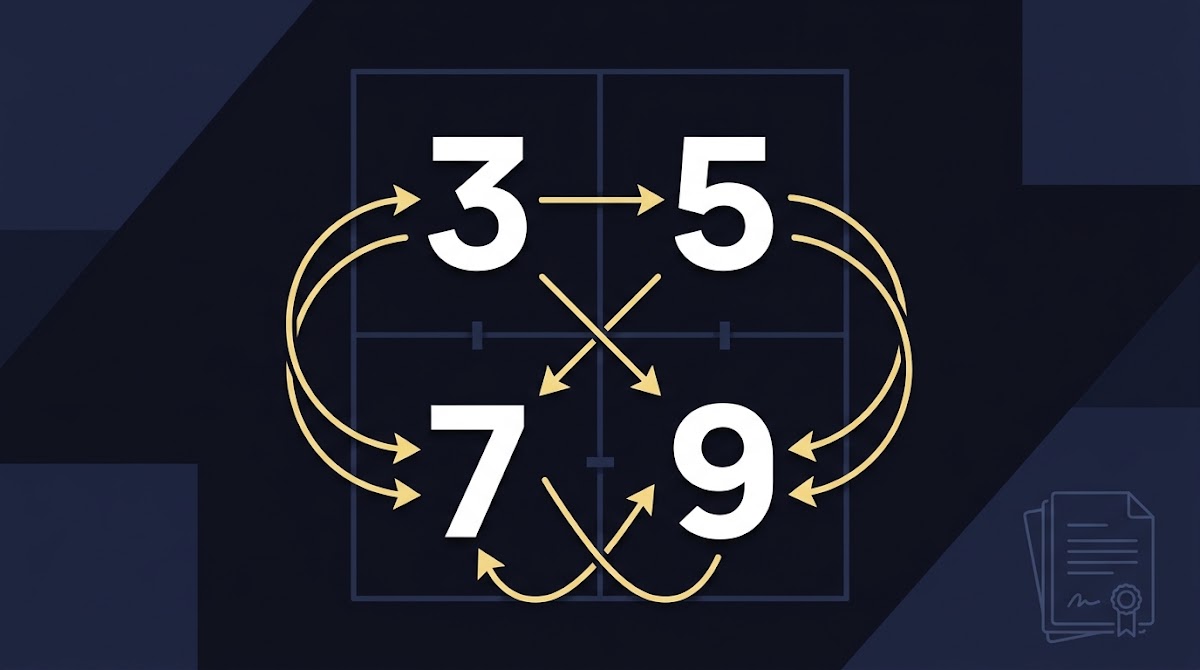
Quick answer: what a pick 4 calculator shows you
The short answer is that a pick 4 calculator converts your chosen digits, play type and stake into a clear comparison of likely prizes and cost per play, based on the state prize table; in many states a $1 Straight play commonly pays about $5,000 on a hit, which is why Straight remains the highest single payout for a single-dollar wager Pennsylvania Code prize table.
Try a calculator with your state prize table
Try entering your digits, choose Straight or Box and pick your state to see side-by-side payouts without assuming uniform values; the calculator helps you compare top prize versus hit frequency.
A good pick 4 calculator will list the prize for a Straight hit, the applicable Box payout by permutation class, the combined outcome for a Straight/Box split, and the total cost if you buy a Combo that covers every permutation. Calculators remove the counting work and show what you would get per hit and what each play costs, but they must use the state or jurisdiction prize table to be accurate.
At-a-glance outcome for common bet types
For a quick comparison a calculator typically reports: the Straight prize for a $1 stake, Box payouts for 4-way, 6-way, 12-way and 24-way numbers, the split result on a Straight/Box ticket and the cost and payout profile of a Combo. The numbers a calculator returns should match your state payout chart or its codified rule language to be authoritative Illinois Lottery pick-4 page.
Why calculators depend on state rules
Pick 4 is a fixed-payout game whose prize amounts and allowable play types are set by each state, so calculators must reference the correct rulebook or game page for that jurisdiction rather than using a one-size-fits-all table New Jersey Lottery rules.
How Pick 4 works: fixed payouts, odds and state rules
Pick 4 is not a pari-mutuel pool; state rules set fixed prizes, draw procedures and liability limits, and those values are the basis for any calculator output. Administrative codes and official game rules establish the payout tables and therefore determine the exact prizes you should expect.
Where available, codified rules are the primary authority because they are the legally enacted statement of the game. For example, several states publish administrative-code language or official rule documents that spell out the Pick 4 prize table and play types Ohio Administrative Code Pick 4 rule.
Online game pages often summarize the same information and are convenient to read, but if there is any discrepancy between a posted chart and codified language you should rely on the codified rule or the official notice for that state. Calculators that fail to check the authoritative source risk showing incorrect payouts.
Why Pick 4 is a fixed-payout game
Fixed payouts mean the prize for a given play type is predetermined. This allows a calculator to map a play type and stake to an expected prize amount on a hit, rather than estimating a variable pool share. The official game page or rule document is the correct data source to feed the calculator Virginia Administrative Code Pick 4.
Where to find official prize charts and rule language
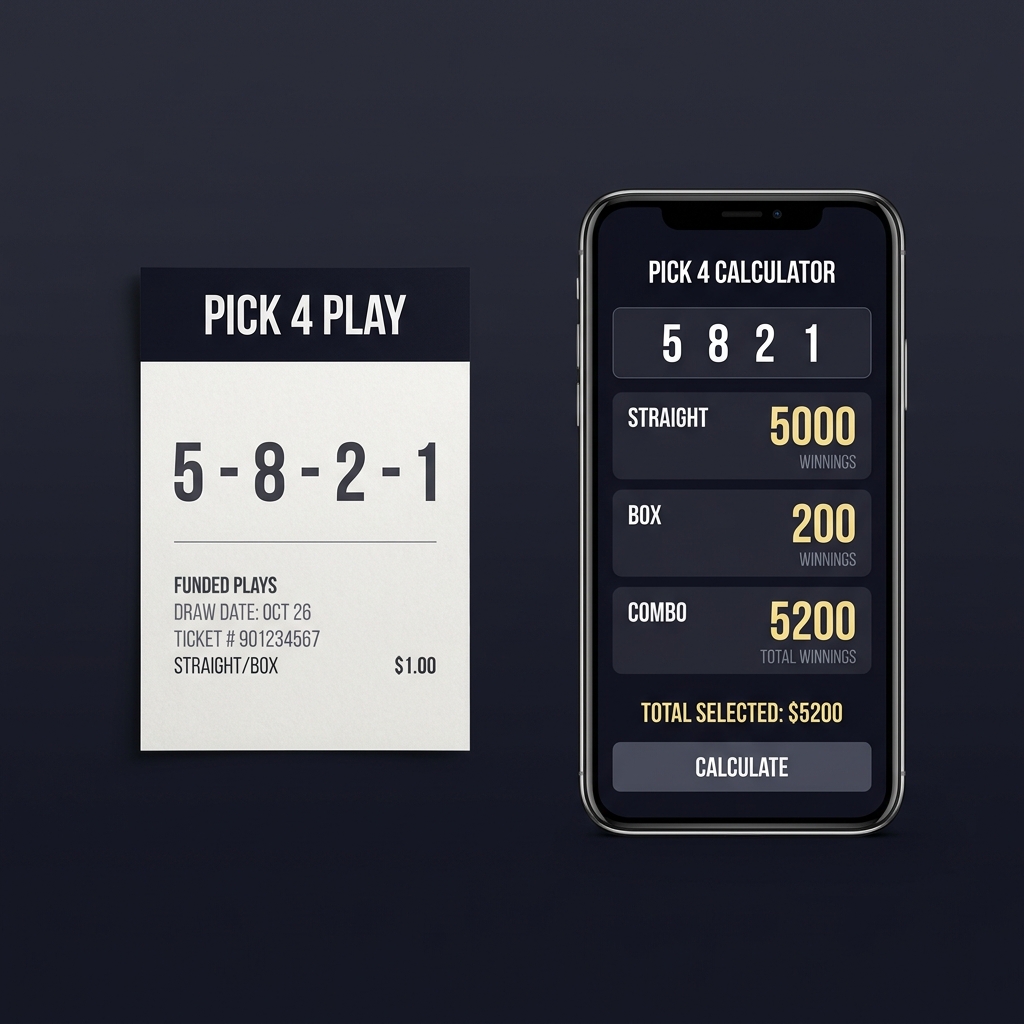
Authoritative sources include a state's Pick 4 game page, linked rule documents and any administrative-code entries that codify the game. Save or bookmark the page that the calculator uses so you can verify it later.
Using a pick 4 calculator: step-by-step
To run reliable outputs enter five core inputs: the four digits you have chosen, the play type (Straight, Box, Straight/Box, or Combo), the stake per single play, the state or jurisdiction, and any add-on option such as FIREBALL if offered by your state.
After input, the calculator expands the chosen digits into the number of permutations for Box and Combo plays, applies the state's prize table for the selected play types, and returns: the cost of the ticket, the prize for each winning outcome, and an effective payout-per-dollar comparison. The calculator's math rests on counting permutations and matching each result to the state's fixed prize values Pennsylvania Code prize table.
Fields and outputs for a pick 4 calculator
Use state prize tables for accurate results
Most calculators also show the cost multiplier for Combo plays, for example listing that a 24-way Combo costs 24 times the base stake. If you select Straight/Box the tool should show how the stake is split between the Straight portion and the Box portion so you can see which portion pays depending on the draw order.
Make sure the calculator you use exposes the source of its prize table. A transparent calculator will display the rule page or game chart it used for each state so you can cross-check values when the calculator gives a surprising result.
Input needed: digits, play type, stake, state, and add-ons
Required inputs are straightforward: the digits you want, the play type, stake per unit, the state that governs the payout table and any add-on like FIREBALL. Omitting the state or an active add-on will produce an incomplete or incorrect result.
How the calculator handles permutations and costs
The calculator counts the distinct permutations of your digits to determine Box classes. For example, four identical digits have a single permutation and no Box variants, while four distinct digits generate 24 permutations. The tool then matches the permutation class to the state prize table and multiplies by the stake or applies the Combo multiplier to compute total cost and potential payout.
How straight, box, straight/box and combo bets are calculated
Straight is the simplest calculation: you buy the exact-order number for a stake and receive the Straight prize if the drawn digits match your order. In several states a common baseline for a $1 Straight play is about $5,000, which is why calculators list that figure prominently for reference Pennsylvania Code prize table.
Box calculations depend on digit permutations. Numbers fall into permutation classes such as 4-way, 6-way, 12-way and 24-way. A calculator determines the permutation class from the digits, looks up the Box payout for that class in the state's chart, and shows the Box prize for the stake you entered.
Straight payouts and odds
The odds of a Straight win are 1 in 10,000 because there are 10,000 unique four-digit combinations from 0000 to 9999; a $1 Straight common payout of about $5,000 reflects the fixed prize model used by many states and should be confirmed on the state page before relying on it Illinois Lottery pick-4 page. See the Illinois How to Play page for additional detail How to Play.
Box permutations and payout scaling
Box payouts scale inversely with permutation count: the more permutations, the lower the Box prize, since each permutation increases the chance of a win. Typical example payouts for $1 plays illustrate the trade-off: roughly $1,250 for a 4-way Box, about $800 for a 6-way Box, near $400 for a 12-way Box, and about $200 for a 24-way Box, though you should confirm exact amounts on your state's prize chart North Carolina Education Lottery Pick 4.
Straight/Box split and Combo cost math
Straight/Box tickets split your stake between a Straight portion and a Box portion. The calculator shows how the single stake is divided, what the Straight portion would pay if the digits hit in exact order, and what the Box portion pays if any order matches. Combo buys every Straight permutation and therefore costs the number of permutations multiplied by the base stake while paying the Straight prize for any drawn order.
Examples: common $1 plays and what you get
To make examples concrete, a $1 Straight ticket is commonly listed at about $5,000 for a hit in many states, so a calculator reporting that number is using the typical baseline found in official prize tables Pennsylvania Code prize table.

Example Box payouts for $1 plays are useful for validating calculator output: typical reference values are roughly $1,250 for a 4-way Box, $800 for a 6-way Box, $400 for a 12-way Box and $200 for a 24-way Box. These demonstrate the trade-off between higher hit frequency and lower single-ticket prize Illinois Lottery pick-4 page.
Worked example, 4-way Box versus Straight/Box split: if you buy a $1 4-way Box and a $1 Straight, your costs and prizes differ. A calculator will show the 4-way Box prize and the Straight prize separately and then compute the combined expected payout for the combined ticket. Use the state's chart to confirm the exact Box and Straight figures before making a decision.
Typical Straight, Box and Combo outcomes for $1 plays
When a number is straight-matched you receive the Straight prize; when you have a Box match you receive the Box prize appropriate to the permutation class. Combo tickets list the total cost on purchase and the Straight prize for a hit in any order. These example outputs are the core values a calculator should display for $1 plays.
Worked example: a 4-way Box vs a Straight/Box split
Imagine digits that produce a 4-way permutation class. A $1 4-way Box would show the Box prize for that class. If you instead buy a Straight/Box with a $1 total stake, the calculator should split that dollar into the Straight part and the Box part and show which portion pays under each outcome. Always cross-check with the state game page or rule to confirm the exact split and prize amounts North Carolina Education Lottery Pick 4.
How FIREBALL and other add-ons change calculations
Add-on features like FIREBALL create extra combinations and separate prize tables; a calculator must apply the add-on table only after computing base outcomes, because FIREBALL prizes are usually listed independently and change the overall chance to win on a ticket Illinois Lottery pick-4 page.
FIREBALL increases the number of winning permutations but generally reduces the top prize relative to the base Straight prize, which is why calculators must show base prizes and add-on prizes separately so players can see the trade-off between increased hit frequency and reduced top payout.
Because some states run time-limited promotions that temporarily alter FIREBALL or add-on payouts, a trustworthy calculator will include an effective date or link to the state page so players can verify they are using the current table. If a promotion changes the add-on table the calculator must be updated to match.
What FIREBALL does to combinations
Mechanically FIREBALL substitutes a digit drawn from a separate pool into one position to create additional winning combinations. The calculator must enumerate those additional results and map them to the add-on prize table rather than folding them into the base prize values.
Why add-ons change top prize and hit frequency
Add-ons increase the number of ways to win and therefore increase hit frequency, but the add-on prize table typically offers smaller top prizes for specific add-on matches; calculators should report both base and add-on returns so users can compare net effects before deciding.
Which play type suits your goals: decision criteria
Choose your play type by balancing bankroll, tolerance for low-frequency large payouts and the desire for more frequent smaller wins. Straight maximizes the single-ticket top prize, while Box and Straight/Box increase win frequency at the expense of the top amount.
The payout depends on play type and state rules; a $1 Straight commonly pays about $5,000 in many states, while Box, Straight/Box and Combo outcomes vary by permutation class and must be verified on the state's prize chart.
If you want occasional large wins and can tolerate long dry spells, prioritize Straight. If you prefer frequent smaller wins to smooth results and keep sessions active, Box or Straight/Box can be better choices; Combo preserves the Straight payout across orders but costs proportionally more, so it fits players who want full Straight exposure but can afford higher per-draw spend.
Choosing between top prize size and hit frequency
The central trade-off is simple: Straight offers the highest single-ticket payout but the lowest probability of a win, while Box increases the probability of any-order wins by distributing the prize across permutations. Use the calculator to see how often Box wins might occur versus the rare Straight hit.
When Combo or Straight/Box makes sense
Combo is appropriate if you want the Straight prize for any drawn order and are willing to pay the permutation multiplier. Straight/Box suits players who want partial coverage of both outcomes at a lower cost than a full Combo. Verify state payout values before committing because the same play type can have different prize amounts across jurisdictions.
Typical mistakes and how to avoid them
One common mistake is misunderstanding how a Straight/Box ticket splits your stake. If you assume the full stake applies to both Straight and Box you will overstate potential returns. Use a calculator that clearly lists the stake allocation for combined tickets New Jersey Lottery rules.
Another frequent error is assuming identical payouts across states. A generic table may be a good starting point but it can be wrong for your jurisdiction; always cross-check the calculator's source against your state game page or codified rule.
Quick input-validation checklist: confirm the state selected, verify whether add-ons like FIREBALL are active in that jurisdiction, check that the calculator uses the state's prize table, and ensure the stake per play is set correctly. These simple checks prevent most calculation errors.
State-by-state differences: where a calculator must match the rulebook
Authoritative sources are the official game page, any linked rule documents and administrative-code entries that codify the game. If in doubt, prefer the codified rule because it is the legally adopted standard for the game's operation Pennsylvania Code prize table.
Examples of regulatory sources to cite include state lottery game pages and administrative-code or rule documents. A calculator provider should document which source it used for each state so users can reconcile differences if they appear.
Examples of regulatory sources to cite
Useful reference documents include the New Jersey Lottery Pick-4 game rules and administrative code entries in states such as Ohio and Virginia, which show how prize tables and procedures are officially set and updated Ohio Administrative Code Pick 4.
How to resolve conflicts between printed charts and online pages
First check the date on the printed chart and the online page. If the online page links to a codified rule that differs, treat the codified rule as authoritative. Reach out to the lottery's customer service for confirmation if the discrepancy affects a purchase or a claimed prize.
Bankroll and stake planning for Pick 4 players
Treat stake decisions as personal bankroll rules rather than promises of return. Decide a unit stake, a session limit, and an acceptable loss threshold before you play, and use the calculator to simulate the cost of running sequences of plays at your chosen unit size.
Use the calculator to model expected hit frequency and the number of plays needed to encounter a likely Box or Straight hit, remembering that calculators show theoretical outcomes based on fixed prize tables and simple combinatorics rather than guaranteeing results.
Setting a unit stake and tracking plays
Set a consistent unit stake and log every ticket you buy so you can compare actual results with the calculator's projected payouts. A disciplined log helps you refine choices between Straight, Box and combo buys over time.
When to scale up or reduce play size
Scale stake size only when it fits your bankroll rules and session limits. If the cost of a Combo or repeated Straight bets exceeds your session budget, choose smaller unit sizes or fewer draws and use the calculator to confirm you can afford your planned sequence of plays.
Legal and regulatory basics: what the codes say about Pick 4
Many states codify Pick 4 rules in administrative code or official rule documents. These sources define prize amounts, draw procedures and the operator's liability, and a calculator must mirror those codified provisions when producing payouts Ohio Administrative Code Pick 4.
Administrative codes also clarify procedural details such as how errors are handled, how prize claims are processed and what counts as an official winning ticket. That matters because a calculator cannot substitute for official determinations in disputed cases.
Administrative code excerpts and what they mean for payouts
Codified language commonly lists prize amounts for Straight and Box classes and explains how add-ons are treated. Where the code lists a dollar amount, that is the definitive prize unless changed by a later revision or emergency order.
Limitations, liability, and official procedures
Rules also set liability limits and the operator's responsibilities for paying prizes. If you find a calculator output that contradicts the codified amounts, use the rule document as your verification step and contact the lottery for a final determination.
How to verify official payout charts and when they change
Best practice is to check the official state lottery game page and any linked rule documents before relying on a calculator for financial planning. Look for publication or revision dates and any notice of promotions or add-on updates.

If a state posts a promotion or temporary change to an add-on such as FIREBALL, the prize table may be modified for the promotion period. A responsible calculator will show the effective date of the table it uses and link back to the state page for verification.
Checking for promotions, add-on updates and rule amendments
Look for banners or news items on the state lottery page announcing promotional changes, and check linked rule documents for official effective dates. If in doubt, contact lottery customer service for confirmation.
Best practice sources to bookmark
Bookmark your state's Pick 4 game page, any linked PDF of the official rules and the administrative-code entry if one exists. These sources are the primary references a calculator should cite when it lists a prize table.
Quick cheat sheet: permutations, costs and common ticket examples
Permutation counts and common cost multipliers are the most useful quick references: 4-way, 6-way, 12-way and 24-way describe how many distinct orders a four-digit selection can form, and Combo cost is the permutation count times the base stake.

Table-ready list of permutation counts and cost multipliers
Remember the simple cost math: a 24-way Combo costs 24 times the base stake and pays the Straight prize for any drawn order. For precise payout amounts you must plug the permutation class into your state's prize table rather than relying on a generic figure Illinois Lottery pick-4 page.
Table-ready list of permutation counts and cost multipliers
Permutation classes map to Combo multipliers directly. Use the calculator to produce a small table showing permutation class, Combo cost multiplier and the Box prize for a $1 stake according to your state chart.
How to read a calculator summary at a glance
A clear summary lists the ticket cost, the prize for each winning scenario, and a simple net figure showing prize divided by cost for easy comparison. Ensure the calculator shows the source of the prize table so you can confirm the numbers.
Summary and next steps: using the calculator responsibly
Calculators are practical tools for converting digits and play choices into expected payouts, but they must reference the official state prize table and any active add-on rules to be accurate. A common baseline is that a $1 Straight often pays about $5,000 in many states, but you should verify that value for your jurisdiction before relying on it Pennsylvania Code prize table.
Next steps: run your numbers on a calculator that cites its sources, cross-check the prize table with your state game page or codified rule, and keep a results log to compare actual outcomes with theoretical results over time.
It needs your digits, play type, stake per play, the state or jurisdiction and any active add-ons so it can apply the correct state prize table and permutation counts.
Payouts are set by each state's lottery rules or administrative code, so prize amounts and add-on rules can vary and calculators must use the local rulebook.
No. FIREBALL increases ways to win via a separate prize table and typically reduces the base game's top prize effect; check your state page for exact tables.
References
- https://www.pacodeandbulletin.gov/Display/pacode?file=/secure/pacode/data/061/chapter875/s875.4.html
- https://www.illinoislottery.com/games/pick-4
- https://nclottery.com/pick4-payout?dn=9130
- https://www.njlottery.com/content/dam/njlottery/PDF/RulesAndRegulations/PICK-4_GameRules.pdf
- https://codes.ohio.gov/ohio-administrative-code/rule-3770:1-9-954
- https://law.lis.virginia.gov/admincode/title11/agency5/chapter60/section150/
- https://www.fundedplays.com/challenges
- https://www.fundedplays.com/blogs
- https://www.fundedplays.com/blogs/how-fundedplays-evaluations-work
- https://www.fundedplays.com
- https://nclottery.com/pick4
- https://www.illinoislottery.com/dbg/how-to-play/pick4
- https://www.texaslottery.com/export/sites/lottery/Documents/daily4_fireball_prize_chart.pdf