

Quick overview: how Pick 3 payouts vary by state
What fixed-prize and pari-mutuel mean for players
The method you use to estimate a Pick 3 payout starts with one key distinction: some states publish fixed prize tables that set exact payouts for each bet type, while others run pari-mutuel pools where the prize per winning unit is determined after the draw from the available pool.
For example, California operates a pari-mutuel Daily 3 format where payouts depend on sales and the number of winning wagers, and so exact prizes are not known until after the draw. For details see California Daily 3.

Which examples illustrate each model
In contrast, states such as Texas and Pennsylvania use fixed-prize tables that give players certainty about the payout for standard bets, which makes straight and box math straightforward to apply; the Texas Lottery materials illustrate a fixed-prize approach that can be used as a baseline for calculations. See the Texas guidance at Texas Lottery pick 3.
Knowing which model your jurisdiction uses changes everything: fixed prizes let you compute an exact return per unit, while pari-mutuel requires estimating pool size and likely winner counts to project a range of possible outcomes.
quick placeholder to estimate per-unit payouts from a pool share
Use as a basic placeholder for pick 3 and pick 4
Fixed-prize or pari-mutuel: how to identify your state rules
Where to find official game rules and prize tables
Step one is a direct check of the official state lottery page for explicit wording that indicates fixed prizes or pari-mutuel pools; official pages normally state whether prizes are fixed or paid from a prize pool and publish prize tables when fixed prizes apply. For example, the Pennsylvania Lottery site lists prize tables and prize descriptions used for its PICK 3 game, which is useful when confirming fixed-prize wording. See the Pennsylvania prize information at Pennsylvania PICK 3.
Look for words such as prize table, pari-mutuel, paytable or pool in the draw game rules, and check the page date or rule update notices so you are using current information.
Quick checklist to confirm game type before calculating
Before you calculate any payout, confirm these items on the official lottery page: whether the game is fixed-prize or pari-mutuel, the current prize table if fixed, add-on availability and any stated liability limits or rounding rules. If a page shows explicit payouts for $1 Straight and Box bets, you are in a fixed-prize jurisdiction; otherwise expect pari-mutuel logic.
As a practical tip, keep a screenshot or save the page link you used for any published estimate so readers or auditors can trace the source of your assumptions.
Step-by-step: calculating fixed-prize Pick 3 payouts
Common fixed-prize baseline values and variations
When a jurisdiction uses fixed prizes you apply the posted prize table directly; a common benchmark seen in several state pages is a $500 prize for a $1 Straight win, or proportionally $250 for a $0.50 Straight play in states that use half-dollar unit pricing. That $500 benchmark appears in state materials such as Texas and Pennsylvania and can serve as a working baseline when a local prize table uses similar tiers. See Texas Lottery pick 3 details at Texas Lottery pick 3.
Practice payout calculations with a simple fixed-prize table
Copy the fixed-prize example table from this section into your spreadsheet to try the numeric examples hands-on and confirm the arithmetic.
Fixed-prize tables typically list payouts for Straight, Box 3-way, Box 6-way, Straight/Box and Combo plays. Use the table row that matches your stake and bet type to read the payout per winning unit, then multiply by the number of winning units you hold to get total gross payout.
Worked example using a $1 Straight and 3-way Box
Example steps for a fixed-prize state using the $1 Straight baseline: 1) Identify the $1 Straight payout on the prize table, which we will assume is $500 for this worked example, 2) For a $1 Straight ticket that matches the drawn number exactly you receive the posted $500, 3) For a 3-way Box (an AAB number) the prize is divided by the 3 permutations so the per-unit Box payout will be roughly one third of the Straight amount on fixed tables that list Box payoffs by permutation. Use the state prize table for exact per-unit Box payouts.
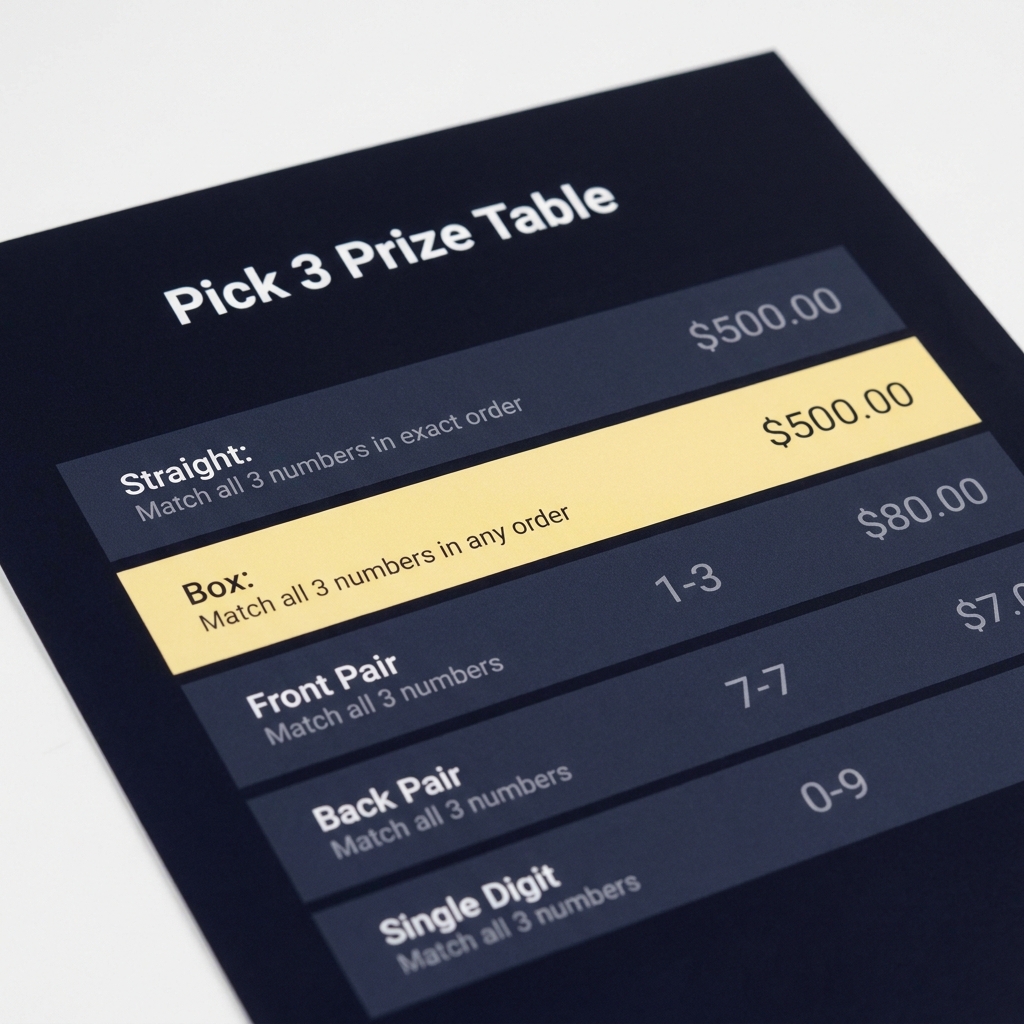
When computing totals: multiply per-unit payout by the number of units you purchased. For a $1 Straight/Box where the ticket simultaneously covers Straight and Box, add the Straight payout and the Box payout amounts when the ticket qualifies for both prize types, following the state table rules on double counting or exclusions.
Step-by-step: calculating pari-mutuel Pick 3 payouts
How prize pools are formed and divided
In pari-mutuel states the available payout for each prize category comes from the pooled sales allocated to that prize after the draw; the pool is funded by game sales and any retained percentages are subtracted before winners share the remainder. California Daily 3 illustrates pari-mutuel mechanics where the prize depends on the final pool and the count of winning wagers, so you estimate rather than know the exact prize until after the draw. See California Daily 3 details at California Daily 3.
In practice, pari-mutuel calculation follows this formula: determine total pool allocated to a prize category, subtract any required keepers or operational deductions if published, then divide the remaining pool by the number of winning units to get the per-unit payout.
Sample pool-share calculation with hypothetical sales and winners
Worked example: suppose a pari-mutuel Pick 3 draw allocates a pool of funds to the Straight prize equal to 40% of relevant sales after keepers, and the pool amount is estimated at 100,000 USD for a given draw. If there are 200 winning Straight units, the per-unit payout estimate is 100,000 divided by 200, or 500 USD per winning unit. This shows how the same per-unit value can arise in pari-mutuel results, but it depends on sales and winner counts so it is not guaranteed.
Because pari-mutuel payouts vary, analysts often produce a small payoff table with scenarios: low sales and many winners, medium sales and moderate winners, high sales and few winners. Each scenario reuses the pool division formula so readers can see the payout range rather than a single number.
Understanding bet types and permutations: Straight, Box, Straight/Box, Combo
Permutation counts and how they affect Box payouts
Correctly classifying your wager is essential because Box payouts are prorated by the number of permutations your selection generates: an AAB number has 3 permutations and is considered a 3-way Box, an ABC number has 6 permutations and is a 6-way Box, and an AAA triple has only one ordering so it generally pays Straight only. Permutation counts and category rules are documented in state prize explanations such as the Pennsylvania and New Jersey pages. See the New Jersey Pick-3 guide at New Jersey Pick-3.

Straight wins require the exact order, while Box wins pay for matching digits in any order; a Straight/Box combines both functions and divides the stake into Straight and Box units, which affects potential payouts in both fixed and pari-mutuel contexts.
How triples and doubles are treated in prize rules
Triples such as 555 typically are one-way plays for Straight only in many rule sets, which means they do not get standard Box multiplicative payouts; doubles like 223 get the 3-way Box treatment for permutation math. Always check the state prize table or rules to confirm how triples and doubles are handled because some pages clarify exceptions and rounding behavior.
Adding FIREBALL and other add-ons: how they change payouts
How add-ons modify winning combinations
Optional add-ons such as FIREBALL introduce extra drawn digits or replacement mechanics that create additional winning combinations beyond base play, and states publish separate prize tables for those add-ons; for example certain state pages document how add-on pay tables sit beside base play pay tables and expand the count of winning units, which changes per-unit math. See a representative state add-on outline at the Maryland Pick 3 information page Maryland Pick 3.
Because add-ons increase the number of winning combinations, they typically reduce the per-unit payout for each added unit in pari-mutuel pools and alter the fixed-permutation payouts listed in fixed-prize tables, so include add-on units separately in any spreadsheet calculation.
Where to find separate prize tables for add-ons
Official lottery pages normally have a dedicated section for add-ons and their prize tables; check the draw game rules and the add-on product paragraph for exact payouts. If add-ons are available in your jurisdiction, copy both base and add-on tables into your calculator to avoid omitting extra winning units when estimating total returns.
Common errors and traps when estimating payouts
Mistakes that cause overestimates or underestimates
A frequent error is assuming fixed prizes when the state is pari-mutuel, which can dramatically overstate certainty; always verify model type on the official page. The California Daily 3 rules are an example of pari-mutuel wording that should prevent this mistake if checked in advance. See California Daily 3 for pari-mutuel details at California Daily 3 (see also lottery.net).
Other pitfalls include miscounting permutations, forgetting to include add-on units, ignoring posted liability limits, and failing to account for rounding or cutoff rules that can change final payouts in edge cases.
First confirm whether your state uses fixed prizes or pari-mutuel pools, then apply permutation counts for your bet type and use the state prize table or pool division formula to compute per-unit payouts, documenting all assumptions and verifying on the official page.
Use a short verification checklist before publishing any estimate: confirm jurisdiction model, copy the current prize table or pool wording, note add-ons, record any liability caps, and test the arithmetic with a small example ticket.
Worked examples: fixed-prize calculations for common bets
Example 1: $1 Straight winning payout
Example 1, fixed-prize step-by-step: 1) From the state prize table find the $1 Straight amount; for many fixed-prize tables a common published baseline is 500 USD for a $1 Straight ticket, 2) If your ticket is a $1 Straight that matches the draw exactly, the payout equals the $1 Straight amount from the table, 3) Record the payout amount and confirm whether the state pays a single lump sum or splits across multiple entries in case of multi-unit tickets; for reference see Pennsylvania PICK 3 prize tables at Pennsylvania PICK 3.
Example 2: 3-way Box and 6-way Box calculations
Example 2, Box math: using a $1 baseline Straight of 500 USD as above, a 3-way Box usually divides the available Box payout across the three permutations so a single winning permutation would receive roughly one third of the Straight benchmark in jurisdictions where Box payouts are tied to Straight amounts. For a 6-way Box the per-unit Box payout is roughly one sixth of the Straight baseline where that proportionality is used. Always confirm exact Box payouts on the state table to apply the correct per-unit value.
For $0.50 plays, the payout is commonly proportional to the unit size, meaning a $0.50 Straight often pays half the $1 Straight amount on fixed tables that support half dollar pricing; check the specific table row for the $0.50 units to avoid arithmetic errors.
Worked examples: pari-mutuel calculations with sample pools
Hypothetical pool, keepers, and division among winners
Example pari-mutuel: assume total sales for the pick game day were 500,000 USD and the published allocation to the Straight prize pool is 40 percent after keepers and operational deductions, giving 200,000 USD available. If there are 400 winning Straight units, divide 200,000 by 400 to estimate 500 USD per winning unit. Because both sales and winner counts move each draw, this estimate is conditional on those assumptions and should be presented as a scenario rather than a guarantee. For pari-mutuel mechanics see California Daily 3 and historical payout summaries such as LotteryUSA.
Show results for low, medium and high winner scenarios to illustrate dispersion: the same pool divided by twice as many winners halves the per-unit payout, while fewer winners increase the per-unit amount proportionally.
How winner counts shrink or expand per-unit payout
Because pari-mutuel payouts are inversely related to winning units, small changes in winner counts can materially change per-unit returns; demonstrate this in a spreadsheet by varying the winning units input and observing the per-unit output using the pool division formula to visualize sensitivity.
Using the permutation method to build Straight/Box and Combo bets
How to calculate how many units a Combo or Wheel uses
To convert a desired coverage into wager units, compute the number of unique permutations generated by your Combo or Wheel selection. For example, a full 3-digit ABC combo uses 6 permutations, so a $1 per permutation Combo costs 6 USD per full coverage. Multiply permutations by unit cost to get total stake, and compute potential gross payout by multiplying per-unit prize by the number of winning units you hold.
When building a partial wheel or a customized combo, list the distinct permutations explicitly to avoid paying for duplicate orders; some ticketing interfaces deduplicate automatically while others charge for every permutation listed, so confirm how your vendor handles duplicates before finalizing cost calculations.
Practical tips to avoid over-betting duplicate permutations
Keep a running table of permutations as you add numbers and use quick combinatorics formulas or a spreadsheet function to count unique permutations so you do not accidentally buy the same permutation twice. Record the total units and cost clearly to compare to your budget before you submit the wager.
How to build a simple spreadsheet or manual calculator
Essential fields and formulas to include
Design a compact spreadsheet with these input fields: State model type, Bet type, Stake per unit, Number of units, Prize table reference or Pool size estimate, Add-on units. For fixed-prize rows use a formula like =Stake_per_unit*PerUnit_Payout to compute gross payout. For pari-mutuel rows use =Estimated_Pool/Winning_Units*Tickets to estimate per-unit payout then multiply by Tickets for gross payout. Use explicit cell names or a clear key so others can follow your formulas. See our blog for related templates and examples.
Validate the calculator by reproducing published fixed-prize payouts from the state table and by testing pari-mutuel scenarios that approximate known post-draw payouts if historical data is available. Log test cases and the source page screenshots used during validation so readers can verify the origin of any assumptions.

When to check official state sources and what to verify
Which parts of the rules change most often
Prize tables, add-on availability, and liability limits are common change points, as are any published roundup or rounding rules; check the official lottery page for the game and note the page date. If the page lists current rules and prize tables, use that canonical source for your calculator inputs and for any communication about estimated payouts.
How to find the current prize table and add-on rules
Use the lottery site navigation for draw games and the specific game page for Pick 3 or Daily 3; many pages label the relevant content clearly and include a rules or prizes section. For example, both the Virginia and Maryland pages list game rules and prize descriptions that can be used to confirm exact payouts and add-on treatments. See Virginia Pick 3 rules at Virginia Pick 3 rules.
Decision checklist: pick the right model, bet type, and add-ons
Before you run any estimate, check these items: confirm jurisdiction model, select the correct permutation category, verify add-ons and unit cost, and note any liability or rounding rules on the official page. Document the date and URL of the source you used for transparency.
When estimating for pari-mutuel scenarios, record your pool assumptions and a plausible range of winner counts so readers understand how sensitive the outcome is to those inputs. Add a short caveat stating that estimates depend on stated assumptions.
Summary and next steps
Key takeaways
Jurisdiction determines method: fixed-prize jurisdictions use published pay tables and let you compute exact per-unit payouts, while pari-mutuel jurisdictions allocate a prize pool and divide it among winners so payouts are estimates until after the draw. Confirm add-ons and state exceptions before finalizing any estimate and use the formulas shown to build a small spreadsheet to automate repeat calculations.
Where to go for official verification
Always verify final numbers on the official state lottery game page for the draw you are analyzing and save a screenshot or link for the prize table used. If you want a place to practice structured prediction challenges rather than wagering with a sportsbook, consider FundedPlays as a factual example of a funded sports prediction platform that offers challenge formats and virtual accounts without implying guaranteed outcomes. Learn how our evaluations work at this post or visit Funded Plays to get started.
Check the official state lottery game page for explicit wording like prize table or pari-mutuel and look for published prize tables or pool allocation details.
A commonly used benchmark in several state materials is 500 USD for a $1 Straight, but always confirm on the state prize table you are using.
Yes, add-ons create additional winning combinations and use separate prize tables or pool allocations, so include add-on units when estimating payouts.
References
- https://www.calottery.com/en/draw-games/daily-3
- https://www.texaslottery.com/export/sites/lottery/Games/Pick_3/
- https://www.palottery.state.pa.us/Games/Draw-Games/PICK-3.aspx
- https://www.njlottery.com/en-us/drawgames/pick3.html
- https://www.fundedplays.com/challenges
- https://www.mdlottery.com/games/pick-3/
- https://www.lottery.net/california/daily-3
- https://www.lotteryusa.com/california/daily-3/
- https://www.valottery.com/aboutus/rules/pick-3
- https://www.fundedplays.com/blogs
- https://www.fundedplays.com/blogs/how-fundedplays-evaluations-work
- https://www.fundedplays.com