
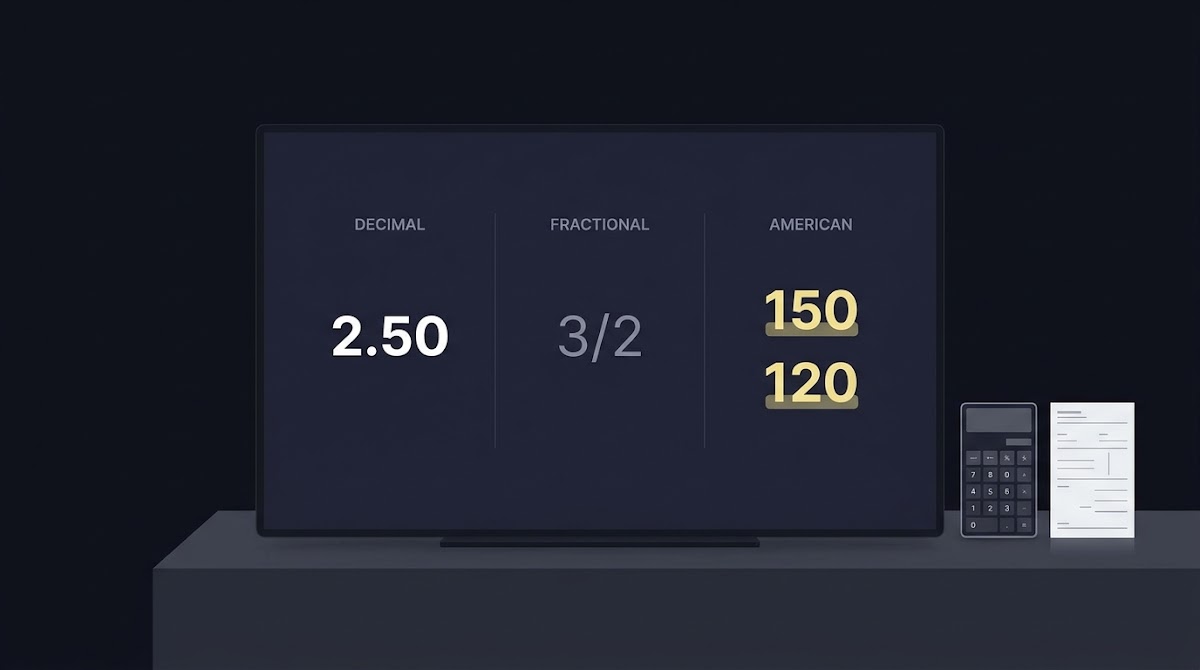
What "payout on betting odds" means
When people ask about payout on betting odds they usually mean the total return a bettor receives if a selection wins. That total return includes the original stake and any net profit; distinguishing return from profit is essential because some sources quote odds to show total return while others quote only net profit, and mixing those conventions leads to calculation mistakes. For a practical definition and the standard odds formats used by modern explainers see Investopedia's guide to reading odds Investopedia's odds guide.
Odds appear in three common formats: decimal, fractional, and American. Decimal odds are widely used online and internationally, fractional odds are traditional in the UK and Ireland, and American or moneyline odds are the common form in the United States. Each format represents the same underlying price in a different notation, and you can convert between them to compare offers or to compute payout across platforms. This practical detail is summarized in responsible-gambling primers that explain how formats map to implied probability and return BeGambleAware's overview of odds.
Implied probability is a simple conversion from odds into the percentage chance a market implies as the break-even point for that price. Implied probability helps you judge whether your own estimate of the chance of an outcome gives you an edge, but it is not a prediction or guarantee. Regulators and safer-gambling resources stress that implied probability is an interpretive tool rather than a certainty UK Gambling Commission terms explained.

How decimal odds calculate payout
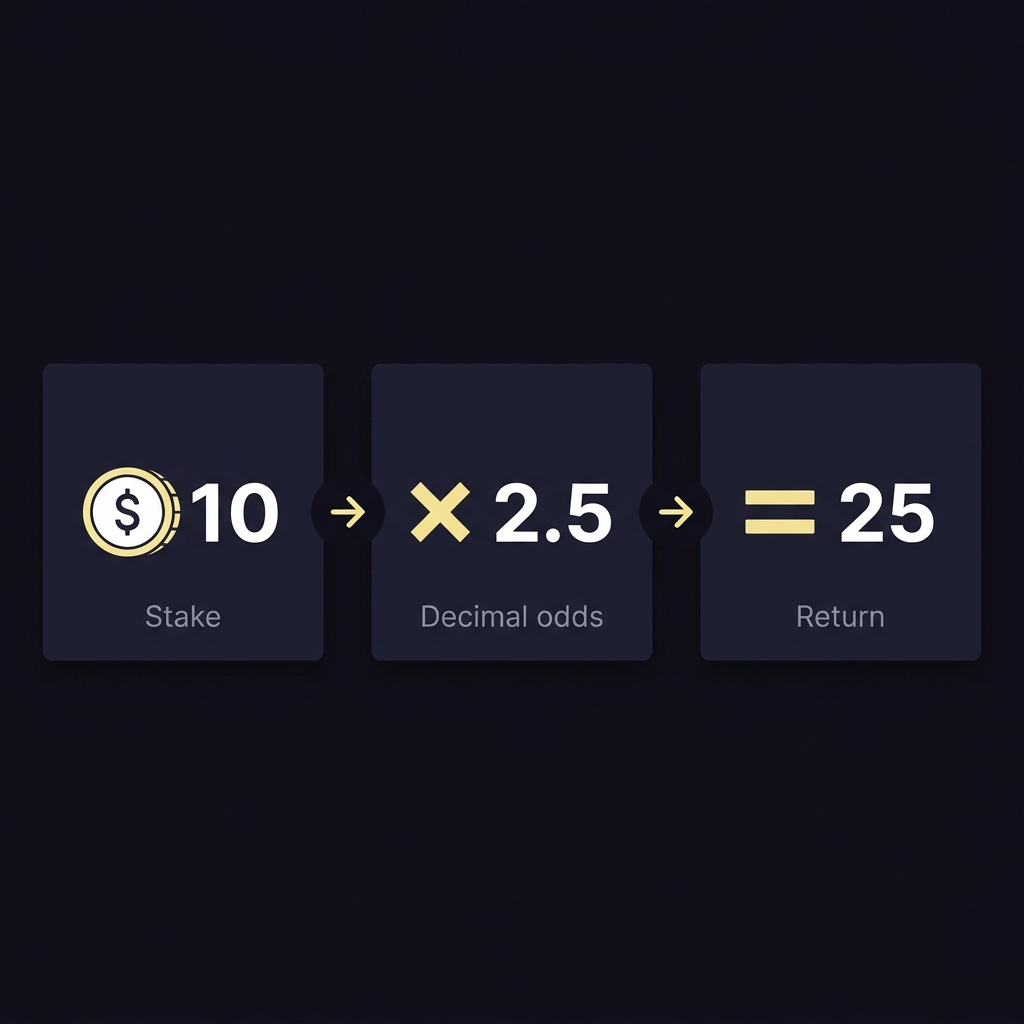
Decimal odds quote the total return per unit stake, which makes the payout calculation straightforward: total return equals stake multiplied by the decimal odds. Put as a formula: total return = stake × decimal odds. The implied probability is the reciprocal: implied probability = 1 / decimal odds. This convention simplifies many calculations because decimal odds already include the stake component; authoritative explainers use this formula when showing decimal conversions Investopedia's odds guide.
Example steps to compute a decimal payout, using a small stake so you can replicate: 1) Choose a stake, for example 20. 2) Choose the decimal price, for example 2.50. 3) Multiply stake by decimal odds: 20 × 2.50 = 50. 4) Total return is 50; net profit equals total return minus stake, so profit = 50 − 20 = 30. These steps show why decimal is useful for quick checks and for combining multiple legs into parlays.
Practice a decimal payout using a small stake
Try this quick decimal exercise with a small stake to see the payout and profit differences for yourself.
Because decimal odds include the stake, convert other formats into decimal first can reduce calculation errors when you later multiply prices for multi-leg bets or compare returns across platforms.
How fractional odds calculate payout
Fractional odds quote net profit relative to a unit stake; the numerator shows the potential profit and the denominator shows the stake unit. In practice the formula for profit is profit = stake × (numerator / denominator), and the total return is profit + stake. This presentation emphasizes net profit instead of giving the return directly, and it is the form commonly used in UK betting guides Investopedia's odds guide.
To interpret implied probability for fractional odds use denominator / (numerator + denominator). For example, 5/2 fractional odds imply a probability of 2 / (5 + 2) = 2/7 ≈ 28.57 percent. To convert fractional odds to decimal for easier multiplication use decimal = numerator / denominator + 1. Using 5/2 again gives decimal = 5/2 + 1 = 3.5. Once converted you can compute total return with the decimal formula and then subtract stake if you need net profit.
Worked numeric example: stake = 10, fractional price = 3/1. Profit = 10 × (3/1) = 30. Total return = 30 + 10 = 40. If you prefer a single expression, converting the fraction to decimal first gives decimal = 3/1 + 1 = 4.0, and 10 × 4.0 = 40, the same total return.
How American (moneyline) odds calculate payout
American or moneyline odds use positive and negative values to show the relationship to a 100-unit reference. When the moneyline is positive, the formula for profit is profit = stake × (odds / 100). For negative moneyline values the formula flips to profit = stake × (100 / |odds|), and total return is profit + stake. These two formulas are the standard way moneyline prices are presented in U.S.-focused explainers American Gaming Association sports betting primer.
Positive example: stake = 25, moneyline = +150. Profit = 25 × (150 / 100) = 25 × 1.5 = 37.5. Total return = 37.5 + 25 = 62.5. This shows how a positive moneyline ties profit to the 100 reference amount in a direct multiplication.
Payout on betting odds is the total return a winning bettor receives and is calculated differently by format: decimal returns equal stake times the decimal; fractional odds quote net profit per unit stake and add the stake to get total return; and American odds use positive or negative moneyline formulas tied to a 100‑unit reference. Parlays multiply decimal legs and then multiply by stake. Implied probability converts prices into break‑even percentages and expected value combines your probability estimates with payouts to assess long‑run edge.
Negative example: stake = 50, moneyline = -200. Profit = 50 × (100 / 200) = 50 × 0.5 = 25. Total return = 25 + 50 = 75. The negative number signals a shorter price and the formula scales profit relative to a 100-unit base.
To get implied probability from a moneyline you can use the reciprocal forms: for positive moneyline odds use 100 / (odds + 100), and for negative odds use |odds| / (|odds| + 100). These calculations make the break-even percentage clear and let you compare your own win estimates to the market.
Payouts for parlays and accumulators
Parlay payouts combine individual legs into a single price and are calculated by converting every leg into decimal odds, multiplying those decimal values together, and then multiplying the product by the stake to get the total return. Because decimal odds include the stake component, this approach yields the final return directly and is the widely recommended method for parlay math Investopedia's parlay explanation.
Stepwise parlay calculation: 1) Convert each leg to decimal. 2) Multiply all decimals together to get the combined price. 3) Multiply that combined price by the stake. Remember that every leg must win for the parlay to pay out; if any leg loses the whole parlay fails. Many guides emphasize this all-or-nothing aspect when describing accumulator risk.
Worked parlay example: three legs priced in decimal as 1.80, 2.20, and 1.60, stake = 10. Multiply the decimals: 1.80 × 2.20 = 3.96; 3.96 × 1.60 = 6.336. Total return = 10 × 6.336 = 63.36. Net profit = 63.36 − 10 = 53.36. Keep in mind that some platforms round intermediate values or apply rules for voided legs, so the displayed payout may differ slightly from manual multiplication depending on the provider's rounding policy Investopedia's parlay explanation.
Using implied probability and expected value to evaluate payouts
Expected value, or EV, combines your own estimate of a selection's chance to win with the payout that the market offers, and it is the standard way to judge long-run advantage. The EV formula for a single bet is EV = (win probability × net profit if you win) − (loss probability × stake). Here, net profit uses the payout math you calculated earlier, and loss probability is 1 minus your win probability. Investopedia's EV primer explains the approach and shows how to apply it across examples Investopedia on expected value.
Short numeric EV example: decimal price = 3.00, stake = 10, your estimated win probability = 0.40. Net profit if you win = 10 × (3.00 − 1) = 20. EV = 0.40 × 20 − 0.60 × 10 = 8 − 6 = 2. A positive EV of 2 indicates a theoretical long-run edge on average per identical wager. Use EV to decide whether the market price combined with your probability estimate is worth the risk.
Compute EV using stake, decimal odds, and your win probability
Enter decimal odds for accuracy
The implied probability from the market gives a break-even chance: compare that to your estimate to see if you have an edge. If your win probability estimate exceeds the implied probability, and your EV is positive after accounting for stake and fees, the bet represents a potential advantage in the long run, subject to variance and bankroll management considerations.
How platforms display odds and convert formats
Most modern sportsbooks and platform interfaces let users toggle between decimal, fractional and American odds for display, but changing the display does not change the underlying price. Display settings are a convenience for different user preferences: decimals simplify multiplication for parlays, fractionals suit traditional UK readers, and American odds match moneyline culture in the U.S. For clarity on format choices and regional usage patterns see general odds explainers Investopedia's odds guide.
When you switch formats on a platform the system converts the price mathematically, so checking the converted decimal can help avoid mistakes when calculating total return or parlay products. Always confirm platform rounding rules and whether the displayed payout includes the stake or not, since presentation differences sometimes cause confusion.
Common mistakes and pitfalls when calculating payouts
Numeric errors often start with not knowing whether a quoted number is return or profit. Confusing return and profit can double-count the stake or omit it entirely. Other common mistakes include failing to convert fractional or American odds to decimal before multiplying for parlays and forgetting that bookmaker margins make the implied probability sum exceed 100 percent across an event.
Behavioural pitfalls matter as much as arithmetic. Bettors sometimes treat implied probability as a certainty, ignore the bookmaker margin, or use unrealistic win probabilities in EV calculations. Parlays are particularly prone to misuse because correlated legs and variance make long-shot accumulators much less likely to provide value than they appear at first glance. Responsible-gambling resources emphasize that implied probability is an interpretive tool, not a promise of outcome BeGambleAware's overview of odds and that regulators provide guidance to help players understand these distinctions UK Gambling Commission terms explained.

Short checklist to avoid calculation errors: confirm whether the displayed price is return or profit, convert all legs to decimal before multiplying, factor in bookmaker margin when comparing implied probabilities, and use realistic win-probability estimates when computing EV.
Practical examples and worked scenarios
Single bet examples across all formats help illustrate the same math in different notations. Decimal example: stake = 15, decimal = 2.20 → total return = 15 × 2.20 = 33, profit = 18. Fractional example: stake = 15, fractional = 6/4 → profit = 15 × (6/4) = 22.5, total return = 37.5. American example: stake = 15, moneyline = +120 → profit = 15 × (120 / 100) = 18, total return = 33. These parallel examples show how the same underlying price can appear in different forms but give identical total returns when converted correctly Investopedia's odds guide.
Parlay example (repeated with work): leg A decimal 1.90, leg B decimal 2.10, leg C decimal 1.50, stake = 20. Multiply: 1.90 × 2.10 = 3.99, 3.99 × 1.50 = 5.985. Total return = 20 × 5.985 = 119.70. Net profit = 119.70 − 20 = 99.70. This shows how even modest decimals compound quickly and why one loss cancels the entire parlay, reinforcing the all-or-nothing risk profile described by parlay explainers Investopedia's parlay explanation.
EV worked example bringing it together: suppose a selection is available at decimal 2.80, stake = 25, and you estimate win probability at 0.40. Net profit if you win = 25 × (2.80 − 1) = 45. EV = 0.40 × 45 − 0.60 × 25 = 18 − 15 = 3. A positive EV of 3 means that, on average over many identical wagers with accurate estimates, this bet would earn 3 units per wager, though variance means short runs differ. For an account-level approach consider expected value alongside drawdown limits and bankroll rules when planning bet size.
Quick checklist and conclusion
Key takeaways: decimal odds give total return via stake × decimal; fractional odds quote net profit per unit stake with profit = stake × (numerator/denominator) and decimal conversion = numerator/denominator + 1; American odds use +/− conventions with formulas tied to a 100-unit reference; parlays multiply decimal legs and then multiply by stake; implied probability converts odds into a break-even percentage but is not a guarantee. These are the practical formulas you can use immediately when checking prices.
Before you place a bet: read the platform rules and convert if it helps your math, confirm whether the platform shows return or profit, calculate implied probability and your own win estimate, compute EV to see if there is a potential edge, and read the platform rules for rounding, voided legs, and payout display. A responsible approach treats payouts as outcome-dependent and uses EV and sensible bankroll limits rather than chasing large accumulators without realistic probability estimates.
Final thought: Understanding payout on betting odds reduces arithmetic mistakes and clarifies value decisions. Use the simple formulas and worked examples above, check platform rules, and treat implied probability as a tool for comparison rather than a promise of an outcome.
Final thought: Understanding payout on betting odds reduces arithmetic mistakes and clarifies value decisions. Use the simple formulas and worked examples above, check platform rules, and treat implied probability as a tool for comparison rather than a promise of an outcome.
Return includes your original stake plus any net profit; profit excludes the stake and shows only the winnings.
Convert each leg to decimal odds, multiply all decimal odds together, then multiply the product by your stake; all legs must win.
A positive EV means your estimated probability combined with the market payout suggests a theoretical long‑run advantage per identical wager.
References
- https://www.investopedia.com/how-to-read-odds-in-sports-betting-5217918
- https://www.begambleaware.org/safer-gambling/understanding-the-odds
- https://www.gamblingcommission.gov.uk/public-and-players/guide/gambling-terms-explained
- https://www.americangaming.org/resource/sports-betting-101/
- https://www.investopedia.com/terms/p/parlay-bet.asp
- https://www.investopedia.com/expected-value-in-sports-betting-7486621
- https://www.fundedplays.com/challenges
- https://www.fundedplays.com
- https://www.fundedplays.com/blogs
- https://www.fundedplays.com/blogs/how-fundedplays-evaluations-work
- https://www.aceodds.com/bet-calculator/odds-converter.html
- https://www.actionnetwork.com/betting-calculators/betting-odds-calculator
- https://www.covers.com/tools/odds-converter