
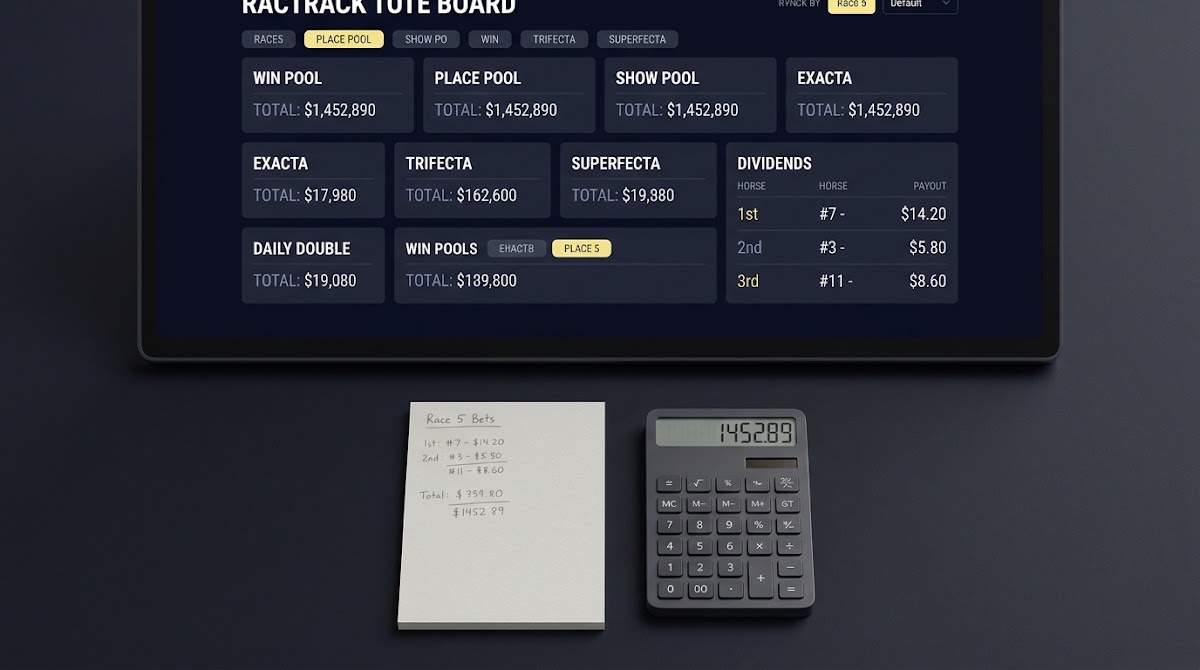
What is a payout calculator horse racing and why it matters
A payout calculator horse racing tool helps estimate what a winning ticket will return under pari-mutuel rules. In plain terms, the calculator models how the total money bet for a bet type becomes a dividend after the track takes its commission and the remaining pool is split among winning tickets.
Using a calculator is not the same as reading posted odds. Odds are dynamic signals while calculators show the arithmetic behind a possible dividend, letting you plan stake size, compare bet types, and check a track's published payout after the race.
Practice payout estimation on the FundedPlays Challenges page
Try a sample calculation or move to the worked examples below to see the math in action.
For many bettors and analysts, a simple calculator is useful for estimating risk and reward before the race closes and for verifying that the official posted dividend matches expectations after the race.
How pari-mutuel systems determine payouts
Understanding a pari-mutuel payout starts with three pieces: the pool size, the takeout, and the dividend. The pool is the total of all stakes for a bet type. The takeout is the percentage removed for taxes, track operations, and distribution. The dividend is the remainder divided among the winning tickets.
Think of the pool like a shared prize pot. When the race is decided the operator reduces that pot by the takeout, and the remaining money is split proportionally across the winning tickets to produce the payout per unit stake.
Because the dividend is the result of arithmetic on pooled amounts and winning stakes, small changes in how many winning tickets exist or how concentrated stakes are can change the final payout noticeably from preliminary estimates.
The pool, the takeout, and the dividend
The pool contains every bet placed for a specific type, such as win or exacta. The takeout is declared by the racing authority or track and is applied to that pool to fund racing and payout structures. The dividend is calculated from the pool after the takeout, then rounded to the published unit.
Operations staff and mutuel tellers record totals and compute dividends once bets stop and the result is official. For most uses a calculator models those steps so users can estimate outcomes before official numbers are posted.

Step-by-step: using a payout calculator horse racing to estimate returns
Before you use a payout calculator horse racing you need to gather the inputs: the total pool for the bet type, the declared takeout rate, the total stake of winning tickets or number of winning tickets at the unit stake, and your planned stake size.
With those inputs the calculation order is predictable. Remove the takeout from the total pool, compute the money left for distribution, divide by the total winning stake to find the dividend per unit, then multiply that dividend by your stake to estimate your return.
Collect pool and takeout data, compute the distributable pool, divide by winning units to get the dividend per unit, multiply by your stake, and apply the track rounding rules to match the published payout.
Common user errors happen when one of these inputs is omitted or misrecorded. Asking which inputs you often forget is a quick way to improve accuracy before you run a calculation.
When you do the arithmetic by hand a payout calculator horse racing simply helps automate the steps and reduce transcription errors, but learning the manual flow is valuable for verification.
Inputs required by a payout calculator
Typical inputs are the total pool, declared takeout rate, the total winning stake or number of winning tickets, and the unit stake denomination used at the track. Make sure unit sizes match when you compare your output to official dividends.
Calculators may also accept variations like alternate takeout rates for certain jurisdictions, multiple unit sizes, or ticket breakdowns for exotics that involve many combinations.
A simple calculation flow you can do by hand
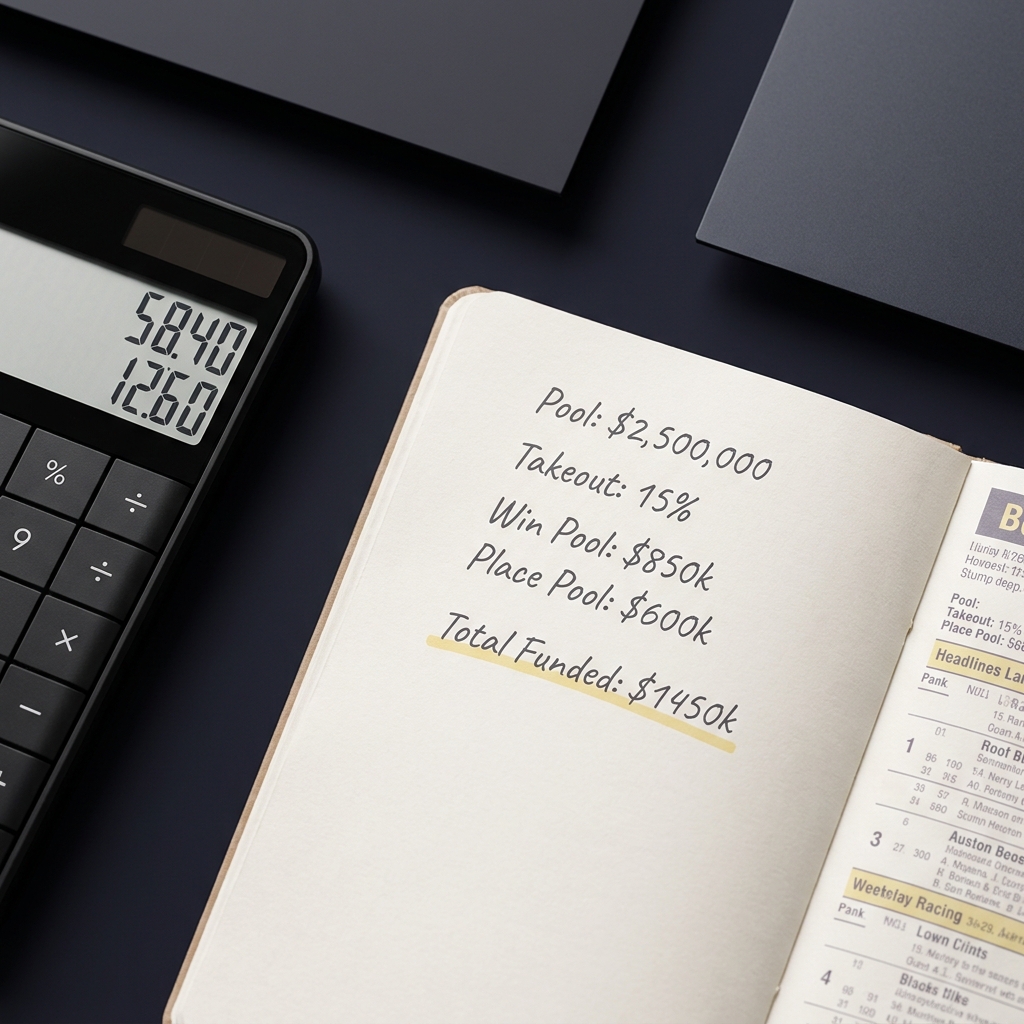
Practicing the hand flow helps you spot tool errors, and it clarifies why changes in pool size or the number of winning tickets shift the final dividend.
By hand you follow four steps: subtract takeout from the pool, compute the distributable pool, divide by total winning stake to get the dividend per unit, and multiply the dividend by your stake. Rounding rules then convert the decimal result into the published payout units.
Core formulas and a worked example you can follow
A basic formula in words is simple: payout per unit equals distributable pool divided by total winning units. Algebraically for a win pool you can express the distributable pool as total pool times one minus the takeout rate, then divide by total winning units to get the dividend.
Working step by step keeps the process transparent. First compute distributable pool, then the per unit dividend, and finally your payoff by multiplying by your unit stake. Track rounding rules at the end so your estimate aligns with how the track publishes dividends.
Formula for a simple win payout
In words the formula reads: dividend per unit equals (total pool minus takeout) divided by total winning stake. That dividend multiplied by your unit stake gives the gross return before any taxes or fees outside the pari-mutuel pool.
Keep in mind most tracks round published dividends to standard unit increments, so your calculated decimal value will usually be adjusted to the nearest published amount.
Worked example with numbers
Imagine a simple scenario to follow the steps. Start with the total pool, remove the takeout to get the distributable pool, divide by the combined stake of the winning tickets to find the dividend per unit, and multiply by your unit stake for the payout. Follow each step and apply the track rounding rule at the end.
Running through a numeric example by hand is a reliable way to check a calculator and to build confidence about when official dividends will match or differ from estimates.
Common bet types and how a payout calculator handles them
Straight bets such as win, place, and show each use a single pool and produce dividends based on winners in those positions, while exotics like exacta, trifecta, and superfecta use separate exotic pools that are divided among combination winners.

When a place or show pool has multiple horses finishing in paying positions that pool is split across those positions before dividends are calculated for each finishing place, and dividends are then determined by dividing each position's share by the winning stakes for that position.
Straight bets: win, place, show
Win pools pay to the ticket(s) backing the finishing horse. Place and show pools pay to the top two or three finishers, depending on the jurisdiction. A calculator must account for multiple winners when it divides the pool for place and show payouts.
Multiple winners means each place or show position has its own divisor: the total winning stake for that position. When many tickets cover a place position the per-unit dividend shrinks compared with a situation where only a few tickets covered that outcome.
Popular exotics: exacta, trifecta, superfecta
Exotic payouts are calculated from separate exotic pools. Each winning combination of horses divides the exotic pool share in proportion to the stakes on that combination. Calculators for exotics must accept either combination counts or a breakdown of winning stakes to compute a dividend.
Because exotics can have many winning tickets or few large tickets, expect larger variation in divisional outcomes and more rounding effects than with simple win pools.
How ticket pools and ticket counts change payouts for place and show
Place and show pools often yield lower dividends because each pool may be paid out to more than one finishing position, and the stake distribution among winning tickets directly affects the per-unit dividend. When many small tickets win, each one receives a smaller share.
By contrast, if only a few large tickets hit a place or show, the dividend per unit will be higher because the divided portion of the pool goes to fewer winning units. That ticket concentration is one reason dividends can swing significantly between races with similar pools.
Calculators that accept winning stake totals are therefore more accurate than those that only accept winning ticket counts, because stake totals capture situations where winning tickets use different unit sizes.
When you build an estimate, check whether the tool expects total winning stake or ticket count and convert your inputs accordingly to avoid under or overestimating the dividend.
Using online payout calculators and tools to speed calculations
Online payout calculators automate the arithmetic of pool handling, takeout removal, dividend calculation, and rounding. Good tools accept live pool inputs, have presets for takeout rates, and handle multiple bet types including exotics, saving time when you need quick estimates.
Use calculators to iterate bet sizing and to compare expected payouts across bet types. They are especially helpful when exploring scenarios such as split stakes or when evaluating complex exotic combinations.
Quickly compute payout estimates using live inputs
Verify against official dividends after the race
Always remember that automated tools only reflect the inputs they receive. Pools can change up to closing time and takeout rates or jurisdictional rules might differ, so verify any important estimate against official posted dividends after the race.

When in doubt, run the same scenario by hand or with a second tool to ensure consistency and to catch data entry errors.
Where to find official payout information at the track and online
Authoritative payout information comes from track programs, mutuel windows, on-track display boards, and official result sheets published by the racing operator. These sources are the final record of what was paid for each race and bet type.
Final dividends are typically declared after the pool closes and the race result is official. Before that moment any calculator output is provisional and should be treated as an estimate rather than a final payout amount.
If you need an audit trail, keep screenshots or written records of pool totals and the time you took your estimates. That documentation helps if you later compare your calculations to track-published dividends and need to reconcile differences.
How to verify payouts and reconcile calculator output with track dividends
Use a short reconciliation checklist when posted dividends differ from your estimate. Confirm the pool total you used, verify the takeout rate you applied, check rounding conventions, and confirm whether winning stake was reported as total units or ticket counts.
Timing differences are a common reason for discrepancies. Late bets posted before the pool closed can increase the pool size and change the dividend, and some jurisdictions may apply special takeout rules that alter the distributable pool.
If the difference persists, document the numbers you used and raise the inquiry with the track or official operator, providing your calculations and the time you captured pool totals so staff can review the records.
Keeping a simple calculation log helps prevent repeated confusion and gives you a record to reference when comparing multiple races or running retrospective analysis.
Decision criteria: when to use a calculator to inform betting choices
A payout calculator horse racing is most useful for pre-race planning, comparing potential returns between bet types, and sizing stakes within a disciplined bankroll plan. Use estimated dividends to inform expected payout and to decide whether a straight bet or an exotic fits your objective.
Prefer straight bets when liquidity is important and outcomes are more predictable. Consider exotics when the potential reward justifies the higher variance and when you can size tickets across combinations strategically to manage risk.
Always balance payout estimates with sound bankroll management. Expected payout is only one input: account for variance, pool volatility, and your own tolerance for stretched sequences of losses when choosing bet types and stake sizes.
Typical mistakes and how they lead to wrong payout estimates
Common errors include forgetting to apply takeout, miscounting winning tickets or units, using inconsistent unit sizes, and incorrectly applying rounding rules. Each mistake can materially change the estimated dividend and therefore the expected return.
For example, omitting the takeout will make your estimate too large, while miscounting winning units will produce too high or too low a per-unit dividend. Simple safeguards help avoid these pitfalls.
Practical safeguards include using a short template that lists required inputs, double-checking unit sizes, and keeping a calculation log for each race. These steps reduce the likelihood of transcription or logic errors when you run multiple scenarios.
Practical scenarios and worked problems for practice
Try a simple win example first. Follow the four-step flow: start with the pool, remove takeout, divide by winning units, multiply by your stake, then apply rounding. Doing this by hand for a small example builds confidence before you move to exotics.
Next try an exacta problem where the exotic pool is divided among winning combinations. Calculate the distributable exotic pool, then divide by the total winning combination stake to find the payout per combination, and multiply by how many units you bought for that combination.
Finally practice a trifecta by listing winning combinations, summing stakes that hit each combination, computing the per combination dividend, and multiplying by your unit exposures. These exercises illustrate how ticket concentration and combination coverage change the return.
Set aside time to work through at least three practice problems before relying on a tool for live decisions. That practice improves speed and helps you catch input mistakes on the fly.
When to use a payout calculator and when to rely on posted payouts
Use a payout calculator for planning bets, comparing strategies, and getting pre-race estimates of expected return. Calculators are valuable in pre-race analysis and to test how different stake sizes or coverage choices affect potential payouts.
Rely on posted dividends once the pools are closed and the racing operator has declared final results. Posted dividends are the authoritative outcome and are what a bettor actually receives, so always verify important estimates against those official numbers.
The best practice is to use both approaches: build estimates to plan and manage risk, then confirm with posted payouts and log any differences for future learning.
Conclusion: key takeaways and next steps
Calculating a payout involves a clear sequence: collect pool and takeout data, compute the distributable pool, divide by winning units to get the dividend, multiply by your stake, and apply rounding consistent with the track. A payout calculator horse racing implements this flow to save time.
Next steps are practical: practice the worked examples, bookmark official sources for post-race verification, and use a reliable calculator while keeping a simple verification checklist. Responsible participation and careful records make payout estimation a useful tool rather than a source of confusion.
You need the total pool for the bet type, the declared takeout rate, the total winning stake or count, and your unit stake size.
Differences come from timing changes to the pool, late bets, rounding rules, or incorrect input values such as takeout or winning stake.
Calculators are useful for estimates, but verify exotics and large-stake scenarios against official track dividends because inputs and rounding can change outcomes.
References
- https://en.wikipedia.org/wiki/Parimutuel_betting
- https://www.sportsbettingdime.com/guides/how-to/parimutuel-betting-horse-racing/
- https://www.twinspires.com/wager-types/
- https://www.fundedplays.com/blogs
- https://www.fundedplays.com/blogs/how-fundedplays-evaluations-work
- https://www.fundedplays.com
- https://www.fundedplays.com/challenges