

What is a payout calculator horse racing and why it matters
A payout calculator horse racing is a tool that estimates how money flows from pari-mutuel betting pools and published purses to final recipients. For bettors, it models pool totals, removes takeout and breakage, and calculates likely dividends; for connections, it helps compare published purse splits to net owner receipts after fees and percentages. Funded Plays
Calculators separate two distinct uses: estimating dividends paid to winning bettors from tote pools, and estimating how a published purse is divided among owners, trainers, jockeys, and other stakeholders. Both outputs depend on the same basic inputs, but they answer different questions for different audiences.
Estimate payouts and owner net with a sample calculation
Try a simple calculation using the worked example below to see how a small change in takeout or breakage alters the final dividend or the owner net.
Because exact rules vary by race and state, a payout calculator horse racing provides estimates rather than guarantees, and users should confirm outcomes against official tote results and race conditions. For example, takeout and breakage rules are set by jurisdiction and will change the dividend calculation in practice Kentucky General Assembly. Kentucky wagering rules
Definition and quick overview
In simple terms, a parimutuel payout calculator models how a betting pool is divided after mandated deductions. It usually requires inputs such as pool size, takeout rate, and breakage rule. The same idea applies to purse calculators that start from a published purse and list deductions, so users can see owner net before downstream payments.
Who uses a payout calculator and for what decisions
Bettors use payout calculators to estimate likely dividends for win, place, show, and exotic wagers. Owners and connections use similar tools to estimate net receipts after nomination and entry fees and the customary payments to trainers and jockeys. Analysts and handicappers use these calculators to run scenarios when takeout, fees, or pool sizes shift.

A reliable parimutuel payout calculator separately models each bet type. It treats win, place, and show as simple pools with single winners per pool endpoint, while exotic bets require combinatorial handling and may report multiple dividends broken down by correct combinations.
How race purses are officially distributed
Race purses are distributed according to the published race conditions or a jurisdiction's prize-money code, which set the percentage splits among finishing positions and any special awards. These published rules are the primary source for how owner shares are determined in any given race British Horseracing Authority.
Different jurisdictions and events publish explicit guidance on purse allocation and any special distributions, and those documents are the authoritative reference when disputes or questions arise. Major events provide detailed schedules that can include breeder or nominator payments in addition to the owner shares Breeders' Cup Purses and Awards.
Published conditions and governing codes
Race conditions or regulatory prize-money codes spell out whether the listed purse includes certain fees, how late scratches alter percentages, and how ties are handled. These rules are binding on the race and determine the owner's gross share before internal deductions are applied.
Typical finishing-position splits

While exact percentages vary by event and class, most prize-money schedules allocate the largest share to first place, with descending percentages for the next finishers. The owner receives the owner's share and then pays trainers, jockeys, and any stated parties from that amount, as specified by local practice and contracts.
How a payout calculator horse racing actually works
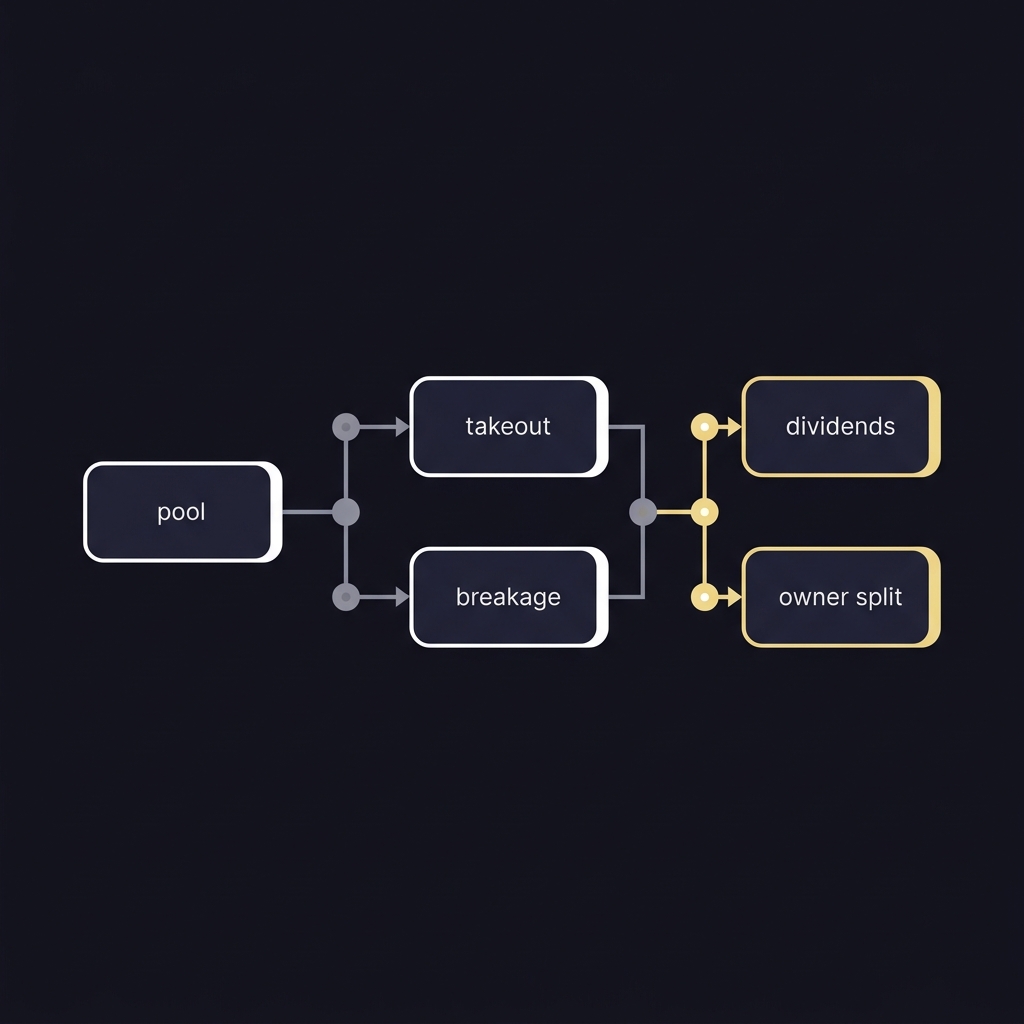
A payout calculator horse racing follows a clear sequence: total the pari-mutuel pool, subtract takeout, apply breakage rules, then calculate dividends by dividing the remaining pool among winning tickets. This step order is central to producing a valid estimate of the dividend for bettors.
Calculators must also account for bet type rules. A win pool yields one dividend per winning runner, while exotic pools such as exacta or trifecta divide among combination tickets that correctly predict multiple finishing positions. Takeout rates and breakage rules differ across bet types and matter for the final number NYRA takeout rates. For background on parimutuel systems see parimutuel betting.
Pari-mutuel dividends are determined by pooling bets, subtracting takeout and applying breakage, then dividing the remainder among winning tickets; published race conditions and event Purses and Awards determine how the purse is allocated to owners, with trainers and jockeys receiving contractual percentages from the owner share.
To be useful, a calculator makes explicit assumptions about takeout by bet type and the breakage convention used, such as rounding to the nearest penny or applying penny breakage rules where enacted. Those assumptions should be visible to the user so they can be adjusted to match local rules Kentucky General Assembly.
Step order: pools, takeout, breakage, dividends
Step one is total the pool for the bet type. Step two is to apply the official takeout percentage, which funds taxes, track operations, and purses. Step three applies breakage rules, which round dividends and can slightly change per-ticket payouts. The remaining amount is divided by the number of winning tickets to produce the dividend.
How calculators model different bet types
A reliable parimutuel payout calculator separately models each bet type. It treats win, place, and show as simple pools with single winners per pool endpoint, while exotic bets require combinatorial handling and may report multiple dividends broken down by correct combinations.
Who gets what: trainer and jockey compensation
Trainers and jockeys are typically paid as a percentage of the owner's purse share and receive mount fees, with the specific percentages and mount fee schedules set by industry bodies and local regulations. For current mount fee schedules and guidance, consult industry sources such as the Jockeys' Guild Jockeys' Guild mount fees.
Common practice often sees the jockey receive a stated percentage of the owner's share for a win and a smaller percentage for placing, plus a fixed mount fee, but the exact split varies by jurisdiction and contract. Trainers likewise receive a standard percentage, with net remainder going to the owner.
Common percentage splits and mount fees
Typical splits are governed by local practice and may be summarized in industry guides. These splits are not universal, so owners and riders should confirm percentages in the relevant race conditions and employment agreements before assuming outcomes.
Where to find local rules
Local racing commissions, national industry associations, and track offices publish current schedules and rules that determine mount fees and percentage splits. Checking those official postings ensures parties use the correct figures when estimating net receipts from a purse British Horseracing Authority.
Stakes races, nomination fees, and how fees change the purse
Stakes programs commonly require nomination, entry, and supplemental fees that affect the final purse and how it is paid to connections. Those fees may be added to the purse pool or deducted from payouts, depending on the event terms, and they are explicitly detailed in stakes conditions and award schedules Breeders' Cup Purses and Awards.
Because fees can change who ultimately receives how much, owners should factor nomination and entry costs into net payout estimates before entering horses in stakes races. These costs can be meaningful relative to the owner's net, especially if multiple rounds of fees are required for a series.
Nomination, entry, and supplemental fees explained
Nomination fees allow owners to indicate interest early in a series and are often small, while entry and supplemental fees to start in the race may be larger. Event rules show when fees are credited to purses, paid to organizers, or allocated to specific awards for breeders or nominators.
How fees are collected and where they appear in the purse
Fees are collected according to the event schedule and appear in the event's financial statements and purse schedules. Major events publish those terms so owners can see whether fees are part of the gross purse or treated as separate allocations.
Pari-mutuel takeout, breakage and examples that change payouts
Takeout is the percentage removed from a pari-mutuel pool to cover taxes, track and operator fees, and purse contributions. Breakage is the rounding convention applied to dividends that may slightly increase or reduce the per-ticket payout. Both factors directly change the dividend a payout calculator reports.
Takeout rates vary by state and bet type, and policy changes can alter bettor returns. For example, recent legislative changes in some jurisdictions have adopted penny breakage rules which reduce rounding losses and modestly increase dividend returns to bettors Kentucky General Assembly. See state schedules such as Iowa takeout guidance.
What takeout and breakage are
Mathematically, dividend equals (pool total minus takeout minus taxes and other statutory deductions minus breakage adjustments) divided by number of winning tickets. A small change in takeout, even by a point or two, can change the dividend materially when pools are large.
Jurisdictional examples and how they alter dividends
As an example of varying outcomes, the same win ticket in two different states with different takeout rates and breakage rules will often yield distinct dividends even if the pool sizes are identical. Track and state published rate tables are the source for these values NYRA takeout rates.
Using a payout calculator horse racing: a worked example
Before the worked calculation, here is a useful resource for those who want to try structured challenges and learn responsible forecasting:

Below are the inputs you should gather before entering a calculation. After the product link, the tool specification lists the essential fields and defaults to help you structure the inputs.
Estimate dividends and owner net from pool totals and purse splits
Use local takeout rates
Worked example, step 1. Gather inputs: imagine a simple win pool of 10,000 dollars, a takeout rate of 15 percent, and a penny breakage rule. These inputs will produce a clear sequence of calculations that mirrors what a payout calculator horse racing performs in practice NYRA takeout rates.
Step 2. Apply takeout: subtract 15 percent of 10,000 which is 1,500, leaving 8,500 in the pool to be returned to winning tickets. Step 3 is applying breakage: under penny breakage, the dividend is rounded according to the rule, which slightly changes per-ticket payouts from the raw division.
Step 4. Divide the remaining pool by the number of winning tickets. If there are 100 winning tickets, the raw payout before rounding is 85 dollars per ticket. After applying breakage rounding, the final paid dividend might be 84.99 or 85.00 depending on the convention, and the remainder is handled by the tote operator under the published rules Kentucky General Assembly.
Interpretation and limits. This example shows how sensitive dividends are to inputs. A calculator helps by allowing you to vary pool size, takeout, or number of winning tickets and see how the dividend changes in real time, but it remains an estimate until official tote calculations are published at pool close.
Inputs to enter and expected outputs
Typical inputs: pool size, takeout rate by bet type, breakage rule, and number of winning tickets or combinations. Outputs: estimated dividend per winning ticket, total dividend paid, and any residual amounts from rounding.
Interpreting results and limits of the estimate
Remember calculators assume the user provides accurate inputs and the jurisdiction applies the listed rules. Final, official dividends may differ if pool behavior, late bets, or post-time adjustments change the totals before closing. See the Funded Plays post on how Funded Plays evaluations work for one validation approach.
Tax reporting and large pari-mutuel payouts
In the U.S., substantial pari-mutuel winnings may trigger IRS reporting and possibly withholding, typically via Form W-2G, and the thresholds and requirements are set by the Internal Revenue Service IRS Form W-2G guidance.
Bettors who receive large payouts should keep clear records of their winnings and consult tax professionals regarding reporting obligations. A payout calculator can help estimate gross winnings that may be reportable, but it cannot replace tax advice.
When winnings trigger Form W-2G reporting
The IRS sets thresholds for reporting and potential withholding on certain gambling winnings. When a payout exceeds the reporting threshold, the payor may be required to issue Form W-2G and withhold taxes according to federal guidance.
Potential withholding and recordkeeping
Keep records of tickets and official payout slips. If you expect payouts near reporting thresholds, ask the paying office how they handle withholding and reporting in your state and under federal rules.
Common mistakes and how a payout calculator prevents them
Typical errors include using the wrong takeout rate, omitting breakage, confusing owner purse splits with bettor dividends, or ignoring nomination and entry fees when estimating owner net. These mistakes lead to inaccurate expectations for both bettors and connections.
A payout calculator helps prevent these errors by making assumptions explicit and allowing users to test scenarios. Always verify that the calculator lets you change takeout and breakage to match the jurisdiction and race type you are analyzing Breeders' Cup Purses and Awards.
Misreading published splits or ignoring fees
Do not assume that a published purse is the amount the owner will take home. Subtract nomination and entry fees, then apply the standard trainer and jockey percentages to see the owner net.
Overreliance on a single simulated output
Use calculators to explore ranges. If a single number is presented without sensitivity checks, treat it cautiously and run additional scenarios to understand potential variance.
How owners receive net purse money after deductions
The path from published purse to owner net typically runs: gross published purse, plus or minus event-specific additions or deductions, then the owner's gross share, followed by standard payments to trainer and jockey and any breeder or nominator awards. Public guidance explains this flow and lists exceptions British Horseracing Authority.
For a brief example, a published purse might list 100,000 dollars with set splits by finishing position. After applying any fees specified by the event and distributing the owner's share, the owner pays contractual percentages to trainer and jockey and receives the remainder as net.
From published purse to owner net
First confirm whether the published purse has been supplemented by entry fees or reduced by awards. Then compute the owner share and subtract contractual payments. This sequence yields the owner net that actually reaches the account holder.
Subsequent payments to trainers and jockeys
Connections should confirm mount fees and percentage splits in local schedules or association guidance, since those figures determine the exact amounts the trainer and rider receive from the owner's share Jockeys' Guild mount fees.
How major events publish special award and distribution terms
Major events publish bespoke Purses and Awards or similar documents that list special distributions beyond standard owner splits, including breeder and nominator payments. These documents are definitive for how the purse and supplementary awards are applied Breeders' Cup Purses and Awards.
When estimating either bettor dividends or owner net, always check the event's published terms because these papers can change the arithmetic by allocating portions of the gross purse to third parties or adding funds from nomination pools.
Examples from high-profile events
High-profile races often have additional revenue streams and awards that alter the simple published purse split. Reading the event's Purses and Awards schedules clarifies whether those amounts change owner receipts.
Where to find official Purses and Awards
Event websites, regulatory bulletins, and industry publications host the official Purses and Awards documents. Use those sources when you need to reconcile estimates with official allocations. Funded Plays blogs
Regional differences in takeout rates and payout rules
Takeout and breakage rules vary by state and track. These differences are a core reason why the same bet can produce different dividends in different places. Track and regulatory websites publish current rate tables that are authoritative for calculators NYRA takeout rates.
Policy changes and occasional legislative updates mean you should confirm current rules before relying on a calculator. A small change in takeout or the adoption of a penny breakage rule can move dividends by measurable amounts.
Why rates vary across jurisdictions
Rates vary to reflect local tax policy, purse funding needs, and operational costs. State commissions and track operators negotiate or set rates under regulatory oversight, which leads to the observed diversity in tables.
Where to check local rate tables
Use the track website, the state racing commission, or national regulator postings to obtain the current takeout and breakage policies for the jurisdiction where the race runs.
Building or choosing a reliable parimutuel payout calculator
A trustworthy calculator requires clear inputs: pool totals, takeout rates by bet type, breakage rules, and any event fees or deductions that affect owner nets. It should document assumptions and allow users to change inputs for different jurisdictions NYRA takeout rates.
Validation is essential. Test a calculator against published dividends from past races and confirm it reproduces official outcomes within rounding tolerances. If the tool cannot replicate published dividends for simple historical races, treat its estimates cautiously.
Essential inputs and transparent assumptions
Make sure the calculator lists takeout per bet type, the breakage convention, whether fees are added or deducted from purses, and how ties or dead heats are handled. These details determine whether outputs are a realistic reflection of official practice.
Validation and edge cases to test
Validate with past races that have published pool sizes and dividends. Also test edge cases such as very small pools, extreme takeout rates, or many winning tickets to reveal how the tool handles rounding and residual amounts.
Conclusion: using a payout calculator horse racing responsibly
Payout calculators are practical tools for bettors and connections when they are used with accurate, jurisdiction-specific inputs. They bridge two related domains: estimating bettor dividends from pari-mutuel pools and estimating owner net from published purses.
Always verify calculator assumptions against official race conditions, local takeout and breakage rules, and published Purses and Awards before acting on results. For tax questions and contract issues, consult the IRS guidance or appropriate professionals IRS Form W-2G guidance.
You need pool size, takeout rate by bet type, breakage rule, number of winning tickets, and any event fees affecting the purse.
No, they estimate dividends based on supplied inputs and local rules; official dividends are calculated by the tote at pool close.
In the U.S., substantial pari-mutuel winnings can trigger Form W-2G reporting and possible withholding; consult IRS guidance and a tax professional.
References
- https://apps.legislature.ky.gov/record/22RS/hb607.html
- https://www.britishhorseracing.com/regulation/prize-money/
- https://www.breederscup.com/purses-awards
- https://www.nyra.com/nyra-bets/takeout-rates
- https://www.jockeysguild.com/jockey-info/mount-fees
- https://www.fundedplays.com/challenges
- https://www.fundedplays.com
- https://www.fundedplays.com/blogs
- https://www.fundedplays.com/blogs/how-fundedplays-evaluations-work
- https://www.irs.gov/forms-pubs/about-form-w-2g
- https://www.kentuckyderby.com/wp-content/uploads/sites/3/2024/04/CDRT-Wagering-Rules.pdf
- https://irgc.iowa.gov/media/130/download?inline
- https://en.wikipedia.org/wiki/Parimutuel_betting