

What parlay cash-out means and when operators offer it
Parlay cash-out is a feature that lets you settle a multi-leg bet before every outcome completes by accepting a single cash amount derived from current market prices; operators can change availability or suspend offers at any time, so the feature is a convenience rather than a guaranteed right Betfair explanation of cash out.
In plain terms, a cash-out replaces the parlay's remaining potential return with a live quoted value so you can lock in profit or limit loss while some legs remain unsettled.
Convert every leg to implied probability, multiply probabilities under independence to get a combined probability, convert that to fair payout, and then apply a plausible operator margin or liquidity discount. Record market prices and timestamps to audit differences.
Do you want to lock a partial profit or keep exposure on the remaining legs when you consider an early settlement?
Because cash-out prices track market odds, they may differ substantially from a simple fair-value calculation that ignores operator margin, liquidity or timing.
Key operator rules, consumer guidance and advertising notes
Regulators and advertising bodies remind consumers that cash-out is a product feature, not a guaranteed price, and that marketing claims should not imply consumers have a fixed entitlement to a specific cash-out amount Advertising guidance on cash-out claims.
Operators publish house rules that explain when cash-out can be paused, suspended or withheld during live events, and they typically reserve the right to change availability during market suspension or when liquidity disappears.
When reviewing an operator's behavior, consult the help centre and house rules to understand exact treatments for live markets, pushes and voids because the written rules determine what you can reasonably expect from an offer Example house rules covering parlay treatment.
Odds formats and converting odds to implied probability
Before any modeling, convert each leg's displayed odds into an implied probability. For decimal odds use the formula p = 1 / decimal odds; for American odds use the standard positive and negative formulas documented by educational sources How to convert odds to implied probability (or explanatory guides such as Investopedia's parlay guide).
Quick reference and small examples you can copy: decimal 2.50 means p = 1 / 2.50 = 0.40, or 40 percent; American +150 converts to decimal 2.50 then to the same 40 percent; American -200 converts to decimal 1.50 and p = 66.67 percent when applied using the negative formula.
When building a calculator, decide a precision policy up front, for example keep probabilities to four decimal places and round final payouts to two decimal places to match operator display conventions (see parlay calculators such as Action Network's parlay calculator).
Convert odds into implied probability for each leg
Use consistent rounding
How to combine leg probabilities to estimate a fair parlay value
Under the common independence assumption, combine each leg's implied probability by multiplication to get the parlay win probability; for example, for three independent legs with probabilities p1, p2 and p3 the parlay probability is p1 * p2 * p3 Probabilities and odds conversion guide.
To convert that combined probability back to a fair decimal payout, use fair decimal odds = 1 / combined probability. That result is the no-margin fair payout that a neutral market would offer at that moment.
Compare your fair-value result with live cash-out offers on the FundedPlays Challenges page
If you want to test the calculator steps below on a real parlay, follow the worked examples and plug your numbers into the step sequence to compare a fair-value result with any live cash-out quote.
Keep in mind the independence assumption breaks when legs are correlated, for example same-game lines that move together; in those cases independence multiplication will overstate or understate the true combined probability.
How bookmaker margin and overround affect cash-out offers
Bookmaker margin, often called overround, is the sum of implied probabilities across all outcomes exceeding 100 percent and represents the operator's built-in edge; that same margin can be applied to cash-out pricing so offered amounts are typically lower than a naive fair-value calculation Explanation of overround and margin.
For example, if a fair no-margin parlay converts to decimal 10.00 but the operator embeds a margin or liquidity discount, the cash-out quote might be closer to decimal 8.50 after the platform applies its adjustments and rounding policy.

When auditing an offer, comparing your calculator's fair-value payout to the live cash-out makes the operator margin and any additional discounts visible, and the difference is often the quickest indicator of embedded costs. Funded Plays
How partial cash-out works in practice
Partial cash-out divides your original stake into two parts: a portion settled immediately at the quoted cash-out price and the remaining stake that continues to a reduced parlay position; this is a common operational pattern offered by exchanges and books Operator description of cash-out and partial settlement.
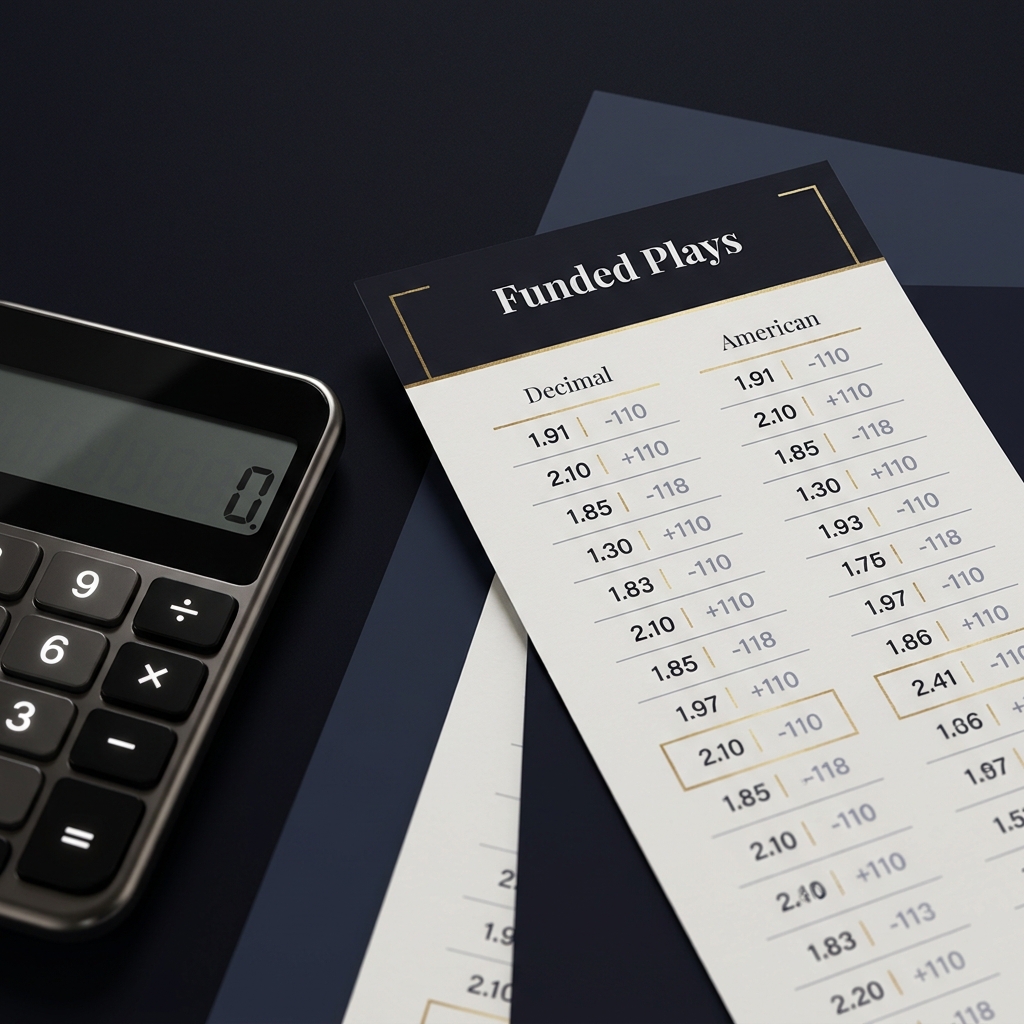
Model the two pieces separately. The settled portion returns the quoted cash amount. The continuing portion keeps the original odds on the remaining legs but uses a reduced stake, so compute its new potential return separately and add the settled portion to get total realized value.
Example one, single partial cash-out: you wager 10 units on a 3-leg parlay. The operator offers to cash out half the stake for 3 units. You accept, pocketing 3 units immediately. The remaining 5 units continue on the same three legs or, depending on operator mechanics, on only the unsettled legs at the same effective odds. Example two, later full cash-out: you can later cash the remainder at its then-current quote and sum the two settled amounts for total realized return Explanation of partial cash-out mechanics.
Voided legs, pushes and same-game correlations
When a parlay leg is voided or pushed, many house rules treat that leg as settled at odds 1.00 and recalculate the parlay using the remaining legs; this changes both fair-value calculations and any outstanding cash-out offers because the effective number of active legs decreases House rules on voids and pushes.
Same-game legs create correlation where independence no longer holds. Operators may internally restrict certain same-game combinations or apply internal correlation adjustments when pricing parlays and cash-outs, so your independence-based calculator can diverge from an operator quote when correlation is present.
Live markets, volatility and times when cash-out is unavailable
In-play legs move quickly as events unfold, producing rapid swings in implied probabilities and therefore in cash-out values; operators sometimes suspend cash-out during stoppages, reviews or brief market freezes to manage risk and liquidity Guidance on live cash-out dynamics.
Audit practice: if you need to validate a past cash-out, capture timestamps, market snapshots and the related odds at the moment of the offer because delayed screenshots or memory alone will not reliably reflect transient prices.
A step-by-step framework for a parlay cash out calculator
Inputs the calculator needs: list each leg's current odds (specify format), original stake, any legs already settled with their settled returns, indicator flags for voids or pushes, an operator margin or liquidity discount parameter if known, and a same-game correlation flag to warn when independence is dubious Odds conversion reference (and you can cross-check with a parlay tool such as DraftKings' parlay calculator).
Processing steps, numbered for clarity: 1) Normalize odds into decimal format. 2) Convert decimal odds to implied probability p = 1 / decimal. 3) Apply any known adjustments for pushes by setting pushed legs to probability 1.0. 4) If independence is assumed, multiply remaining leg probabilities to get combined probability. 5) Convert combined probability to fair decimal payout = 1 / combined probability and multiply by remaining stake to get theoretical return. 6) Apply an operator margin factor or liquidity discount to estimate a realistic cash-out quote. 7) For partial cash-out, split stake and process the cashed portion separately while recomputing the continuing portion. Each step should log intermediate values for auditing.

Special-case handling: if same-game correlation is flagged provide an alternative path that either asks for a correlation coefficient or warns the user that a simple independence model may be invalid. For voided legs implement the push logic and recalculate. For American odds include conversion routines that handle positive and negative values and keep a consistent rounding policy across steps.
Output and reporting: present both the no-margin fair payout and the adjusted operator-style cash-out estimate so auditors can see the breakdown of adjustments, and include a short explanation string for every adjustment applied so a reviewer understands why the final quote differs from the fair value Cash-out calculation notes from an exchange.
Worked examples: building a calculator and testing offers
Decimal-odds example, three-leg parlay: Leg A decimal 1.80, Leg B decimal 2.20, Leg C decimal 1.50. Convert to probabilities pA = 1 / 1.80 = 0.5556, pB = 1 / 2.20 = 0.4545, pC = 1 / 1.50 = 0.6667. Under independence combined probability = 0.5556 * 0.4545 * 0.6667 = 0.1684. Fair decimal odds = 1 / 0.1684 = 5.94. If your original stake is 10 units the fair expected payout is 59.4 units before margin.
Compare with a hypothetical operator cash-out: if the operator applies a 12 percent combined margin and a small liquidity discount, the platform might quote a cash-out equivalent to decimal 5.22, giving a quoted cash-out near 52.2 units for the same moments. The gap between 59.4 and 52.2 highlights embedded margin and discounts Overround and margin context.

American-odds and partial cash-out walkthrough: suppose you placed 20 units on a parlay with legs at American +120, -150, and +200. Convert American odds to decimals and then to probabilities, multiply to get combined probability and derive the fair payout. If an operator offers a partial cash-out on 10 units for an immediate amount, compute the cashed portion return separately and then compute the continuing 10-unit potential return using the same conversion steps. Sum both settled and unsettled expected values to get total realized exposure and compare that to the operator's quoted immediate plus potential remainder to find pricing differences Partial cash-out example reference.
When you test your calculator against live offers, record the market prices used for each leg and the timestamp of the operator quote. Differences larger than expected after applying a plausible margin suggest either correlation adjustments, different rounding rules, or liquidity pricing from the operator. How FundedPlays evaluations work
Common mistakes, auditing tips and best-practice checklist
Frequent modeling errors include: forgetting to remove or treat voided legs as pushes, mis-converting American odds, failing to include the bookmaker's overround, and assuming independence when correlation exists. These mistakes explain many apparent mismatches between a user's fair-value result and an operator quote Consumer guidance on common cash-out misunderstandings.
Audit checklist to validate a cash-out offer: 1) Capture timestamps and market snapshots. 2) Convert all odds to decimal and record conversion steps. 3) Treat pushes or voids explicitly and record them. 4) Compute no-margin fair payout and then apply a plausible overround or liquidity discount. 5) Check operator rules for same-game restrictions and rounding. 6) Log the final comparison and flag any unexplained gaps for further inquiry Overround reference for margin estimates.
Practical tip: when you see repeated small differences across many offers, treat them as the operator's normal pricing pattern; when you see large, inconsistent deviations gather more samples before concluding that a rule or error is present.
Closing thoughts on modeling fairness and operator pricing
Modeling a parlay cash-out is straightforward once you standardize conversions and logging, but the final offered amount will almost always differ from a no-margin fair payout because operators include margin, liquidity adjustments and sometimes correlation pricing. Use the step-by-step framework here to make those differences transparent and to produce a defensible audit trail when comparing quotes.
With consistent recording and conservative adjustments you can decide when a cash-out offer matches your risk tolerance and when it is wise to let the parlay run to completion. Funded Plays blogs
A parlay cash out is an early settlement option offered by operators; availability and price are not guaranteed and can be suspended during live events, so check the operator's rules.
Convert all odds to decimal, use p = 1 / decimal odds for each leg, then multiply probabilities under independence to get combined probability.
Operators embed overround, liquidity discounts and possible correlation adjustments, which typically reduce the quoted cash-out versus a no-margin fair value.
References
- https://betting.betfair.com/what-is-cash-out.html
- https://www.asa.org.uk/advice-online/gambling-cash-out-claims.html
- https://sportsbook.draftkings.com/help/rules
- https://www.pinnacle.com/en/betting-articles/educational/how-to-convert-odds-to-implied-probability/
- https://www.investopedia.com/parlay-bet-5217711
- https://www.actionnetwork.com/betting-calculators/parlay-calculator
- https://www.pinnacle.com/en/betting-articles/educational/what-is-overround-in-betting/
- https://www.fundedplays.com/challenges
- https://help.smarkets.com/hc/en-gb/articles/212582085-What-is-cash-out-and-how-is-it-calculated
- https://www.fundedplays.com
- https://sportsbook.draftkings.com/help/how-to-bet/parlay-calculator
- https://www.fundedplays.com/blogs/how-fundedplays-evaluations-work
- https://www.fundedplays.com/blogs