
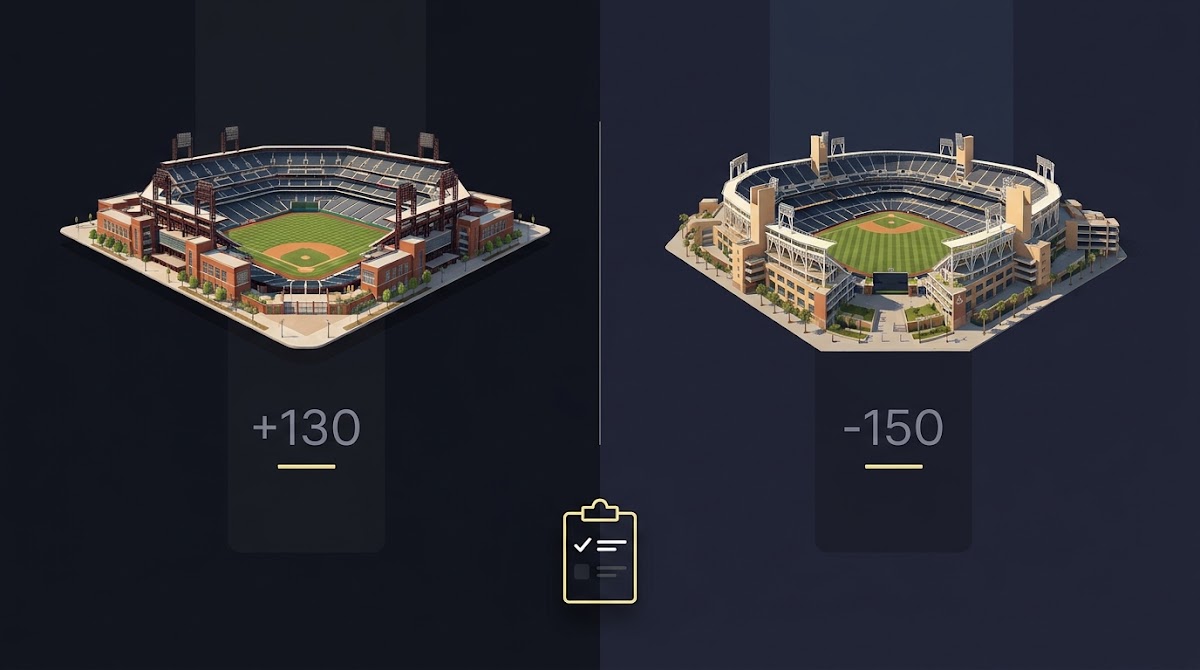
Quick verdict: padres phillies prediction, who the market favors now
Short answer
Short answer, the market favorite is the side showing negative American odds, and converting that moneyline to an implied win probability gives a clear sense of how strongly traders prefer one team; for example negative odds like -150 translate roughly to a 60 percent implied chance, which you can confirm in the moneyline primer linked here Investopedia moneyline guide.
What the moneyline says right now
Before acting on any padres phillies prediction you should verify the listed starters and any injury updates because the current board can shift sharply near game time; the authoritative day-to-day source for expected starters is the MLB probable pitchers listing and that page is where to confirm the matchup on game day MLB probable pitchers page.
Try FundedPlays Challenges to practice the checklist in a disciplined environment
Use the checklist below to confirm starters, check both teams injury pages, convert the posted moneyline to implied probability, and note any line movement before you lock a pick.
How to confirm the starting pitchers (use MLB's Probable Pitchers)
Where to check
Start with the MLB probable pitchers page each day to see the expected starters for both clubs; that listing is updated by the league and is the fastest authoritative place to confirm who the scheduled starters are for the Phillies and the Padres MLB probable pitchers page (you can also check CBS Sports probable pitchers for a secondary listing).
Timing and last-minute changes
Check the probable pitchers several times in the hours before first pitch, then cross-check local beat reports and official club communications; if a starter is scratched within a few hours of the game the matchup value can change substantially, so reconfirm within one hour of first pitch using the same MLB page as your baseline MLB probable pitchers page, and consider cross-checking aggregator listings like FantasyPros probable pitchers.
Quick workflow, in order: open the MLB probable pitchers page, note the listed starter for each team, search team social and press releases for confirmation, and recheck the MLB listing about 30 to 60 minutes before first pitch to catch any late scratches.
Check injury pages: Phillies and Padres status updates matter
Which statuses to watch
Use the official Philadelphia Phillies injuries page to confirm IL stints and day-to-day designations for players who could materially change the lineup or bullpen usage on game day Philadelphia Phillies Injuries.
How injuries change the edge
Also check the San Diego Padres injuries page for equivalent updates, because a late update on a middle-of-order hitter or a key reliever returning or leaving the game can shift the expected run environment and the implied advantage for either side San Diego Padres Injuries.
The market favorite is the side with negative American moneyline odds, which you should confirm against MLB probable pitchers and both teams official injury pages, then convert the price to an implied probability and check line movement before deciding.
Your quick cross-check sequence should be: team injury page, official team social or press release, then a final check of probable pitchers and the published lineup 30 to 60 minutes before first pitch. If any of those items are uncertain, treat your pregame analysis as provisional.
How to convert the moneyline to an implied win probability
The standard conversion formula
To quantify how the market leans, convert American moneyline odds into implied probability using the standard formulas for negative and positive lines; the method and rationale are explained in the moneyline primer and that resource is the reference for the conversion steps Investopedia moneyline guide.
Quick examples

For negative American odds the formula is: implied probability = -odds / (-odds + 100). For positive odds the formula is: implied probability = 100 / (odds + 100). As a worked example, a -150 moneyline becomes approximately 150 / (150 + 100) or about 60 percent implied probability; this gives a concise snapshot of how strongly the market favors the negative side, though it does not account for bookmaker margin.
Remember that implied probability is a comparative tool; it helps you translate a posted price into a single percentage you can compare across books and historical lines, but it omits the vigorish that keeps the bookmaker profitable, so use it as one input rather than a final prediction.
Track line movement: open vs current moneyline and what it signals
What line movement can indicate
Line movement is the change between the opening price and the current moneyline and it often reflects market reaction to news and bets rather than a change in the underlying probability; a clear primer on why lines move and what market action means is available and useful when you compare opening to current prices Action Network line movement guide.

Examples of news-driven moves
Common causes of movement include a confirmed starter change, a late injury to a key hitter or reliever, heavy public money on one side, or sharp action from professional bettors; when you see a rapid move shortly after a probable starter update it often reflects new information being priced into the board rather than a guarantee of outcome.
Compare the opening and current moneyline by recording both values, converting each into implied probability, and noting the absolute change in percentage points; a large swing in implied probability can justify a reassessment of the pick, but treat movement as signal, not certainty.
Historical context: Phillies vs Padres head-to-head records
What head-to-head tells you
Baseball-Reference maintains franchise head-to-head records for Phillies versus Padres and that data can provide historical context for narratives around matchups and pitcher history Baseball-Reference head-to-head (see related previews at Baseball-Reference previews).
Use and limits of historical records
Head-to-head records are most useful when they highlight durable matchup tendencies or long-term ballpark splits, but they must not override the immediate factors that decide a single game such as the confirmed starters, current injuries, and recent form. Look to recent season splits and home and away performance to refine any historical signal.
Matchup deep dive: analyzing the likely starters for a padres phillies prediction
Starter strengths and exploitable patterns
When the probable pitchers are posted, evaluate the starters by checking recent form, home and road splits, and any known matchup history; confirm the identity of the starter via the MLB probable pitchers page before you rely on those starter metrics MLB probable pitchers page.
quick starter comparison score based on three inputs
use as a quick filter
After you compute a starter score, layer in bullpen context by checking recent reliever workload and recent high-leverage usage; a starter who leaves early into a taxed bullpen can change the moneyline value, so evaluate both the projected starter and the likely relief bridge when the posted line is tight.

Assess bullpen depth by looking at recent appearances and days of rest for key relievers, and adjust your expectation for late innings accordingly; when a team has a thin bullpen and the game is likely to be close, that can make the moneyline less attractive for the team that would otherwise be favored by starter matchups.
Checklist for a quick matchup deep dive: confirm the starter on MLB probable pitchers, calculate a starter comparison score, check bullpen workload, review recent head-to-head or split data for the starter, and translate your confidence into an implied probability comparison with the posted moneyline.
Offense and lineup checks that affect a padres phillies prediction
Key hitters and platoon issues
Confirm the expected lineup and watch for missing middle-of-order hitters who materially reduce a team offensive projection, and check platoon splits because a lefty-righty imbalance can change how you value a given matchup.
Late scratches and lineup construction
Late scratches matter because a bench replacement or an extra lefty can change run expectancy and the manager's defensive and bullpen choices. Also consider ballpark characteristics and weather updates because they can amplify offensive or pitching advantages on certain days.
Decision criteria: a concise checklist to decide a Phillies vs Padres pick
Primary signals to act on
Prioritize confirmed starters and official injury updates before you factor in implied probability and line movement; if either starter is unconfirmed or a key player status is uncertain, wait for clarification rather than guessing, and convert the posted moneyline into implied probability to quantify the market lean Investopedia moneyline guide. See Funded Plays for related resources.
When to stand down
Example thresholds to guide action: if the favorite's implied probability is modest and a critical starter is unconfirmed, stand down; if the moneyline gap is small and late scratches create uncertainty, do not escalate stake. Use a stop rule: no pick when starter or key injury is unresolved within 60 minutes of first pitch.
Final checklist, ordered: confirm MLB probable pitchers, check both clubs injury pages, convert the moneyline to implied probability, compare opening and current boards for movement, then decide if your edge justifies action based on documented thresholds.
Common errors and pitfalls in padres phillies prediction workflow
Mistakes that bias judgment
A common error is over-relying on opening lines or all-time historical records without checking the confirmed starters and the up-to-date injury status; line movement alone is a market signal, not a predictive guarantee, and it should be interpreted in light of the underlying news that caused it Action Network line movement guide.
How to avoid last-minute traps
Avoid misreading line movement as predictive certainty; instead record the opening price, monitor news that could drive changes, and set a maximum stake based on confidence. Also document the rationale for each pick so you can review outcomes and learn over time. If you cannot verify a starter or a key injury, treat the selection as provisional and reduce your stake or stand aside.
Practical scenarios: two example pregame checks for padres phillies prediction
Scenario A: favorite confirmed starter
Scenario A, step by step: 1) confirm both starters on the MLB probable pitchers page, 2) convert the current moneyline into implied probability to measure market lean, 3) check both team injury pages for any missing lineup pieces or reliever issues, and 4) if the starters are confirmed and no late injuries appear, compare your estimated edge to the implied probability before deciding; start by confirming starters using the MLB page as your authoritative source MLB probable pitchers page.
Scenario B: late scratch and line move
Scenario B, step by step: 1) a last-minute scratch appears on a team injury page, 2) note any corresponding line movement on the board, 3) if the starter is unclear or the replacement significantly alters the matchup, apply the stop rule and wait for final confirmation, and 4) if the line moved sharply because the replacement is clearly inferior, recalculate implied probability and only act if the new price meets your documented thresholds; begin by checking the relevant team injury page for the official update Philadelphia Phillies Injuries.
For both scenarios record the steps you took and the time of each confirmation so you can learn which signals were helpful in future decisions.
Responsible notes and disclaimers for prediction-focused readers
No guarantees and performance variability
Implied probabilities and posted lines are probabilistic estimates, not guarantees of outcome; use official sources for confirmations and manage risk and stakes responsibly rather than treating any single game as a sure result Investopedia moneyline guide.
Sources and transparency
Rely on the official sources named above and document each pick and its justification so you can track performance over time. Remember that line movement reflects market reaction to news and bets rather than causal certainty, so keep records to separate noise from useful signals Action Network line movement guide.
Conclusion: quick pregame checklist to finalize a padres phillies prediction
Three-minute checklist
Three-minute checklist: confirm probable pitchers on MLB, check both team injury pages, convert the posted moneyline to implied probability, compare opening versus current line for movement, then decide according to your pre-set thresholds. If any critical item is uncertain within 60 minutes of first pitch, pause and wait for confirmation. See the Funded Plays blog for more workflow examples.
Where to learn more
To build long-term skill document every pregame check and outcome, review what signals were predictive, and refer back to the official sources named in this guide when you need authoritative confirmation. A disciplined, repeatable workflow is the best way to improve the quality of your padres phillies prediction process. For details on our approach, review how Funded Plays evaluations work.

Negative American odds indicate the market favorite; converting those odds to implied probability shows the market's estimated chance of a win.
MLB's probable pitchers page is the authoritative daily source for expected starters and should be checked close to game time.
Treat line movement as a market response to news or bets, not as a guarantee; investigate the cause and adjust your view only if it changes the underlying matchup.
References
- https://www.investopedia.com/terms/m/moneyline-bet.asp
- https://www.mlb.com/probable-pitchers
- https://www.cbssports.com/fantasy/baseball/probable-pitchers/
- https://www.fantasypros.com/mlb/probable-pitchers.php
- https://www.mlb.com/phillies/roster/injuries
- https://www.mlb.com/padres/roster/injuries
- https://www.actionnetwork.com/education/line-movement
- https://www.fundedplays.com/challenges
- https://www.baseball-reference.com/teams/PHI/head-to-head.shtml?team=SDP
- https://www.baseball-reference.com/previews/index.shtml
- https://www.fundedplays.com
- https://www.fundedplays.com/blogs
- https://www.fundedplays.com/blogs/how-fundedplays-evaluations-work