

What opening lines and closing lines are
Definitions: opening line, closing line, market price (Opening Lines vs Closing Lines)
Opening Lines vs Closing Lines describes a simple contrast: opening lines are the first broadly posted odds for an event, while closing lines are the last widely available odds just before the event starts. The opening line represents the market starting point, often set from initial information and early risk assumptions. The closing line is the consensus price after information and money have moved through the market, and it is commonly treated as the most efficient single-price benchmark for price accuracy and bettor performance, especially in mature, liquid markets Action Network guide.
Practice CLV tracking with one clear test
Track one bet using the workflow in this article to see how your execution compares to the market closing price; use a simple log and no-vig conversion steps to keep the comparison clean.
Think of the opening line as a starting offer and the closing line as the market s last agreed price. Between those two points the market absorbs new facts, shifts in who is wagering, and adjustments by bookmakers managing exposure. Calling the closing line a consensus recognizes that many separate forces converge into a single market price as kickoff approaches TheLines primer.
What moves lines: common causes of line movement
Information shocks: injuries, weather, lineup news
Line movement is fundamentally about new information. Injury reports, late weather forecasts, or announced lineup changes can create immediate reappraisals of an event s likely outcomes. When such news arrives, prices change because participants update their expected probabilities, and that information is often the clearest cause of a directional move in the line TheLines primer.
Liquidity and sharp action
Beyond news, the type and size of money moving the market matters. Sharp bettors and large, informed orders can push prices faster than many small retail wagers because they concentrate liquidity and signal stronger conviction. In many events a few well-timed, larger bets will move the price more than a steady stream of small public bets, particularly in markets with limited initial liquidity TheLines primer.
Book management: hold and risk balancing
Sportsbooks actively manage their books to balance exposure and protect their expected hold. When one side attracts a disproportionate amount of money, book managers will adjust prices to encourage the other side or to reduce potential loss, and those operational adjustments show up as line movement even when there is no single new piece of public information. This process is part of routine risk management and affects closing prices across events TheLines primer.
What closing line value (CLV) means and why it matters
Definition and intuition for CLV
Closing line value, or CLV, measures the gap between the price you secured on a wager and the market s closing price, typically expressed after converting both prices to no-vig implied probabilities. The core idea is simple: if you consistently get better prices than the market s final consensus, you have been executing at a market advantage, and that pattern is widely treated as a sign of skill in forecasting and execution Unabated CLV guide and OddsJam explanation.
Decide based on information timing and liquidity: bet early when you have specific, credible reason to expect moves toward your position; wait when uncertainty is high or when public-driven late money often inflates one side. Always log your reasoning so you can evaluate outcomes objectively.
Why consistent positive CLV signals skill
Practitioners emphasize that occasional wins above the closing line can happen by luck, but a repeated pattern of securing positive CLV over many bets suggests persistent informational or executional advantage. That relationship holds as a statistical tendency rather than a guarantee; consistent CLV is an informative metric for long-run evaluation, while short samples can mislead Action Network guide.
How to calculate CLV step by step
Remove the vig and convert odds to no-vig implied probabilities
Start by removing the sportsbook s vig so both your bet odds and the closing odds are expressed as fair, no-vig probabilities. The usual method sums the implied probabilities derived from posted odds, divides each implied probability by the sum to rescale them, and thus produces no-vig probabilities that are comparable across prices. This no-vig step is essential for apples-to-apples comparison and is a standard approach in practical guides to CLV and odds evaluation Unabated no-vig explanation.
quick CLV delta from your odds and the closing odds
difference in implied probabilities
After removing vig, convert both rescaled numbers into implied probabilities by taking the inverse of the decimal price. Those probabilities let you see whether your execution had positive edge relative to the final market price. Keep the calculations in a simple spreadsheet so you can reproduce them for every bet without manual error Unabated CLV guide.
Compute the edge and express as percentage or expected value
Once you have no-vig implied probabilities for your bet and the closing market, compute the difference to get the raw edge in probability terms. You can express that edge as a percentage of the closing probability or translate it into an expected value on your stake by multiplying the edge by your stake. Interpreting the result depends on sample size and variance, but this workflow provides a reproducible measure to track execution quality over time Unabated no-vig explanation.
Using CLV and line movement to shape betting timing decisions
When betting early can be advantageous
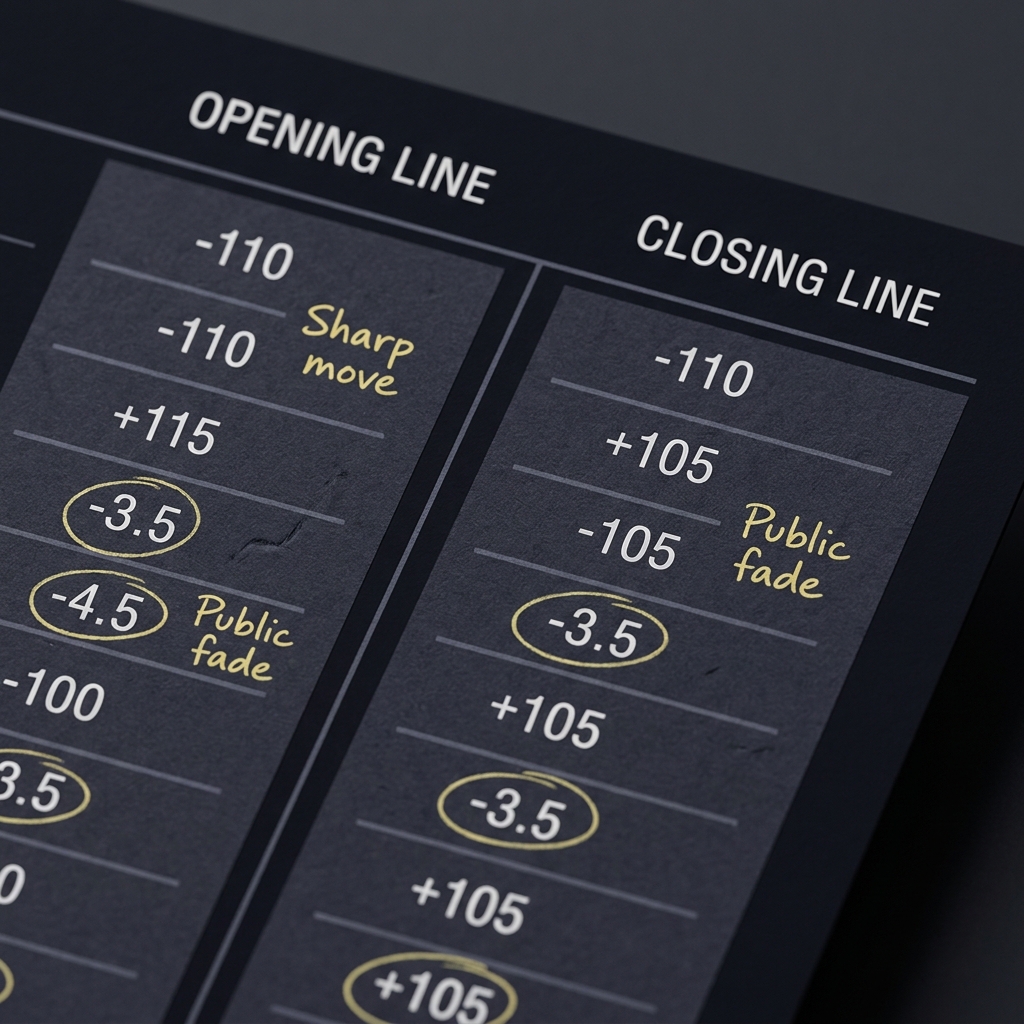
Betting early can be the correct choice when you expect incoming information to move prices toward your position. If you have reason to predict that a late update will favor your side, taking the opening or early line locks in a price before the market incorporates that information. The market often moves predictably after certain kinds of news, and early action can capture value if your forecast about the news or its impact is accurate TheLines primer.
When waiting for the closing line makes sense
Conversely, waiting for the closing line can be the better tactic when uncertainty about upcoming information is high or when public money often inflates one side near kickoff. In those situations the closing line s consensus may be the most reliable expression of available information, and securing a price closer to the close can reduce the risk of poor execution driven by noisy early prices SportsBettingDime guide and Action Network guide.
Practical rules of thumb
Use simple heuristics: if you are trading on specific, credible information that others do not yet have, act early; if you are relying on general public sentiment or there is likely to be heavy late public money, consider waiting. Monitor liquidity, the timing of scheduled news items, and whether early action is dominated by a small number of large wagers or many small retail bets. Those signals help you choose when the opening line offers true value and when the closing line is the safer reference point TheLines primer.

Common mistakes and pitfalls when tracking CLV
Ignoring vig or using inconsistent calculations
A frequent error is comparing posted odds directly without removing vig or using inconsistent methods across bets. That mistake produces misleading CLV numbers because the vig distorts implied probabilities. Standardizing the no-vig conversion and applying it uniformly is the basic hygiene of reliable CLV tracking Unabated no-vig explanation.
Reading small-sample CLV as proof of skill
Another common pitfall is treating a short run of positive CLV as definitive proof of skill. Variance can produce streaks that look meaningful but evaporate with more data. Practitioners caution that CLV is most informative as a long-run signal, and small samples should prompt revision, not celebration Unabated CLV guide.
Confusing public moves with sharp value
Late, public-driven moves can make an early execution look poor when the movement actually reflects a different information set or a change in public sentiment. Distinguishing between sharp-led moves and public-money runs helps prevent misreading CLV results and avoids unfairly blaming execution when the market simply incorporated a shift that did not reflect superior information TheLines primer.
Practical examples and scenarios to practice CLV checks
Example scenario: early bet before injury news
Imagine you place an early wager because you expect a late injury update to favor your side. If the late news indeed reduces the favored team s expected probability, the market will often move toward your position, giving your earlier bet positive CLV. The key is that your forecast about the upcoming information was explicit and documented in your log so you can evaluate whether the prediction was correct TheLines primer.
Example scenario: waiting through public money surge
In a different scenario you might hold off because a league-wide publicity event or market momentum could cause a wave of public stake on one side. By waiting you avoid getting caught at a temporarily inflated price and secure a price nearer the market s consensus, which can be better for execution quality when the late move is driven by public sentiment rather than new factual information Action Network guide.

How to log bets and compute portfolio CLV
Build a simple bet log that records posted odds when you placed the wager, the exact time of placement, the closing odds you will later use for comparison, and a note on why you acted early or waited. Include the no-vig method you used so future comparisons are consistent. Over time aggregate the per-bet edges into a portfolio CLV and treat that aggregate as the meaningful statistic for judging your execution Unabated CLV guide.
Summary and next steps for readers
Key takeaways
Opening lines and closing lines serve different roles: the opening line provides an initial market reference and the closing line reflects the market s consensus after information and money flow. For meaningful CLV analysis always remove vig so your comparisons are based on fair implied probabilities, and interpret CLV as a long-run indicator rather than a short-term guarantee Unabated CLV guide. Also see the blog for related posts on evaluation and process at our blog.

How to practice CLV tracking responsibly
Practical next steps are modest: set up a reproducible bet log, apply the no-vig conversion with care, and track CLV across a reasonable sample before drawing strong conclusions. Use the timing heuristics to test whether early or late execution better fits your information sources, and keep expectations realistic about variance and risk management Action Network guide.
Closing line value is the difference between the price you received and the market s final price, most cleanly measured after converting both prices to no-vig implied probabilities.
Yes. Removing the vig standardizes odds into fair implied probabilities and is essential for apples-to-apples CLV comparisons.
No. Consistent positive CLV is a strong long-run indicator of skill, but it does not guarantee profits in small samples or under different risk constraints.
References
- https://www.actionnetwork.com/education/closing-line-value
- https://www.thelines.com/betting/what-moves-betting-lines/
- https://unabated.com/articles/what-is-closing-line-value-clv/
- https://oddsjam.com/betting-education/closing-line-value
- https://www.pinnacleoddsdropper.com/blog/closing-line-value
- https://unabated.com/articles/how-to-calculate-no-vig-odds/
- https://www.sportsbettingdime.com/guides/betting-101/closing-line-value/
- https://www.fundedplays.com
- https://www.fundedplays.com/blogs/how-fundedplays-evaluations-work
- https://www.fundedplays.com/blogs
- https://www.fundedplays.com/challenges