

What OddsJam calculators are and who they serve
Overview of available calculators
OddsJam provides a set of math-focused utilities that many users run to check payouts, remove bookmaker margin, or size stakes; the main free tools listed on the site are the Parlay Calculator, the No-vig Fair Odds Calculator, and the Kelly Calculator, each implementing standard betting math as documented by OddsJam OddsJam parlay calculator.
These calculators are designed as utilities for analysis rather than prediction engines: they take odds or probabilities and return derived values such as estimated fair probability or a recommended stake fraction based on inputs.
Typical users include analytically minded sports fans who want quick checks on payout math, traders who benchmark prices across books, and disciplined bettors who pair probability models with stake-sizing rules to manage risk.
The tools suit both casual users seeking a fast parlay payout or modelers who need no-vig adjustments and Kelly sizing to test hypothetical edges, while acknowledging the limits of calculators when inputs are uncertain.
They can be worth it for frequent users who need automation, API access, or integrated workflows; casual users often get sufficient value from the free calculators. The decision should be based on frequency of use, the value of automation, and your commitment to validating outputs through testing and records.
The math behind the calculators: how they work in plain terms
No-vig / overround removal concept
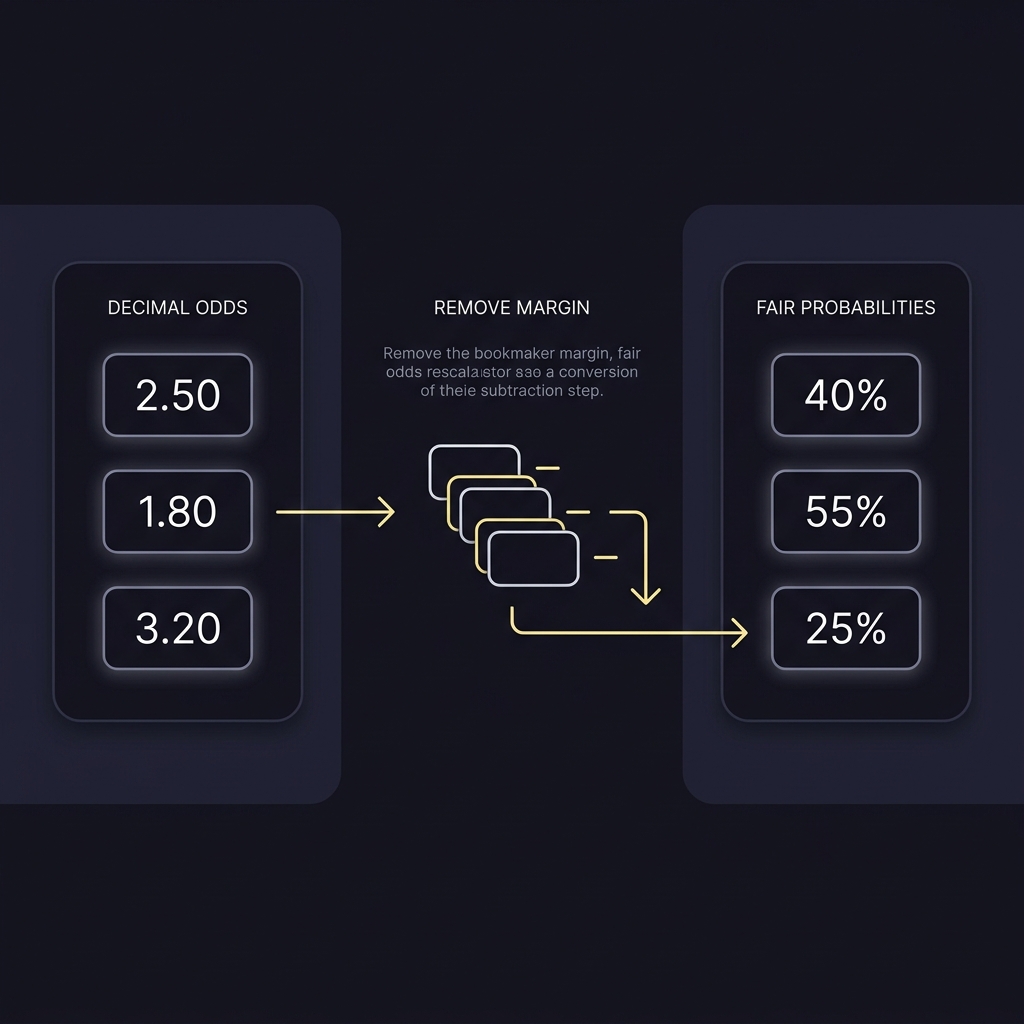
Bookmaker prices include a margin that inflates the sum of implied probabilities; removing that margin, often called overround removal or no-vig adjustment, rescales market odds into a set of 'fair' probabilities so you can compare them to your model outputs, following the same margin concepts explained by industry resources Pinnacle bookmaker margin methodology. See Unabated's no-vig calculator.
No-vig adjustment assumes the market-implied probabilities are the starting point and that the overround is the only distortion to correct; it does not change the underlying information content of the market and therefore only helps benchmark prices rather than creating new information.
Parlay payout math compounds the decimal odds for each leg, multiplying them to produce a single combined multiplier, then applies the stake to compute total return, which is the same rule the parlay calculator uses to produce payout estimates OddsJam parlay calculator.
Because multiplication amplifies both gains and mistakes, parlays can produce attractive headline payouts but carry higher variance and lower expected value if the underlying legs are not independently +EV relative to your true probabilities.
The Kelly Criterion computes a stake fraction that maximizes expected logarithmic growth of capital given a probability of success and odds; the formal description and formula are summarized in standard references on the topic Investopedia Kelly Criterion.
Kelly requires reasonably accurate edge and probability estimates, and because it optimizes for long-run growth rather than short-run stability it is sensitive to estimation error, which is why many practitioners use fractional Kelly rules to reduce risk.
No-Vig (fair odds) calculator: what it tells you and how to use it
When to run no-vig adjustments
Run a no-vig adjustment when you want to compare market prices to your model probabilities on an apples-to-apples basis; the no-vig calculator rescales market-implied probabilities after removing the bookmaker margin so your model and the market are expressed on the same probability scale OddsJam no-vig fair odds calculator. See BettorEdge no-vig calculator.
Using a no-vig output is a benchmarking step: it helps identify where the market price shifts because of built-in margin rather than reflecting a true informational difference.
Explore FundedPlays challenges to practice disciplined prediction workflows
Try the free no-vig calculator to see how market odds change once margin is removed; use it as a benchmarking step rather than proof of a reliable edge.
A small spread between the market price and the fair probability after vig removal does not by itself prove a bet is +EV because you must also consider stake sizing, variance, and your confidence in the model that produced the comparative probability OddsJam no-vig fair odds calculator.
In practice, a modest percentage difference can be meaningful for a disciplined staking plan if your edge estimate is repeatable and you size stakes conservatively; if the edge is uncertain, even a noticeable difference can be lost to variance or market movement.
Kelly calculator: how to size stakes and avoid common pitfalls
Full Kelly versus fractional Kelly
The Kelly result is a mathematically derived fraction of your bankroll that maximizes long-term expected logarithmic growth given the inputs; OddsJam exposes this calculation so users can see the theoretically optimal fraction from their supplied edge and odds OddsJam Kelly calculator.
Because Kelly assumes accurate edge estimates, many users prefer fractional Kelly, for example half-Kelly, which reduces volatility and the risk of large drawdowns when the edge estimate is noisy.
Why Kelly is sensitive to edge estimates
Kelly outputs scale directly with estimated edge, so overstating probability or ignoring correlations can inflate recommended stakes; this sensitivity is a core reason for conservative scaling and frequent re-evaluation of inputs, as standard discussions of Kelly emphasize Kelly Criterion description.
Practical steps to mitigate sensitivity include capping stake sizes, using fractional Kelly, and testing stake rules under backtests or small live runs before committing larger capital.
Parlay calculator: payouts, juice, and realistic expectations
How parlays compound payout
Parlay payout equals the product of the leg odds times the stake; the parlay calculator uses that same multiplicative rule to show total return estimates for a given stake and set of leg prices OddsJam parlay calculator.
Because legs multiply, adding more legs increases headline payout rapidly but also increases the probability that at least one leg fails, which raises variance and typically lowers expected value unless every leg embodies a true, independent edge.
Parlays can be reasonable for small discretionary wagers when a bettor values the potential upside or entertainment value, but relying on parlays as a primary strategy without accurate positive expectation and correlation checks tends to produce inconsistent results.
When legs are correlated, naive parlay math understates the true likelihood of loss; always consider correlation between legs and whether your model treats correlated outcomes appropriately.

Pricing and subscription tiers: what to expect from OddsJam
Free tools versus paid features
OddsJam offers free calculators alongside paid subscription tiers, and the provider documents specific plan inclusions and pricing on its pricing page, so users should review that page to see which features are gated behind each tier OddsJam pricing page.
Free tools often include the basic calculators while paid tiers typically add automation, alerts, or broader data access, but the exact bundle and pricing can change over time so don’t rely on a static price list.
Assess whether you need automation, frequent access, or data feeds that save time or remove manual steps; if a subscription cuts hours of work or unlocks API access you plan to use, it may justify its cost.
If your use is occasional, the free calculators may be sufficient; heavy users or those who need integrated workflows are likelier to benefit from paid tiers.
Workflows: integrating calculators into a disciplined betting or prediction process
Model -> benchmark -> stake sizing loop
A practical loop starts by generating or sourcing event probabilities from your model, running a no-vig adjustment to benchmark market prices, and using a Kelly-based size as a starting point for an explicit staking plan OddsJam no-vig fair odds calculator.
Combine those steps with a record-keeping habit that logs inputs, outputs, and results so you can review where probability estimates diverge from outcomes and adjust models or stakes accordingly OddsJam Kelly calculator.
Guide to follow a calculator-based workflow
Log inputs and outcomes
Track every calculated edge, the stake you placed, market movement after calculation, and the final outcome; consistent records let you detect persistent biases or mis-specified probabilities and improve your approach over time.
Schedule periodic reviews to compare model predictions to realized outcomes and to test whether your staking rule produced the expected growth or if adjustments are needed.
Decision criteria: when OddsJam calculators are worth paying for
Frequency and scale of use
If you run calculators multiple times per day or need programmatic access, a paid tier with automation or API access may save time and justify the subscription cost as a productivity expense OddsJam pricing page.
Casual users who only check a few bets per week often find the free calculators adequate because the core math is the same regardless of interface.
Ask whether the paid features materially change your workflow: does automation reduce manual errors, do alerts capture fleeting value opportunities, and does data access let you test strategies faster than manual methods?
If those capabilities lead to better decision hygiene and faster validation cycles, they are more likely to pay for themselves for serious users.
Common mistakes and pitfalls when relying on calculators
Overconfidence in model inputs
The most common error is treating calculator outputs as definitive when they are only as good as the inputs; overstated probabilities or unrecognized biases produce misleading stake recommendations and poor outcomes Kelly criterion guidance.
Maintain humility about model precision, build error margins into your staking decisions, and avoid making large, single-event bets based solely on point estimates.
Applying full Kelly with noisy probability estimates often increases risk of deep drawdowns; fractional Kelly reduces leverage and helps protect capital when edge estimates are uncertain OddsJam Kelly calculator.
Also watch for correlated bets, liquidity constraints, and market movement between calculation and execution, all of which can erode the theoretical advantage a calculator suggests.
Practical examples and scenarios: how calculator outputs map to decisions
Example 1: benchmarking a single-market value bet
In a typical benchmarking workflow you compare your model probability to the market-implied probability after removing vig; if your model consistently shows a higher probability and your staking plan is conservative, you may place a stake aligned to a fractional Kelly recommendation while logging the result and reasoning OddsJam no-vig fair odds calculator.
Remember that a few wins do not prove a model; repeated, well-documented results are needed to build confidence in any claimed advantage.
Example 2: sizing a stake with Kelly under uncertainty
Use the Kelly calculator to get a theoretical stake fraction, then scale down to a fractional Kelly level to account for estimation uncertainty; this converts an abstract optimal fraction into a risk-managed action that is easier to live with during adverse runs OddsJam Kelly calculator.
Combine fractional Kelly with diversification and strict record-keeping so you can observe whether your adjusted approach produces the expected growth over a statistically meaningful sample.
Testing and verifying calculator outputs against real results
Backtesting basics
Start by backtesting calculator outputs against historical markets: log market prices, compute no-vig fair odds, record your model probability and the Kelly stake you would have placed, and compare how that approach would have performed on past data OddsJam parlay calculator.

Backtests are only as good as their assumptions and the data quality, so keep tests simple, reproducible, and transparent about any data cleaning steps you apply.
Before scaling a staking plan, run small, controlled live tests to confirm that execution, timing, and market impact do not materially change expected outcomes, and keep detailed logs so you can trace discrepancies as they arise OddsJam no-vig fair odds calculator.
Small-sample variance will be large, so resist the temptation to alter the plan after a few results; use pre-defined review intervals to decide on adjustments.
How calculators fit into +EV strategies and their limits
Calculators as enablers, not guarantees
Calculators can help identify candidate +EV opportunities and provide disciplined sizing rules, but they do not create EV; execution, estimation accuracy, and disciplined risk controls determine whether theoretical edges translate into performance Kelly criterion guidance.
Always treat calculator output as a component of a broader strategy that includes bankroll rules, diversification, and explicit stop conditions to limit downside.
Complement calculator outputs with rules such as maximum stake caps, position limits, and diversification across uncorrelated markets to protect capital against model error and rare events Pinnacle margin methodology.
Such controls are especially important when your edge estimate is marginal or when market liquidity and execution speed can change the available price between calculation and bet placement.
Alternatives and complementary tools to consider
Why you might pair calculators with models or trackers
Calculators are most useful when fed reliable model probabilities and coupled with tracking tools that record inputs and outcomes; this combination turns isolated calculations into a learning process that improves estimates over time. See discussions of alternatives at BetHeroSports.
Complementary tools include probability-modeling packages, simple spreadsheets or trackers for outcomes, and historical data sources to improve calibration, all of which raise the signal quality that calculators depend on.
Conclusion: Is OddsJam worth the money?
Key takeaways
OddsJam publishes free calculators that implement standard betting math for parlay payouts, no-vig fair odds, and Kelly sizing, and it offers paid tiers that add features beyond the core free tools OddsJam parlay calculator.
Whether a subscription is worth it depends on how often you use the tools, whether automation or API access saves you time, and whether enhanced data or workflow features materially improve your validation and execution speed OddsJam pricing page.
A simple decision checklist
Check frequency of use, need for automation or data feeds, willingness to log and validate results, and your risk tolerance; if a paid tier meaningfully reduces manual work or enables programmatic validation, it may be worth the cost.
Remember that calculators do not guarantee profits and that outcomes depend on disciplined execution, quality of probability estimates, and market factors outside calculator control Kelly criterion guidance.

No. Calculators compute derived values from inputs; profits depend on input accuracy, execution, and discipline.
Full Kelly is theoretical and sensitive to estimation error; many practitioners use fractional Kelly to reduce risk.
No. No-vig adjusts for bookmaker margin to benchmark prices but does not prove a reliable edge by itself.
References
- https://oddsjam.com/calculator/parlay-calculator
- https://www.pinnacle.com/en/betting-articles/educational/how-to-calculate-bookmaker-margin/GLYJ2C2Y5ZBA63Q8
- https://unabated.com/betting-calculators/no-vig-fair-odds-calculator
- https://www.investopedia.com/terms/k/kellycriterion.asp
- https://oddsjam.com/calculator/no-vig-fair-odds-calculator
- https://www.bettoredge.com/novig-calculator
- https://www.fundedplays.com/challenges
- https://oddsjam.com/pricing
- https://oddsjam.com/calculator/kelly-calculator
- https://www.fundedplays.com/blogs
- https://www.fundedplays.com/blogs/how-fundedplays-evaluations-work
- https://www.fundedplays.com
- https://betherosports.com/blog/oddsjam-alternative