
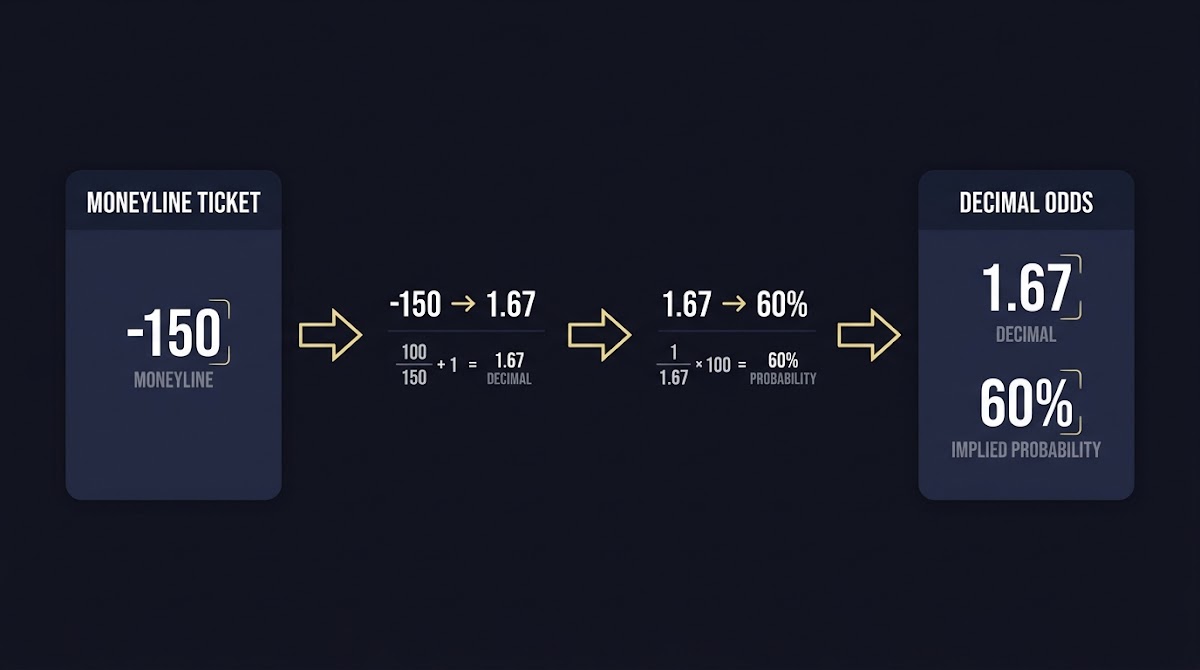
What American (moneyline) and decimal odds mean
American odds, often called moneyline odds, state how much profit you would win relative to a $100 reference stake and are standard in U.S. markets. Decimal odds show the total return per unit staked, including the original stake, which makes them convenient for quick conversion to implied probability; for a concise overview of these conventions see Wikipedia odds.
Put simply, a positive American line like +150 tells you how much profit a $100 bet would earn, while a negative line like -180 tells you how much you must risk to win $100. Decimal odds express the same outcome as a single number that multiplies your stake to return both stake and profit.
Check conversions for challenge entries or reports
Try converting one or two sample lines by hand to see how profit and stake relate before using a tool or spreadsheet for larger lists.
Because decimal prices include the stake, they are often easier to use when you need probabilities or to feed model inputs. If you want a quick conversion utility, using an odds to percentage calculator can speed verification and help when you compare U.S. books to international feeds.
Knowing both formats matters when you track markets, share numbers with international collaborators, or build analytics pipelines that assume one standard notation.
Why convert odds: practical reasons and when you need it
One reason to convert American odds to decimal odds is that decimal odds directly relate to implied probability through a simple inversion, which makes them easier to use in models and comparisons. For background on decimal odds and their relationship to probability, see Investopedia decimal odds.
Conversion also helps when comparing lines across jurisdictions. U.S. books use moneyline notation while many international sites and data feeds use decimal odds, so converting lets you compare prices, identify value, or aggregate markets consistently.
Analysts and reporting systems commonly accept decimal odds because a decimal is a direct multiplier for stake and returns, which simplifies calculations for expected value, portfolio exposure, and model inputs.
Finally, converting is practical for communication: if a dataset or a colleague uses decimal odds, converting ensures everyone reads the same numbers and avoids misinterpreting whether an odds number includes stake or not.
Step-by-step conversion formulas: positive and negative American lines
There are two simple formulas, one for positive American odds and one for negative lines. For a positive American odds value A (for example +150), the decimal odds equal 1 + (A / 100). For negative American odds A (for example -180), the decimal odds equal 1 + (100 / |A|). These are standard conversions; a good reference for the formulas and tools that use them is Pinnacle odds converter.
Worked example for a positive line: start with +150. Divide 150 by 100 to get 1.50, then add 1 to include the stake: decimal = 1 + (150 / 100) = 2.50. That means a $1 stake returns $2.50 total, $1.50 profit.
Use two simple formulas: for positive American odds A use decimal = 1 + (A/100); for negative American odds use decimal = 1 + (100/|A|). Convert decimal to implied percentage with p = 1/decimal and remember summed probabilities include bookmaker margin.
Worked example for a negative line: start with -180. Take the absolute value 180, divide 100 by 180 to get about 0.5556, then add 1: decimal = 1 + (100 / 180) = 1.5556. That means a $1 stake returns about $1.5556 total, approximately $0.5556 profit.
Keep these two one-line formulas handy when you convert manually. They make it quick to check a price or to code a conversion so that your analytics and reports use consistent decimal inputs.
From odds to implied probability: basic inversions
Implied probability from decimal odds, odds to percentage calculator
To convert decimal odds into an implied probability p, use the inversion p = 1 / decimal. This gives the probability as a fraction; multiply by 100 to express it as a percentage. The inversion is straightforward and useful when you want to read a price as a chance rather than a payout; see a clear definition at Investopedia implied probability.
Example: if decimal odds are 2.50, implied probability p = 1 / 2.50 = 0.40, or 40 percent. You can derive the same number from the original American positive line by converting to decimal first and then inverting.
Implied probability from American odds
You can compute implied probability directly from American odds without an intermediate decimal step. For positive American odds A, use p = 100 / (A + 100). For negative American odds A, use p = |A| / (|A| + 100). Both formulas reflect the $100 base used by moneyline notation and yield the same percentage you would get by converting to decimal and then inverting; these relationships are standard in explanations of moneyline math.
Example for a positive line: A = +150 gives p = 100 / (150 + 100) = 100 / 250 = 0.40 or 40 percent. Example for a negative line: A = -180 gives p = 180 / (180 + 100) = 180 / 280 ≈ 0.6429 or about 64.29 percent.
Accounting for bookmaker margin and overround
When you convert posted odds into implied probabilities and then sum the probabilities across outcomes in a market, the total usually exceeds 100 percent. That excess is the bookmaker margin, often called overround or vigorish, and it means the posted prices do not represent fair probabilities without adjustment; general background on odds and market margins is available at Wikipedia odds.

Conversions give you price-based implied probabilities, which are useful for comparing books or normalizing feeds, but analysts who want fair probabilities will remove the margin by proportional scaling or more advanced calibration methods. Any such adjustment is an analytic step beyond the basic conversion formulas and requires decisions about how to allocate the margin across outcomes.
For quick checks, converting odds and summing implied probabilities exposes how large the overround is in a market and whether different books are quoting materially different margins.
Common mistakes and how to avoid them
A top error is forgetting to add 1 when converting American odds to decimal. The decimal form includes the original stake, so omitting the +1 yields the profit-only number instead of the total return. A reliable way to avoid this is to treat decimal as 'total return per unit staked' and moneyline as 'profit or risk relative to $100'. For reference on standard conversions and common calculator behavior see Pinnacle odds converter.
Another frequent problem is sign handling: mixing up a positive sign on underdog lines with a negative sign on favorite lines will flip whether you divide 100 by the number or divide the number by 100. Write the conversion step explicitly when you do it by hand and test with a known example like +150 and -180.
Rounding can also cause mistakes in presentation. Keep decimal odds to at least four decimal places when you are doing intermediate calculations, then round final published decimals to two or three places to match the destination format. When you report implied percentages, show at least two decimal places for clarity on tight markets but avoid over-precision that implies spurious accuracy.
Quick manual calculator: step-by-step examples
Use these paired examples to practice converting by hand: for each American odds value, show the decimal conversion and the implied percentage, with each arithmetic step spelled out. The worked examples below follow the formulas given earlier and are designed so you can replicate each step without a calculator if you want to check logic.
Example set A, favorites and underdogs: 1) +150 -> decimal = 1 + (150 / 100) = 2.50 -> implied p = 1 / 2.50 = 0.40 -> 40.00 percent. 2) -180 -> decimal = 1 + (100 / 180) = 1.5556 -> implied p = 1 / 1.5556 ≈ 0.6429 -> 64.29 percent.
Convert American odds to decimal and compute implied probability
Enter American odds with sign
Example set B, mid-range and longshots: 1) +250 -> decimal = 1 + (250 / 100) = 3.50 -> implied p = 1 / 3.50 ≈ 0.2857 -> 28.57 percent. 2) -120 -> decimal = 1 + (100 / 120) = 1.8333 -> implied p = 1 / 1.8333 ≈ 0.5455 -> 54.55 percent. 3) +800 -> decimal = 1 + (800 / 100) = 9.00 -> implied p = 1 / 9.00 ≈ 0.1111 -> 11.11 percent.
Tip for formatting: present decimal odds with two or three decimal places for publication and implied percentages with two decimal places for clarity. Keep raw calculations in a separate column if you publish a table so readers can see both the rounded display and the precise input used for model calculations.
Batch conversions: spreadsheet formulas and quick automation
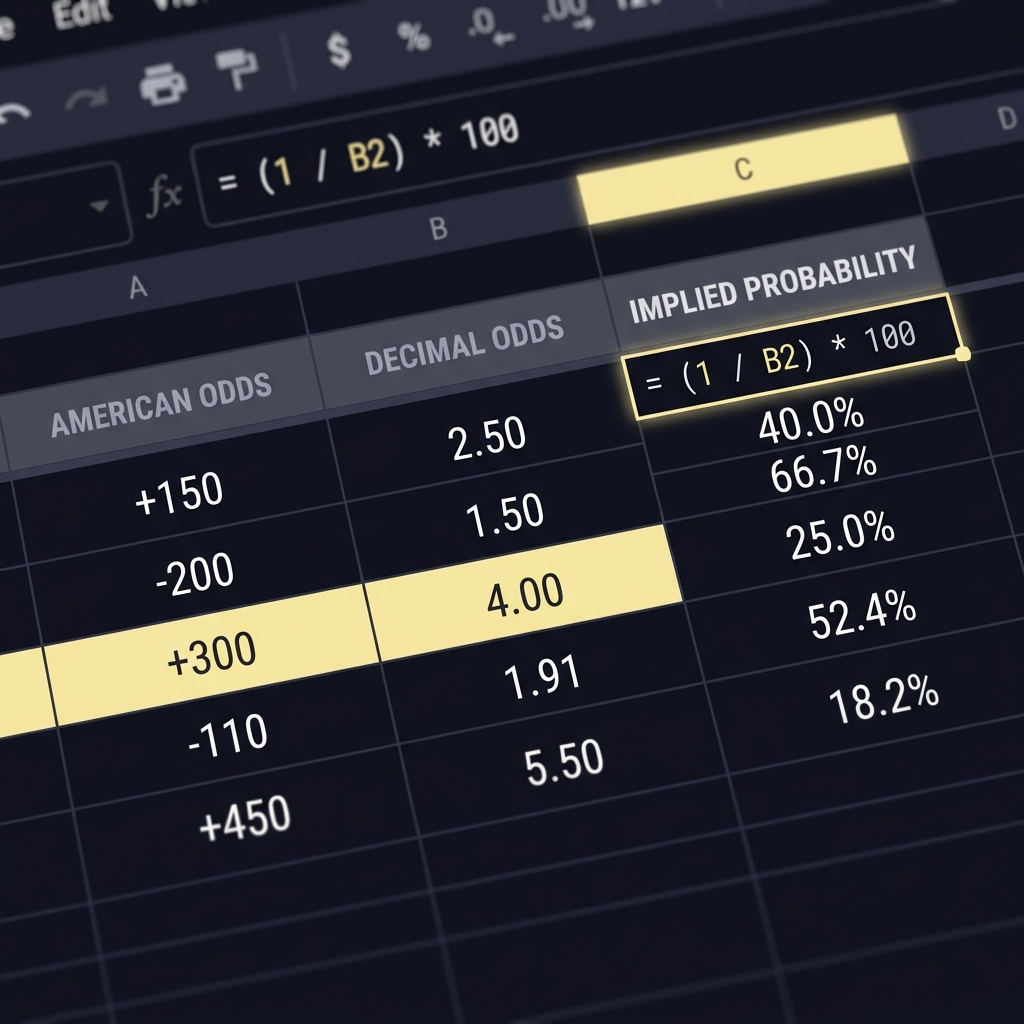
If you have a column of American odds in Excel or Google Sheets, use a single expression to compute decimal odds for both positive and negative values. A compact formula you can paste into a cell for Excel or Sheets is: =IF(A2>=0,1+(A2/100),1+(100/ABS(A2))). This approach matches the conversion formulas and scales across rows when you fill or array-copy the formula; common advice and examples for calculator and spreadsheet use are summarized by betting resource tools like the Pinnacle converter Pinnacle odds converter.
To generate implied probability in the next column you can then use =1 / B2 where B2 is the decimal odds cell and format the result as a percentage. For Google Sheets you can apply array formulas to compute a full column at once, e.g. =ARRAYFORMULA(IF(A2:A>=0,1+(A2:A/100),1+(100/ABS(A2:A)))) and then compute probabilities similarly.
Add data validation to prevent division by zero or invalid text inputs: check that the American odds cell is numeric and not zero before converting. A simple guard is IFERROR around the expression to return a blank or an error message for invalid entries.
When to prefer decimal odds vs American odds in analysis
Decimal odds are usually preferable for modeling and probability work because they are direct multipliers for expected return and invert cleanly to implied probability. That simplicity reduces conversion mistakes when you build models, simulate portfolios, or calculate expected value across many events; see definitions that explain why decimals are commonly used internationally at Wikipedia odds.
American odds are still useful for U.S. audiences and when communicating with bettors who expect moneyline notation. The important point is consistency: store model inputs in decimal to simplify math and convert to American only for presentation when your audience expects it.
For published reports that mix readers across regions, consider including both notations in a table or provide a short footnote with the conversion so readers can confirm how you computed probabilities or returns.
Use cases and platform scenarios (including skill-based prediction platforms)
Converting odds is common in workflows for prediction challenges, leaderboards, and performance tracking where users or administrators aggregate prices from multiple books and want uniform inputs for scoring or ranking. For example, organizers of skill-based prediction challenges may normalize incoming lines from different markets to decimal odds before computing leaderboard metrics.
Two short example workflows: 1) An analyst pulls U.S. moneyline feeds, converts the lines to decimal, computes implied probabilities, and stores them as decimal inputs for an evaluation model. 2) A challenge operator shows both decimal and American formats on a public leaderboard so participants from different regions can read numbers in their preferred notation.
Neutral mention: FundedPlays is a funded sports prediction platform where users complete structured challenges using virtual funded accounts; converting and normalizing odds is a typical preparatory step when comparing performance across markets or reporting results to participants.
Tools and calculators to double-check conversions
Online converters provided by established bookmakers and betting resources are convenient for quick verification. For a reliable converter that covers multiple formats and shows both decimal and implied probability outputs, see the Pinnacle odds converter Pinnacle odds converter or the Action Network betting odds calculator.
Calculators reduce transcription errors and are useful when you need to check a handful of conversions quickly, but you should still understand the underlying formulas so you can spot input convention issues such as whether a tool expects a sign or a percent input. See an implied probability calculator for another practical verification option.
When you automate conversions in spreadsheets or scripts, include unit tests or a small checklist of known examples to ensure the implementation matches manual conversions for sample cases like +150 and -180.

Advanced: converting percentages and decimals back to American odds
To convert decimal odds back into American format use these rules: if decimal >= 2 then American = (decimal - 1) * 100, which yields a positive moneyline; if decimal < 2 then American = -100 / (decimal - 1), which yields a negative moneyline. These formulas reverse the earlier conversions and are standard in conversion references such as betting tools and explainers.
Round-trip example: start with American +150 -> decimal 2.50 -> implied p = 1 / 2.50 = 0.40. Now convert decimal back: (2.50 - 1) * 100 = 150, which recovers the original +150. For a favorite: start with -180 -> decimal ≈ 1.5556 -> implied p ≈ 0.6429 -> converting back: -100 / (1.5556 - 1) ≈ -180, returning to the original moneyline.
Beware edge cases: probabilities very close to 0 or 1 produce extreme decimals or very large American numbers; validate inputs and guard against division by numbers near zero.
Checklist: quick reference of formulas and steps
Core one-line formulas: Positive American A -> decimal = 1 + (A / 100). Negative American A -> decimal = 1 + (100 / |A|). Decimal -> implied probability = 1 / decimal. Decimal >= 2 -> American = (decimal - 1) * 100. Decimal < 2 -> American = -100 / (decimal - 1).
Verification steps: 1) Convert a known pair (+150 and -180) end-to-end to ensure code or spreadsheet matches manual arithmetic. 2) Sum implied probabilities in a market to estimate overround; if the sum exceeds 100 percent, the difference approximates the bookmaker margin.
Reminder: conversions produce price-based implied probabilities. To estimate fair probabilities, analysts remove the margin using a chosen adjustment method, but that is a separate analytic decision beyond the arithmetic in this guide.
Summary and next steps
Converting American odds to decimal odds is a straightforward two-formula process: add 1 to the scaled positive case or add 1 to the reciprocal scaled negative case. From decimal you can get implied percentage with a simple inversion. The formulas and examples in this guide are consistent with established resources and online converters such as Pinnacle and general odd explainers like Wikipedia.
Next steps: practice with the worked examples, add the spreadsheet formulas to your workflow, and use a trusted online converter to validate results when you first automate. Keep an eye on overround when you interpret summed probabilities and be clear whether you are showing price-based or fairized probabilities in reports.
Use the one-line formulas: for positive A use 1 + (A/100); for negative A use 1 + (100/|A|). Then invert decimal with 1/decimal to get implied percentage.
No. Summed implied probabilities usually exceed 100 percent because of the bookmaker margin, so they reflect posted prices not fair probabilities.
Yes. Use a single IF formula such as =IF(A2>=0,1+(A2/100),1+(100/ABS(A2))) and then compute probability with =1/B2.
References
- https://en.wikipedia.org/wiki/Odds
- https://www.investopedia.com/terms/d/decimal-odds.asp
- https://www.aceodds.com/bet-calculator/odds-converter.html
- https://www.pinnacle.com/en/betting-resources/betting-tools/odds-converter
- https://www.investopedia.com/terms/i/implied-probability.asp
- https://www.fundedplays.com/challenges
- https://www.fundedplays.com
- https://www.fundedplays.com/blogs
- https://www.fundedplays.com/blogs/how-fundedplays-evaluations-work
- https://www.actionnetwork.com/betting-calculators/betting-odds-calculator
- https://oddsjam.com/betting-calculators/implied-probability