
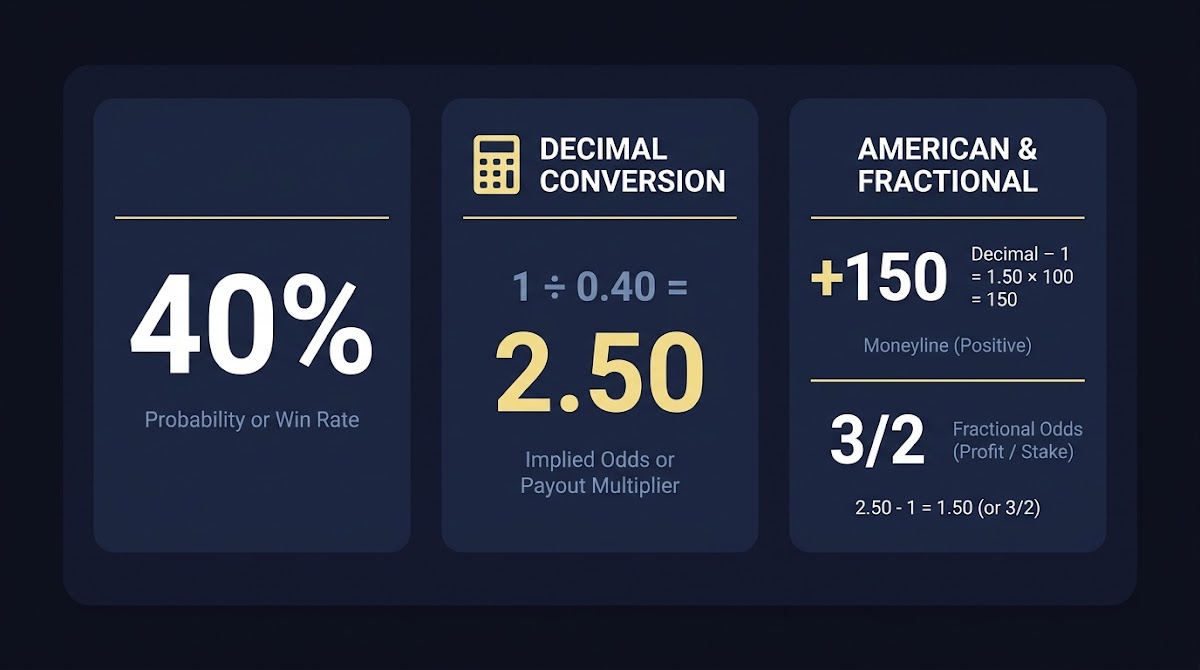
What does a 40% implied probability mean?
When you estimate a 40% chance for an event, you have an implied probability that can be expressed as a percentage or converted into odds to compare with market prices. Using an odds to percentage calculator can make that conversion immediate and consistent with standard formulas used across odds formats.
Convert percent to decimal with decimal = 1 / p, then derive American and fractional from that decimal; for 40% this yields decimal 2.50, American +150, fractional 3/2.
Implied probability is simply the chance of an outcome expressed as a share of one. Converting that percentage into a betting format helps you compare your view to posted odds and spot potential value, and the basic conversion identity is consistent and widely used in betting education sources Implied Probability: Definition, Formula, and Uses.
Core formulas: converting percentage to decimal, American, and fractional odds
The cleanest starting point is decimal odds, because implied probability equals the inverse of decimal odds, p = 1 / decimal, so decimal = 1 / p. This identity means you can convert any probability into decimal odds directly and then move between formats.

For American (moneyline) odds, there are two formulas depending on sign. For positive moneylines A, implied probability is p = 100 / (A + 100). For negative moneylines -A, use p = A / (A + 100) with A as the absolute value. The same conversion logic is explained in standard moneyline references Moneyline (American Odds): Definition, Examples, and Payouts.
Fractional odds a/b imply probability p = b / (a + b). Fractional format is a simple ratio that maps directly to implied probability and is commonly described in betting guides; you can derive fractional odds from decimal by taking decimal - 1 = a/b and simplifying the fraction as needed Fractional Odds Definition and Examples.
Worked example: converting 40% into decimal, American and fractional odds
Start with the estimate p = 0.40. Decimal odds are the inverse of probability, so decimal = 1 / 0.40 = 2.50. This is the straightforward algebraic step that links a percentage to decimal odds Decimal Odds Definition and Examples.
To get American odds from the decimal, note that when decimal is greater than 2.00 the moneyline is positive and can be computed as 100 * (decimal - 1). For decimal 2.50 this gives 100 * (2.50 - 1) = +150. That formula aligns with standard moneyline-to-probability identities How to convert betting odds to implied probability.
For fractional odds, subtract 1 from decimal to obtain the fractional ratio: 2.50 - 1 = 1.5, which expressed as a ratio is 3/2. The fractional identity p = b / (a + b) is the inverse statement of this conversion and yields the same result for a 40% chance Fractional Odds Definition and Examples.
Quick summary for 40%: percent 40% equals decimal 2.50, American +150, fractional 3/2. Each representation is equivalent when you ignore bookmaker margin and use the standard formulas.

How bookmaker margin (overround) changes market odds
Fair odds derived from a raw percentage assume no house margin. In real markets bookmakers add a margin so the sum of implied probabilities for all mutually exclusive outcomes usually exceeds 100%, a concept known as the overround. That phenomenon explains why market odds are often shorter than your converted fair odds Overround.
Because the overround inflates implied probabilities, you should not treat a fair conversion as a direct betting recommendation. Instead, compare your fair decimal or moneyline to the market quote and check how much margin the market includes before deciding whether there is value; the same caution is noted in betting education resources How to convert betting odds to implied probability.
Tools and calculators: when to use an odds to percentage calculator and how to read its output
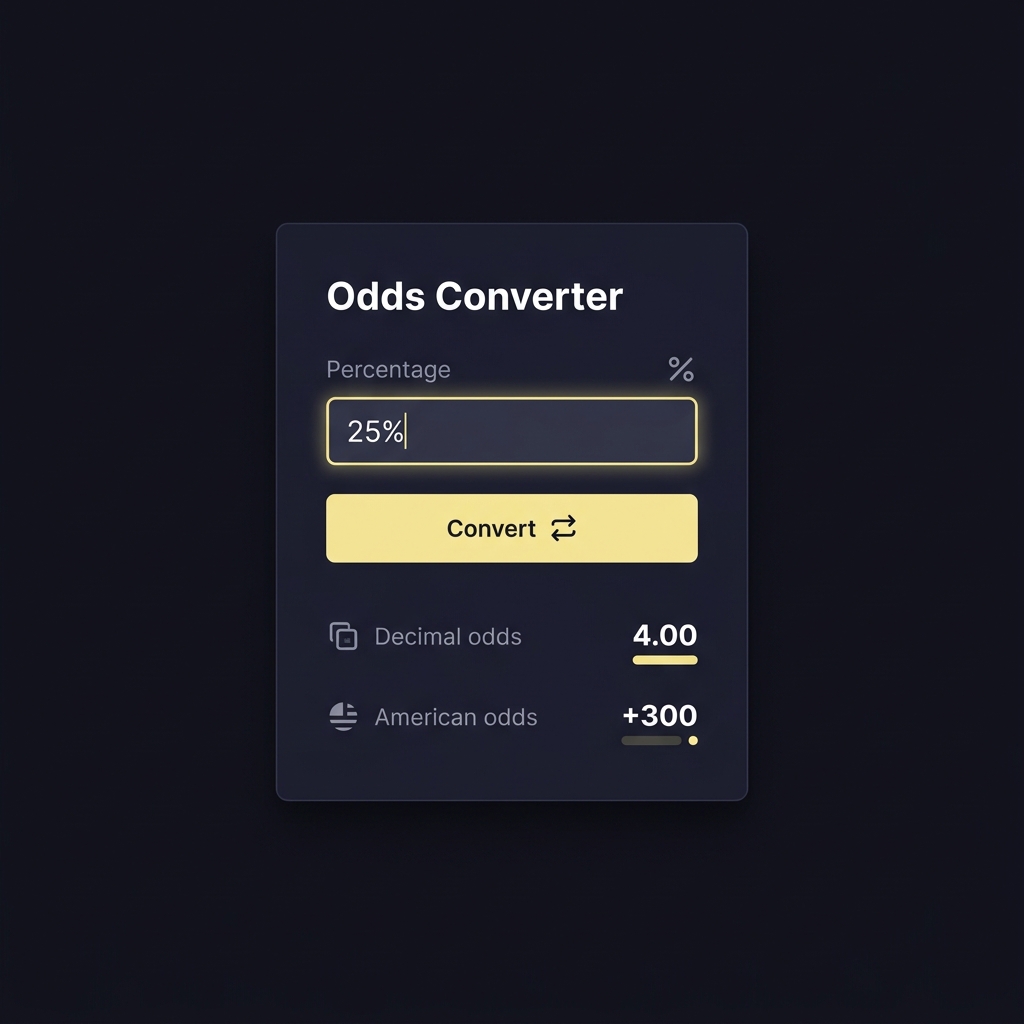
An odds to percentage calculator accepts either an implied probability or a quoted odd and returns the common formats: decimal, American and fractional, plus the implied probability. A reliable tool makes the input format explicit (percent as 40 or 0.40) and usually shows whether results include or exclude bookmaker margin. See general calculators such as betting odds calculator for examples.
Typical features include batch conversion, toggles for vig adjustment, and an explicit display of implied probability so you can see how the algebra is applied. Calculators apply the formulas from earlier, so a decimal output should always match decimal = 1 / p when the tool is set to fair odds Decimal Odds Definition and Examples.
check calculator inputs and vig setting
Verify one manual decimal check
When you use a calculator, verify one result manually by applying decimal = 1 / p to ensure the tool is not silently applying a margin. If the calculator offers a vig adjustment, check whether the adjusted decimals match your expectation for market odds, and keep a small provenance note with each exported batch about whether vig was included.
Decision criteria: when a converted percentage suggests positive expected value
Expected value is present when your fair odds are longer than market odds after adjusting for the house margin. Practically, convert your percent to fair decimal, convert market prices to implied probability and back to a margin-adjusted fair decimal, then compare the two decimals to estimate edge Overround.
A simple way to estimate house margin is to sum the market implied probabilities for all outcomes and divide that sum by 1 to get the overround; the excess above 100% is the bookmaker margin you should account for. When the adjusted market decimal remains shorter than your fair decimal by a meaningful gap, you may have positive expected value, all else equal How to convert betting odds to implied probability.
Common mistakes when converting percentages to odds
A frequent error is using fair odds from a percentage as a direct bet signal while ignoring vig. That mistake treats the algebraic conversion as if it were a market quote and can misstate value. Always check whether the market includes a margin and adjust comparisons accordingly Overround.
Another common issue is mixing American formulas: using the positive-moneyline formula for a negative moneyline or vice versa produces incorrect implied probabilities. Double-check whether a moneyline is shown with a plus or minus sign and apply the correct identity as outlined in moneyline references Moneyline (American Odds): Definition, Examples, and Payouts.
Rounding and display quirks can matter for tight edge estimates. Fractional odds simplify decimals into ratios that may appear rounded; where precision matters, keep a decimal check to avoid misreading a 1.49 versus a 1.50 conversion.
Practical examples: 40% across different sports and markets
Imagine you estimate a single-match win probability at 40% and convert it to decimal 2.50. In a two-outcome market like a head-to-head bet, the bookmaker margin is often smaller than in multi-outcome markets, so the market decimal may be closer to your fair decimal. That difference is why the same 40% can appear as a closer or wider price depending on market structure Overround.

Player props and niche markets often carry larger vig or wider spreads because they attract specialized risk management; a 40% fair conversion may therefore be more difficult to back at a market price that offers edge. Checking market depth and typical overround for that prop helps set realistic expectations How to convert betting odds to implied probability.
Step-by-step walkthrough: using a calculator to convert a batch of percentages
When you have many probabilities to convert, prepare a single-column input file with percentages in a consistent format. Some tools expect 40 while others accept 0.40, so note which format each calculator requires and use that consistently across your batch.
Run the batch and export results to a CSV that lists the original percent, fair decimal, American, fractional, and a column noting whether vig was applied. To validate, pick one row and compute decimal = 1 / p manually to ensure the tool produced the expected fair decimal Decimal Odds Definition and Examples.
Quick validation checklist: confirm input format, compare one manual decimal conversion, verify American sign conventions, and record whether vig was included. Keeping that provenance makes it easier to audit model outputs later.
How to present conversions in reporting and model output
Label outputs clearly. Use tags such as 'fair decimal' for conversions that ignore vig and 'market decimal' for prices taken from bookmakers. That clarity prevents readers from confusing algebraic conversions with posted odds.
Show margin-adjusted and fair odds side by side and include a short uncertainty note when probabilities derive from models rather than objective frequencies. A single line like 'Model estimate: 40% (±5 percentage points)' helps readers interpret how precise the conversion needs to be for decision-making.
Summary and practical checklist
Key takeaways: converting 40% yields decimal 2.50, American +150, fractional 3/2 when margin is ignored, the algebraic identities are stable, and market odds typically include a bookmaker margin you must account for How to convert betting odds to implied probability.
Quick checklist before acting on a conversion: verify input format, compute decimal = 1 / p for a manual check, compare fair decimal to market decimal, estimate house margin and then decide on edge. Keep records of whether your comparisons included vig.
Practice conversions with disciplined checks
Try converting a few probabilities with the checks above and review any differences between fair and market odds before acting; treat conversions as tools to inform disciplined decisions.
Further questions readers often ask
Some readers ask whether conversions vary by jurisdiction. The math does not change across regions because these formats are conventions, but market practices and available prices can vary, so check local offers and rules.
No conversion or tool guarantees profit. Use conversions to spot potential value, but decisions still depend on your estimate quality, staking plan and adherence to platform rules, such as those on structured challenge platforms.
Divide 1 by the probability expressed as a decimal, for example decimal = 1 / 0.40 = 2.50.
Bookmakers add a margin called overround, so posted odds typically imply higher summed probabilities than fair conversions.
Some calculators offer a vig adjustment option; always verify whether results include margin and validate one conversion manually.
References
- https://www.investopedia.com/terms/i/implied-probability.asp
- https://www.investopedia.com/terms/m/moneyline.asp
- https://www.investopedia.com/terms/f/fractional-odds.asp
- https://www.investopedia.com/terms/d/decimal-odds.asp
- https://www.pinnacle.com/en/betting-articles/education/convert-odds-to-probability/
- https://en.wikipedia.org/wiki/Overround
- https://www.fundedplays.com/challenges
- https://therundown.io/betting-calculators/odds-converter-calculator
- https://www.actionnetwork.com/betting-calculators/betting-odds-calculator
- https://www.aceodds.com/bet-calculator/odds-converter.html
- https://www.fundedplays.com
- https://www.fundedplays.com/blogs
- https://www.fundedplays.com/blogs/how-fundedplays-evaluations-work