
What a 20 percent probability means in plain terms
A 20 percent probability means one chance in five and can be written as the decimal probability 0.20. For readers using tools, an odds to percentage calculator can confirm that 20% is a 0.20 probability and show equivalent odds in different formats.
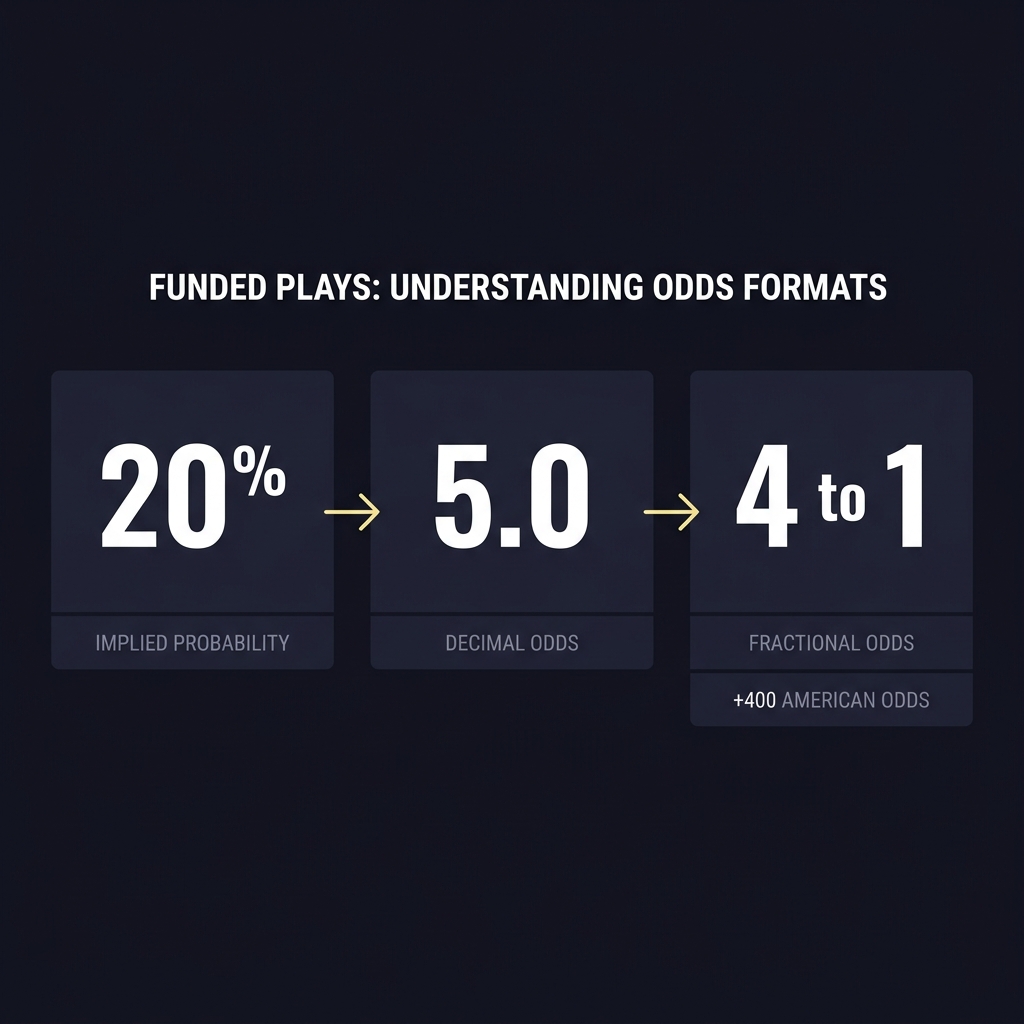
Under fair, no-margin assumptions, a 20% probability is decimal 5.0, fractional 4/1, and American moneyline +400; use the formulas decimal = 100 / percent, fractional = (100 - percent) / percent, and moneyline = +((100/percent) - 100) for percent at or below 50.
Stating 20% as odds simply changes how you read the same chance. In fair, no-margin terms, 20% corresponds to decimal odds 5.0, fractional 4/1, and American moneyline +400, which are different displays of the same implied probability Investopedia implied probability.
Core conversion formulas you can rely on
Use the probability p as a number between 0 and 1 or as a percent P between 0 and 100. The compact formulas are: decimal = 1 / p, or when p is a percent decimal = 100 / P. Fractional odds use fractional = (1 - p) / p, or fractional = (100 - P) / P when P is a percent. These identities are standard and stable in 2026 Decimal odds reference.
For American moneyline odds, for positive A the implied probability is 100 / (A + 100) and for negative A it is -A / (-A + 100). The practical inverse for probabilities at or below 50 percent is A = 100 * (1 / p - 1), which produces positive moneyline signs for underdogs in fair conversions Implied probability formulas.
Step-by-step: converting 20% into decimal, fractional and moneyline odds
Step 1, decimal: start with P = 20. Decimal = 100 / P = 100 / 20 = 5.0, which matches 1 / 0.20. This tells you the total return for each unit staked on a fair price.
Step 2, fractional: fractional = (100 - P) / P = 80 / 20, which reduces to 4 / 1. Read as four units returned plus the original stake for each one unit staked at fair odds. The reduction from 80/20 to 4/1 is a simple greatest common divisor division.
Step 3, moneyline: since P = 20 is at or below 50, use moneyline = +((100 / P) - 100) = +((100 / 20) - 100) = +400. This is the positive American price that corresponds to a one-in-five fair chance. Note that these are fair conversions without bookmaker margin Odds explanation.
Try the conversions yourself
Try these three short calculations yourself: divide 100 by the percent for decimal, form (100 - percent) over percent for fractional, and compute +((100/percent) - 100) for a fair moneyline.
How to use an odds to percentage calculator and avoid common input mistakes
Most converters accept percent (20 or 20%), decimal odds (5.0), fractional odds (4/1), and American moneyline (+400) as inputs and will show the equivalent formats. A reliable odds to percentage calculator will handle either percent or probability input but watch how you enter the number, because 20 and 0.20 mean different things to the tool, for example try Action Network's odds calculator Pinnacle odds converter.
Common input errors include entering 20 when the tool expects a decimal probability of 0.20 or typing a fractional odds string in a field that only accepts numeric fractions. If results look off, cross-check with the basic formulas above or a known converter to validate the output Quick validation method.
Regional formats: where decimal, fractional and American odds are used
Decimal odds are common across continental Europe, Australia, and many international platforms; fractional odds are traditional in the United Kingdom and Ireland; American moneyline odds are the default format in the United States. The formats are regional conventions, not different probabilities, and they are mathematically equivalent when fair conversions are used Odds regional usage.

Platform interfaces will usually let you switch display formats on Funded Plays. When you see a price displayed differently across sites, you can convert it back to implied probability to check whether two displays represent the same underlying chance.
How bookmaker margin and overround change implied percentages
An overround is the sum of implied probabilities across all outcomes in a market and often exceeds 100 percent because bookmakers include a margin or vig. That margin is why live market prices usually differ from the clean conversions you get with the basic formulas Overround explained.
To detect vig in a simple market, convert each quoted price to its implied probability, sum those probabilities, and compare the total to 100 percent. A total above 100 percent indicates the market contains margin; the excess proportion gives a rough sense of how much vig the book included Implied probability check.
When to use fair conversions versus market odds
Use fair conversions, the direct 100 / percent and (100 - percent) / percent formulas, for teaching, simulations, and analytic models where you want a clean link between probability and payout. Fair conversions are the right choice for academics, classroom work, and controlled backtests where vig would cloud the relationship between probability and price Decimal odds guidance.
Market odds are the correct reference when you are placing wagers, estimating market expectations, or hunting for value. Live prices include vig and can show where the market disagrees with your assessed probability; use those live numbers when you need to measure real-world expected value Market vig note.
Verify percent to odds conversions quickly
Save the tool link for fast checks
Common mistakes and troubleshooting when converting percentages to odds
Rounding can hide small differences. For example, decimal odds that are shown as 5.0 may actually be 5.003 after rounding; recomputing implied probability from the displayed decimal and comparing it to the original percent will reveal the gap Converter sanity check.
Fractional odds are often misread: 4/1 describes a four-to-one payout and does not mean four percent. Moneyline signs indicate favorite or underdog - positive for underdogs, negative for favorites - and mixing the sign convention up will invert your implied probability. Quick fixes are to convert back to decimal and then to percent to confirm Implied probability reconversion.
Practical scenarios: forecasting, simulations and funded challenge platforms
In forecasting workflows, a 20 percent implied probability can be used as an input to Monte Carlo simulations or payout modeling; using the fair decimal 5.0 makes payoff math straightforward for simulated bankrolls. When you simulate outcomes, be explicit whether you use fair conversions or sampled market prices, as that choice changes expected returns in the model OddsJam implied probability tool Simulation note.
Funded-style prediction challenges run on simulated bankrolls and structured rules to assess consistency and skill without real-money wagering. When documenting a forecasting strategy or an evaluation submission, note if you used fair conversions like the 20% to 5.0 mapping or live market odds so reviewers can reproduce your work, see how Funded Plays evaluations work.
Quick conversion cheatsheet: formulas to memorize
Decimal: decimal = 100 / percent. Fractional: fractional = (100 - percent) / percent and then reduce the ratio. Moneyline (percent at or below 50): moneyline = +((100 / percent) - 100). These one-line formulas let you convert mentally or check a calculator quickly Core formulas.
To reduce a fractional ratio, divide numerator and denominator by their greatest common divisor. For 80/20, both divide by 20 to yield 4/1. Keep a short list of common percent-to-odds pairs you use frequently to speed checks.
How to verify conversions with online tools and manual cross-checks
Check with a reputable odds converter to confirm your math, then run two manual checks: implied probability = 1 / decimal and the moneyline-to-percent inverse for American odds. These quick cross-checks catch input format errors or tools that inject margin by default Use a known odds converter or try AceOdds.

Watch for converters that state an option to include bookmaker margin or to show fair odds. If a tool includes margin automatically, results will differ from the simple 100 / percent approach, so toggle settings or use the manual formulas to compare Manual inverse check.
Implications for strategy and simple bankroll considerations
A fair +400 price indicates a one-in-five chance. Expected value reasoning requires you to pair that implied probability with your independent estimate of outcome probability; if your assessed chance exceeds 20 percent, the fair +400 implies a positive expectation before considering vig EV context.
Market vig reduces theoretical edge. When building staking rules or tracking performance, note whether you used fair comparisons or market prices; this transparency helps you judge whether a strategy performed due to skill or because it benefited from specific market margins Vig impact.
Worked practice problems: quick conversions to try
Problem 1: Convert 20% to decimal, fractional, and moneyline. Answer: decimal 5.0, fractional 4/1, moneyline +400. Verify by converting decimal 5.0 back to implied probability 1 / 5.0 = 0.20.

Problem 2: Convert 33.33% to odds. Answer: decimal = 100 / 33.33 ~ 3.000, fractional about 2/1 after reduction, moneyline ~ +200. Check by computing 1 / decimal to confirm the percent.
Problem 3: Convert 5% to odds. Answer: decimal = 20.0, fractional = 19/1, moneyline = +1900. Recompute implied probability from the moneyline or decimal to confirm the original percent.
Summary: the quick takeaway and next steps
Core fact to remember: 20% is one-in-five, which converts to decimal 5.0, fractional 4/1, and moneyline +400 when you assume fair odds without bookmaker margin. Use the one-line formulas for rapid conversion and a trusted odds to percentage calculator to check work Core summary.
Next steps: try the practice problems, save a reliable odds converter, and always document whether your numbers assume fair conversions or live market prices with vig. Clear documentation and consistent checks make forecasting and evaluation work reproducible and disciplined. Visit our blog.
Divide 100 by 20 to get decimal 5.0, which equals 1 divided by 0.20.
Fractional 4/1 means you receive four units plus your stake for each unit staked at fair odds.
Bookmaker margin increases the summed implied probabilities above 100 percent, so market odds will differ from fair conversions.
References
- https://www.investopedia.com/terms/i/implied-probability.asp
- https://en.wikipedia.org/wiki/Decimal_odds
- https://en.wikipedia.org/wiki/Odds
- https://www.pinnacle.com/en/odds-converter
- https://en.wikipedia.org/wiki/Overround
- https://www.fundedplays.com/challenges
- https://www.fundedplays.com
- https://www.fundedplays.com/blogs
- https://www.fundedplays.com/blogs/how-fundedplays-evaluations-work
- https://www.actionnetwork.com/betting-calculators/betting-odds-calculator
- https://oddsjam.com/betting-calculators/implied-probability
- https://www.aceodds.com/bet-calculator/odds-converter.html