
What implied probability means and why it matters
Definition in plain language: odds to implied probability
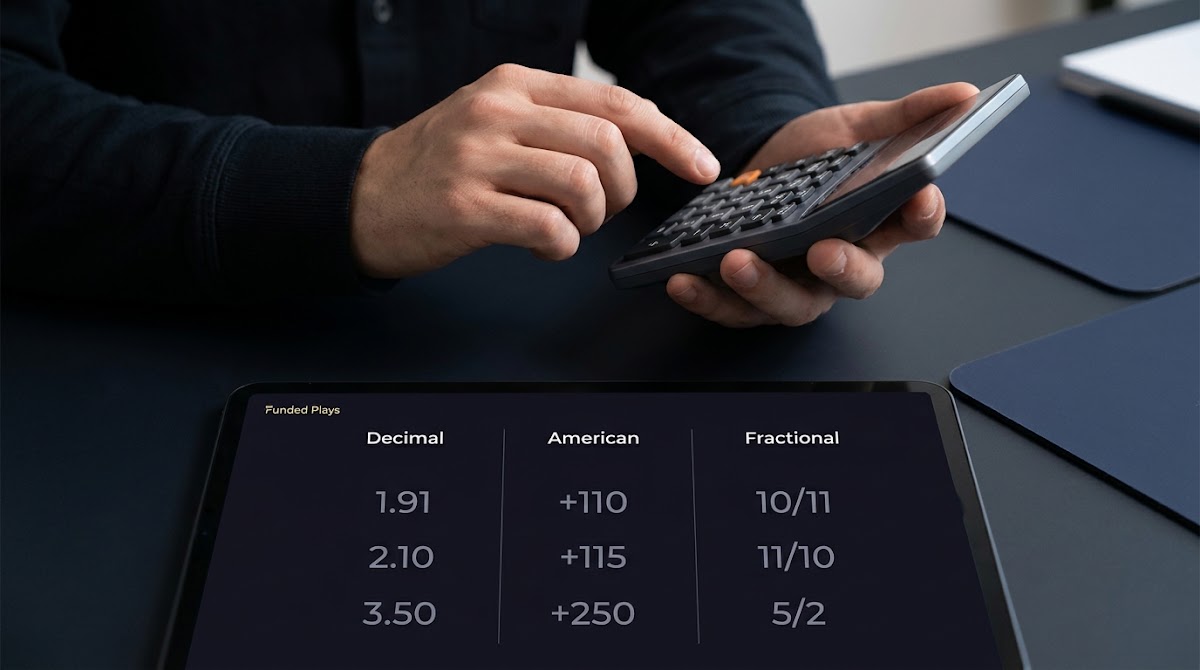
Implied probability is the straightforward conversion of market odds into a percentage chance that an outcome will occur, and knowing how to convert odds to implied probability helps you compare market prices with your own forecasts.
The basic formulas that underpin these conversions are stable and widely taught in betting education, so they are the standard reference when converting odds into chance; see the Investopedia guide for a clear definition and formulas Investopedia implied probability guide or try an online odds converter Odds converter.
Quick preparation steps for following worked conversions
Use simple tools to avoid calculation errors
In practice, implied probability appears inside sportsbook lines and in skill-based prediction contexts where users benchmark prices against their own estimates, but it does not guarantee outcomes or profits.
How to convert decimal odds to implied probability
The formula and a one-line example
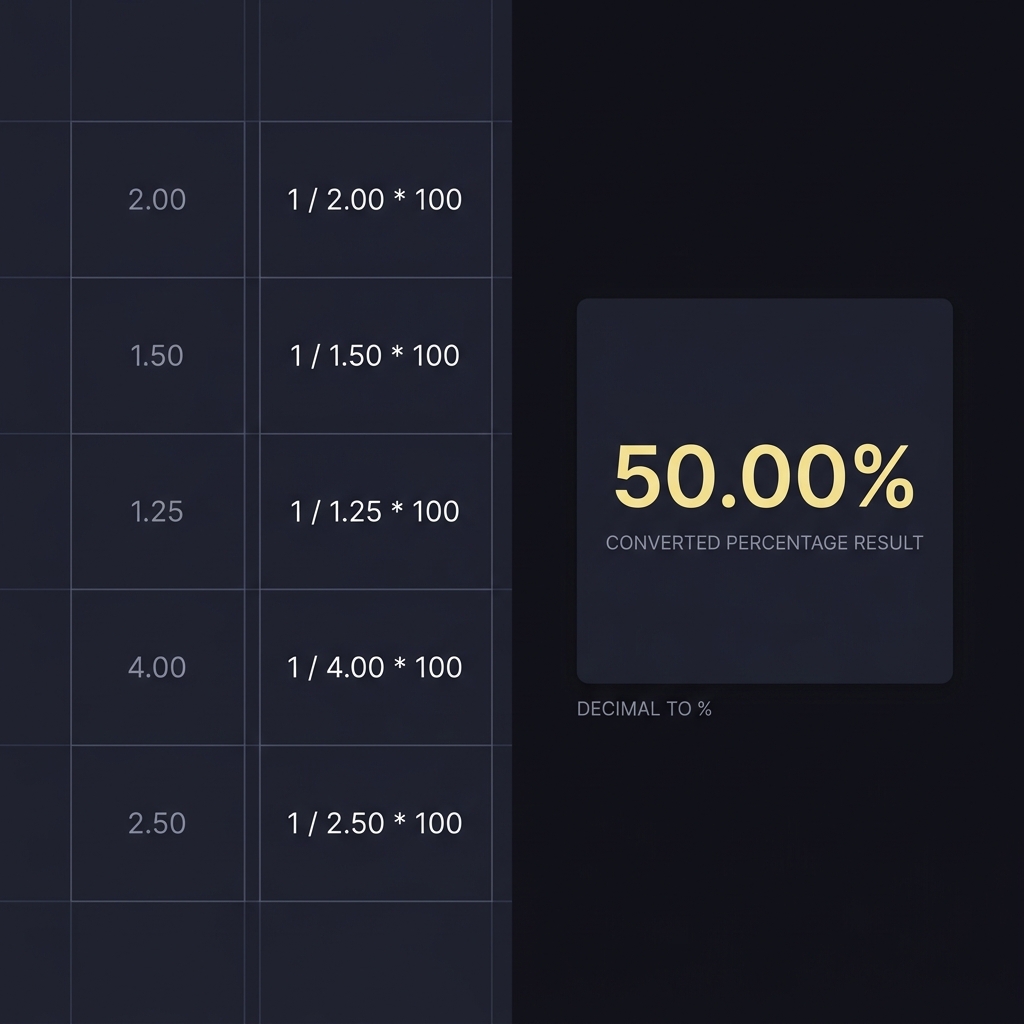
The conversion for decimal odds uses the formula P = 1 / decimal_odds; to express it as a percentage multiply by 100. This single-line rule is the standard method taught in conversion guides Smarkets help article on conversion or use an online implied probability calculator Implied Probability Calculator.
Example: decimal odds 2.50 -> P = 1 / 2.50 = 0.40, which equals 40 percent when multiplied by 100. Write the intermediate fraction to avoid rounding mistakes and then convert to percent for interpretation.
Common traps include rounding too early, misreading decimal separators on some interfaces, and forgetting that displayed odds formats can vary by region; treat the formula result as a precise fraction first and round only for presentation.
Quick practice: convert one decimal odd
Try converting one decimal price now: pick a live decimal odd, divide 1 by that number, then multiply by 100 to get a quick sense of the market chance.
How to convert American odds to implied probability
Different formulas for positive and negative lines
American odds require two different formulas depending on the sign. For positive American odds A use P = 100 / (A + 100), and for negative odds A use P = |A| / (|A| + 100); these conventions are standard in educational resources Investopedia implied probability guide.
Worked example, positive: A = +200 gives P = 100 / (200 + 100) = 100 / 300 = 0.333..., or 33.33 percent. Keep the division visible when you calculate so the percent is clear.
Worked example, negative: A = -150 gives P = 150 / (150 + 100) = 150 / 250 = 0.60, or 60 percent. Remember to use the absolute value of the negative line when you plug it into the formula to avoid sign confusion.
Many errors come from misreading the sign and using -150 directly in a formula that expects a positive magnitude; check whether the platform shows a plus sign explicitly or omits it for positive lines to be sure.

How to convert fractional odds to implied probability
The a/b formula and interpretation
Fractional odds written a/b convert using P = b / (a + b), which maps the fractional parts directly to chance and is a common instructional formula Investopedia implied probability guide.
Worked example: fractional 3/1 gives P = 1 / (3 + 1) = 1 / 4 = 0.25, or 25 percent. Treat the numerator as the chance portion and the denominator as the total parts for a simple mental picture.
An example is converting decimal odds 2.50 into implied probability by computing 1 / 2.50 = 0.40, or 40 percent; the same logic applies to American and fractional odds with their respective formulas.
Fractional odds often appear in older British-style displays and some specialist markets; if you prefer decimal checks, convert fractional a/b to decimal by computing (a/b) + 1 and then apply the decimal formula to cross-check the result Smarkets help article on conversion.
Quick mental tip: when the numerator is much smaller than the denominator, the implied probability will be relatively high, and vice versa; use the numerator-to-total-parts view for fast estimates.
Overround (vig): why implied probabilities can sum to more than 100%
What overround is and how it appears in markets
Bookmakers build a margin into prices so the sum of implied probabilities across a market usually exceeds 100 percent; this margin is called overround or vig and explains why market percentages are not fair odds Smarkets overround guide.
Simple three-outcome example: if implied probabilities for three outcomes are 40 percent, 35 percent, and 30 percent, the sum is 105 percent, showing a 5 percent overround that represents the market margin; calculate each implied probability first and then add them to find the total market implied probability Betfair education on overround.
Practical implication: the market price reflects both the market view of chance and a profit margin for the operator, so direct comparison to your personal probability should account for that embedded margin.
How to approximate fair probabilities by removing vig
Normalization method step-by-step
A common way to estimate fair probabilities is to normalize each implied probability by dividing it by the market total and then rescaling so the set sums to 100 percent; this simple rescale is a practical approximation used to remove vig Smarkets overround guide.
Example walkthrough: suppose a three-outcome market yields implied probabilities 40, 35, 30 percent, totaling 105 percent. To normalize, divide each value by 105 and multiply by 100, giving 38.10, 33.33, and 28.57 percent respectively. This gives a rescaled set that sums to 100 percent and approximates fairer chances.
Limitations: normalization assumes the market overround is applied proportionally across outcomes and does not correct for nuanced biases or asymmetric bookmaking behavior, so use it as a rough adjustment rather than a definitive fair price Betfair education on overround.
Using implied probability to spot value
Compare market probability to your own estimate
To spot potential value, compare the market-implied probability to your own independent probability estimate; if your estimate is meaningfully higher than the market-implied probability after adjusting for overround, the selection may represent value. This comparison is a core practical use of implied probability explained in foundational guides Action Network implied probability overview.
Basic expected value logic: multiply your estimated probability by the net payout to see whether the long-run return would be positive using your forecast; this is a conceptual check rather than a guarantee of outcomes.

Use a consistent logging process to record the market implied probability, your estimate, and the normalized probability when assessing multi-outcome events; discipline and repeatable records are essential to test whether value identification improves long-run performance.
Decision criteria when comparing probabilities and making calls
Thresholds and confidence bands
Simple decision rules help you act consistently: set a minimum gap threshold that you require between your estimate and the market-implied probability before you take an action, and widen that threshold for outcomes where your personal uncertainty is greater Investopedia implied probability guide.
When you normalize market probabilities, apply the same thresholds to the normalized numbers so your decision rule compares like with like; remember that overround adjustment can change whether a difference crosses your action threshold Smarkets overround guide.
Record confidence bands for your estimates and treat small differences as noise; only consistent, repeatable gaps beyond your uncertainty range should inform strategy decisions.
Typical mistakes and how to avoid them
Common calculation errors
Typical errors include applying the wrong formula for an odds type, using negative signs incorrectly for American odds, rounding too early, and failing to adjust for overround; many of these are preventable with a simple checklist and cross-checks Smarkets help article on conversion.
Fixes: write the intermediate fraction, check signs on American lines, convert fractional odds to decimal as a cross-check, and use a spreadsheet for batch calculations to minimize manual mistakes.
Also watch for display differences between platforms and for rounding conventions that can make very small probability differences appear larger than they are; consistent units help avoid misinterpretation.
Three worked examples: decimal, American, and fractional conversions
Example 1: decimal conversion walkthrough
Step-by-step decimal example: take decimal odds 3.20. Compute P = 1 / 3.20 = 0.3125. Multiply by 100 for a percentage result of 31.25 percent. Keep the intermediate division visible to catch errors and present the final number with one or two decimal places depending on your needs Investopedia implied probability guide.
If you normalize that decimal in a market context, first compute all implied probabilities for the event, sum them, then divide each by the total and multiply by 100 to rescale to 100 percent; this checks whether the 31.25 percent stands up after removing vig Smarkets overround guide.
If you normalize that decimal in a market context, first compute all implied probabilities for the event, sum them, then divide each by the total and multiply by 100 to rescale to 100 percent; this checks whether the 31.25 percent stands up after removing vig Smarkets overround guide.
Example 2: American conversion walkthrough
Positive example: line +180. Compute P = 100 / (180 + 100) = 100 / 280 = 0.357142..., or 35.71 percent. Keep the numerator 100 visible to avoid algebra slips and round only at the final step Investopedia implied probability guide.
Negative example: line -250. Use the magnitude 250 and compute P = 250 / (250 + 100) = 250 / 350 = 0.714285..., or 71.43 percent. Confirm the sign and magnitude before calculating to ensure you use the correct formula Action Network implied probability overview.
Example 3: fractional conversion walkthrough
Fractional example: 5/2. Compute P = 2 / (5 + 2) = 2 / 7 = 0.285714..., or 28.57 percent. Cross-check by converting fractional to decimal: (5 / 2) + 1 = 3.5, then P = 1 / 3.5 = 0.285714..., which matches the fractional conversion Smarkets help article on conversion.
These worked examples form templates you can reuse: write the calculation steps, keep intermediate fractions, and only round at the end for clarity.
How these conversions apply in skill-based prediction platforms
Platform-agnostic principles
The same conversion formulas and overround concepts are platform-agnostic and apply whether you are looking at sportsbook lines or benchmark prices inside skill-based prediction environments Investopedia implied probability guide.

On funded or challenge platforms, use implied probability to benchmark your forecasts, record outcomes, and measure reproducible performance rather than expecting guaranteed rewards; for example, platforms that use evaluation challenges help participants track consistency under defined rules Action Network implied probability overview.
FundedPlays is a funded sports prediction challenge platform where these conversions can help you compare market prices to your forecasts and track long-run performance under challenge rules, without implying guaranteed earnings or outcomes.
Quick tools, calculators, and next steps
When to use a calculator
A small calculator or a simple spreadsheet is the fastest way to convert many lines, normalize markets, and log results; spreadsheets also let you automate the normalization step when assessing multi-outcome events Smarkets overround guide. You can also use a free odds calculator online Free Betting Odds Calculator to speed practice.
How to practice: pick a daily set of live market lines, convert their implied probabilities, normalize multi-outcome markets, and record the difference to your estimate in a practice log. Repeat this exercise weekly to build a reproducible record. See our blog for related practice routines.
Summary and practical next steps
Key takeaways
Core formulas: decimal P = 1 / decimal_odds; fractional a/b P = b / (a + b); American positive P = 100 / (A + 100) and American negative P = |A| / (|A| + 100). These are standard formulas used in betting education Investopedia implied probability guide.
Remember overround: market implied probabilities often sum to more than 100 percent because of the bookmaker margin, and normalization provides a quick approximation to fair probabilities Smarkets overround guide.
Practice plan: convert a set of lines, compare the normalized market numbers to your estimates, and log the results for at least 30 comparable events to get an initial sense of model calibration and value identification. Read more about how funded evaluations work on the Funded Plays site here.
Divide 1 by the decimal odds and multiply by 100 to get a percentage; for example, decimal 2.50 becomes 40 percent.
For positive American odds A use 100 / (A + 100); for negative odds A use |A| / (|A| + 100).
Calculate implied probabilities for all outcomes, sum them, then divide each implied probability by the total and rescale to 100 percent to approximate fair probabilities.
References
- https://www.investopedia.com/terms/i/implied-probability.asp
- https://www.aceodds.com/bet-calculator/odds-converter.html
- https://help.smarkets.com/hc/en-gb/articles/360000101657-How-to-convert-odds-to-implied-probability
- https://www.omnicalculator.com/statistics/implied-probability
- https://help.smarkets.com/hc/en-gb/articles/360011194793-Understanding-overround-and-how-to-calculate-it
- https://betting.betfair.com/education/overround-explained
- https://www.actionnetwork.com/education/implied-probability
- https://www.fundedplays.com/challenges
- https://www.fundedplays.com
- https://www.fundedplays.com/blogs
- https://www.fundedplays.com/blogs/how-fundedplays-evaluations-work
- https://www.covers.com/tools/odds-converter