
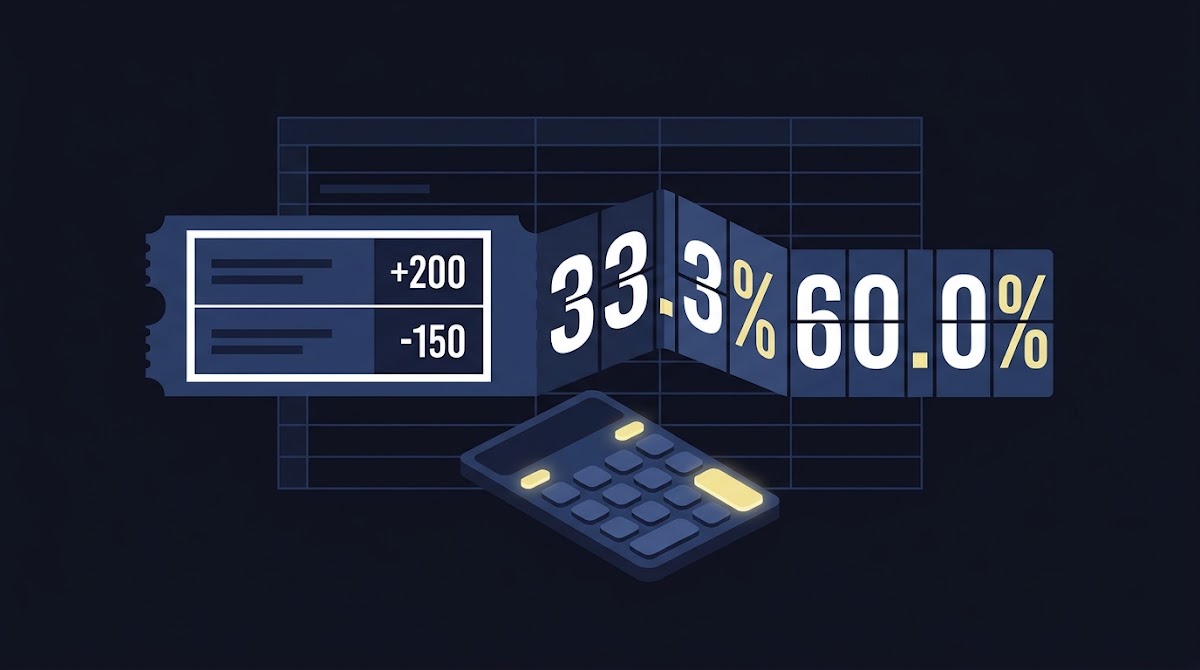
What American odds mean and why they matter
American odds, often called moneyline odds in U.S. markets, express how much you win relative to a base amount and are the standard display for many U.S. sportsbooks and prediction platforms. A concise definition and comparison to other formats helps: American odds use positive and negative integers, decimal odds show the total return per unit staked, and fractional odds express profit relative to stake; this distinction is commonly explained in betting reference guides Moneyline (American) Odds: Definition and How They Work.
In the American format, a positive number like +450 signals how much profit you would make on a $100 stake, while a negative number shows how much you must risk to win $100. That practical framing, profit per $100 or amount required to win $100, makes the moneyline easy to translate into payouts for fixed stakes and is one reason the format is common in U.S. markets Understanding betting odds: decimal, fractional and American.
Because the American display ties directly to a $100 reference point, readers can scale payouts up or down quickly for any stake. That scaling is what lets you convert to decimal odds or an implied probability with a short formula and then test those results against your own estimate or model.
See FundedPlays challenge options and rules
Try the worked conversion examples below with a few stakes so you can see how profit and return scale from the $100 reference point.
This simple clarity is also useful in structured prediction challenges and simulations where participants track returns and compare them to a model, because record-keeping often uses the same stake-oriented math used by sportsbooks.
How to convert +450 to an implied probability
To turn positive American odds into an implied market probability, use the standard positive-odds formula: implied probability = 100 ÷ (odds + 100). Applying that formula to +450 gives 100 ÷ 550, which equals 18.18 percent when rounded to two decimals, a calculation explained in detail by betting math references Implied Probability: Formula, Definition, and Examples. Implied probability calculator

odds to implied probability
Step by step, the formula divides the base 100 by the total of the base plus the American odds, because the market reference combines the stake unit and the potential profit into one denominator. That setup yields a share of the whole that the market is implicitly pricing as the chance of the outcome.
Concretely, plug in the numbers: odds = 450, so denominator = 450 + 100 = 550. Then 100 ÷ 550 = 0.181818..., shown as 18.18 percent when rounded to two decimal places. Rounding conventions vary by site and display, which is why you may sometimes see small differences of a few hundredths of a percent.
Why the denominator is odds plus 100 can be explained without algebra. The market shows profit on a $100 base for positive odds, so combining the base stake and profit produces the total return for that reference bet. Dividing the base 100 by that total return expresses the base as a share of the total, which is the implied chance that the market assigns.
Convert +450 to decimal odds and see the payout math
Decimal odds are useful because they show total return per unit staked and work directly in multiplication for any stake. For positive American odds use decimal = 1 + (odds ÷ 100). For +450 that gives 1 + 4.5 = 5.50, a conversion noted in standard odds explanations Understanding betting odds: decimal, fractional and American.
The profit formula follows naturally from the decimal conversion. Profit = stake × (odds ÷ 100). Total return = stake + profit, which is algebraically equivalent to stake × decimal odds. These relationships let you compute payouts directly for any stake without repeating unit conversions.
Use implied probability = 100 ÷ (odds + 100) to get 18.18 percent for +450, convert to decimal with 1 + (odds ÷ 100) to get 5.50, then compute profit as stake × 4.5 and total return as stake × 5.5.
As an example formula check, if you prefer to compute total return directly, use total return = stake × decimal odds. With decimal odds of 5.50, a $10 stake returns $10 × 5.50 = $55. The profit portion of that return is $55 minus the original $10 stake, which is $45, matching the profit formula above.
Convert +450 to decimal odds and see the payout math
Decimal confirmation is useful when running spreadsheets or simulation code because the decimal form is multiplicative and avoids sign rules for positive versus negative American odds. Many educational guides recommend converting to decimal odds before batch calculations to reduce formula errors and rounding anomalies Understanding betting odds: decimal, fractional and American.
When you display decimal odds to two decimal places you may see 5.50 shown as 5.5 or 5.50 depending on the site. That formatting is cosmetic; the underlying math is identical. Still, when comparing sites, use the raw American or decimal numbers rather than their percent displays to avoid small rounding differences.
Worked examples: $5, $10, $50 and $100 stakes at +450
Use profit = stake × (odds ÷ 100) to compute exact profit and total return. For +450 the factor (odds ÷ 100) is 4.5, so profit is simply stake × 4.5 and total return is stake × 5.5. These payout relationships are standard and shown in payout explainers +450 Odds Explained: Payouts, Implied Probability and Conversions. Or try the free odds calculator at Covers.
$5 stake: profit = 5 × 4.5 = $22.50. Total return = 5 + 22.50 = $27.50, or 5 × 5.50 = $27.50.
$10 stake: profit = 10 × 4.5 = $45. Total return = 10 + 45 = $55, or 10 × 5.50 = $55.
$50 stake: profit = 50 × 4.5 = $225. Total return = 50 + 225 = $275, or 50 × 5.50 = $275.
$100 stake: profit = 100 × 4.5 = $450. Total return = 100 + 450 = $550, or 100 × 5.50 = $550.
These worked numbers are exact under the math; visible cents or display rounding may differ if a site truncates or round to fewer decimal places, but the underlying operations are stable.
What +450 implies about the market: underdog interpretation and decision context
Positive odds like +450 indicate the market regards the outcome as less likely than its rival options, and the implied probability for +450 of about 18.18 percent gives a quick sense of that view. That interpretation is a core use of implied probability in decision contexts and is described in odds documentation Implied Probability: Formula, Definition, and Examples.

For a user comparing outcomes in a prediction challenge, +450 signals an underdog outcome that offers a higher payout if it occurs, but also a lower implied chance. Treat the implied probability as a market price to compare with your own model estimate rather than as a definitive assessment of actual chance.
Remember that the market price embeds the bookmaker margin, so the implied number you compute is a snapshot of the market after the house edge has been applied. That is why value decisions require comparing your estimated probability to the market-implied probability adjusted for margin if you want a cleaner view of potential edge.
How bookmakers add margin: overround and vig explained
Bookmakers build a margin into their odds so their summed implied probabilities exceed 100 percent. The standard way to estimate that margin is to convert all market outcomes to decimal odds and compute margin = sum(1 ÷ decimal odds) − 1. This margin calculation and its reasoning are described in margin guides How to calculate bookmaker margin (overround).
For a simple two-outcome market, if the decimal odds translate to implied probabilities that sum to 102 percent, the overround is 2 percent and that is the bookmaker margin embedded across the market. That extra portion is the house edge that slightly reduces the prospective value a bettor extracts compared with a no-margin market.

Practical consequence: when you compare your model probability to the market-implied probability, include the margin as a reminder that the market number is inflated above a fair, zero-edge market. Adjust your required edge threshold upward to account for that embedded cost.
How to compare +450 prices across sites and avoid rounding traps
Minor differences between sites usually come from three sources: different rounding conventions, display formats that truncate or round decimal values, and differing margins applied by each bookmaker. These common causes are discussed in odds conversion references Implied Probability: Formula, Definition, and Examples.
Checklist for fair comparisons: convert each site price to decimal odds using 1 + (American odds ÷ 100) for positive numbers, compute implied probability with 100 ÷ (American odds + 100), and if you want to compare net pricing, remove or estimate margin using decimal-odds margin calculations. Comparing raw odds numbers rather than site percent displays avoids display rounding traps.
compute total return for a stake using decimal odds
Paste the fields into a spreadsheet row
When you need a quick check, enter the raw American odds and stake into a small spreadsheet or calculator using the formulas above. You can also try an odds converter at AceOdds. That approach yields repeatable results and avoids misreading a site percent display that shows a rounded number.
Common mistakes when converting odds and interpreting implied probability
A frequent arithmetic error is applying the wrong formula for positive versus negative American odds. Positive odds use implied probability = 100 ÷ (odds + 100). Negative odds use a different structure. Misapplying the positive formula to a negative line will produce incorrect probabilities and misleading comparisons, a point emphasized in betting math overviews Implied Probability: Formula, Definition, and Examples.
Another common mistake is treating the implied probability as the true probability of the event. Implied probability is a market price that includes margin, liquidity and bookmaker positioning. It is useful as a comparison point, but it is not an objective measure of event likelihood.
Rounding errors also cause confusion. If you calculate 100 ÷ 550 and a site displays 18.2 or 18.18, those are the same underlying values shown with different rounding. For exact accounting in simulations, keep raw numbers to sufficient precision until final display.
When implied probability differs from your model: evaluation criteria
Value exists when your model assigns a higher probability to an outcome than the market-implied probability, after accounting for margin and variance. That comparison is a common decision rule for bettors and predictors who seek systematic edges, described in margin and value guides How to calculate bookmaker margin (overround).
Quick decision checklist: first, confirm your model probability is robust and not overfit. Second, check the stake size relative to your bankroll or challenge rules. Third, adjust your target edge to cover the bookmaker margin and expected variance. Fourth, document the choice for later calibration.
Even when a price appears to offer value, remember that variance and sample size matter. Use disciplined staking and tracking rather than assuming a single apparent edge guarantees success.
How to use these conversions in practice: tips for prediction challenges and simulations
When you run simulations or enter structured prediction challenges, record the market-implied probability and your model probability for each selection. That record lets you calculate calibration over time and see whether your estimates systematically outperform or underperform the market.
Standardize on decimal odds for simulation math because it keeps calculations multiplicative and reduces conditional branching in code or spreadsheets. Use the decimal conversion 1 + (odds ÷ 100) for positive American odds and the corresponding negative-odds formula for favorites when needed.
Account rules matter for challenge users. Many platforms set stake limits, place caps on returns, or use simulated bankroll mechanics that differ from real-money sportsbooks. Always confirm the evaluation rules before applying a staking plan derived from market odds. Keep in mind the FundedPlays model focuses on performance in simulated funded accounts and structured evaluation challenges rather than guaranteed earnings or investment returns.
Quick conversion cheat sheet and formulas to keep
Core formulas to copy: positive American implied probability = 100 ÷ (odds + 100). Decimal conversion for positive American odds = 1 + (odds ÷ 100). Profit = stake × (odds ÷ 100). Total return = stake × decimal odds. Margin = sum(1 ÷ decimal odds) − 1. These compact formulas are the practical toolkit for conversions and quick checks Implied Probability: Formula, Definition, and Examples.

Quick verification: compute total return both as stake × decimal odds and as stake + stake × (odds ÷ 100). If the two numbers match, your math is consistent and you have avoided sign or formula errors.
Note on rounding: when you report probabilities or decimal odds, choose a consistent display convention and keep raw calculations at higher precision to avoid cumulative rounding drift in long simulations.
Short glossary of terms
American odds: a U.S.-centric odds format showing profit relative to a $100 stake for positive numbers and the amount required to win $100 for negatives, useful for direct payout scaling Understanding betting odds: decimal, fractional and American.
Implied probability: the market-derived chance implied by odds, computed from the relevant conversion formula and interpreted as a pricing snapshot rather than an objective probability.
Decimal odds: total return per unit staked, used directly in multiplicative payout calculations and preferred for simulations and spreadsheets.
Overround: the bookmaker margin created when summed implied probabilities exceed 100 percent, which reduces expected value compared with a no-margin market.
Stake, profit, return: stake is the amount risked, profit is stake multiplied by the conversion factor for the odds, and return is stake plus profit or stake multiplied by decimal odds.
How a funded prediction platform user might apply these conversions
A user in a simulation or challenge can apply these conversions to set proportional stake sizes, compare model probabilities to market-implied probabilities, and document decisions for later calibration. That disciplined record-keeping aligns with the performance-oriented approach used by funded prediction platforms.
Because challenge accounts are typically simulated or funded under specific rules, apply your staking within the platform constraints and track outcomes against your model. Use decimal conversions to compute returns in batch and record both implied and model probabilities for later analysis.
Conclusion: main takeaways and next steps
Recap: +450 converts to an implied probability of roughly 18.18 percent using 100 ÷ (450 + 100), and decimal odds equal 5.50 using 1 + (450 ÷ 100); a $10 stake at +450 returns $55 total and $45 profit under the standard payout formulas Implied Probability: Formula, Definition, and Examples.
Next steps: practice the conversions with three stakes of your choice, record the market-implied probability and your own estimate, and track outcomes to measure calibration over time. Always remember bookmaker margin and platform rules when you assess value or apply stakes. Visit Funded Plays for challenges and resources.
Use the positive-odds formula implied probability = 100 ÷ (odds + 100). For +450 that is 100 ÷ 550 = 18.18 percent.
Yes. Decimal conversion is 1 + (odds ÷ 100), so +450 becomes 5.50, and total return equals stake × 5.50.
Small differences come from rounding rules and each site s embedded margin; convert raw odds to decimal then compute implied probability to compare cleanly.
References
- https://www.investopedia.com/terms/m/moneyline.asp
- https://www.pinnacle.com/en/betting-resources/educational/understanding-betting-odds
- https://www.investopedia.com/terms/i/implied-probability.asp
- https://www.fundedplays.com/challenges
- https://www.pinnacle.com/en/betting-resources/educational/how-to-calculate-bookmaker-margin
- https://www.actionnetwork.com/education/american-odds-decimal-fractional
- https://www.covers.com/tools/odds-converter
- https://www.fundedplays.com
- https://www.fundedplays.com/blogs/how-fundedplays-evaluations-work
- https://www.aceodds.com/bet-calculator/odds-converter.html
- https://www.omnicalculator.com/statistics/implied-probability
- https://www.fundedplays.com/blogs