
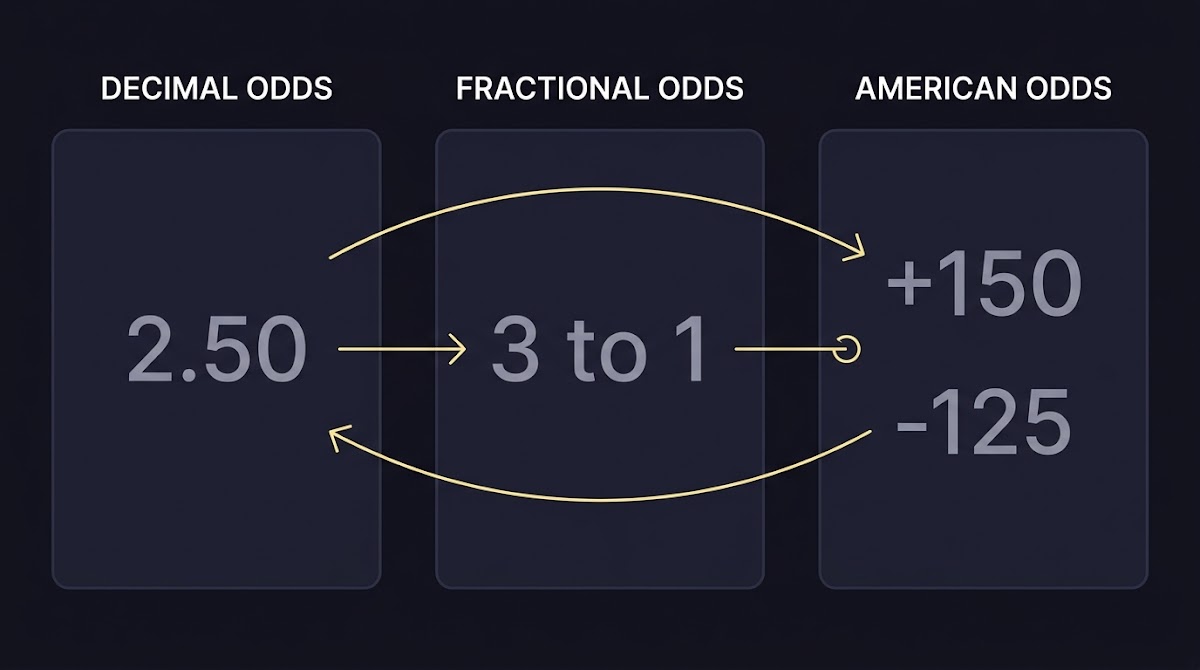
Odds formats explained: American, decimal and fractional
Odds Fundamentals Every Sports Trader Should Master
Understanding the three common representations of price is the first step in odds literacy. American odds, decimal odds, and fractional odds all encode the same pricing information; learning to read them lets you compare markets and standardize models for sports trading odds.
At a glance, American odds show how much you would win on a 100-unit stake for positive values or what stake is required to win 100 units for negative values; decimal odds show the total return per unit staked; fractional odds show profit relative to stake. These formats are regional conventions rather than different prices, and you can convert between them mechanically for analysis, which is useful when you work across markets and platforms Betfair odds guide.
Worked example, moneyline style: a game with a favourite shown as -150 in American odds is equivalent to 1.67 in decimal odds and about 2/3 in fractional form; the underdog at +130 corresponds to 2.30 decimal and 13/10 fractional. Use one representation you are comfortable with to avoid errors when comparing quotes.
Convert decimal odds to implied probability quickly
Use Decimal Odds when available; fall back to conversions
Keep a single column in your spreadsheet for decimal odds or implied probability so your models and logs use a consistent metric. This reduces mistakes when you import prices from multiple sources and supports systematic reading of betting odds in your workflow.
How to convert odds to implied probability
Converting listed prices to implied probability is a core calculation for traders. For decimal odds the implied probability formula is 100 divided by the decimal price. For fractional odds expressed as A/B the implied probability is B divided by (A plus B) times 100. For American odds the conversions differ by sign: for positive American odds, the implied probability is 100 divided by (American plus 100); for negative American odds, it is the absolute American divided by (absolute American plus 100), then multiplied by 100. For a reference on the general formulas, see the standard implied probability explanation Investopedia implied probability guide. You can also use a free implied probability calculator to check conversions quickly Therundown calculator.
Worked example one: decimal 2.50 implies 100 / 2.50 = 40 percent. Worked example two: American +150 implies 100 / (150 + 100) = 40 percent. Showing both steps helps you spot entry errors and confirm that different formats yield the same implied probability when converted correctly.
Common pitfalls include forgetting to convert fractional strings to numeric values, mixing percentage and decimal formats in the same column, and rounding too early. A mental check is to confirm that decimal values above 2.00 correspond to probabilities below 50 percent and that American signs match your interpretation of favourite versus underdog.
Understanding bookmaker margin: vig and overround
Bookmakers price books so that the sum of implied probabilities across all outcomes exceeds 100 percent; the excess is the overround or vig and quantifies the house margin. Calculating that excess on a quoted market lets you measure how much of the price is the book's built-in edge and is a standard technique used by traders Smarkets on overround.
Example on a two-outcome market: if the implied probabilities from the quoted odds are 55 percent and 48 percent, the sum is 103 percent and the overround is 3 percent. That 3 percent is not a gambler's fee but the margin embedded in the quotes that you should account for when assessing whether a price offers value.
Practice these steps in the FundedPlays Challenges framework
Try the short checklist in this article when you read a quoted market: convert, sum implied probabilities, calculate the overround, then normalize to a 100 percent distribution before comparing to your model.
Commissions or platform fees can be added on top of the raw overround, which means the effective cost of taking a price can be larger than the quoted vig alone. In challenge-based environments, be explicit about whether published odds already include platform fees and record both quoted and net costs when you log trades.
Normalizing probabilities: removing the vig to estimate fair odds
Normalizing implied probabilities converts an overround book into a 100 percent distribution so you can estimate the market-implied fair probabilities. The standard normalization divides each implied probability by the total sum of implied probabilities, then multiplies by 100 to rescale the distribution to 100 percent; this method is a practical way to approximate fair odds from quoted prices Smarkets overround explanation.
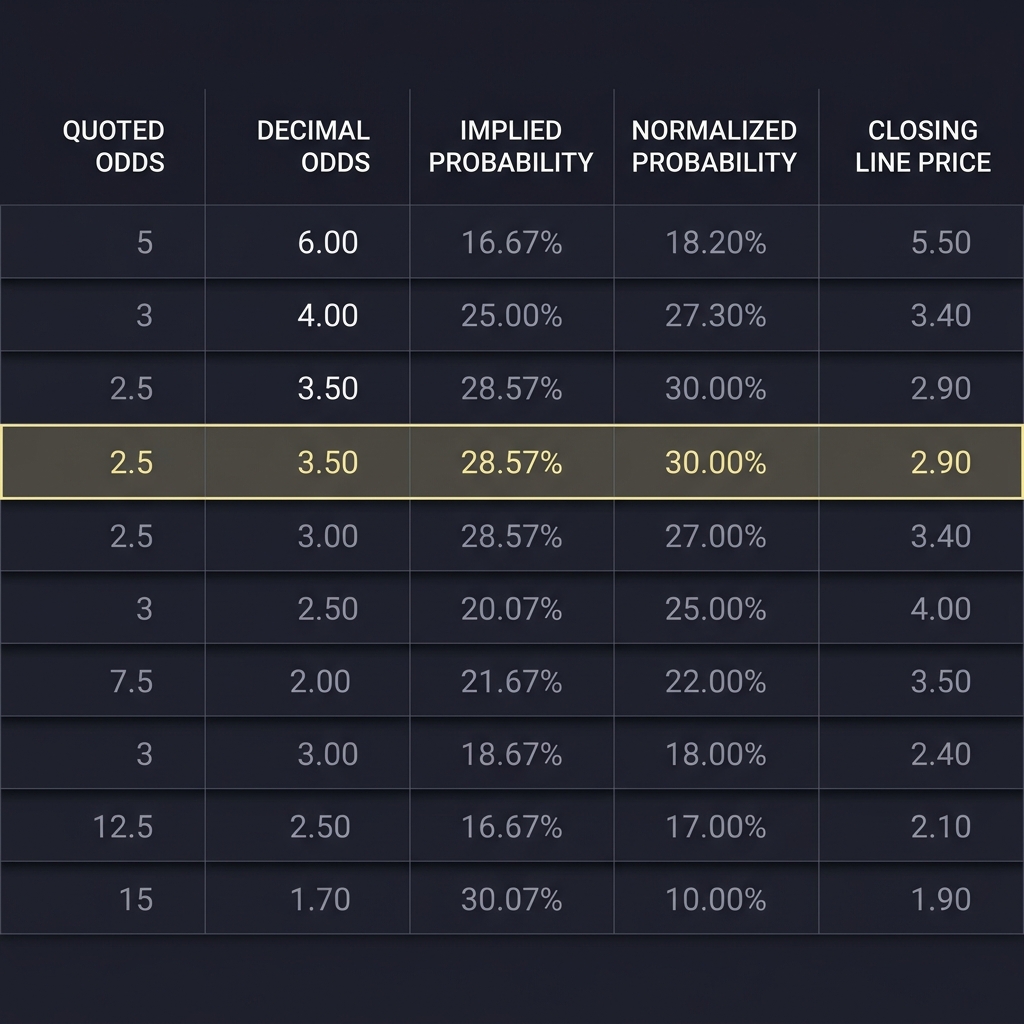
Step-by-step example: suppose three outcomes have implied probabilities 40 percent, 35 percent, and 30 percent, which sum to 105 percent. Divide each by 105 percent to get normalized probabilities of about 38.1 percent, 33.3 percent, and 28.6 percent, then convert those back to your preferred odds format if you need fair prices for sizing or comparison. Numbered steps and a calculator check reduce conversion mistakes.
Normalization clears the built-in margin so you compare your own probability estimates to a fair, 100 percent market distribution. However, normalization assumes the book is close to an unbiased aggregator of opinion; in thin markets or books that purposely bias prices to limit liability, the normalized result can still mislead about the true underlying probabilities.
Detecting value: when your probability estimate beats the market
Value exists when your independently estimated win probability exceeds the vig-adjusted implied probability from the market. That comparison is the practical definition of value betting used in mainstream betting education and by systematic traders Smarkets guide to value betting.
Worked expected value example: if your model assigns a 45 percent chance to an outcome while the normalized market probability is 38 percent, the edge is 7 percentage points. For a single 100-unit stake, the expected return is edge times the payout above break-even; using a standard expected value formula helps you translate probability edge into long-run expectation without implying short-term certainty.

A generic funded-account workflow fits this logic: record the offered odds, convert and normalize to get the fair market probability, compare to your model probability to flag value, and log the trade with contextual notes for later review. In challenge environments, consistent logging of offered prices and your reasoning matters as much as the edge calculation itself.
Market movement and closing line value (CLV)
Odds move as information arrives and as liquidity shifts; prices incorporate new facts, public sentiment, and large money, so watching line moves is a way to observe how the market updates. Traders use closing line value as a benchmark for price quality, interpreting a bet that beats the close as evidence of having taken a superior price relative to the market's final consensus Pinnacle on CLV.
CLV is a practical, retrospective metric rather than a guarantee of future profit. Across sports and market types, CLV's predictive power varies with liquidity; in thin markets small moves may reflect little information and large bettors can shift prices in ways that do not correlate with long-run value.

When you log trades for a challenge, include the time-stamped offered price and the eventual closing price so you can compute CLV for each selection. Over many bets, the sign and size of average CLV can help validate whether your sourcing and timing consistently capture value.
A practical trading framework for challenge-based funded accounts
Run a short pre-trade checklist every time you enter a selection: convert the quoted odds to implied probability, compute the market overround and normalize to a 100 percent distribution, compare the normalized probability to your independent model, and only mark trades as value when the edge exceeds your minimum threshold. Keeping this checklist simple makes it repeatable under time pressure. For quick calculator checks you can use an implied probability calculator such as the one at OddsJam.
Execution notes: snapshot the offered odds, the normalized market probability, and a short note on the information set you used. Log these entries in a single spreadsheet or a lightweight database so you can later filter by sport, market type, and time of day to study patterns. This recorded context is often decisive when reviewing edge and CLV results Smarkets value betting guide. You can also use an odds converter for quick checks of format equivalence Covers odds converter.
Convert any odds format to implied probability, sum the probabilities to find the overround, normalize each probability by dividing by the total, and compare the normalized market probability to your model estimate.
Post-trade review should compare realized results with pre-trade expectations and add closing-line comparisons. Track rolling averages of edge, incidence of positive CLV, and return on capital used in challenge rounds; make only measured model adjustments once samples reach a size that reduces noise.
Common mistakes and how to avoid them
A frequent error is overfitting probability models to a small sample and then treating minor CLV wins as confirmation. Overfitting produces unstable estimates that do not generalize; one corrective action is to hold back a validation set or to prefer simpler, robust features that perform across seasons and markets Smarkets on value and model caution.
Another common mistake is ignoring the overround or misapplying normalization. Failing to remove the vig before comparing to your model means you overestimate your edge. Always document the raw implied probabilities, the overround you calculated, and the normalized distribution so errors are visible and traceable.

Misreading very small line moves as persistent edges is a third pitfall. In low-liquidity events, tiny differences between offered and closing prices can arise from single large bets or from bookmakers' liability management rather than a sustainable market inefficiency. Use sample-size-aware rules before increasing exposure.
Quick checklist and concluding notes
One-page checklist you can copy: 1) Convert offered odds to decimal and implied probability. 2) Sum implied probabilities and compute overround. 3) Normalize probabilities to remove vig. 4) Compare normalized market probability to your model. 5) Record offered price, normalized probability, your model probability, stake, and closing price. 6) Review CLV and adjust only after adequate sample size.
Where to study formulas further: read practical guides on implied probability and overround, and practice conversions until they are automatic. Keep in mind that value depends on disciplined, repeatable estimation and that no single method guarantees profit in every market.
Convert positive American odds with 100 divided by (American plus 100) and negative American odds with absolute American divided by (absolute American plus 100); express the result as a percentage.
Overround is the sum of implied probabilities across all outcomes minus 100 percent and it represents the bookmaker margin you must remove to compare prices to your own probability estimates.
Beating the closing line is a useful retrospective benchmark but its predictive power depends on market liquidity and sample size, so use it alongside systematic logging and validation.
References
- https://betting.betfair.com/betting-guides/betting-odds-explained-140413-579.html
- https://www.covers.com/tools/odds-converter
- https://www.investopedia.com/terms/i/implied-probability.asp
- https://therundown.io/betting-calculators/implied-probability-calculator
- https://help.smarkets.com/hc/en-gb/articles/213207145-Understanding-commission-and-market-overround
- https://smarkets.com/guides/betting/what-is-value-betting/
- https://www.fundedplays.com/challenges
- https://www.pinnacle.com/en/betting-resources/education/what-is-closing-line-value/
- https://oddsjam.com/betting-calculators/implied-probability
- https://www.covers.com/tools/odds-converter
- https://www.fundedplays.com
- https://www.fundedplays.com/blogs
- https://www.fundedplays.com/blogs/how-fundedplays-evaluations-work