

Read +350 quickly with an odds converter sports betting
Start with the short answer: +350 American odds mean a $100 stake wins $350 profit for a $450 total return. This convention for positive American prices is commonly explained in betting references and guides, which describe the plus sign as the amount won on a $100 stake Investopedia on American odds.
Put another way, the price shows how much you gain relative to a fixed $100 base, which makes quick mental scaling easy for different stakes.
One-line summary
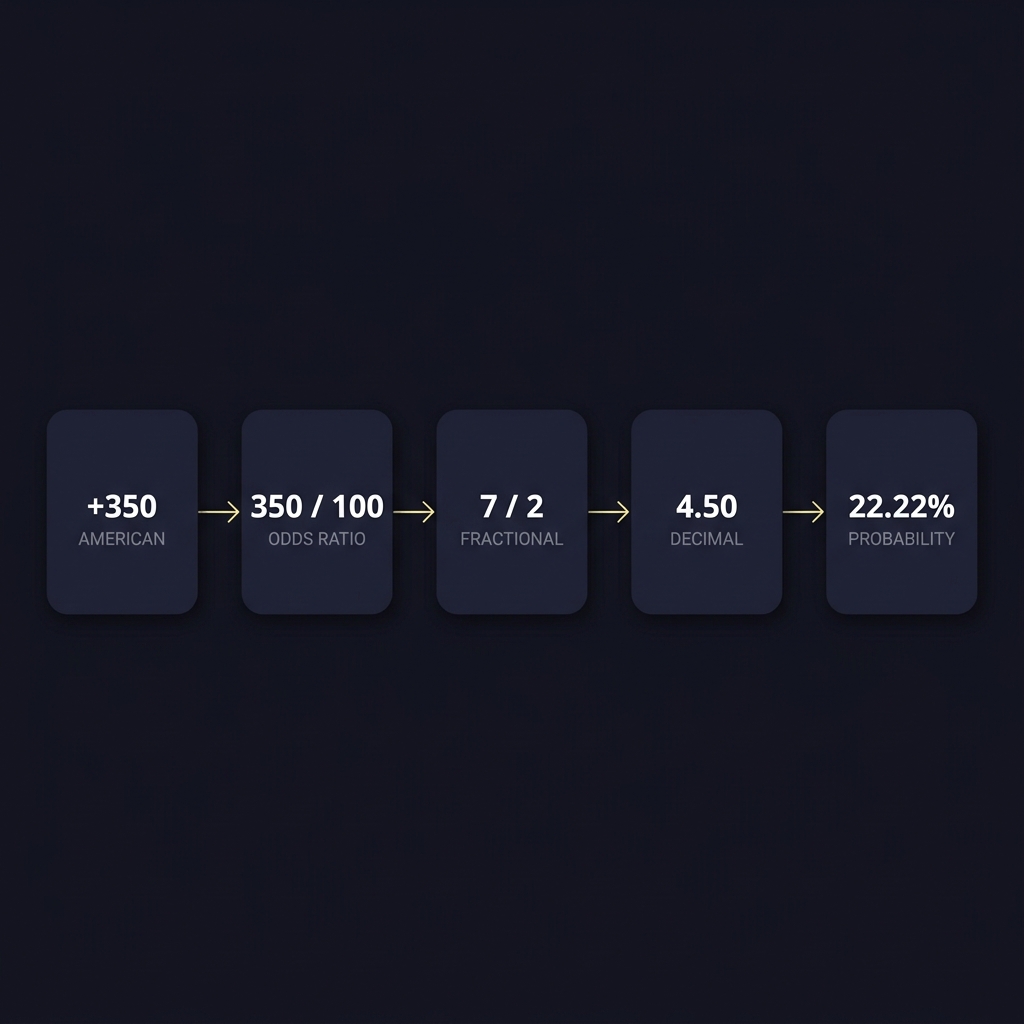
+350 equals 4.50 in decimal odds and 7/2 in fractional odds, and its implied probability is about 22.22% when viewed as a standalone market price.
Quick conversion table
Decimal: 4.50. Fractional: 7/2. Implied probability: about 22.22%.

Where this is useful
Knowing how to convert +350 is helpful when comparing books, building models, or recording predictions for later review.
Definition and context: how American moneyline odds work
American moneyline odds use a plus or minus sign to express payout relationships. A positive sign shows how much profit a $100 stake yields, while a negative sign shows how much you must stake to win $100. This plus/minus convention is the standard presentation for moneyline odds in U.S. markets Wikipedia on odds.
Moneyline odds are one of three common formats alongside decimal and fractional odds, and converting between them lets you compare prices across different markets or tools.
Plus and minus convention
For underdogs a plus sign precedes the number and tells you the profit per $100. For favorites a minus sign precedes the number and tells you the stake required to win $100.
Moneyline versus other formats
Decimal odds show total return per unit staked and fractional odds show profit relative to stake, so knowing the conversion formulas helps avoid misunderstandings when you switch formats.
When sportsbooks use American odds
American odds are common in U.S. focused offerings and in some matchups where local conventions favor the moneyline presentation, which is why many calculators and trackers include an American to decimal odds option Pinnacle odds conversion guide or converters like AceOdds.
Convert +350 to decimal and fractional using an odds converter sports betting
Formulas for positive American odds are straightforward. For A positive, decimal odds D = 1 + (A / 100). For fractional odds F = A / 100, then simplify the fraction. These formulas are the standard conversion rules used by educational resources on odds conversion Pinnacle odds conversion guide.
Step-by-step worked example: start with A = 350. Compute the fractional component 350 divided by 100 which equals 3.5. For decimal add 1 to get D = 1 + 3.5 = 4.50. For fractional write 350 over 100 and simplify to 7/2.
Plus-350 indicates a $350 profit on a $100 stake, which converts to decimal 4.50 and fractional 7/2; implied probability is 100/(350+100) or about 22.22 percent.
Quick mental shortcuts
A simple memory aid is that positive American odds of +100 equal 2.00 in decimal, and each additional +100 adds 1.00 in decimal. So +350 maps to roughly 1 plus 3.5, which is 4.50.
Calculate implied probability for +350 and what that number means
To turn a positive American price into implied probability use P = 100 / (A + 100). Substituting A = 350 gives P = 100 / 450 which equals about 0.2222 or 22.22%. This formula and approach are standard in probability explanations for market prices Investopedia on implied probability.
Interpreting 22.22 percent: read it as the market-implied chance of the outcome if this price were a fair representation of probability, remembering that market prices often include a bookmaker margin.
Interpreting 22.22% in plain terms
In practical language, +350 implies that, on the numbers alone, the outcome is estimated by the market to occur a bit over once in five times if prices were perfectly fair.
What probability does and does not tell you
Implied probability is a market signal, not a definitive forecast. It helps you compare your own estimate to market odds when deciding whether you see an edge.
Negative odds and paired conversions - use an odds converter sports betting for both sides
Negative American odds use mirrored formulas. For negative A, decimal D = 1 + (100 / |A|) and fractional F = 100 / |A|, and the implied probability for a negative price is |A| / (|A| + 100). These paired conversions let you handle favorites and underdogs consistently Wikipedia on odds.
Worked example with a favorite price: if the price is -150 then D = 1 + (100 / 150) = 1 + 0.6667 = 1.6667 and fractional simplifies to 2/3, while implied probability equals 150 / 250 = 0.6 or 60 percent.
Try the FundedPlays Challenges to practice disciplined forecasting
The conversion method is the same for favorites and underdogs, so take a moment to practice converting one positive and one negative price before recording predictions.
The stake-to-win relationship flips between signs. For negative odds you must stake more than $100 to secure $100 of profit, which helps when setting risk limits and bookkeeping.
When odds are negative
Negative odds signal favorites: the number magnitude shows the stake required to win a fixed profit, which affects how you size bets and compare value across markets.
Formulas for negative American odds
The key practical point is memorizing the mirrored formulas so you do not apply the positive formula to a negative price by mistake.
How bookmaker margin and overround affect the implied probability
Bookmakers include a margin, often called overround, so the summed implied probabilities for all market outcomes typically exceed 100 percent. That means the implied probability derived from a single price like +350 is a market figure, not a pure event probability Wikipedia on overround.
Because of margin, you cannot simply add implied probabilities and expect them to equal 100. Adjusting for the margin requires a normalization step if you want market probabilities that sum to 100 percent.
What overround is
Overround describes how bookies price markets to ensure a margin. It shows up as the excess when you total implied probabilities across all outcomes.
Why implied probabilities sum to more than 100%
Each price embeds a small markup. When those markups are combined the market implied probabilities exceed 100 percent, which is why many converters and models include a margin adjustment option.
Adjusting for margin conceptually
You can normalize implied probabilities by dividing each implied probability by the sum across all outcomes, but bear in mind this produces a market-normalized view rather than revealing the true underlying chance of an event.
Practical examples and scenarios using an odds converter sports betting
Example 1, single wager: at +350 a $50 stake yields profit proportional to the $100 base. Since +350 is $350 profit on $100, scale that for $50 by halving to $175 profit and a $225 total return.
Example 2, portfolio context: if you include a +350 selection inside a set of predictions, record decimal equivalents and implied probabilities so you can compute expected value across your portfolio and track performance over time. You can also use online converters such as OddsJam to speed the process.
Compute profit and total return from stake and American odds
Use decimal for totals
How to check conversions quickly: keep a small spreadsheet or use a simple decimal calculator so you never rederive the same conversion by hand under time pressure. You can also try a free converter such as Covers' odds converter.
Example 1: one-off wager at +350
Worked math for $50: profit = 50 * (350 / 100) = 175 so total return = stake + profit = 50 + 175 = 225. This is a proportional scaling from the $100 base explanation commonly used in odds guides Investopedia on American odds.
Example 2: using +350 inside a portfolio of predictions
When you log multiple predictions include stake, American and decimal odds, implied probability, and your reason for the pick. That record helps you measure whether your forecasting beats market-implied probabilities over time.
How to check conversions quickly
If you prefer a mental check, convert to decimal and multiply stake by decimal to get total return, then subtract stake to recover profit. That two-step approach reduces calculator errors.
Common mistakes when converting odds and reading +350
Mixing stake and profit is the most frequent error. Remember that +350 refers to profit on a $100 stake, not the total return, and adjust your math accordingly to avoid overestimating outcomes Pinnacle odds conversion guide.
Another mistake is using the positive formula for negative prices or vice versa. Keep the mirrored rules in mind so you do not flip numerator and denominator by accident.
Mixing stake and profit
If you cite an American price in records, always state whether your logged number is profit or total return to avoid confusion when reviewing past bets.
Misreading decimal vs fractional
Decimal shows total return per stake unit; fractional shows profit relative to stake. When you convert +350 to 4.50 decimal, a $1 stake returns $4.50 in total, not $3.50 profit unless you subtract the stake.
Ignoring overround and vig
Failing to account for bookmaker margin can make your implied probability comparisons too optimistic; include a margin check when you assess whether you have an edge.
How to think about conversions for bankroll and risk management
Use implied probability as one input when you estimate whether a selection is mispriced relative to your own view. Treat it as data rather than a promise of results.
Sizing stakes should follow a disciplined plan and not change because a single conversion looks attractive. Keep records of stakes, conversions, and outcomes so you can measure long term performance.
Using implied probability to calibrate edge
Compare your internal probability estimate to the market implied probability to see if there is a potential edge, and only act when you have a reasoned approach to sizing.
Sizing stakes without promising returns
Choose stake sizes based on risk tolerance and the repeatable quality of your forecasts, not on a single high-return price.
Record keeping and disciplined practice
Track every prediction with the original American price, converted decimal, implied probability, stake, and outcome for objective evaluation and continuous improvement.
Examples: step-by-step conversions for different stakes
$10 stake at +350: profit = 10 * (350 / 100) = 35, total return = 45.
$50 stake at +350: profit = 50 * 3.5 = 175, total return = 225.
$100 stake at +350: profit = 100 * 3.5 = 350, total return = 450. These show simple proportional scaling from the $100 base used in American odds explanations Investopedia on American odds.
How to scale results
Scaling is linear: if you halve the stake you halve the profit; if you double the stake you double the profit, because American odds are expressed relative to the $100 reference stake.
Rounding conventions
Round practical totals to the nearest cent for bookkeeping, and be consistent when you report results in a ledger or spreadsheet.

Quick checklist: what to verify before you act on +350
Conversion sanity checks: confirm decimal equals 1 + (A / 100) and fractional simplifies from A / 100.
Market context checks: compare implied probability to your internal estimate and account for overround before sizing a stake.
Record and log: save stake, American price, decimal, implied probability, and rationale for every prediction so you can evaluate performance.
Conversion sanity checks
Verify you used the correct formula for the sign of the odds and that your decimal matches the expected total return per unit.
Market context checks
Check whether prices are shifted by market liquidity or a heavy favorite; these factors can change the usefulness of a single implied probability.
Log
Keep a concise log entry for each pick so you can review outcomes without needing to reconstruct conversions later.
Where conversions come from: statistical foundations and the NIST linkage
Conversions rest on the odds to probability mapping, a basic relationship in statistics and decision analysis discussed in standard references on odds and probability NIST odds and probability.
The algebra behind the formulas is straightforward: odds express a ratio and probability normalizes that ratio to a 0 to 1 scale, which explains why the formulas map cleanly between American, decimal, fractional, and probability representations.
Odds and probability relationship
Odds represent relative chances while implied probability expresses the same idea as a fraction of one, which is why one can move between formats with simple arithmetic.
Why formulas are mathematically consistent
The formulas maintain equivalence because decimal multiplies stake to yield total return and fractional represents profit per unit stake; each is just an algebraic rearrangement.
Limitations of model-based interpretation
Remember that the formulas transform price to probability, but they do not remove market bias or bookmaker margin; treat results as market-derived informational inputs.
Conclusion and next steps for practicing conversions
Key takeaways: +350 means $350 profit on a $100 stake, decimal 4.50, fractional 7/2, implied probability about 22.22 percent. Keep these formulas handy when comparing markets.
Practice exercises: convert a mix of positive and negative American prices, compute implied probabilities, and log the outcomes to measure your forecasting accuracy over time. For background on how the process is evaluated you can read about how Funded Plays evaluations work.
Further reading: use authoritative conversion guides and probability references on our blog to deepen understanding of market mechanics and margin adjustments.
For positive American odds like +350, profit scales from a $100 base: profit = stake * (350/100). So a $50 stake wins $175 profit and returns $225 total.
Use P = 100 / (A + 100). For +350 that is 100 / 450, or about 22.22 percent as the market implied probability.
No, implied probabilities are market-derived and typically include bookmaker margin, so they are signals rather than absolute event probabilities.
References
- https://www.investopedia.com/terms/a/american-odds.asp
- https://en.wikipedia.org/wiki/Odds
- https://www.pinnacle.com/en/betting-resources/educational/convert-odds-implied-probability/2JEU6VJGQNasNf5N
- https://www.investopedia.com/terms/i/implied-probability.asp
- https://en.wikipedia.org/wiki/Overround
- https://www.aceodds.com/bet-calculator/odds-converter.html
- https://oddsjam.com/betting-calculators/odds-converter
- https://www.covers.com/tools/odds-converter
- https://www.itl.nist.gov/div898/handbook/eda/section3/eda366i.htm
- https://www.fundedplays.com/challenges
- https://www.fundedplays.com/blogs/how-fundedplays-evaluations-work
- https://www.fundedplays.com/blogs
- https://www.fundedplays.com