
What an odds converter calculator does and why it matters
An odds converter calculator is a simple tool that takes a stake and one odds input and returns the net profit and the total return in currency, making it easier to understand what a quoted price actually pays in cash. The odds converter calculator phrase describes the common utility of such a tool and helps readers check listed payouts and compare offers at a glance, which is especially useful when you want to validate a number shown by an operator or when you are learning how prices map to money and probability Wikipedia odds.
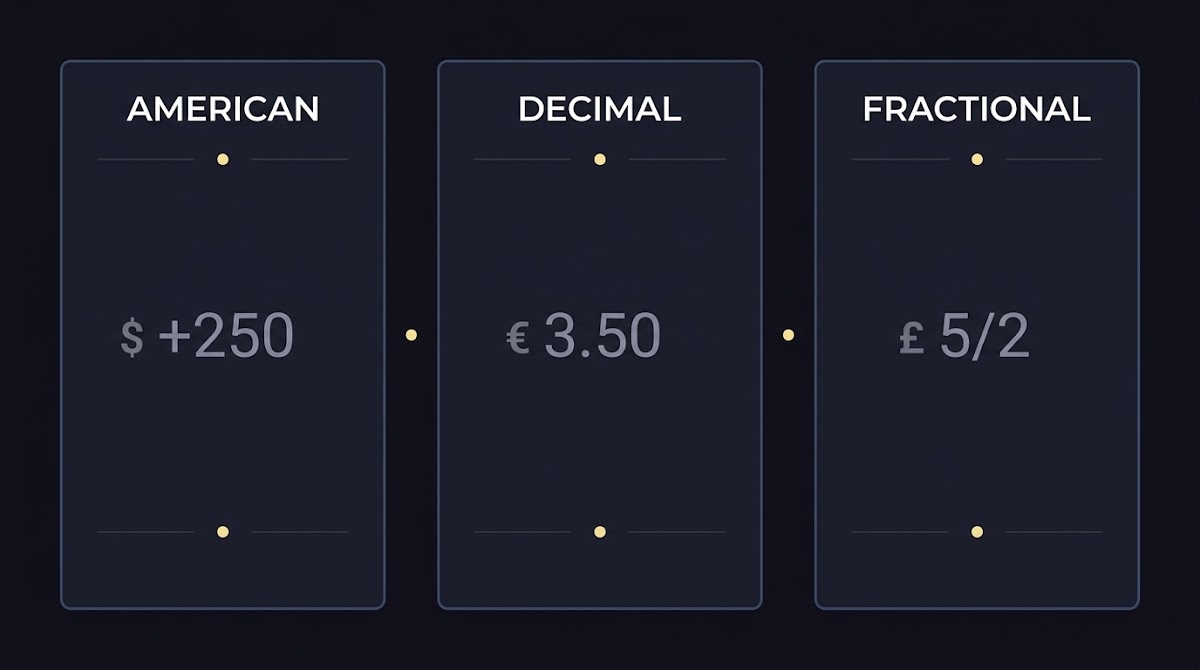
The calculator supports the three widely used formats: American (moneyline), decimal, and fractional. Each format encodes the same economic relationship between stake and payout but uses a different presentation: American odds show how much you win on a nominal $100 or how much you must risk to win $100; decimal odds quote total return per unit staked; and fractional odds show profit relative to the stake as a ratio Wikipedia odds.

At its core the tool needs only two inputs, a currency stake and a single odds value in one of the three formats, and it outputs two numbers: net profit and total return. Because the conversions use stable, standard formulas you can compute results by hand or with a simple script and then cross-check them against the calculator output to ensure consistency Implied probability.
One quick validation step is the even-odds sanity check: even odds are equivalent across formats (+100 in American, 2.00 in decimal, and 1/1 fractional) and should always yield profit equal to the stake and total return equal to two times the stake. If a calculator or operator listing deviates from that equivalence, you should review rounding or house rules that might be in play Implied probability.
Input and quick workflow for an odds converter calculator

Required inputs are minimal: a stake expressed in your currency and a single odds value in one of the supported formats. Begin by entering the stake amount, then select which format the quoted price uses, and finally input the odds value as shown by the listing or your source Investopedia moneyline explanation.
The typical single-stake workflow is intentionally short. Step 1, enter stake. Step 2, choose the odds format. Step 3, compute profit using the format-specific formula. Step 4, compute total return as stake plus profit or directly from the decimal form. Many calculators also display implied probability as an optional output that helps compare true expected chances across formats Sports Betting 101.
Display choices matter for clarity. Good tools show net profit and total return side by side and, when helpful, show implied probability and the equivalent prices in the other two formats for cross-checking. A well-designed output makes it easy to see whether the quoted price gives the payout you expect or if rounding changes the visible numbers Investopedia decimal odds.
Validation steps you should run after calculation include an even-odds test and a format-detection check to ensure a negative sign for American odds is not being misread as a dash or a separator. If results still look off, compare the calculator output with the operator’s stated payout rules, because final displayed payouts may be subject to house rounding or settlement rules Sports Betting 101.
Practice conversions and review challenge rules on the FundedPlays Challenges page
Try the step-by-step workflow above with a small test stake to confirm you understand profit and total return before using larger amounts
Convert American (moneyline) odds to dollars: formulas and examples
American moneyline odds require two case formulas, one for positive prices and one for negative prices. For positive odds displayed as +X the profit on a given stake is stake × (X/100) and total return is stake + profit. For negative odds shown as -X the profit is stake × (100/|X|) and total return is stake + profit, where the sign indicates whether the price quotes profit on a nominal $100 or the amount you must risk to win $100 Investopedia moneyline explanation.
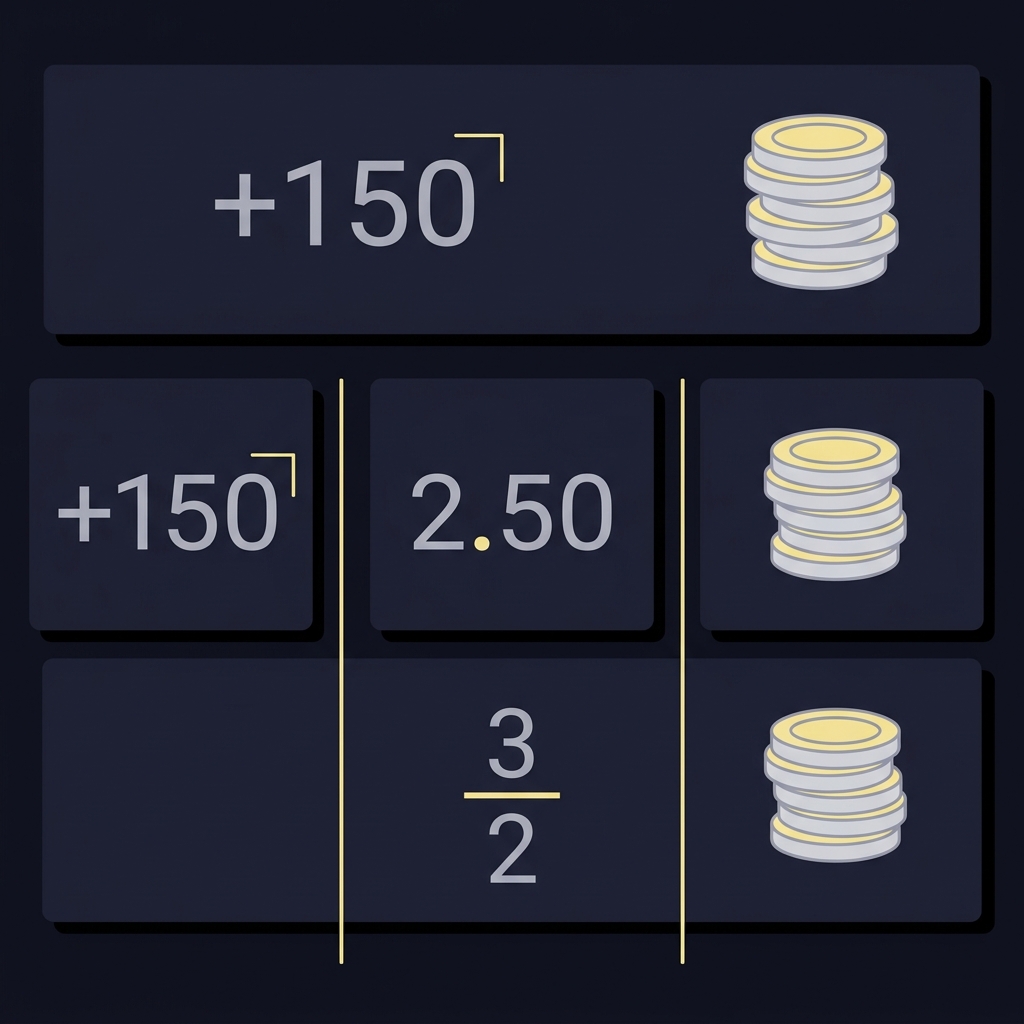
Worked example, positive odds: suppose you stake $50 at American +150. Use the + case formula: profit = 50 × (150/100) = 50 × 1.5 = 75, so net profit is $75 and total return is 50 + 75 = $125. This calculation follows the standard positive-moneyline rule and illustrates that a positive sign indicates profit relative to a $100 reference Investopedia moneyline explanation.
Worked example, negative odds: suppose you stake $50 at American -200. Use the - case formula: profit = 50 × (100/200) = 50 × 0.5 = 25, so net profit is $25 and total return is 50 + 25 = $75. The negative sign means the market prices that outcome as the favorite and specifies how much must be risked to win $100 in the reference frame Wikipedia odds.
To cross-check consistency you can compute implied probability from American odds. For positive American odds the formula is 100/(odds + 100) and for negative odds it is |odds|/(|odds| + 100). Using +150 from the earlier example, implied probability = 100/(150 + 100) = 100/250 = 0.4 or 40 percent, which aligns with the expected chance implied by that price Implied probability.
Remember that operator rounding or advertised minimum stakes can make the posted payout differ slightly from the pure formula result. If an operator shows a different total, check their stated rounding policy or settlement rules before assuming an error in the conversion Sports Betting 101.
Convert decimal odds to money: direct calculation and quick validation
Decimal odds are the simplest for direct money conversion because they quote total return per unit staked. The primary formulas are profit = stake × (decimal − 1) and total return = stake × decimal, which makes the mental steps quick and reduces risk of misreading stake versus return Investopedia decimal odds.
Use the format-specific formulas: for American use the plus or minus case formulas; for decimal multiply stake by decimal minus one for profit; for fractional multiply stake by a/b for profit. Always cross-check with implied probability and the even-odds test and verify operator rules for settlement and rounding.
Worked example: with a decimal price of 2.50 and a $20 stake, profit = 20 × (2.5 − 1) = 20 × 1.5 = $30 and total return = 20 × 2.5 = $50. This shows how decimal odds directly produce the cash outcome without converting to a separate stake reference point Investopedia decimal odds.
To validate results, use decimal → implied probability = 1/decimal. For the 2.50 example implied probability is 1/2.5 = 0.4 or 40 percent, which you can compare with a converted American or fractional price to ensure consistency across formats Implied probability.
Convert fractional odds to money: reading a/b formats
Fractional odds are expressed as a ratio a/b and represent net profit relative to the stake. The profit formula is profit = stake × (a/b) and total return is stake × (1 + a/b). Fractional prices can be converted to decimal with decimal = 1 + a/b to cross-check results, which keeps calculations consistent across formats Investopedia fractional odds.
Worked example 1: 1/1 with a $50 stake. Here a/b = 1/1 = 1, so profit = 50 × 1 = $50 and total return = 50 × (1 + 1) = 50 × 2 = $100. This matches the even-odds equivalence and is a useful sanity test when you want to validate calculators or listings Wikipedia odds.
Worked example 2: 3/1 with a $20 stake. Profit = 20 × (3/1) = 60 and total return = 20 × (1 + 3) = 80, which you can convert to decimal as 1 + 3 = 4.00 to confirm the same cash outcome using decimal formulas Investopedia fractional odds.
Watch for fractional formats like 6/5 where the numerator is only slightly larger than the denominator. Reading a/b correctly matters because misreading the order or misplacing the slash can produce a materially incorrect payout. Converting to decimal for a second check helps avoid these mistakes Investopedia fractional odds.
Implied probability and validation checks: ensure your calculator is consistent
Implied probability ties the three formats together and provides a quick way to verify a conversion by checking whether the implied chance matches across representations. Use decimal → 1/decimal, fractional a/b → b/(a + b), and American as 100/(odds + 100) for positive or |odds|/(|odds| + 100) for negative to compute the same implied chance in each format Implied probability.
The even-odds sanity test is a common first check: American +100, decimal 2.00, and fractional 1/1 all imply a 50 percent chance and should show profit equal to the stake and total return equal to 2× stake. If your calculator or an operator listing does not match this, investigate rounding rules or display conventions Wikipedia odds.

Be mindful that rounding and house rules can shift the last displayed cent of a payout. When you convert odds for real-money decisions, always verify your computed amounts against the operator’s published terms for settlement, minimum stakes, and maximum payout caps to avoid surprises Sports Betting 101. See Funded Plays for examples.
Common rounding, operator rules and pitfalls to watch for
Rounding affects how values are displayed and sometimes how they are settled. An operator might round displayed payouts to two decimals, truncate at settlement, or apply special rules for markets that close early, and those differences can create small mismatches between a mathematical calculator and the posted payout Sports Betting 101.
Typical operator rules that change payouts include minimum stake requirements, maximum payout caps, and settlement criteria for events that are voided or postponed. If you see an odd discrepancy, check whether the operator imposes a maximum payout or refuses single-cent rounding that your calculator assumed Sports Betting 101.
Another common pitfall is confusing net profit and total return. Net profit is what you gain above your stake, while total return is the stake plus profit. Make sure any comparison you do compares the same quantity across operators or formats to avoid mistaken conclusions Investopedia decimal odds.
Typical mistakes and a troubleshooting checklist
Many errors come from input mistakes: entering the wrong sign for American odds, omitting the currency for stake, or pasting fractional text incorrectly. Before you trust a result, run a short checklist to validate the inputs and outputs Investopedia moneyline explanation.
Input validation steps that quickly catch mistakes include format detection (is there a plus or minus sign for American?), requiring a currency field for the stake, and running the even-odds test to ensure the tool returns profit equal to stake at the equivalent of +100 / 2.00 / 1/1 Implied probability.
validate stake and odds format before calculation
Use this checklist before using the calculator
Fixing a mismatched payout example: suppose a user expected $125 but a calculator returned $124.98. First check rounding rules and the operator minimum stake, then verify the odds input was entered in the correct format. If everything checks out, consult the operator’s terms for settlement rules that might explain the cent difference Sports Betting 101.
Worked examples: three quick calculator scenarios
Example 1, American +150 with $50 stake. Using the positive moneyline formula profit = 50 × (150/100) = 75 and total return = 50 + 75 = $125. This is a straightforward conversion that demonstrates the positive-odds case Investopedia moneyline explanation.
Example 2, fractional 3/1 with $20 stake. Profit = 20 × (3/1) = 60 and total return = 20 × (1 + 3) = 80. Convert to decimal to check: decimal = 1 + 3 = 4.00, then profit = 20 × (4 − 1) = 60, total return = 20 × 4 = 80, which confirms consistency across formats Investopedia fractional odds.
Example 3, aggregated returns for multiple stakes. If you place $30 at decimal 2.2 and $50 at American +120 compute each profit separately then add. For the decimal leg profit = 30 × (2.2 − 1) = 36 and total return = 66. For the American leg profit = 50 × (120/100) = 60 and total return = 110. Combine profits 36 + 60 = 96 and combined returns 66 + 110 = 176 to get the aggregated picture aggregated returns Investopedia decimal odds.
Conclusion: best practices and what to trust
Conclusion: best practices and what to trust
Recap the core formulas: American positive profit = stake × (X/100), American negative profit = stake × (100/|X|), decimal profit = stake × (decimal − 1), fractional profit = stake × (a/b), and total return = stake + profit or stake × decimal or stake × (1 + a/b) depending on format. These relationships are stable and the foundation of any reliable conversion Wikipedia odds.
Before accepting a posted payout, run quick validation checks: compute implied probability and run the even-odds test to detect obvious mismatches, and verify operator’s published rules when real money is involved. Your final trust should be guided by the operator’s published rules, not only the raw calculator output Sports Betting 101.
Using an odds converter calculator or implementing these formulas by hand gives you a transparent, repeatable way to check payouts and compare offers. Keep a short checklist for input validation and you will reduce errors and increase confidence in the conversions you rely on Implied probability.
Use two cases: for positive odds profit = stake × (X/100); for negative odds profit = stake × (100/|X|); total return is stake plus profit.
Decimal odds are easiest because they quote total return per unit staked, so profit = stake × (decimal − 1).
Differences usually come from rounding, minimum stake rules, maximum payout caps, or settlement conventions on the operator side.
References
- https://en.wikipedia.org/wiki/Odds
- https://en.wikipedia.org/wiki/Implied_probability
- https://www.investopedia.com/terms/m/moneyline-bet.asp
- https://www.americangaming.org/resources/sports-betting-101/
- https://www.investopedia.com/terms/d/decimal-odds.asp
- https://www.fundedplays.com/challenges
- https://www.investopedia.com/terms/f/fractional-odds.asp
- https://www.actionnetwork.com/betting-calculators/betting-odds-calculator
- https://www.covers.com/tools/odds-converter
- https://oddsjam.com/betting-calculators/odds-converter
- https://www.fundedplays.com
- https://www.fundedplays.com/blogs/how-fundedplays-evaluations-work
- https://www.fundedplays.com/blogs