
Odds as decimal: what decimal odds mean and why it matters
Odds as decimal is a concise way to show the total return you get per unit staked, including your original stake. Decimal odds are expressed as a multiplier, so they make it easy to compute total payout with simple multiplication, which is why many platforms offer a decimal view in their settings.
Decimal odds matter when you calculate returns, track performance, or communicate picks, because they show the full return rather than profit-only figures; that distinction affects how you record results and compare selections across formats, especially when you move between fractional and decimal displays Investopedia guide to betting odds.
Practice conversions with FundedPlays challenge documentation
Keep reading for a step-by-step conversion and a worked example so you can check a sample calculation yourself without confusion.
Most betting and simulation platforms allow users to toggle between fractional, decimal, and American formats in their account settings, but the underlying math does not change when you switch views.
Quick definition

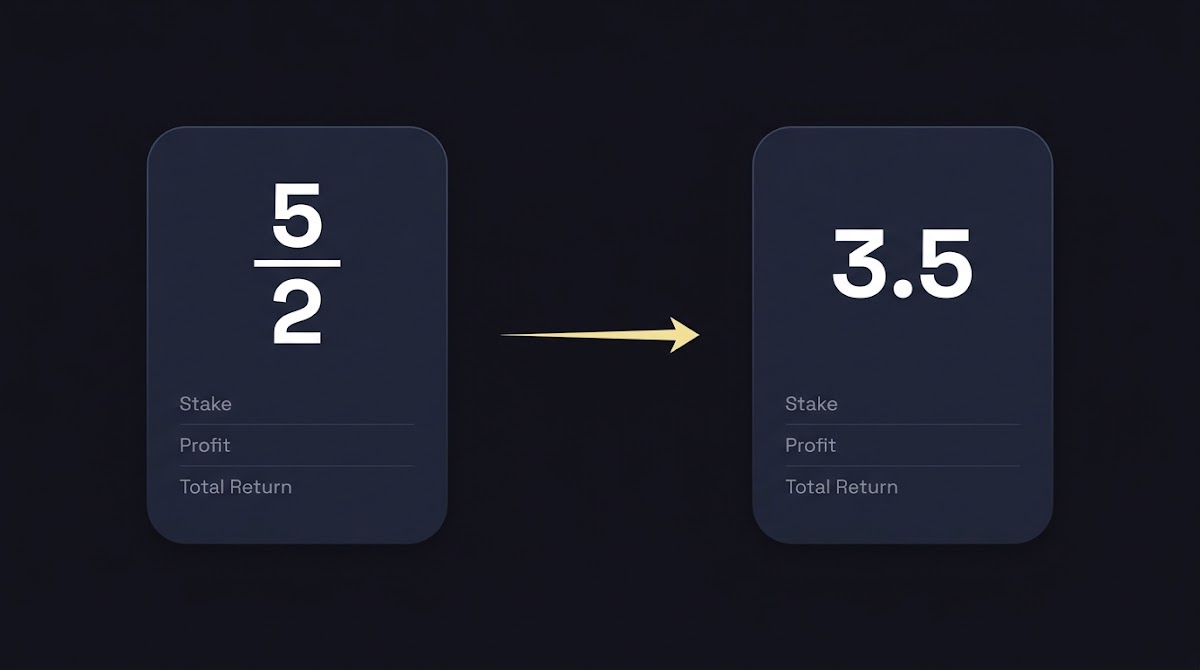
Decimal odds show total return per unit staked, including the returned stake, written as a number like 3.5 that you multiply by your stake to get the total payout.
Why formats differ and where you see them
Regional preferences and historical convention lead some services to display fractional or American odds by default, while others prefer decimal for its straightforward arithmetic. Knowing how to read decimal odds prevents miscommunication when sharing picks across audiences.
How to convert fractional odds to decimal
The conversion formula
The formula to convert fractional odds a/b to decimal is decimal = (numerator denominator) + 1. Stated clearly, divide the top number by the bottom number and then add one to include the returned stake; this is the standard conversion shown in educational guides sports betting references.
Step-by-step worked conversion
Start with a generic fraction a/b. Compute a divided by b to get the profit-per-unit figure. Then add 1 to convert that profit-only result into a total-return multiplier. This two-step method is the reliable way to convert any fractional quote into decimal odds Investopedia guide to betting odds.
As a practical tip, write the steps down when you first learn the method: 1) divide numerator by denominator, 2) add 1, 3) multiply your stake by the decimal to get the total payout.

Common missteps when using odds as decimal
One common error when converting or reading decimal odds is omitting the +1 step and treating fractional quotes as if they were already total-return multipliers; that leads to underestimating returns and mismatching profit versus total payout figures Pinnacle on understanding odds.
Another frequent mistake is confusing the profit-only interpretation of fractional odds with the total-return interpretation of decimal odds; fractional 5/2 quotes profit of 2.5 per 1 staked, while decimal expresses the full return including stake.
No. Fractional 5/2 converts to decimal 3.5 because decimal odds include the returned stake; use decimal = (numerator/denominator)+1 to convert and p = 1/decimal for implied probability.
To check your work quickly, recalculate with the formula, compute implied probability, or paste the numbers into a simple spreadsheet formula to confirm results.
Worked example: converting 5/2 to decimal and calculating payout
Step 1: convert fraction to decimal
Apply decimal = (5 2) + 1. Dividing 5 by 2 gives 2.5; adding 1 yields 3.5, so the correct decimal equivalent of fractional 5/2 is 3.5, not 2.5. This conversion and its reasoning are standard in modern explanations of odds formats Investopedia guide to betting odds.
Step 2: apply to a stake and show total return and profit
If you stake 10 at decimal 3.5, your total return is stake times decimal, which is 10 d 3.5 = 35, meaning you receive 35 back. The profit portion is total return minus stake, so 35 d 10 = 25 profit; this worked payout example is a clear way to see the role of the returned stake in decimal odds Betfair betting guide.
As a cross-check, converting that decimal back to implied probability using p = 1/decimal shows how likely the market implies the selection is to win; use this next section for the probability math.
Why 5/2 is not the same as 2.5: algebra versus betting convention
Algebraically, 5 divided by 2 equals 2.5, and you can colloquially say 2.5-to-1. In betting terms, however, fractional odds quote profit relative to stake, so the fractional 5/2 represents profit of 2.5 per 1 staked; converting to decimal requires adding 1 to include the returned stake, giving 3.5 as the correct decimal equivalent Investopedia guide to betting odds.
That distinction explains why the raw ratio 2.5-to-1 is not the same as the decimal number 2.5 when you are evaluating payouts and implied probabilities; one is a profit-only ratio, the other would be a total-return multiplier if it were used as a decimal, and here the correct decimal is 3.5.

Platforms that support educational simulations and funded challenge models typically document how they display odds and allow switching formats, which helps users learn conversions without changing the underlying calculations.
How to convert decimal odds to implied probability
The probability formula
The formula linking decimal odds to implied probability is p = 1 / decimal. This is the standard method used to translate market odds into an implied chance and is commonly covered in betting education materials Investopedia on implied probability.
Examples and common rounding choices
Applying p = 1 / 3.5 gives approximately 0.2857, or about 28.57% implied probability for decimal 3.5. By contrast, decimal 2.5 implies 1 / 2.5 = 0.4, or 40% probability, which demonstrates numerically why 5/2 and decimal 2.5 are not equivalent Pinnacle on implied probability.
For display, many writers round probabilities to one or two decimal places depending on audience and context; choose a consistent rounding rule and state it when publishing picks or reports.
Tools and calculators to check odds conversions
To avoid manual errors, use an online odds converter or a simple spreadsheet formula that applies the conversion formula directly; reliable guides show both approaches and why they are helpful for fast verification Investopedia guide to betting odds.
Copy-paste spreadsheet formulas save time: for conversion use =(numerator/denominator)+1 and for implied probability use =1/decimal, which you can adapt into Excel, Google Sheets, or similar tools.
quick decimal and probability check from fraction inputs
returns decimal and implied probability
When using online converters be mindful of rounding options and whether the converter displays profit-only or total-return figures; using your own spreadsheet lets you control rounding and labels explicitly.
Converting between decimal, fractional, and American odds
At-a-glance conversion rules
Fractional to decimal: decimal = (numerator d denominator) + 1. Decimal to fractional: subtract 1 from the decimal, then express the remainder as a fraction and simplify. These rules let you move cleanly between formats without losing the meaning of profit versus total return OddsJam guide to decimal odds.
When American odds behave differently
American (moneyline) odds use a sign to indicate favorites and underdogs and a different numeric mapping; converting between American and decimal requires separate formulas and care with sign conventions, which educational resources cover alongside decimal and fractional conversions Pinnacle on odds formats.
As a compact example, present the same selection in all three formats so readers can compare: show fractional 5/2, decimal 3.5, and the corresponding moneyline where applicable, and label each as profit-only or total-return to avoid ambiguity.
Practical stakes examples and show-your-work templates
Example 1: Stake 10 at fractional 5/2. Convert 5/2 to decimal 3.5, multiply 10 by 3.5 to get total return 35, then compute profit 35 minus 10 to get 25. This step-by-step layout keeps the arithmetic transparent for record-keeping Betfair betting guide.
Example 2: Stake 25 at a fractional 2/1 quote. Convert 2/1 to decimal by (2 d 1) + 1 = 3.0, multiply 25 by 3.0 to get 75 total return, with 50 profit. Example 3: Stake 5 at fractional 1/4. Convert to decimal as (1 d 4) + 1 = 1.25, multiply 5 by 1.25 to get 6.25 total, profit 1.25.
Reusable template: decimal = (a/b)+1; total return = stake * decimal; profit = total return - stake. Paste those lines into a spreadsheet or note to make every conversion auditable and repeatable.
When choice of odds format matters: platforms, clarity, and communication
Choose the format that best suits your audience: decimal for quick math, fractional for traditional readers in some regions, and American for moneyline-oriented audiences. State the format when you share picks to avoid misunderstanding about whether figures are profit-only or total-return BeGambleAware on odds and payouts.
FundedPlays and similar educational platforms document format options and let users select their preferred view so that learners can practice conversions and track simulated bankrolls without changing the underlying calculations.
When posting picks, consider listing both fractional and decimal forms to reach readers who use different conventions and to maintain clarity in your record-keeping.
Decision checklist: when to use decimal odds in guides or reports
Know your audience: prefer decimal when you expect readers to do arithmetic quickly or compare returns across many selections.
Accuracy and auditability checklist: state your conversion formula, use a spreadsheet formula to compute totals, show implied probability alongside decimal odds, and recompute a sample stake as a final verification step Investopedia on implied probability.
Top errors and how to avoid them when converting odds
Top mistakes include omitting the +1 step, mixing profit and total-return figures, incorrect rounding, and misreading platform displays; these errors are easy to catch if you standardize a show-your-work template and require a verification step before publishing picks Pinnacle on common mistakes.
Editorial checks that help: include one worked example per article, paste the spreadsheet formula in an editor note, and ask a colleague to reproduce one sample payout before sharing picks publicly.
Conclusion: final takeaway on 'Is 5/2 the same as 2.5?'
Bottom line
Bottom line: fractional 5/2 converts to decimal 3.5, not 2.5; remember decimal = (a d b) + 1 to include your returned stake when you move from profit-only fractions to total-return decimals Investopedia guide to betting odds.
Quick reminder for readers
If you ever doubt a conversion, run the three quick checks: apply the formula, compute implied probability with p = 1/decimal, and verify a sample stake payout with your spreadsheet. Clear labeling of profit versus total-return will prevent most misunderstandings.
Divide the numerator by the denominator and add 1; decimal = (numerator/denominator)+1.
Decimal 3.5 means total return is 3.5 times your stake; profit equals that return minus the original stake.
Use p = 1/decimal and express the result as a percentage, rounding consistently for display.
References
- https://www.investopedia.com/betting-odds-explained-5205633
- https://en.wikipedia.org/wiki/Sports_betting
- https://www.pinnacle.com/en/betting-articles/betting-strategy/understanding-betting-odds/LQ2JE4H98TZ2GLMB
- https://betting.betfair.com/betting-guides/betting-odds-explained.html
- https://www.investopedia.com/terms/i/implied-probability.asp
- https://www.fundedplays.com/challenges
- https://www.begambleaware.org/advice-and-support/how-gambling-works/odds-and-payouts
- https://www.aceodds.com/bet-calculator/odds-converter.html
- https://www.covers.com/tools/odds-converter
- https://oddsjam.com/betting-education/decimal-odds
- https://www.fundedplays.com
- https://www.fundedplays.com/blogs
- https://www.fundedplays.com/blogs/how-fundedplays-evaluations-work