

What no vig odds means: a clear definition
No vig odds are prices adjusted to remove the bookmaker margin so you can see the market's implied fair probabilities and compare them to your own estimates. The practice of removing the bookmaker charge, often called vigorish or vig, helps bettors and analysts recover a vig-free price for decision-making, and it is a common step in line comparison and value assessment Investopedia vigorish definition.
In daily use, stripping the vig turns posted prices that include the house fee into a set of probabilities that sum to 100 percent. That normalized view, sometimes called vig-free odds or fair odds, is what most no-vig calculators return after the arithmetic is done Pinnacle betting resources.
The main benefit of producing no vig odds is simple: it creates a common baseline for comparing multiple sportsbooks and for checking whether a model's probability indicates an edge versus the market. Practically, the technique relies on basic probability normalization and works best when input prices are reasonably efficient and margins are distributed in a straightforward way Action Network no-vig explanation.
Explore no-vig comparison with FundedPlays challenge tools
Try stripping the vig on one line you follow, and see how the implied probabilities change before you decide whether a posted price looks like value.
Why bookmakers include a vig and how it affects prices
Bookmakers include a margin so they earn a predictable fee for offering markets and managing risk, rather than operating on zero markup where small pricing errors would eliminate their cushion. That fee, the vigorish, is built into posted odds as a systematic overround that funds operations and balances books Investopedia vigorish definition.
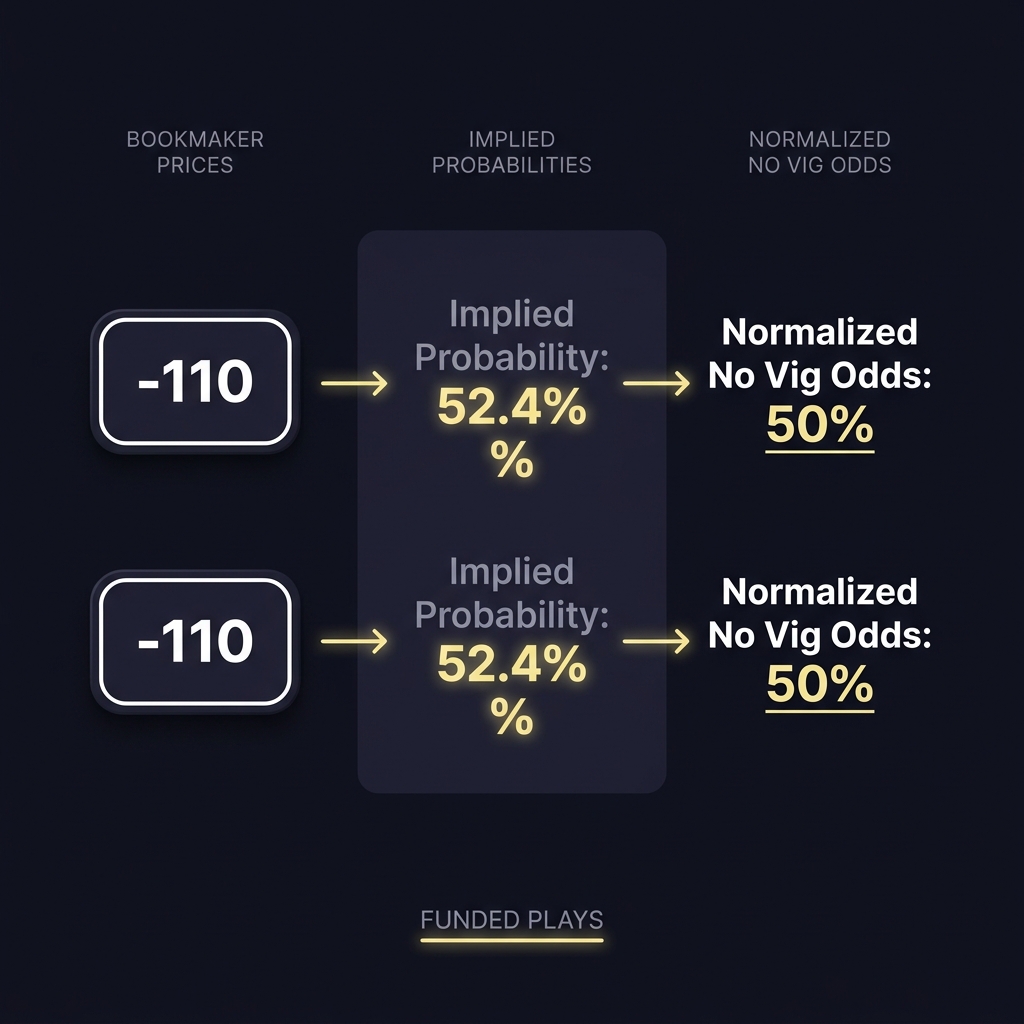
When margins are applied symmetrically you will often see common two-way lines such as -110 on both sides of a point spread or total. Those symmetric prices imply slightly more than a 50 percent chance for each outcome after converting odds to implied probabilities, which is how the market fee becomes visible to a careful observer Smarkets overround explainer.
Margins are not always symmetric. Books adjust lines in response to money flows, new information, or risk management needs, and that can create asymmetric pricing where one side is worse value than the other. Recognizing whether a vig is symmetric or skewed is an important first step before applying a simple no-vig normalization.
How the vig shows up as an overround and implied probability
The algebra behind the vig is straightforward: convert posted odds into implied probabilities, sum those probabilities across all outcomes, and if the total exceeds 100 percent the excess is the book's overround. Identifying that overround is the practical way to see how much margin is in the market Pinnacle betting resources.
For American odds you convert negative and positive lines to decimal or directly to implied probabilities using standard formulas and then add the results. For decimal odds the implied probability is 1 divided by the decimal price; for American odds the same end result follows after conversion, and many educational pages show both conversions side by side Pinnacle betting resources.
No vig means odds have been adjusted to remove the bookmaker's built-in charge, revealing the market's implied fair probabilities for easier price comparison and value assessment.
Recognizing the overround is the first step toward any no-vig adjustment, because normalization uses that summed probability as the divisor when producing vig-free probabilities.
Step-by-step: calculating no vig odds (standard normalization)
Standard proportional normalization follows three clear steps you can reproduce by hand or in a spreadsheet: convert odds to implied probabilities, compute the total probability (the overround), divide each implied probability by that total to get the fair probability, then convert those fair probabilities back into the odds format you prefer. This stepwise method is the one used by many calculators and teaching pages Pinnacle betting resources (see a no-vig calculator: Sharp Betting).
Step 1, convert to implied probabilities: with decimal odds use 1 / decimal. For American odds, convert negative and positive numbers to decimal first or apply the standard American-to-probability conversion. Keep a consistent rounding policy so small differences do not compound when you convert back to odds Action Network no-vig explanation.

Step 3, convert normalized probabilities back to odds: if you want American odds from a normalized probability p, convert using the standard mapping for favorites and underdogs; if you prefer decimal, use 1 / p. Many no-vig calculators return both decimal and American formats so you can compare apples to apples, and they handle rounding choices for you Action Network no-vig explanation.
Implementation notes: watch rounding and display choices, document whether you used decimal or American inputs, and be explicit about ties or three-way markets where the normalization needs to include the draw probability as well. For three-outcome markets the same logic applies, you just include all three implied probabilities in the overround before normalizing Pinnacle betting resources.
How bettors and analysts use no-vig odds to find value
One common use for no-vig odds is line shopping: compute vig-free prices from multiple sportsbooks and see whether a posted price beats the market's implied fair price. If a book posts a price that is better than the vig-free price, that price can represent actionable value for a bettor who trusts their model or edge assessment Pinnacle betting resources.
Modelers often compare their own probability estimates to the vig-free probabilities to estimate expected value. The difference between the model probability and the vig-free price, combined with stake sizing rules, helps determine whether a wager looks justified under a disciplined plan Action Network no-vig explanation.

Practical note: no-vig outputs are only as reliable as the input prices and the normalization assumption. Use multiple books when you can (see our blog) and treat the vig-free price as a benchmark, not a guarantee, especially in less liquid markets.
Decision criteria: when to rely on no-vig adjustments
No-vig normalization works best when markets are competitive and liquid, and when prices do not show obvious skew driven by predictable money flows. In such markets proportional normalization produces a sensible market benchmark for comparison Pinnacle betting resources.
Conversely, avoid treating normalized outputs as ground truth in thin markets, when lines are stale, or when you see persistent asymmetry that suggests the margin is not applied evenly. Those are scenarios where a simple no-vig calculator can mislead you about actual fair probabilities Smarkets overround explainer.
Quick checklist before trusting an adjustment: confirm prices across at least two books, check timestamps to ensure lines are current, and prefer markets with clear liquidity and steady action.
Limitations and alternatives: when proportional normalization falls short
Proportional normalization assumes the bookmaker margin is applied evenly, which is often a reasonable approximation but not always correct. When insiders, skewed flows, or deliberate asymmetry are present, proportional normalization can produce biased fair probabilities Pinnacle betting resources.
An established alternative is the Shin model, which explicitly models insider-driven bets and can shift the fair probabilities when one side looks supported by informed staking. Shin-style adjustments are more complex to implement and require assumptions about the scale of inside information, so they are less common in day-to-day calculators but important for advanced analysis Shin academic article.
a brief checklist for considering advanced no-vig adjustments
Use when simple normalization looks inconsistent
As a practical rule, use simple proportional normalization for quick comparisons and reserve Shin-style or other adjustments for deeper forensic work where the stakes justify the extra complexity Action Network no-vig explanation.
Typical mistakes and traps to avoid when using no-vig odds
A common mistake is computing no-vig odds from a single stale line without cross-checking other books. That single-book approach risks capturing a temporary imbalance rather than a market consensus, and it can falsely suggest value where none exists Pinnacle betting resources.
Conversion and rounding errors are another frequent trap. When you convert between American and decimal formats, or when you round intermediate probabilities too aggressively, small discrepancies can appear in the final odds. Keep consistent precision rules and document conversions Action Network no-vig explanation.
Finally, do not assume a vig-free probability equals the true chance of an event in markets that may be inefficient or affected by insider flows. Treat no-vig odds as a diagnostic and comparison tool rather than an absolute truth Smarkets overround explainer.
Worked example 1: stripping vig from a symmetric -110/-110 market
Start with the common symmetric two-way example you see on spreads and totals: -110 on both sides. Convert -110 to decimal odds (2.9091? No, convert carefully), or use the standard American-to-probability conversion to find the implied probability for -110, which is commonly shown in educational material Smarkets overround explainer.
For clarity, a direct way to compute is: convert -110 to decimal 1.9091, derive implied probability as 1 / 1.9091 which yields about 0.524, or 52.4 percent for each side. Adding both implied probabilities produces an overround around 104.8 percent in the symmetric case, which shows the market is pricing in a margin rather than 100 percent total probability Action Network no-vig explanation.
Normalize by dividing each 52.4 percent figure by the total overround 104.8 percent, which yields a normalized probability very close to 50 percent for each side. Converting that 50 percent back to odds produces a vig-free fair price near even, illustrating how the -110 symmetry hides a roughly 4 to 5 percent margin that disappears once normalized Overround overview.
Interpretation: after normalization the market's fair probability for each side is near 50 percent, and a posted price that offers somewhat better than that vig-free price could indicate value for a disciplined bettor who has a separate reason to prefer one side.
Worked example 2: asymmetric market adjustments and when to be skeptical
Consider a simple asymmetric example where one side is -120 and the other is +100. Convert both to implied probabilities, sum them, and normalize proportionally to remove the overround; that yields a set of vig-free probabilities that reflect the proportional method Pinnacle betting resources.
In this asymmetric case proportional normalization will produce different fair probabilities that still sum to 100 percent, but the result may hide why the prices were asymmetric to begin with. If the skew is due to insider information or an unusually lopsided flow, a Shin-style adjustment would reweight the probabilities to account for informed staking and produce a different fair estimate Shin academic article.
Most everyday calculators apply proportional normalization so be aware that an asymmetric input book can yield a vig-free output that understates the possibility of informed skew. For a free calculator example see The Rundown: The Rundown. Use alternative adjustments when you have reason to suspect non-proportional margins or inside information Action Network no-vig explanation.
Practical checklist: steps to use no-vig odds in your routine
Pre-checks: confirm multiple books show similar lines, verify timestamps so you are not using stale prices, and prefer markets that demonstrate liquidity before trusting normalized outputs Pinnacle betting resources.
Decision rules: when your model probability exceeds the vig-free probability by a meaningful margin consider a stake sized according to your rules; require a buffer that accounts for slippage and conversion rounding Action Network no-vig explanation.
Remember: no-vig is a comparison tool. It helps you see whether posted prices differ from the market's implied fair price, but it does not predict outcomes or eliminate risk.
How to integrate no-vig odds into models and bankroll plans
Use vig-free probabilities as the market benchmark when computing expected value. For each candidate wager compare your model's probability to the vig-free probability and calculate expected value using the market price you would receive if the price exceeds your edge criteria Pinnacle betting resources (see how Funded Plays evaluations work).

Finally, treat no-vig as one input among many. Combine it with sound bankroll rules, variance expectations, and post-entry performance tracking rather than using it as the sole decision rule.
Summary and next steps: what to remember about no vig odds
Key takeaways: no-vig odds are produced by converting odds to implied probabilities, summing the overround, normalizing each probability, and converting back. That process removes the bookmaker margin and yields a market benchmark for comparison Pinnacle betting resources.
Use no-vig adjustments for line shopping and edge estimation, but be mindful of limits: proportional normalization assumes even margins and can be misleading in skewed or thin markets, where alternatives like the Shin model may be more appropriate Shin academic article.
Next steps: try a no-vig calculator with a few lines you follow (for example try OddsGPT or visit Funded Plays homepage), compare results across books, and incorporate the output into your model checks and stake sizing rules rather than treating it as a guarantee.
Further reading and trusted references
For clear definitions and background on vigorish consult Investopedia's explanation of vigorish, which provides accessible context for the bookmaker margin Investopedia vigorish definition.
For step-by-step calculation guidance and overround detail see Pinnacle's betting resources, which walk through probability conversion and margin measurement in practical terms Pinnacle betting resources.
For calculator examples and practitioner-focused guidance, the Action Network overview shows no-vig calculators in action and discusses implementation notes and rounding choices Action Network no-vig explanation.
No vig means odds have been adjusted to remove the bookmaker's built-in margin so the probabilities sum to 100 percent.
No, no-vig odds are a market benchmark; they help compare prices but do not guarantee actual event probabilities, especially in thin or asymmetric markets.
Consider the Shin adjustment when you suspect insider-driven betting or persistent asymmetric lines that simple proportional normalization cannot explain.
References
- https://www.investopedia.com/terms/v/vigorish.asp
- https://www.pinnacle.com/en/betting-resources/education/how-to-calculate-betting-margins
- https://www.actionnetwork.com/education/no-vig-odds-calculator-explained
- https://blog.smarkets.com/understanding-overround/
- https://www.jstor.org/stable/2234527
- https://en.wikipedia.org/wiki/Overround
- https://www.fundedplays.com/challenges
- https://www.fundedplays.com/blogs
- https://sharpbetting.co.uk/calculator/no-vig-calculator
- https://therundown.io/betting-calculators/no-vig-calculator
- https://www.fundedplays.com
- https://www.fundedplays.com/blogs/how-fundedplays-evaluations-work
- https://www.oddsgpt.com/novig-calculator/en