
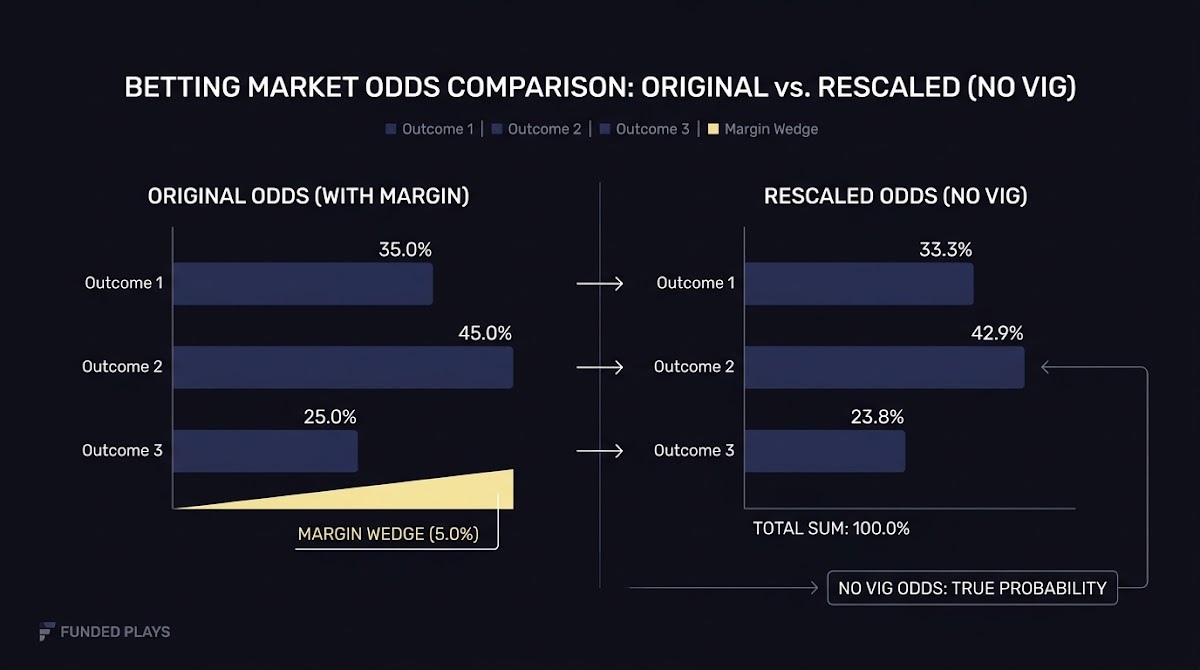
What no vig odds are and why they matter
No vig odds refer to prices adjusted to remove the bookmaker margin so the implied probabilities add up to 100 percent; the process begins by converting posted prices into implied probability and then rescaling them to produce fairer, vig-free prices for comparison.
Bookmakers embed a margin, often called overround or sportsbook hold, which makes the sum of implied probabilities exceed 100 percent and is how operators secure a theoretical edge in markets, a point explained in the industry primer from Pinnacle Betting Resources Pinnacle betting resources.
Traders, analysts and disciplined bettors use no-vig lines to isolate the market-implied assessment of outcomes so they can compare prices across books, compute break-even thresholds and check model output without the distortion of embedded margin, which is useful for systematic line-shopping and model validation as described in practical guides to removing the vig Unabated guide on removing the vig.
How to calculate no-vig odds step-by-step
Step 1, convert posted odds to implied probability. For decimal odds, implied probability equals 1 divided by the decimal price. For American odds, use the standard conversion formulas to turn positive or negative American numbers into the same implied probability format, a process covered in betting education resources Pinnacle betting resources. See a free no-vig calculator at Therundown.
Step 2, compute the book total by summing all implied probabilities. That total is the overround and it usually exceeds 100 percent when a margin is present, which tells you how much rescaling is necessary to reach fair prices Unabated guide on removing the vig.

Step 3, rescale each outcome proportionally by dividing its implied probability by the overround total, then multiply by 100 to get the no-vig percentage. This proportional normalization is the common method used when you want a straightforward, reproducible adjustment to compare markets Unabated guide on removing the vig.
Worked example, two-way moneyline. Suppose Book A posts decimal odds of 1.90 and 2.10. Convert to implied probabilities: 1.90 becomes 1/1.90 = 0.5263 or 52.63 percent, and 2.10 becomes 1/2.10 = 0.4762 or 47.62 percent.
Next compute overround: 52.63 plus 47.62 equals 100.25 percent. To remove the vig proportionally, divide each implied probability by 100.25 and multiply by 100, which rescales the probabilities to sum to 100 percent while preserving the relative assessment between outcomes.
After rescaling, the first outcome becomes 52.63 / 100.25 times 100 = 52.47 percent, and the second becomes 47.62 / 100.25 times 100 = 47.53 percent. You can convert these back to decimal odds by computing 100 divided by each percentage; doing so produces the no-vig decimal prices you can use to compare across books Unabated guide on removing the vig.
Practice removing the vig with a worksheet
Try these steps on a spreadsheet or printed worksheet to see how small differences in posted prices affect your break-even points.
After the worked example, a simple worksheet helps keep calculations consistent: list posted prices, convert to implied probabilities, sum to get overround, rescale proportionally and then convert back to the price format you prefer for comparison; these steps are the practical backbone of a no-vig calculation routine Unabated guide on removing the vig.
Common de-vig methods and modeling choices
The proportional normalization method rescales implied probabilities so they sum to 100 percent and is the most common de-vig technique because it is simple, transparent and easy to reproduce for two-way and three-way markets Unabated guide on removing the vig. See a summary of different no-vig methods at DRatings.
Alternative approaches exist that allocate margin differently. One influential academic model allocates margin under assumptions about informed traders and can produce different no-vig allocations when insider information is a credible concern, a point originally explored in the literature on insider trading models Shin model paper.
Removing margin gives a cleaner basis for price comparison and expected-value checks, but it does not guarantee profit; results depend on method choice, market type and a bettor's real predictive edge.
In practice, the chosen method matters because different de-vig approaches can yield materially different no-vig lines, so tools and published de-vig outputs should state their method and assumptions so users can judge suitability for their workflow Unabated guide on removing the vig.
How to use no-vig odds for expected value, line-shopping and bankroll planning
Start with break-even probability. If your assessment of an outcome exceeds the no-vig probability, that gap is the basis for expected value calculations; converting that gap into expected value requires considering the posted price you can access and your stake size, an approach described in practical betting analytics material Pinnacle betting resources. You can also see how Funded Plays evaluations work at Funded Plays evaluations.
To compute expected value for a posted price, compare your assessed probability to the no-vig probability and then multiply the expected return by stake. Using no-vig probabilities rather than posted prices removes the bookmaker margin and makes the comparison cleaner, which helps disciplined decision-making and sizing choices Unabated guide on removing the vig.

Line-shopping with no-vig lines means converting each book's posted prices into a common, fair scale and then choosing the book that offers the best posted price relative to your assessed probability; this process highlights true price differences that can matter for long-run outcomes when applied consistently Unabated guide on removing the vig.
Remember that no-vig outputs are tools for disciplined evaluation, not guarantees. Realized returns depend on having a genuine edge, reasonable limits, and adherence to bankroll rules, which is why no-vig analysis should be paired with careful testing and conservative stake sizing Unabated guide on removing the vig.
Limitations and common pitfalls when using no-vig odds
Proportional rescaling assumes the bookmaker margin is spread evenly across outcomes; this simplification is practical but can misrepresent true market allocations when books load pricing asymmetrically, a limitation noted in practical bookmaking discussions Smarkets help on overround.
Asymmetric pricing, large overrounds or markets where operators price to manage liability can create distortions that make proportional de-vig outputs misleading if taken as absolute probabilities, so treat the results as model-dependent estimates rather than definitive truths Unabated guide on removing the vig.
Another common pitfall is applying simple de-vig methods to correlated bets or prop markets without sensitivity checks; in those cases the even-margin assumption breaks down and alternative model-based approaches or bespoke pricing may be needed Smarkets help on overround.
Practical examples: de-vig a two-way moneyline and a three-way match market
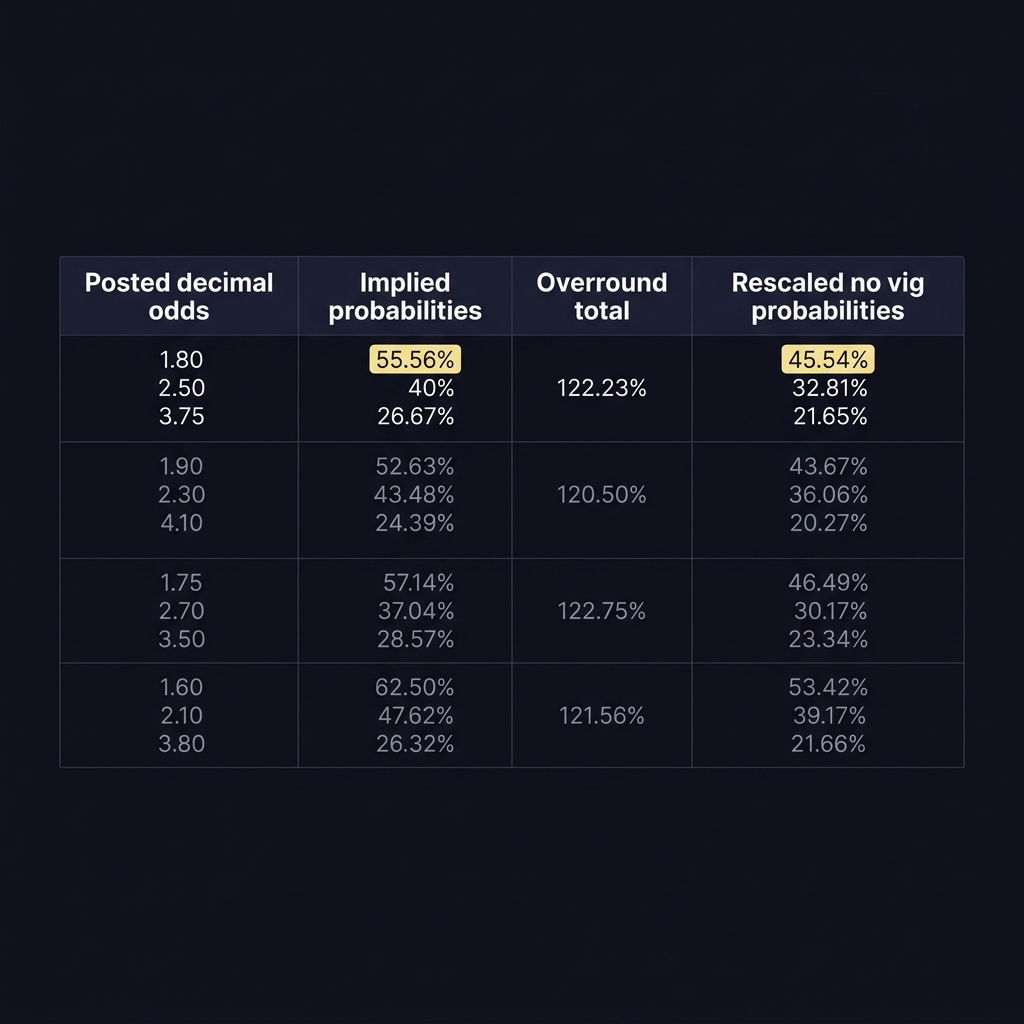
Two-way moneyline worked example, continued. Using the earlier decimals 1.90 and 2.10, after rescaling the no-vig decimals were around 1.907 and 2.103 when you convert the rescaled probabilities back to price format, which makes differences easier to compare across books and confirms the proportional method preserves relative assessments Unabated guide on removing the vig. Try a free no-vig calculator such as Mongoose Bets.
Step labels for replication: 1) list posted decimals, 2) convert to implied probabilities, 3) sum to get overround, 4) rescale each implied probability by dividing by the overround and multiplying by 100, 5) convert rescaled probabilities back to decimals for comparison. Following those labels consistently prevents arithmetic mistakes and supports reproducible checks Unabated guide on removing the vig.
Convert implied probabilities and rescale to 100 percent
Use decimal implied probabilities without percent
Three-way markets extend the same steps but tend to magnify rounding and allocation effects because you rescale three numbers instead of two; small differences in each posted price can shift the no-vig percentages noticeably after rescaling, so label each intermediate number when sharing calculation steps Pinnacle betting resources.
When a book shows very large overrounds or obvious juice on one side, check whether the advantage comes from the book skewing margins rather than true value; in those cases you may prefer to treat the no-vig output cautiously or use model-based pricing to cross-check the result Smarkets help on overround.
Special cases: props, correlated bets and model-dependent outcomes
Prop bets and correlated markets can concentrate margin in a way that violates proportional assumptions, for example when lines are linked by an underlying event or when operators price to limit liability across multiple positions, which complicates simple de-vig routines Smarkets help on overround.
For these special cases, consider sensitivity checks and model-based pricing rather than a single proportional rescale. Running scenario tests or building a small simulation that respects the correlation structure will usually produce more reliable estimates than a blind de-vig calculation Unabated guide on removing the vig.
Expect different de-vig methods to diverge more in these markets; if you report no-vig lines publicly or use them in automated decisioning, always state the method and include caveats about correlation and model dependence so users understand the limits of the numbers Shin model paper.
How industry reporting continues to track sportsbook hold or win as an aggregate measure of margin, and public reports give context for typical marketplace margins across jurisdictions, which helps interpret whether a single book's overround is unusually large AGA State of the States 2024 report.
Comparing an individual book's overround to industry aggregates can highlight outliers; when a book's overround is far above typical levels it may indicate heavy juice on certain lines or a structural pricing choice rather than a pure market disagreement, so use industry data to inform how much weight you place on a given no-vig result Pinnacle betting resources.
A practical checklist: decision criteria before you act on no-vig lines
Quick pre-bet checklist: verify which de-vig method you used, confirm the market type and correlation risk, compare overrounds across books, compute expected value with your assessed probability and make sure the stake fits your bankroll plan; following these steps turns no-vig outputs into actionable inputs rather than final answers Unabated guide on removing the vig. See more in our blog.
Questions to ask when comparing books include whether a price advantage remains after converting to no-vig terms, whether the advantage is larger than transaction costs or limits, and whether asymmetric margin or liability management is driving the difference; these checks help separate meaningful edges from artifacts of pricing structure Pinnacle betting resources.
Decision thresholds are subjective, but treat small no-vig advantages cautiously and prefer consistent, repeatable advantages that survive sensitivity checks and account for platform rules and limits before committing larger stakes Unabated guide on removing the vig.
Conclusion: is no vig good for your betting decisions?
No-vig odds are a useful analytical tool for comparison, break-even calculation and disciplined line-shopping because they remove embedded bookmaker margin and present a cleaner view of market-implied probabilities, which supports repeatable decision processes Unabated guide on removing the vig. Visit Funded Plays for more resources.
However, no-vig outputs are model-dependent and can mislead in special cases such as props, correlated bets or markets with asymmetric pricing, so always state your de-vig method, run sensitivity checks and pair no-vig analysis with sound bankroll discipline rather than treating it as a guarantee of profit Smarkets help on overround.
No vig odds are prices adjusted to remove the bookmaker margin so implied probabilities sum to 100 percent, giving a fairer basis for comparison.
No, no-vig odds help assess expected value and compare prices, but profits require a true predictive edge and proper bankroll management.
The proportional rescale is the simplest and most common. Use alternative models only when you have reason to adjust for insider information or correlation.
References
- https://www.pinnacle.com/en/betting-resources/educational/what-is-margin-and-how-to-calculate-it
- https://unabated.com/insights/how-to-remove-the-vig/
- https://www.jstor.org/stable/2234527
- https://help.smarkets.com/hc/en-gb/articles/214147025-Overround-and-theory-of-bookmaking
- https://www.americangaming.org/wp-content/uploads/2024/05/AGA-State-of-the-States-2024.pdf
- https://www.fundedplays.com/challenges
- https://www.fundedplays.com
- https://www.fundedplays.com/blogs
- https://www.fundedplays.com/blogs/how-fundedplays-evaluations-work
- https://www.dratings.com/a-summary-of-different-no-vig-methods/
- https://therundown.io/betting-calculators/no-vig-calculator
- https://mongoosebets.com/tools/no-vig-calculator