

What no-vig odds are and why they matter
No vig odds are market prices adjusted to remove the bookmaker margin so the implied probabilities sum to 100 percent. The bookmaker margin, often called vigorish or the overround, is the built-in premium that makes the sum of implied probabilities exceed 100 percent; understanding this concept is the first step to seeing why a "no vig" price looks different from listed sportsbook lines, and how removing the margin reveals the market consensus in purer form. Investopedia definition of vigorish
The standard transformation to create no-vig prices starts with converting quoted odds into implied probabilities, summing those probabilities to calculate the overround, dividing each implied probability by that overround to renormalize them to 100 percent, and then converting the renormalized probabilities back into odds. This process isolates the market's consensus probability for each outcome by stripping away the embedded margin. Action Network guide to removing the juice
run the no-vig conversion for a set of quoted odds
Use as a worksheet for each outcome
Why this matters: removing vig helps bettors and analysts compare prices from different venues on the same footing, detect value opportunities, and evaluate whether a given line actually reflects fair probabilities or simply a lower headline margin. When you compare no vig odds from separate sources you are comparing their implied consensus probabilities rather than two different pricing conventions.
Practical usage often means taking a quoted market, converting to no-vig, and then checking whether your estimated probability for an outcome exceeds the no-vig probability enough to justify a bet or trade. This step is fundamental for disciplined decision making and for consistent bankroll management.
Step-by-step: how to calculate no-vig odds
Follow this repeatable sequence to compute no-vig odds from any quoted market. Step 1, convert each quoted price to an implied probability. For decimal odds the implied probability is 1 divided by the decimal odds. For American odds use the standard conversion rules that map positive and negative American values to their decimal equivalent, then to probability. Phrase each step as an action and carry it out for every listed outcome before you compute totals. Action Network no-vig conversion steps

Step 2, compute the overround by summing all implied probabilities. This sum will typically exceed 1.0 when a bookmaker margin is present. Step 3, renormalize by dividing each individual implied probability by the overround; the resulting values will sum to exactly 1.0 and represent the no-vig probabilities. Step 4, convert those renormalized probabilities back to the preferred odds format if you need decimal or American odds for trading or comparison.
When you work with multi-outcome markets, apply the same steps across every listed outcome. Correlated markets require care: if outcomes are not mutually exclusive or the market links outcomes implicitly, a simple renormalization may misstate joint probabilities. In such cases, treat correlated markets as separate instruments and document any dependencies before renormalizing the marginal probabilities.
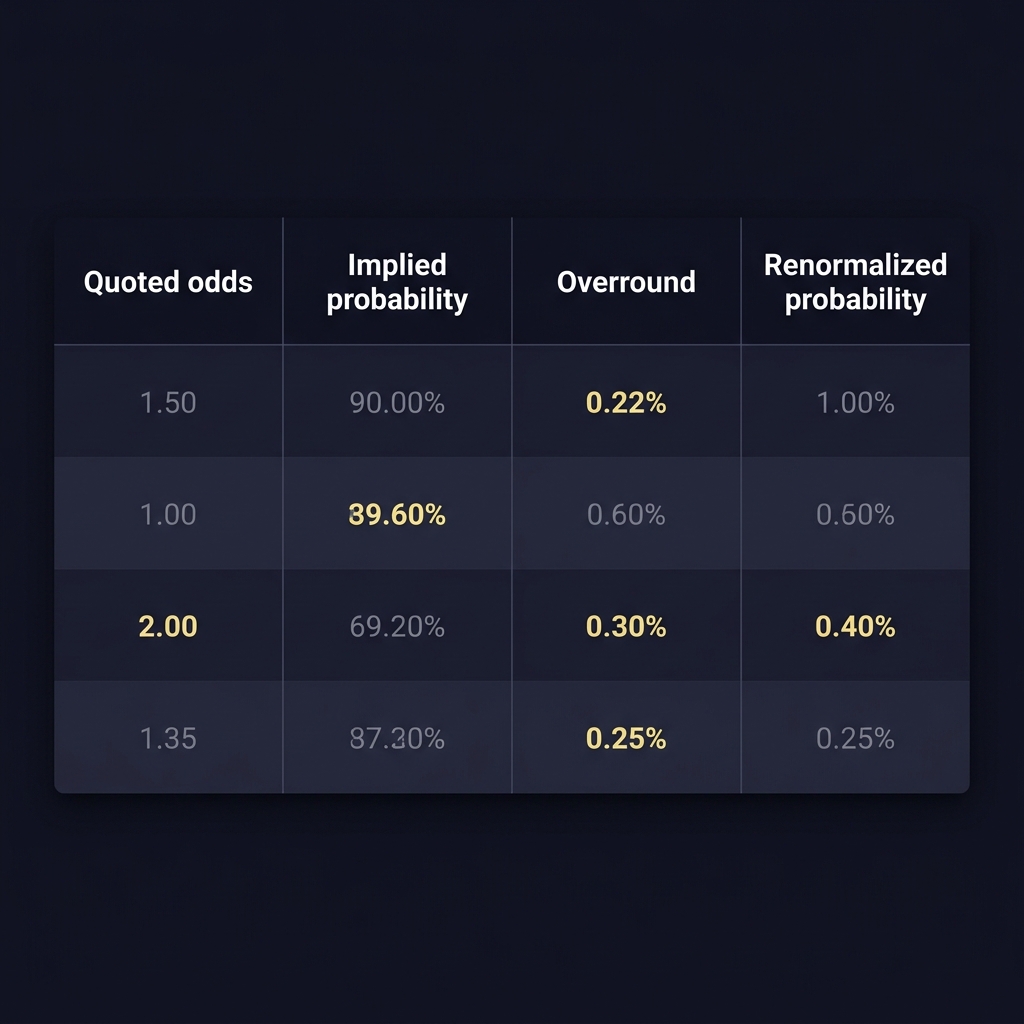
Here is a compact, hypothetical structure you can follow without using platform rates: list each outcome, compute implied probability for each, sum to find the overround, divide each implied probability by the overround to renormalize, then convert renormalized probabilities back to odds. Writing these as columns in a spreadsheet lets you repeat the calculation quickly across markets and time.
Tip: keep a column that shows the difference between the quoted implied probability and the no-vig probability; that delta highlights where the bookmaker margin pulled the price away from the market consensus and where value might exist for a disciplined trader.
Where operators make money when they offer no-vig prices
Removing the embedded margin in the quoted odds does not eliminate operator revenue. Instead, many platforms shift monetization from hidden juice inside the odds to explicit, itemized charges such as commissions or per-trade fees. The model depends on the platform type and often makes the cost clearer to the user even while changing how that cost is collected. Betfair help on exchange commissions
On betting exchanges a common approach is to charge a commission on net winnings rather than embed an overround in the price. This means the prices can appear no-vig while the exchange earns revenue when a user posts a winner and realizes net profits after losing trades are offset. The commission structure moves the economic cost from the price to the settlement stage, which appeals to some traders but has a different risk and cost profile than a built-in vig. Betfair explanation of commission practice Additional context on how exchanges work is available from resources that compare exchange models and explain why they tend to show near no-vig prices, such as OddsJam on betting exchanges.
Compare no-vig fees with FundedPlays Challenges in mind
Try converting the last market you looked at into no-vig odds and then plug the platform fees into the equivalent-margin method described later to see which venue is cheaper for your strategy.
Event-contract and prediction-market platforms replace an overround with per-contract trading fees or settlement charges. Those platforms list prices that more directly reflect consensus probabilities while collecting a fee per contract bought or sold, or a settlement fee when contracts expire. The fee is often visible on fee pages and in settlement receipts, which makes cost comparison straightforward if you translate the per-contract amount into an effective margin equivalent. Kalshi fees page
Traditional sportsbooks still generate revenue through hold on handle, the effective realized margin after payouts, which has been a single-digit percentage of handle in recent U.S. industry data. That means even when operators advertise reduced juice or promotional lines, overall operator revenue in the market continues to come from embedded margins or equivalent fee structures. American Gaming Association state of the states report
Converting commissions and fees into an equivalent margin
Why compute an equivalent margin? Because commissions and per-trade fees are not directly comparable to a sportsbook's embedded vig unless you translate them into the same terms. An equivalent margin converts the explicit fee into the percent reduction in expected return a bettor would face, letting you compare vendors on an apples-to-apples basis. Betfair commission context
How to convert a commission to an effective margin: compute the net payout after commission for a single unit of winning, express that net payout as an implicit probability-adjusted return, and solve for the margin that would reduce the fair odds to the same net payout. For per-trade fees, calculate the fee relative to the stake or to the expected turnover for a given strategy and convert that fraction into an equivalent percentage that can be compared to the overround. Use your own platform fee numbers and run the math for common trade sizes you expect to use.
General formula approach without platform rates: first, express commission or fee as a fraction of the payout or stake; second, adjust the expected return by subtracting the fee; third, solve for the margin m such that the expected return with margin m equals the expected return after fees. This gives you an effective margin you can compare to sportsbook hold.
Practical caution: include liquidity and rebate effects in your calculation. High liquidity tends to reduce bid-ask spread and execution slippage, while rebates or volume discounts can lower effective commission. Settlement rules such as whether a platform refunds voids or handles dead heats differently also affect the practical cost you experience, so fold those contract-level details into the margin conversion where relevant. Kalshi fee notes
How to choose between sportsbooks, exchanges, and prediction markets
Use a short checklist that weighs explicit fee levels, commission structure, market liquidity, settlement rules, and fee transparency. Start by collecting the published fee schedule, then compute the effective margin with the method above so you can compare that figure to the sportsbook hold for equivalent markets. AGA industry hold overview For more on exchange mechanics see a detailed guide to exchanges and peer-to-peer pricing at SX Bet exchanges guide.
Decision criteria, one by one: fee level and how it scales with volume, commission base (net winnings versus turnover), market liquidity and available depth, settlement speed and contract rules, and clarity of fee disclosure. Each criterion affects execution and expected cost for different strategies, so rank them by relevance to how you trade or place predictions.

Trade-offs to consider: a lower headline cost on a no-vig price can be offset by commission frequency, minimum fees, or low liquidity that widens realized execution costs. Conversely, an exchange with transparent commissions may be cheaper for traders who win consistently, while a sportsbook with promotional reduced juice might be better for infrequent bets if the promotional conditions suit your needs. See how Funded Plays evaluates platform trade-offs in our explanation of evaluations.
Before you move capital or switch platforms, compute the platform's effective margin using your expected trade sizes, check market liquidity at the hours you will trade, and confirm settlement rules for voids and cancellations. This process protects against hidden friction and ensures your platform choice fits your approach. A good place to log notes and examples is the Funded Plays blog.
Common mistakes bettors make with no-vig markets
A frequent error is ignoring commissions and settlement friction because the headline odds look cleaner. Even when the odds show no vig, commissions, per-trade fees, and bid-ask spreads can create the same effective cost as a traditional overround, so always include those items when you do expected-value math. Action Network on effective costs
Another mistake is treating a no-vig line as a guaranteed better value. A no-vig price removes embedded margin but does not guarantee better execution or faster settlement, and it may sit on a venue with low liquidity where execution slippage erodes any theoretical advantage.
Miscomputing the overround in multi-outcome or correlated markets is common. Failing to account for dependencies between markets or to renormalize correctly can produce probabilities that sum to something other than 100 percent and lead to incorrect value decisions. Double-check your renormalization steps and, when in doubt, treat correlated outcomes conservatively.
Practical scenarios: how to compare real options without getting misled
Scenario template one, head-to-head: pick a single market outcome on two venues, collect the quoted odds and published fee schedules, compute no-vig probabilities for the quoted lines, translate fees to equivalent margin for each venue, and compare the two effective margins to decide which is cheaper for your expected stake size. Use your actual fee numbers rather than assumed rates. Action Network conversion template Another primer that explains exchange pricing and no-vig effects is available at Oddsshopper.
Scenario template two, multi-market portfolio: for a portfolio of correlated wagers or a frequent trading strategy, estimate turnover and average stake size over your planned horizon, sum expected fees across trades, convert the aggregate fee into an average effective margin, and compare that to a sportsbook hold applied to the same portfolio. Include expected slippage from liquidity limits if you plan to place larger orders.
Removing vigorish from prices reveals consensus probabilities, but operators capture revenue through commissions, per-trade or settlement fees, or sportsbook hold; convert those fees into an equivalent margin to compare true costs.
Checklist before you trade or switch platforms: verify published fee rates, compute equivalent margin for your trade sizes, test market liquidity at your usual times, confirm settlement rules for voids and cancellations, and record a small trial sample of execution prices before scaling up.
Applying this process to your own numbers will reveal whether a no-vig headline actually saves you money in practice or whether the platform's fee model makes it more expensive for your strategy.
Conclusion: key takeaways and next steps
Removing the vig reveals the underlying market probabilities, but it does not remove operator revenue. Exchanges and event-contract platforms typically collect commissions or per-contract fees that replace the embedded overround, while traditional sportsbooks still rely on hold on handle as a revenue source. AGA hold context
Actionable next steps: convert the odds and fees of the venues you use into an equivalent margin using the methods above, test with your expected trade sizes, and include liquidity and settlement rules in your comparison. When in doubt, run a small, live sample of trades to measure realized cost before committing significant volume. For direct resources and examples see the Funded Plays homepage.
No vig odds are prices adjusted to remove the bookmaker margin so the implied probabilities sum to 100 percent, showing the market consensus without embedded juice.
No, platforms typically collect revenue via commissions, per-trade fees, or other charges that create an effective cost even when odds show no vig.
Translate the exchange commission or per-trade fee into an equivalent percentage margin on expected returns, then compare that margin to the sportsbook hold for the same market.
References
- https://www.investopedia.com/terms/v/vigorish.asp
- https://www.actionnetwork.com/education/no-vig-odds
- https://support.betfair.com/app/answers/detail/a_id/405
- https://kalshi.com/fees
- https://www.americangaming.org/resources/state-of-the-states/
- https://www.fundedplays.com/challenges
- https://oddsjam.com/betting-education/betting-exchange
- https://www.oddsshopper.com/articles/betting-101/what-is-a-betting-exchange
- https://blog.sx.bet/sports-betting/guides/cluster/sports-betting-exchanges/
- https://www.fundedplays.com
- https://www.fundedplays.com/blogs
- https://www.fundedplays.com/blogs/how-fundedplays-evaluations-work