
What no vig odds mean and why they matter
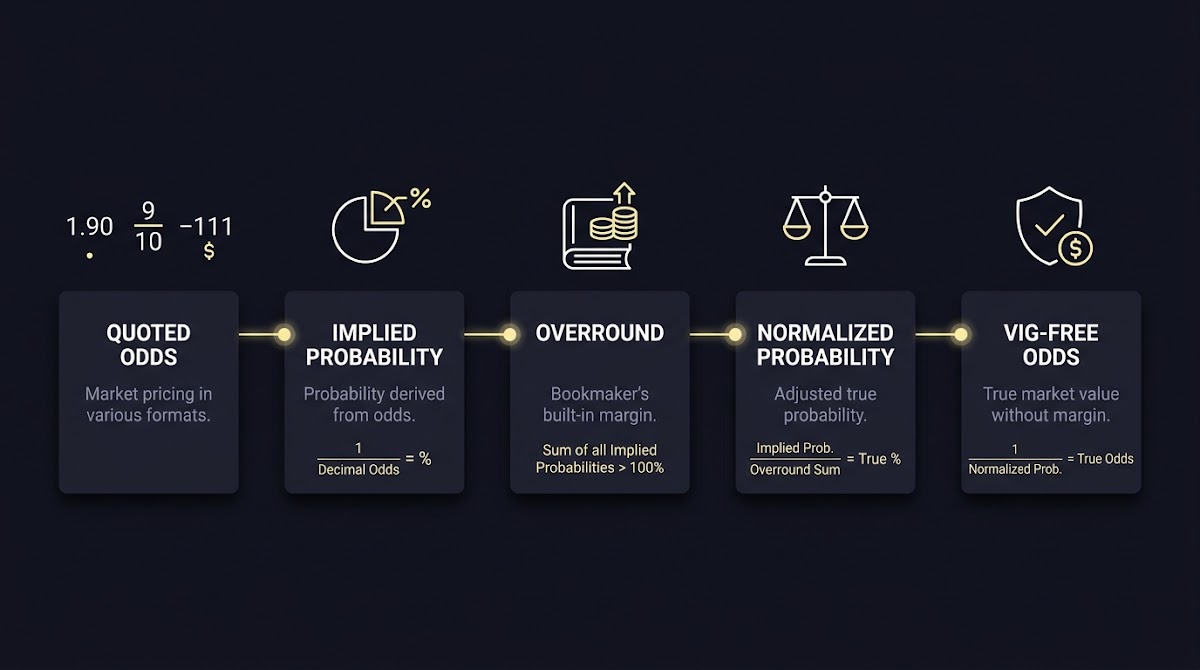
No vig odds are the market prices you get after removing the sportsbook margin so that the implied probabilities sum to 100%. Stated another way, you convert quoted odds into implied probabilities, sum those probabilities to find the overround, then rescale each probability by that sum and convert back to odds; the proportional normalization is the standard method practitioners use to produce vig-free prices and it applies in 2026 as the common baseline for value work Pinnacle article on margin.
Why does this matter? Bookmakers include a margin, often called the sportsbook hold, which inflates quoted prices relative to a fair or vig-free view. That overround is simply the sum of implied probabilities exceeding 100 percent, and normalization rescales each side so the probabilities add to 100 percent, giving a cleaner baseline for comparing a model's edge or for spotting mismatches between markets Overround explainer on Wikipedia.
For two-way markets proportional normalization produces vig-free probabilities that sum to exactly 100 percent, and the same approach generalizes to three-way or multi-outcome markets by normalizing across all listed outcomes. That property makes the method useful whether you work with head-to-head lines or with totals and three-way markets Odds conversion guide.
Keep in mind that no-vig outputs are inputs, not guarantees. Normalizing prices removes the posted margin and yields a consistent set of implied probabilities to compare against your own model or a reference, but it does not change the underlying uncertainty of the event or ensure you will realize an advantage once execution costs and limits are included.
Practice no-vig calculations in a structured challenge on FundedPlays
Try saving the formulas and a short worked example to a spreadsheet so you can reproduce no-vig conversions quickly with fresh price data; treat the results as a benchmark input to your decision process rather than a final trading instruction.
How sportsbook margin and industry hold affect no vig calculations
Industry reporting shows that U.S. sportsbook hold in recent years has been meaningful, typically in the high single digits up to around 10 percent in 2024 and 2025, which is roughly the magnitude of margin removed when you convert to vig-free prices; that size of hold is why deflating lines materially changes the prices you compare against model probabilities AGA State of the States 2025.
It helps to distinguish posted margin on a single market from realized hold measured across many markets using handle and revenue statistics. Regulator and industry publications provide handle and revenue numbers that reflect realized hold and can serve as sanity checks when your no-vig adjustments look unusually large or small compared with typical market experience UK Gambling Commission industry statistics.
Use these benchmarks as directional validation rather than exact truth. Posted overrounds on specific markets can exceed or fall below average realized hold, and volatility or promotional pricing can compress margins temporarily. Comparing your no-vig outputs to regulator or industry benchmarks helps you spot data problems or misapplied conversions before committing capital or treating a signal as reliable Pinnacle article on margin.
Step-by-step: calculating no vig odds across odds formats
Convert odds to implied probabilities: decimal, fractional, American (no vig odds)
Start by converting every quoted price into an implied probability. For decimal odds p = 1 / decimal. For fractional odds expressed as a/b, decimal = (a/b)+1 and then p = 1 / decimal. For American odds, use the standard formula: for negative odds a, p = a / (a + 100) where a is the absolute value; for positive odds a, p = 100 / (a + 100). These conversion formulas are prerequisites for consistent no-vig work Football-Data odds conversion.
Before you proceed confirm your price feed formats and that decimals, fractions, or American odds are parsed correctly. A common error is to treat American odds signs incorrectly or to use the fractional string without turning it into a numeric fraction first, which produces incorrect implied probabilities and invalid no-vig results Pinnacle article on margin.

Convert prices to implied probabilities, compute the overround, normalize probabilities to sum to 100 percent, and compare the resulting vig-free prices to your model or to the best-price aggregated snapshot; always validate feed freshness and execution constraints before acting.
After you have clean implied probabilities, sum them across all listed outcomes in the market to get the overround. If the sum is greater than 1.0 (or 100 percent) that excess is the bookmaker margin embedded in posted prices; the normalization step rescales each probability by dividing by that sum so the adjusted probabilities add to exactly 1.0 Overround explainer on Wikipedia.
Finally convert the normalized probabilities back into the odds format you prefer. For decimal odds use decimal = 1 / p_normalized. To produce American odds from normalized probabilities, convert decimal first then translate: if decimal <= 2, American = -100 / (decimal - 1) rounded and expressed negative; otherwise American = 100 * (decimal - 1) rounded and expressed positive. Watch rounding because extreme US lines can be sensitive to small probability differences Football-Data odds conversion.
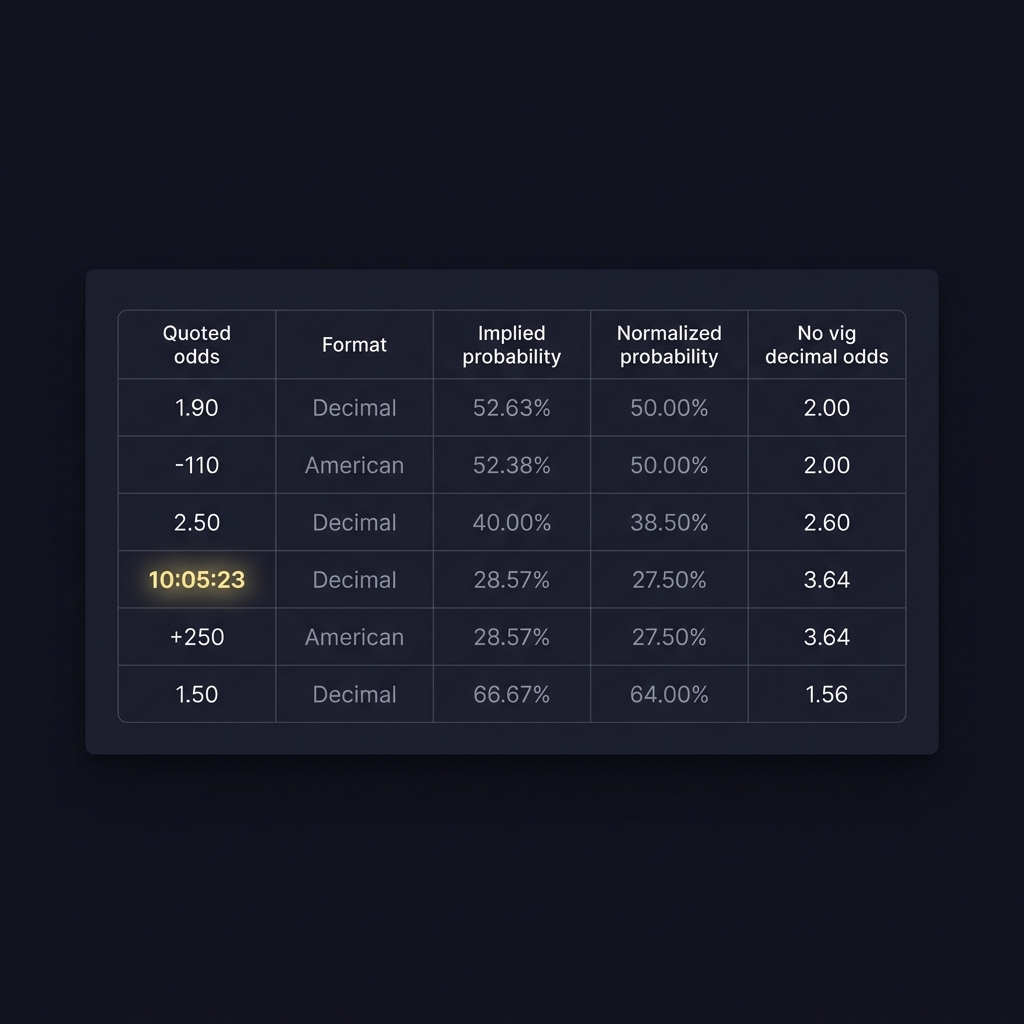
Edge cases to note: markets with very large or tiny American odds can lose precision when you round to the nearest standard price tier. Totals or props with many decimal places may need a rounding rule you apply consistently in spreadsheets or a no-vig calculator.
Extending no-vig to multi-outcome markets and correlated lines
The proportional normalization used in two-way markets generalizes directly to three-way and multi-outcome markets by summing all implied probabilities and dividing each side by that total, so the normalized probabilities will always sum to 100 percent regardless of the number of outcomes Overround explainer on Wikipedia.
However, when outcomes are correlated or when markets are conditional the simple normalization can misstate edge. For example, combining separate market prices for a team's win and a correlated prop that depends on that win can double-count shared uncertainty. In those cases consider modeling joint probabilities rather than naïvely aggregating converted margins Smarkets help centre on overround.

For totals or multi-market constructs where outcomes are not mutually exclusive, treat normalization as a baseline diagnostic rather than a definitive joint model. If your workflow needs correct joint probabilities, build a small joint distribution calibrated to observed correlations or use conditional modeling to avoid overstating your expected edge.
Finding opportunities: aggregating best prices and when overround falls to 100% or less
A practical way to look for short-term value is best-price aggregation: take the best available price for each outcome across operators, convert those prices to implied probabilities, sum them to compute the combined overround, and normalize if you want a consolidated no-vig view. When the combined overround approaches or falls to 100 percent, that theoretical state can indicate positive expected value or an arbitrage opportunity if you can execute across the constituent books Pinnacle article on margin. You can also check aggregator tools like OddsJam when surveying best prices across operators.

That theoretical statement needs strong operational caveats. When the combined overround is below 100 percent there is, in principle, a set of stakes that produces a riskless profit ignoring execution frictions. In practice, liquidity, stake limits, timing, and stale quotes often prevent full execution of the theoretical arbitrage, so treat combined overrounds as signals to investigate rather than automatic trade instructions Smarkets help centre on overround.
Practical constraints to watch include maximum stake caps, account restrictions, cancellation or void rules, and the possibility that one or more prices will move before you can place complementary stakes. Build execution checks into your workflow and verify that the best-price snapshot you used is live before sizing any position.
Common errors, data traps, and operational pitfalls
Conversion errors are a frequent source of invalid results. Using the wrong American odds formula, misreading fractional strings, or mixing decimal and American formats without converting leads to incorrect implied probabilities and therefore to incorrect no-vig outputs; verify conversions with a small set of known examples to validate your parser Football-Data odds conversion.
Stale or delayed price feeds are another major trap. A snapshot that is even a few seconds old can flip a combined overround from slightly above 100 percent to slightly below, turning a non-actionable signal into one that looks like arbitrage; whenever possible use timestamps and prefer sources with millisecond or second-level freshness indicators Pinnacle article on margin.
Operational limits such as partial fills, stake caps, and account-level rules can erode or eliminate a theoretical edge. Even if a best-price snapshot suggests a positive expected value, test whether the required stake size is permitted by each operator and whether sequential execution would expose you to movement risk.
Validation checklist before acting on a no-vig signal: 1) confirm each price timestamp and the feed freshness, 2) ensure conversions use the correct formula for the displayed format, 3) check stake limits and cancellation rules at each operator, and 4) compute the practical stake table to see if the suggested arbitrage or edge survives realistic execution constraints.
Worked examples and quick scenarios you can reproduce
This section gives stepwise examples you can copy into a spreadsheet or a simple no-vig calculator. Inputs you will need for each example are the quoted odds, the format of those odds, and a timestamp so you know the snapshot's freshness. Reproduce the conversions step by step to ensure your parser and calculations match the worked numbers Football-Data odds conversion. For quick checks you can also use online no-vig calculators such as Unabated's No-Vig Fair Odds Calculator.
convert odds to implied probabilities and normalize them
Use consistent rounding rules
Two-way example in decimal and American odds: suppose Book A posts decimal 2.05 and Book B posts decimal 1.85 on the other side. Implied probabilities are 1/2.05 = 0.4878 and 1/1.85 = 0.5405, sum = 1.0283 (overround 102.83 percent). Normalizing, p1 = 0.4878 / 1.0283 = 0.4743 and p2 = 0.5257. Decimal no-vig odds are 1 / 0.4743 = 2.108 and 1 / 0.5257 = 1.902. If you started from American odds you would first convert to implied probabilities using the American formulas, then follow the same normalization and reconversion steps Pinnacle article on margin. You can also validate numbers with an implied probability calculator such as TheRundown's tool.
Three-way example: Book A offers 2.10, Book B 3.40, Book C 3.60 on a match with three outcomes. Convert to implied probabilities, sum them to get the overround, divide each implied probability by that sum to normalize, then convert back to decimal odds. The process is identical in principle to the two-way case but simply uses the three implied probabilities in the denominator so the normalized probabilities sum to 100 percent Overround explainer on Wikipedia.
Best-price aggregation sketch: take the highest available price for each of three outcomes across books, convert each to implied probability, and sum. If the combined overround is under 100 percent, calculate the stake proportions that lock in a theoretical profit ignoring execution and limits. Then check whether the required stakes are permitted and whether prices are current before placing any bets Smarkets help centre on overround.
Summary, responsible next steps, and where no-vig fits in a skill-focused workflow
Key takeaway: no-vig odds are produced by converting odds to implied probabilities, summing them to get the overround, normalizing each probability by that sum, and converting back to odds; this produces a consistent set of vig-free probabilities useful for value assessment and is the method commonly used in modern workflows Football-Data odds conversion.
Responsible next steps: reproduce the worked examples in a spreadsheet, use fresh price feeds with timestamps, validate conversion formulas on a small test set, and treat no-vig outputs as one input among many in disciplined decision-making rather than as a guarantee of profit. Compare your aggregate margins against regulator benchmarks to validate that your pipeline is behaving plausibly and read related posts on our blog AGA State of the States 2025.
For practitioners using skill-focused evaluation platforms, you can test your no-vig workflows in simulation or in structured challenge environments to see how normalized signals behave under execution constraints. Platforms such as Funded Plays evaluations let you practice converting prices, checking execution rules, and measuring whether theoretical signals survive realistic constraints without exposing real capital.
Finally, keep your models and operational checks simple, audit conversions regularly, and use no-vig pricing as a diagnostic and comparison tool in a measured, repeatable workflow. Visit our homepage for more on structured evaluation offerings.
No-vig odds are market prices adjusted to remove the bookmaker margin so implied probabilities sum to 100 percent; they provide a clearer baseline for comparing fair probabilities.
No, removing vig only adjusts prices; execution costs, limits, and market movement can prevent theoretical advantages from being realized.
Support decimal, fractional, and American formats and implement the correct conversion formulas for each to avoid calculation errors.
References
- https://www.pinnacle.com/en/betting-articles/educational/how-to-calculate-margin-in-betting-odds/
- https://en.wikipedia.org/wiki/Overround
- https://www.football-data.co.uk/notes/odds_conversion.php
- https://www.americangaming.org/resources/state-of-the-states-2025/
- https://www.gamblingcommission.gov.uk/statistics-and-research/publication/industry-statistics
- https://help.smarkets.com/hc/en-gb/articles/115000148565-What-is-the-overround
- https://oddsjam.com/betting-calculators/no-vig-fair-odds
- https://www.fundedplays.com/challenges
- https://unabated.com/betting-calculators/no-vig-fair-odds-calculator
- https://therundown.io/betting-calculators/implied-probability-calculator
- https://www.fundedplays.com/blogs
- https://www.fundedplays.com/blogs/how-fundedplays-evaluations-work
- https://www.fundedplays.com