

Quick overview: why vig matters and what this article delivers
Vigorish, also called overround, is the bookmaker margin created when the summed implied probabilities for all possible outcomes exceed 100%, and removing that margin produces fair prices you can use in expected value checks; this article shows the conversion method and practical ways to reduce the drag on returns starting with a no vig odds calculator concept.
Removing vig matters because market margin erodes realized edge and long term bankroll growth, so learning how to remove vig from odds helps you compare your probability estimates to fair market prices and make more disciplined choices, not to promise guaranteed profit.
Roadmap: we cover the conversion formula, a step by step calculator workflow, spreadsheet examples for two way and three way markets, where to capture market snapshots, line shopping strategies and when true arbitrage can appear, conservative fractional Kelly sizing to limit downside, common execution pitfalls, and reproducible paper tests you can run today.
What readers will learn
Readers will leave with a clear definition of vigorish and overround, a hands on conversion workflow to create no vig odds, practical tips on line shopping and stake sizing, and a short checklist for a first 30 minute experiment.
How to use the no vig odds calculator conceptually
The no vig odds calculator converts quoted odds into implied probabilities, rescales them to remove overround, and outputs fair odds for expected value comparison; keep the inputs time stamped and note the operator that supplied each price so you can line shop accurately.
What is vigorish (overround) and how regulators describe bookmaker hold
Vigorish, often shortened to vig or juice, is the margin built into prices when the sum of implied probabilities across outcomes exceeds 100 percent; that excess is commonly called overround and it is the structural source of sportsbook edge in a market, as explained in industry overviews.
Trade association and regulator reports frame operator revenue in a related way using hold percentage or win percentage, which links the pricing construction directly to how much the operator retains on average from market turnover, a view useful for bettors comparing market holds across jurisdictions AGA State of the States 2025.
Convert each price to implied probability, sum them to measure the overround, compute a scaling factor equal to 100 divided by the sum, rescale each probability with that factor, and convert the rescaled probabilities back to odds to get no vig or fair prices.
To work with these concepts you must be able to convert common odds formats to implied probability; for American odds the standard formulas and for decimal odds the reciprocal are the practical starting points when you prepare a no vig conversion.
For example, decimal odds of 2.50 convert to an implied probability of 0.40 by taking 1 divided by the decimal price, and an American favorite like -150 converts to a probability around 0.60 using the conventional negative American formula; summing those implied probabilities across the book produces the overround you will rescale.
Converting odds to implied probability
Decimal odds: implied probability = 1 / decimal odds; American odds: if positive then probability = 100 / (American + 100), if negative probability = -American / (-American + 100); these formulas let you move between prices and probabilities before you rescale to 100 percent.
When the summed implied probabilities exceed 100 percent you have identified the overround and the standard correction is to divide each implied probability by the total overround to compute the scaling factor that returns them to a combined 100 percent, a method widely used in operator education materials Smarkets overround help centre.

How a no vig odds calculator works: step-by-step workflow
Step 1, collect the snapshot: capture exact quoted prices, the odds format, operator name and a timestamp for each side you plan to evaluate; accurate inputs prevent stale price errors once you run the converter.
Step 2, convert each quoted price to implied probability using the correct formula for the odds format you captured; record probabilities per selection and compute their sum to measure the market overround.
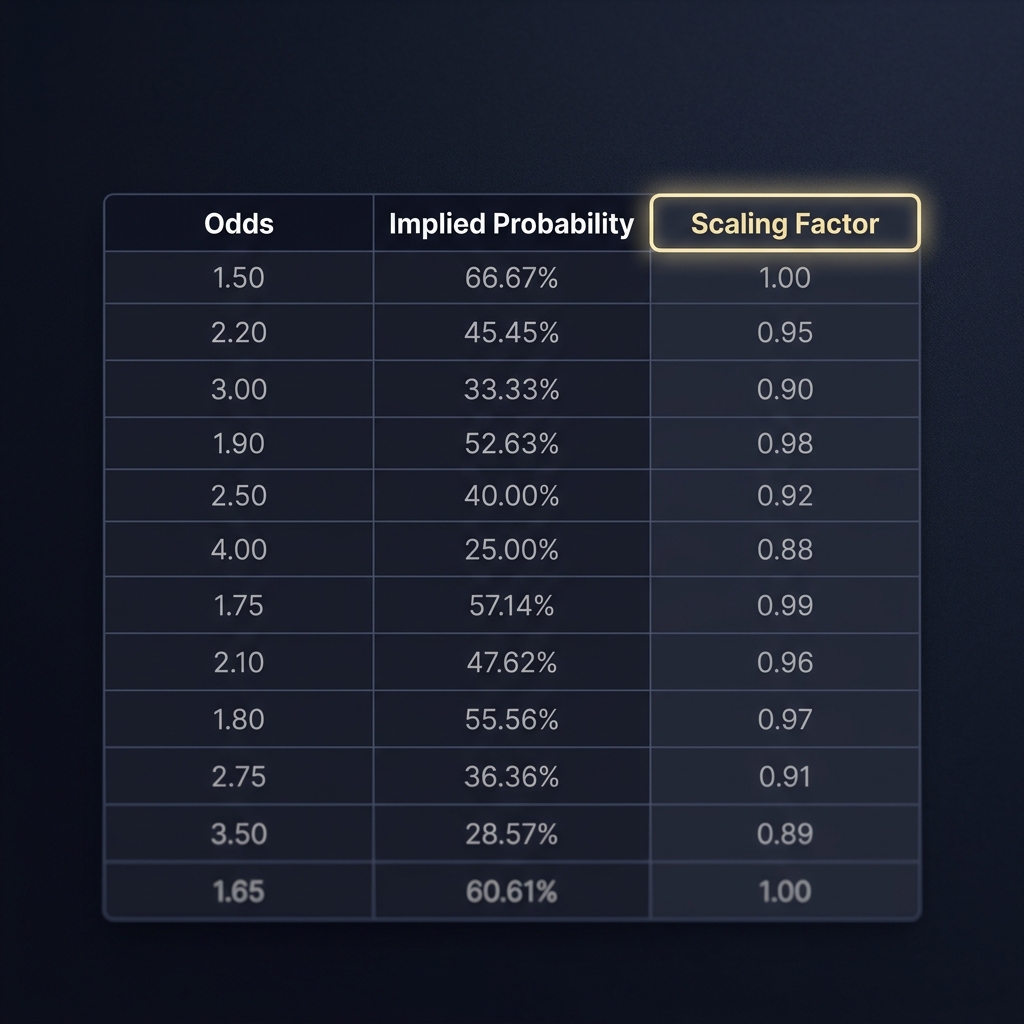
Two way worked example, brief: imagine a market with two sides at decimal 1.90 and 1.95. Convert to probabilities: 0.526 and 0.513, sum 1.039, scaling factor = 100 / 103.9 = 0.962; rescaled probabilities become 0.506 and 0.494, converting back to decimals yields fair prices roughly 1.98 and 2.02, which reflect the same relative chance without the book margin.
Three way example, brief: for a soccer match with decimals 2.30, 3.40, 3.60 convert to probabilities, sum to an overround greater than 100, compute the factor and renormalize; the output fair decimals give you the no vig odds to compare to your model probabilities and compute expected value.

convert market odds to no vig fair prices
use exact quoted odds
The product note above links to the Funded Plays Challenges page for readers who want to learn how structured evaluation challenges present markets in a simulated environment, not to endorse betting activity; use the fair price workflow independently of any platform choice.
Building a simple spreadsheet: column A operator, B selection, C odds format, D quoted odds, E implied probability with a formula depending on format, F summed overround, G scaling factor, H no vig probability and I fair odds derived from H; this layout makes the conversion repeatable and auditable for paper testing and line shopping, see our blog.
Practical tool placement: integrating a no vig odds calculator into your workflow
When to run the calculator: capture market snapshots when you plan to assess opportunities, before placing any wagers or committing to challenge entries; include timestamp, operator name and exact odds so you can reproduce the comparison later.
Dos: record exact odds and format, note operator restrictions, run the no vig odds calculator before sizing a position, and use the fair odds output to compute expected value versus your model probability estimate.
Practice disciplined market checks with a simple no vig test
Try a disciplined 30 minute test, capture three operators for the same market, run the no vig conversion in a spreadsheet and compare the fair prices before you practice conservative sizing.
Donts: do not rely on unstamped prices, do not treat fair odds as guarantees, and avoid staking full bankroll fractions when inputs include estimation error; the calculator helps remove margin, it does not remove uncertainty.
Use outputs for bet sizing: after you convert to no vig odds and compute expected value, apply a conservative staking rule such as a fixed fraction of bankroll or a capped fractional Kelly to limit drawdowns and allow process learning.
Line shopping, price divergence and the reality of arbitrage
Line shopping means selecting the best available price for each outcome across operators, and because effective vig is driven by the prices you accept, taking the top price on each side reduces the market overround you face without altering your probability estimates, a practical way to remove vig from odds in everyday use Investopedia vigorish definition.
Price divergence across operators sometimes produces theoretical arbitrage when the combined best prices allow stakes that cover all outcomes and lock a profit, but those opportunities are rare, often fleeting and require precise stake sizing and fast execution to realize in practice; treat them as edge cases not a strategy.
Caveats when seeking arbitrage: execution speed matters, operators enforce limits, partial fills or bet cancellations can break the hedge, and account restrictions can remove expected profits; plan for operational failure modes before you attempt cross operator covering trades Smarkets overround help centre.
Bet sizing and bankroll methods to counteract vig drag
Why staking matters: even small margins compound against a bettor over many bets, so choosing a staking method that scales position size to estimated advantage helps preserve long run growth when you use fair probabilities as the baseline for expected value, rather than letting a fixed stake erode returns over time.

Fractional Kelly is an edge proportional approach that reduces volatility relative to full Kelly by multiplying the Kelly stake by a conservative fraction such as one quarter or one half; this retains the direction of the Kelly recommendation while limiting sensitivity to estimation error in your no vig probabilities Investopedia Kelly criterion.
Practical conservative approach: compute the Kelly fraction using your no vig win probability and odds, then apply a fractional multiplier and a maximum percent of bankroll cap; document each bet and review performance periodically to adjust your estimation process and faction choice.
Warning: Kelly based sizing magnifies errors when probability inputs are noisy, so never assume nominal Kelly figures are safe without validating your probability model on historical data; use fractional values and conservative caps when you are still learning.
Common mistakes and execution pitfalls to avoid
Timing and data errors are frequent: using stale prices, mixing odds formats without correct formulas, or failing to record operator limits will produce incorrect fair prices and false expected value signals, so always stamp your inputs and check calculations before acting Unabated no-vig guide.
Staking mistakes include applying full Kelly with noisy probability estimates or ignoring transaction restrictions; overbetting relative to the true edge is one of the fastest ways to turn a theoretically profitable process into a losing one, so prefer conservative fractions and explicit caps.
Arbitrage execution pitfalls: partial fills and canceled bets can void the theoretical hedge and create exposure to large losses, and operator limits or account action can remove expected margin gains; operational discipline and small test runs help reveal where assumptions break.
Practical examples and scenarios you can try today
Two way worked example in a spreadsheet: enter decimal odds 1.90 and 1.95, compute implied probabilities with 1 / odds, sum them to get the overround, compute the scaling factor 100 / sum, rescale each probability, then convert back to decimals with 1 / rescaled probability to get no vig odds; compare those fair odds to your model to compute expected value, or check online calculators like Betstamp.
Three way worked example in a spreadsheet: enter three decimal prices, compute individual implied probabilities, sum and compute the scaling factor, apply it to each probability and convert back to prices; a compact set of formulas produces the fair prices you need to evaluate markets like soccer with three outcomes.
Paper test exercise: pick a single market and capture prices from three operators within a 15 minute window, run the conversion for each, then create a best price composite by taking the highest fair price for your predicted side; track results for 20 markets to see how line shopping changes effective vig over time AGA State of the States 2025, and compare the procedure to how Funded Plays evaluations work.
Conclusion and next steps: safe testing and disciplined application
Three takeaways: no vig conversion gives you a neutral baseline for expected value, line shopping reduces the effective vig you face, and conservative staking such as fractional Kelly limits downside while you refine probabilities.
Quick checklist for a 30 minute experiment: capture three operator snapshots with timestamps, run the no vig conversion in a spreadsheet, compute EV for one selection using your probability estimate, and size bets with a conservative fractional Kelly or fixed percent cap.
Remember outcomes depend on your probability accuracy and platform rules; no vig tools help you spot where prices create potential edge but they do not guarantee success, and responsible discipline is essential when you apply these methods.
It converts quoted odds to implied probabilities, rescales them so they sum to 100 percent, and outputs fair odds you can use for expected value checks.
Line shopping reduces the effective vig you face by taking the best available prices, but it rarely eliminates margin entirely and true arbitrage is uncommon and operationally risky.
Fractional Kelly reduces volatility compared to full Kelly and is more conservative, but it still requires reliable probability estimates and caps to limit downside.
References
- https://www.americangaming.org/wp-content/uploads/2025/05/AGA-State-of-the-States-2025.pdf
- https://help.smarkets.com/hc/en-gb/articles/115003066489-What-is-overround-bookmaker-s-margin-and-how-is-it-calculated
- https://unabated.com/learn/no-vig-fair-odds-explained/
- https://oddsjam.com/betting-calculators/no-vig-fair-odds
- https://www.betstamp.com/calculators/no-vig-fair-odds
- https://www.investopedia.com/terms/v/vigorish.asp
- https://www.investopedia.com/terms/k/kellycriterion.asp
- https://www.fundedplays.com/challenges
- https://www.fundedplays.com
- https://www.fundedplays.com/blogs
- https://www.fundedplays.com/blogs/how-fundedplays-evaluations-work