
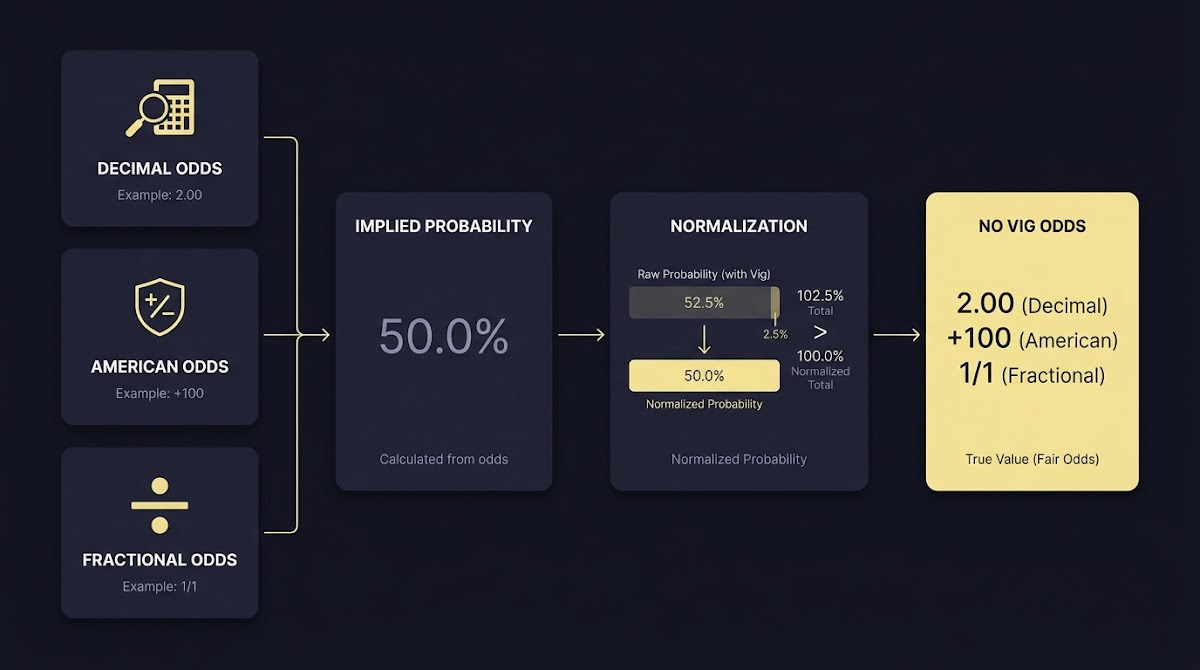
What is vig (overround) and why remove it?
Definition of vigorish and overround
The term vigorish, often shortened to vig, and the related term overround describe the excess of summed implied probabilities over 100% that represents the bookmaker house edge. This excess means quoted market probabilities add up to more than certainty, so removing it with a no vig odds calculator reveals the redistributed, fair probabilities for each outcome, which can help comparison and model checks Investopedia vigorish definition.
Think of the overround as the markup a market-maker embeds across outcomes so the operator expects a margin over time rather than a statement of true event chances. That markup makes direct comparisons between books misleading unless the margin is removed.
Why does that matter? If you want to compare prices across sources, or calibrate a predictive model to market-implied probabilities, using de-vigged probabilities gives a cleaner baseline for measuring edge and consistency. The de-vigged probabilities are not predictions, but they are a normalized market view you can test against your forecasts.
Check your market view with a simple de-vig workflow
Try this quick check in your spreadsheet: convert the odds to implied probabilities, sum them, then normalize each probability to 100% and convert back.
Why bookies build a margin
Bookmakers build a margin to ensure a long-term expected return that covers costs and balances liability; it is a structural feature of quoted odds and not an estimate of the true chance of an event Wikipedia overround.
Margins help operators manage exposure, adjust for customer flow, and account for uncertainty in the market. For end users, recognizing that margin exists is the first step toward using a no-vig odds calculator to see the underlying market distribution.
De-vigging becomes useful whenever you need comparable, market-implied probabilities: benchmarking models, evaluating whether a line offers value, or preparing aggregated probability inputs from multiple sources.
It matters less for single, discretionary wagers where your value judgment and bankroll plan dominate, but it is essential when you measure long-term model calibration or compare quotes across several books.

How odds convert to implied probabilities
Decimal odds: p = 1 / odds
Decimal odds convert to implied probability with the simple formula p = 1 / decimal_odds. For example, decimal 2.50 implies probability 1 / 2.50 = 0.40 or 40% when rounded for display. Use higher precision during calculation and round only for presentation to avoid small checksum errors later Pinnacle odds converter.
American odds: formulas for positive and negative values
American odds require two formulas depending on sign. For positive American odds A, the implied probability is 100 / (A + 100). For negative A, it is -A / (-A + 100). For instance, +150 yields 100 / 250 = 0.40, and -200 yields 200 / 300 = 0.666...; keep decimals until final formatting Pinnacle odds converter.
Quick reference table for common formats
As a quick rule: decimal use 1/odds, American positive use 100/(A+100), American negative use -A/(-A+100). When converting fractional odds first turn them into decimal by adding one, then apply 1/decimal. Precision and consistent formatting help when you later run normalization steps.
Step-by-step: a no-vig odds calculator method
Step 1: convert listed odds to implied probabilities
Start by converting every quoted price into an implied probability using the correct formula for that odds format. Keep a separate column for the converted probability and retain raw odds in their original format so you can trace each conversion.
Step 2: sum implied probabilities (compute overround)
Compute the sum of all implied probabilities in the market. That sum is the overround and equals 100% plus the embedded margin; if the sum equals exactly 100% there is no vig to remove, but practically quoted books usually exceed 100% by varying amounts Smarkets overround explainer.
Convert each quoted price to implied probability, sum those probabilities to find the overround, divide each implied probability by the total to normalize them to 100%, and convert the normalized probabilities back to odds to obtain no-vig odds.
Step 3: normalize each probability and convert back to odds
To de-vig proportionally, divide each implied probability p_i by the total overround T to get normalized probability p_i_no_vig = p_i / T. Then convert the normalized probabilities back to odds as odds_no_vig = 1 / p_i_no_vig for decimal display. This proportional normalization is the standard no-vig odds calculator method used for quick audits and spreadsheets The Power Rank de-vig guide.
Remember proportional de-vig is a straightforward normalization. It scales each outcome so all probabilities sum to 100% while preserving relative market-implied relationships. It does not attempt to infer true causal probabilities beyond that normalization.

In two-way markets, like a head-to-head match, the overround is the sum of the two implied probabilities minus 100%. The normalization step divides each side's implied probability by the two-way total and then turns those normalized probabilities back into no-vig odds; the math is identical to the general method but with two outcomes Wikipedia overround.
Three-way markets (1X2) and distribution across three outcomes
Three-way markets add a draw or tie outcome, so the initial sum of implied probabilities often grows larger than in two-way markets. Normalization still divides each p_i by the total T, but because T is typically higher, proportional adjustments tend to be larger and can noticeably shift the implied chances for home, draw, and away outcomes Smarkets overround explainer.
Practical implications for normalization
Because three-way markets commonly have larger overrounds, you may see larger relative changes after de-vigging, especially for lower-liquidity matchups. That makes verification and cross-checking across sources more important for 1X2 markets.
Building a no-vig odds calculator in Excel or Google Sheets
Cell formulas for conversion and normalization
Use a separate column for input odds, a column for converted implied probabilities, a column for normalization, and an output column for no-vig odds. For decimal odds: implied probability formula = 1 / A2 where A2 holds the decimal odds. For American odds, use conditional formulas: for positive American in B2, use =100/(B2+100); for negative, use =-B2/(-B2+100). After converting, use SUM to compute the overround and normalized p_i = p_i / SUM(range) then final no-vig decimal odds = 1 / normalized_p_i Pinnacle odds converter.
Keep intermediate columns with full precision and only format the displayed cells to a sensible number of decimals. Add a checksum cell that shows SUM(normalized probabilities) and verify it equals 1 or 100% after formatting.
paste one-line formulas into a sheet and run a checksum
Keep full precision until final rounding
Templates and common spreadsheet pitfalls
Common pitfalls include applying the wrong American conversion formula, forgetting parentheses in formulas, or rounding too early. Keep American odds conversion separate and test your sheet by entering a simple market where you can manually verify each step.
Another practical tip is to lock ranges with absolute references when copying formulas so your SUM and normalization references remain consistent as you add rows.
Testing and precision (floating point, rounding)
Due to floating point arithmetic, checksums may show 99.9999% or 100.0001% unless you control formatting. Keep calculation precision high and format only the displayed outputs. If you see larger errors, review formulas for misplaced parentheses or mixed percentage and decimal formats.
Using online no-vig calculators and validating results
When to use an online calculator
Online margin and odds-conversion tools provide a quick sanity check when you need to de-vig a market fast or validate a spreadsheet implementation. These tools automate the same conversion and normalization steps and are convenient for spot checks; try tools such as Unabated's no-vig calculator alongside established options like the Pinnacle margin calculator.
How to cross-check calculator output against your spreadsheet
Cross-check by entering identical inputs in both tools and comparing normalized probabilities and final no-vig odds. Verify that the sum of normalized probabilities equals 100% and that decimal no-vig odds match within rounding tolerance. You can also try a different vendor such as TheRundown's no-vig calculator to confirm consistency.
Reliable tools to try
Use reputable margin calculators and odds converters to validate manual calculations. While online calculators are helpful for quick checks, always keep a simple spreadsheet version you control so you can audit every formula and avoid hidden rounding or display choices. Consider tools like OddsJam's no-vig tool as part of your validation checklist.
Limitations: when proportional de-vig is insufficient
Asymmetric margins and market-maker adjustments
Proportional de-vig assumes the bookmaker applied margin evenly across outcomes. In practice, bookmakers may skew prices selectively due to liability or market information, so a simple proportional adjustment may not reflect those asymmetric adjustments Wikipedia overround.
Sharp books and line-shading for liability
Sharp books and market makers sometimes shade lines to manage exposure or to reflect known flows; these adjustments can create asymmetry that a proportional no-vig odds calculator will not correct for. Observing divergent prices across multiple books or large, targeted market moves can signal such behavior The Power Rank de-vig guide.
For users participating in evaluation challenges on funded or simulation platforms, remember that market-implied probabilities are only one input and platform rules and scoring mechanisms matter for performance assessment.

When more advanced models are needed
If you need to model asymmetric margining, consider building more advanced models that treat one side differently or use market microstructure signals; those approaches move beyond simple proportional normalization and require additional data or assumptions.
Worked example: de-vigging a head-to-head match
Original odds and implied probabilities
Suppose a head-to-head match shows decimal odds 1.80 for Team A and 2.20 for Team B. Convert each: Team A p = 1/1.80 = 0.5555..., Team B p = 1/2.20 = 0.4545.... These two implied probabilities sum to 1.0101 or about 101.01%, indicating a small overround that the no-vig odds calculator will remove.
Normalization math step-by-step
Compute total T = 0.5555... + 0.4545... = 1.0101. Normalized p_A = 0.5555... / 1.0101 = 0.55, normalized p_B = 0.4545... / 1.0101 = 0.45. Convert back to decimal: odds_A_no_vig = 1 / 0.55 = 1.81818..., odds_B_no_vig = 1 / 0.45 = 2.22222.... The no-vig odds show slightly higher payout for the underdog and a slightly lower implied edge for the favorite, reflecting the removed margin Smarkets overround explainer.

Interpreting the no-vig odds
These no-vig odds are the normalized market-implied prices and can be used to compute value by comparing your own model probabilities to the de-vigged probabilities. They are not guarantees but provide a cleaner basis to measure where a market appears to over or under-value outcomes.
Worked example: de-vigging a 1X2 market
Three outcomes and larger overrounds
Imagine a soccer 1X2 market with decimal odds: Home 2.20, Draw 3.40, Away 3.10. Convert to implied probabilities: home 0.4545, draw 0.2941, away 0.3226. Sum T = 1.0712 or 107.12%, a notable overround for a three-way market that a no-vig odds calculator will spread proportionally across all three outcomes Smarkets overround explainer.
Normalize across three probabilities
Normalized home p = 0.4545 / 1.0712 = 0.4244, draw p = 0.2941 / 1.0712 = 0.2746, away p = 0.3226 / 1.0712 = 0.3010. Back to decimal: home 2.355, draw 3.641, away 3.322. The proportional de-vig shifts implied payouts across all outcomes and gives a fairer basis for model comparison.
Practical interpretation
Because draws are often priced with larger uncertainty in lower-liquidity soccer markets, the draw can absorb a meaningful share of the margin. When using no-vig odds from a 1X2 market, consider how that redistribution affects your value calculations and whether you need to weight certain outcomes differently in your model.
Decision criteria: when to remove vig and how to use the results
Use cases: price comparison, model calibration, staking adjustments
Remove vig when you need comparable market-implied probabilities for model calibration, cross-book price comparison, or when computing theoretical edge and stakes based on a fairer market baseline. De-vigged probabilities are a helpful input for long-term predictive work but do not replace robust model validation.
When de-vig matters for long-term predictive work
For long-term predictive and performance evaluation tasks, de-vigging reduces structural bias from book margins and makes your comparison between model and market more meaningful. Use the normalized probabilities as inputs to measure expected value relative to your probability estimates. See Funded Plays for more on evaluation contexts.
Limits of interpretation
Always remember that de-vigging is a mathematical normalization, not an inference of objective truth. Treat no-vig probabilities as a standardized market snapshot and combine them with your own analysis and risk management rules.
Common mistakes and troubleshooting
Rounding errors and precision loss
One common mistake is rounding intermediate probabilities too early. Keep several decimal places while computing and only round final displayed odds. If your checksum does not sum to 100%, review intermediate rounding and formula placement Pinnacle odds converter.
Forgetting to convert odds formats consistently
Another frequent error is mixing formats in calculation without converting them consistently to implied probabilities first. Always convert fractional or American odds into decimal-implied probabilities before summing and normalizing.
Misinterpreting normalized probabilities as guarantees
No-vig probabilities are normalized market-implied figures and should not be treated as guaranteed predictive truths. They are useful benchmarks but require cautious interpretation, especially when markets show asymmetric moves or sharp shading The Power Rank de-vig guide.
Quick checklist and ready-to-use formulas
One-line formulas to paste into a sheet
Decimal to probability: =1 / A2. American positive: =100/(B2+100). American negative: =-B2/(-B2+100). Normalized probability: =C2 / SUM(C$2:C$3) for a two-row example. No-vig decimal odds: =1 / D2 where D2 is normalized probability. These one-line formulas mirror what a no-vig odds calculator automates Pinnacle margin calculator.
Checklist before you trust a no-vig output
Confirm the odds format, verify conversion formulas, check that SUM(normalized probabilities) equals 1, and cross-validate with an online tool or a second sheet. Keep a verification column to highlight any unexpected discrepancies. For templates and examples see our blog.
Short verification steps
Run a checksum, compare decimal no-vig odds against another reputable calculator, and review any unusually large adjustments as potential flags for asymmetric margining or data errors.
How this fits into skill-based platforms and performance challenges
Why transparent fair probabilities matter in evaluation challenges
Removing the vig reveals a cleaner market-implied probability distribution that helps practitioners benchmark predictive models and evaluate consistency during skill-based challenges. If you want to read about how these evaluations work, see the post on how Funded Plays evaluations work.
Using no-vig odds to benchmark predictive models
Use de-vigged probabilities as one of several benchmarking tools. When presenting model performance, show how your probabilities compare to the normalized market view and include details of the de-vigging method so reviewers can reproduce your work.
Caveats when applying market-implied probabilities in challenge settings
Remember platform scoring rules, sample sizes, and other evaluation mechanics matter. No-vig odds are a useful input but never the sole determinant of strategy or claims of skill on funded or simulation platforms.
Conclusion and next steps for readers
Summary of the no-vig workflow
In short: convert odds to implied probabilities, sum to find the overround, normalize each probability by dividing by the sum, then convert normalized probabilities back to odds to get no-vig odds. This transparent normalization is what most no-vig odds calculator tools implement Smarkets overround explainer.
Where to go from here: templates, checks, advanced reading
Next steps include building a small spreadsheet with the one-line formulas provided, validating it against reputable online calculators, and documenting your de-vigging method when you use these figures in reports or challenge submissions. For deeper cases where margins are asymmetric, consider reading more on market microstructure and specialized modeling techniques.
Final cautions
De-vigging is a reliable math-based adjustment but not a predictive guarantee. Use no-vig odds as a normalized market input, combine them with your own models, and keep responsible risk management central to any decision-making process.
Removing vig normalizes quoted implied probabilities so they sum to 100%, producing fairer market-implied probabilities for comparison and model checks.
De-vigging only standardizes market probabilities; it helps identify theoretical value but does not guarantee profitable outcomes on its own.
You can de-vig decimal, American, and fractional formats after converting them to implied probabilities using the appropriate formulas.
References
- https://www.investopedia.com/terms/v/vigorish.asp
- https://en.wikipedia.org/wiki/Overround
- https://www.pinnacle.com/en/betting-resources/tools/odds-converter
- https://help.smarkets.com/hc/en-gb/articles/360000399605-What-is-overround
- https://thepowerrank.com/2013/11/08/how-to-remove-the-vigorish-from-betting-lines/
- https://www.pinnacle.com/en/betting-resources/tools/margin-calculator
- https://www.fundedplays.com/challenges
- https://unabated.com/betting-calculators/no-vig-fair-odds-calculator
- https://therundown.io/betting-calculators/no-vig-calculator
- https://oddsjam.com/betting-calculators/no-vig-fair-odds
- https://www.fundedplays.com
- https://www.fundedplays.com/blogs
- https://www.fundedplays.com/blogs/how-fundedplays-evaluations-work