

What a no vig odds calculator does and why it matters for parlays
A no vig odds calculator converts market prices into implied probabilities and then normalizes those probabilities to remove the bookmaker margin, producing a theoretical fair price for each two-sided market. The result is a de-vig benchmark users can compare with posted payouts to decide whether a market looks underpriced or overpriced by the operator. For a clear primer on vig and how it shifts implied probabilities see Investopedia's vigorish explanation Investopedia vigorish definition.
Yes, a no vig odds calculator can set a theoretical fair parlay benchmark only when each leg is independent; correlated legs require conditional or specialized pricing.
Think of the de-vig process as taking a cake that has been cut into uneven pieces by the house and recalculating equal shares so you can see the underlying fair slice sizes. Removing the overround, or bookmaker margin, reveals those fair slices and lets you treat each market as if the operator applied no margin.
Why does this matter for parlays? Parlays combine outcomes, so a fair parlay benchmark depends on fair leg probabilities rather than the legs' posted prices. A no-vig calculator gives the fair leg probabilities by normalizing each market, which is the first necessary step before any parlay math can be applied. For a practical explanation of overround removal see the Smarkets help article on understanding overround Smarkets overround guide.
Core math behind a no vig odds calculator: step-by-step for single markets
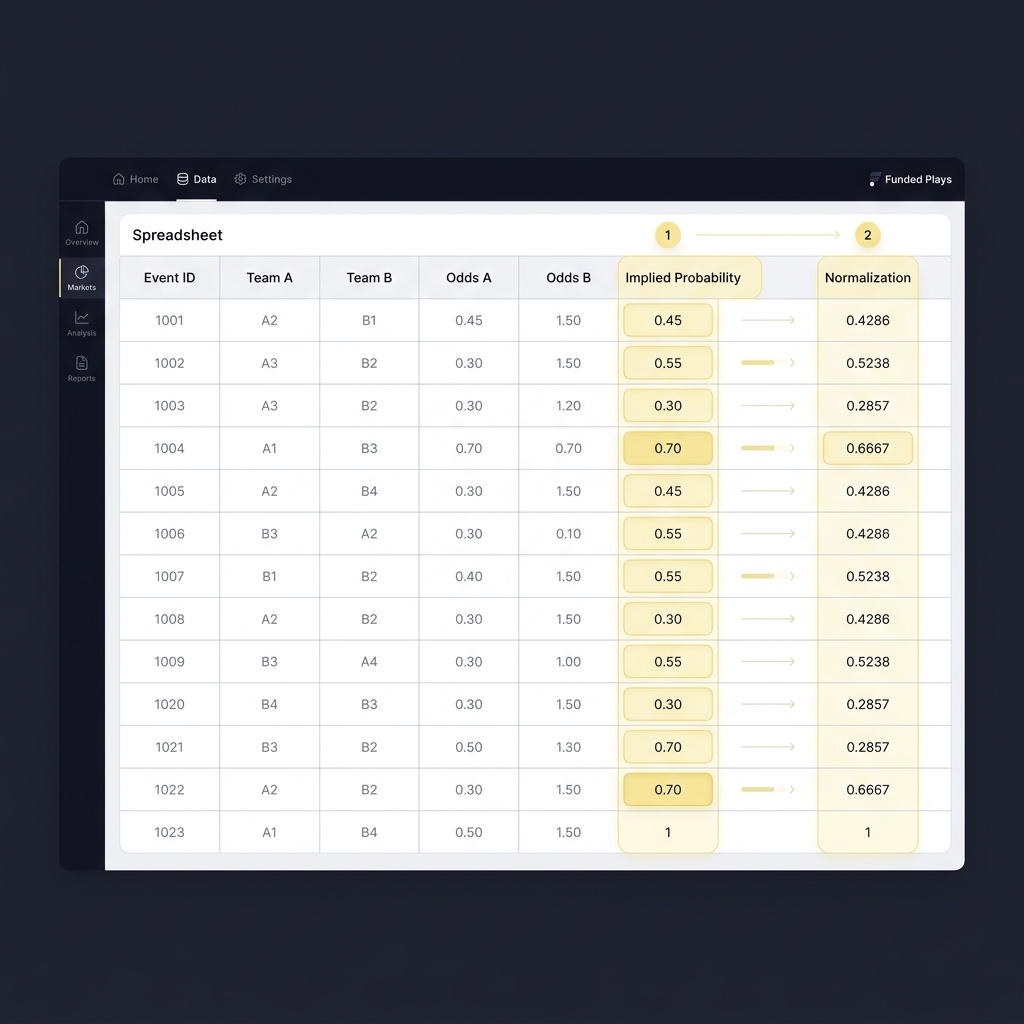
Start with the basic conversions. For decimal odds, implied probability is 1 divided by decimal odds. For American odds, convert the moneyline to decimal and then to implied probability. These conversions give the market's raw implied probabilities, which will usually sum to more than 1 when the house margin is present.
Normalization removes the margin: sum the raw implied probabilities across the two sides of the market and divide each raw probability by that sum. The normalized numbers add to 1 and represent the fair, vig-free probabilities for the two-sided market. The normalization is the core mechanic used by no-vig calculators to remove the overround, and it is a standard approach in practical guides to removing the bookmaker margin Smarkets overround guide.
After normalization, convert the normalized probability back to the preferred odds format, such as decimal or American, using the inverse formulas. Expect small differences between calculators due to rounding choices and precision in intermediate steps; those differences are normal and stem from format and precision handling rather than a conceptual change in the math.


When documenting or replicating these steps, record raw implied probabilities to at least four decimal places before normalization. That reduces rounding drift in the normalized outputs and yields a cleaner benchmark when later multiplying probabilities for parlays.
Can you use a no vig odds calculator for parlays? The independence requirement explained
Short answer: yes, but only when each parlay leg is independent. Statistical independence means the probability of one event does not change when you learn the outcome of another. When independence holds, the fair parlay probability equals the product of the fair probabilities for each leg. The multiplication rule for independent events is a basic probability principle used in many practical probability calculations NIST e-Handbook on independence.
Explore challenge-ready evaluation with FundedPlays Challenges
View FundedPlays ChallengesPut another way, if two legs do not influence each other, de-vig each leg first, then multiply the resulting fair probabilities and convert back to odds to get a fair parlay benchmark. If legs are linked by the same game, a player prop, or an in-play dependency, independence is violated and the simple product overstates or understates fair value.
Same-game parlays are the archetypal example where the assumption breaks down: a goal in a match, a game-level outcome, or the same player's performance can make legs strongly correlated. In those scenarios, simple de-vig multiplication is not appropriate and specialized conditional or correlation-aware models are required.
Practical 5-step workflow to estimate a de-vig parlay benchmark
Step 1, extract both sides of every leg and compute raw implied probabilities from the posted odds. Work in decimal or convert American odds to decimal first. Keep intermediate precision so you do not introduce avoidable rounding error.
Step 2, normalize each two-sided market to remove the vig by dividing each raw implied probability by the market sum of probabilities. The normalized results are your fair leg probabilities and are what a no-vig odds calculator produces as the basis for parlay math. For the normalization rationale see the Smarkets help article on overround Smarkets overround guide.
Step 3, test independence. Checklist items to flag correlation: legs from the same game, player props tied to the same outcome, or markets that reference the same underlying event. If you find any of these, treat the parlay as correlated and proceed to specialist methods or accept that a simple de-vig product is inappropriate.
Step 4, if legs pass the independence test multiply the fair probabilities from Step 2 to get the parlay probability. This multiplication follows the standard probability rule for independent events and yields a theoretical fair parlay probability that you can then invert to odds. The multiplication rule is a fundamental result in probability theory NIST probability multiplication.
Step 5, convert the parlay probability back into decimal or American odds and compare to the book's posted parlay price. Remember to check house rules and payout tables because operator rounding and fixed payouts frequently create small but material gaps between theoretical fair odds and the posted parlay payout.
How operator rules, payout tables, and rounding change real parlay prices
Real-world parlay payouts depart from pure de-vig math for several reasons. Operators may layer additional margin on top of single-market vig, use fixed payout tables that map parlay combinations to predetermined payouts, or apply rounding that changes practical payouts in favor of the house. These operational choices mean posted parlay prices are often not equal to the de-vig benchmark, so always treat the de-vig number as a diagnostic rather than a contract.
Many jurisdictions require operators to publish or adhere to specific house rules and payout structures, and those rules can mandate rounding conventions or payout granularity that move posted payouts away from theoretical fair prices. For an overview of how house rules and regulations shape payout behavior see the Nevada gaming rules and related regulatory overview Nevada Gaming Commission rules overview.
When you compare your de-vig benchmark to a posted parlay price, document differences and check whether the operator uses a fixed payout table or a combination pricing engine. If the operator publishes a payout table, the posted payout for a given combination will often be the table value rather than the exact inverse of the de-vig probability.
Cash-out, live offers, and why you should not assume them in valuation
Cash-out and live offers are valuable features but they are discretionary. Regulatory technical standards treat cash-out as a feature that operators can make available and withdraw under certain conditions. Because cash-out terms can change or be removed, you should avoid assuming a cash-out option when computing a fair parlay value used for decision-making. The UK Gambling Commission's technical standards explain the discretionary nature of cash-out features and their regulatory context Gambling Commission RTS on cash-out.
In practice, treat cash-out as an optional adjustment: if an operator publishes a transparent cash-out rule or amount, you can include it as a separate line in your valuation. If cash-out is not explicit or can be withdrawn, exclude it from the parlay fair-price calculation and treat any cash-out offer as a tactical choice rather than part of the theoretical benchmark.
For decision-making, run two numbers: the raw de-vig parlay benchmark and an adjusted figure that reflects a known, documented cash-out. Use the adjusted figure only when the cash-out is contractually clear and you understand the operator's right to change or remove it.
Correlation cases: same-game parlays, in-play links, and specialized pricing
Common correlated scenarios include player props linked to the same player's minutes or scoring, game-level lines paired with player outcomes, and in-play legs where one event alters the probability of another. These linkages invalidate the independence assumption and make the simple product rule unreliable.
The simple multiplication of de-vig probabilities can either understate or overstate the true joint probability depending on whether the legs are positively or negatively correlated. For correlated legs, operators typically respond in one of three ways: block the combination, reprice using conditional models, or apply a cross-market correlation adjustment in the pricing engine. Regulatory and operator frameworks describe how house rules are used to handle these cases Nevada Gaming Commission rules overview.
When you encounter correlated legs, pause and consider conditional probability models, a correlation matrix, or scenario simulation instead of simple multiplication. Those approaches let you account for how the outcome of one leg changes the distribution and therefore the joint probability of the parlay. For tools that address linked legs see a correlated parlay calculator such as the one provided by SportsBettingOddsCalculator.
Typical errors and pitfalls when using a no vig odds calculator for parlays
A common error is treating correlated legs as independent and applying the de-vig product blindly. That mistake is the single largest source of overconfidence in a calculated parlay edge because correlation can materially change the true joint probability.

Another frequent pitfall is using one-sided markets or failing to de-vig both sides of a market before multiplying probabilities. Always de-vig a two-sided market so your leg probabilities sum to one before you multiply them for a parlay benchmark.
Finally, do not assume the de-vig number equals the book payout. Fixed payout tables, rounding, and operator margin layers mean the posted parlay payout can be higher or lower than your theoretical benchmark. Treat the de-vig result as a comparative tool to identify potential value rather than a guaranteed payout.
Worked example: two independent legs computed step-by-step
Step 1, extract posted odds for two independent legs and convert to decimal if necessary. Record each leg's raw implied probability as 1 divided by decimal odds. Keep at least four decimals to limit rounding drift.
Step 2, normalize each market by dividing each side's raw implied probability by the sum of the market's raw probabilities. The outputs are the fair leg probabilities you will use for the parlay product. For a refresher on the normalization rationale see the overround guide Smarkets overround guide.
Reproduce a two-leg fair parlay probability
Use probabilities as decimals between 0 and 1
Step 3, multiply the two normalized leg probabilities to get the parlay probability. This multiplication is valid because the legs are independent. Step 4, convert the parlay probability back to decimal or American odds using the inverse formulas and format as needed for comparison with the operator's posted parlay price.
Step 5, check operator rounding and payout tables. If the operator publishes a payout table for similar combinations, consult it and document any gap between the theoretical de-vig odds and the posted payout. Use the documented difference to decide whether the posted parlay offers practical value after accounting for house rules.
When a no vig odds calculator is not enough: advanced methods and specialist models
When legs are correlated or when the operator uses complex cross-market pricing, you need conditional probability models, correlation matrices, or Monte Carlo simulation to estimate joint probabilities correctly. Conditional models explicitly compute the probability of one event given another, which is essential when one leg materially changes the distribution of the other.
Monte Carlo and scenario simulation are effective when closed-form conditional models are difficult to specify. Simulate many possible game outcomes with the known dependency structure to estimate the joint distribution and derive a fair parlay probability from the simulated frequencies. These approaches are higher effort but necessary when same-game or in-play dependencies are significant.
If operator rules or payout tables impose hard limits or rounding that dominate the gap between de-vig and posted payouts, it may be practical to accept the posted price rather than attempt advanced modeling. In those cases document your reasons and treat the de-vig calculation as informative background rather than decisive proof of value.
Practical checklist, next steps, and how this ties to challenge platforms like FundedPlays
Quick checklist: de-vig each two-sided market, test independence, multiply fair probabilities only for independent legs, convert to odds, and check house rules and payout tables before drawing practical conclusions. Use documented steps and keep an audit trail so you can review decisions later. For related posts see the FundedPlays blog.
Using a de-vig benchmark helps users on skill-based challenge platforms evaluate theoretical value without implying guaranteed outcomes. Applying a structured workflow and testing independence aligns with disciplined performance measurement and helps users make consistent, documented decisions while participating in evaluation challenges on platforms such as FundedPlays.
Finally, always treat calculators as estimation tools and practice responsible participation. Benchmarks inform choices but do not guarantee qualification or rewards on any platform, and outcomes depend on performance and adherence to platform rules.
You can use it for parlays only when each leg is independent; correlated legs require conditional or specialized models.
No, posted payouts can differ due to house rules, fixed tables, rounding, and additional operator margin.
Not by default; treat cash-out as discretionary unless the operator documents a clear, contract-like offer.
References
- https://www.investopedia.com/terms/v/vigorish.asp
- https://help.smarkets.com/hc/en-gb/articles/213040365-Understanding-overround
- https://www.itl.nist.gov/div898/handbook/eda/section3/eda3661.htm
- https://gaming.nv.gov/index.aspx?page=51
- https://www.gamblingcommission.gov.uk/technical-standards/remote-gambling-and-software-technical-standards-rts
- https://www.fundedplays.com/challenges
- https://www.fundedplays.com
- https://www.fundedplays.com/blogs
- https://www.fundedplays.com/blogs/how-fundedplays-evaluations-work
- https://oddsjam.com/betting-calculators/no-vig-fair-odds
- https://oddsindex.com/guides/same-game-parlay-calculator
- https://www.sportsbettingoddscalculator.com/correlated-parlay