
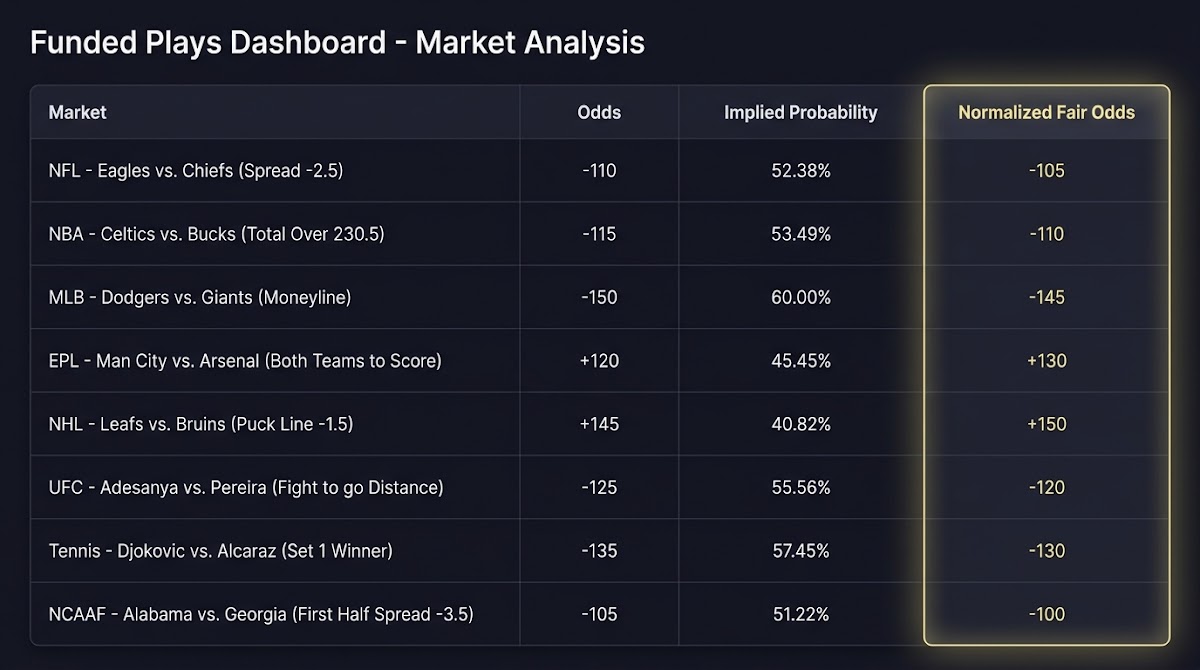
What is a no vig odds calculator and why use one?
A no vig odds calculator is a tool that converts market prices into implied probabilities and then removes the bookmaker margin so the probabilities sum to one. The process strips out the vigorish, sometimes called the juice or overround, to produce what many traders call fair or vig free probabilities; this makes it easier to compare lines and assess value across markets and books, and it is a common first step in many analytical workflows, including forecasting and staking models Investopedia vigorish definition
Convert posted odds to implied probabilities, sum them to find the overround, divide each probability by that sum to normalize, and convert the normalized probabilities back to your preferred odds format.
Practically, a no vig odds calculator takes decimal or American odds, computes each selection's implied probability, measures the market overround, and then normalizes the probabilities so they add to one; the result can be expressed again as decimal or American fair odds for evaluation or pricing purposes Pinnacle margin guide
People use de-vigged prices for several reasons: to compare pricing between books without the distortion of differing margins, to estimate a consensus fair price for modeling inputs, and to improve calibration when building predictive models that expect probabilities to sum to one CRAN implied vignette
How a no vig odds calculator works - step by step
Step 1, convert market odds to implied probabilities. For decimal markets the mapping is straightforward, and American odds require sign handling; compute an implied probability for every selection before any adjustment so you capture the book's built-in margin Action Network implied probability guide
Step 2, compute the market overround by summing the implied probabilities. If the sum is greater than one, the excess represents the bookmaker's vig or margin and explains why market probabilities do not directly represent a fair distribution Pinnacle margin guide
Step 3, normalize the probabilities by dividing each implied probability by the total sum of implied probabilities. The resulting normalized probabilities are the no vig probabilities. Convert those back to decimal odds with 1 divided by the normalized probability, and map to American format if you need that representation for downstream tools CRAN implied vignette
These three steps form the backbone of most no vig odds calculators and are simple enough to implement in a spreadsheet, script, or statistical package; they also form the baseline against which more complex adjustments, such as Shin adjustments, are compared Pinnacle margin guide
Quick formulas: converting American and decimal odds for the calculator
Decimal-to-probability formula, copy ready: p = 1 / decimal_odds. To return to decimal odds from a probability use decimal_odds = 1 / p. These direct inverses are the simplest conversions used in de-vigging workflows Pinnacle margin guide
American-to-probability formula, positive American A: p = 100 / (A + 100). For negative American A: p = -A / (-A + 100). Use these mappings when converting American odds into implied probabilities before normalization Action Network implied probability guide
Back-conversion notes: once you have fair probabilities, convert to decimal as 1 / p and to American using the standard inverse mapping. Be mindful of rounding choices when presenting American odds because the sign and magnitude affect the published number CRAN implied vignette
Rounding and tie handling: apply consistent rounding rules and set a small probability floor for numerical stability in very long shots. For three-way markets such as many soccer lines, compute implied probabilities for each outcome and then normalize across all three to remove the larger overround typical of these markets Smarkets overround guide
Implementing the basic no-vig normalization in a spreadsheet
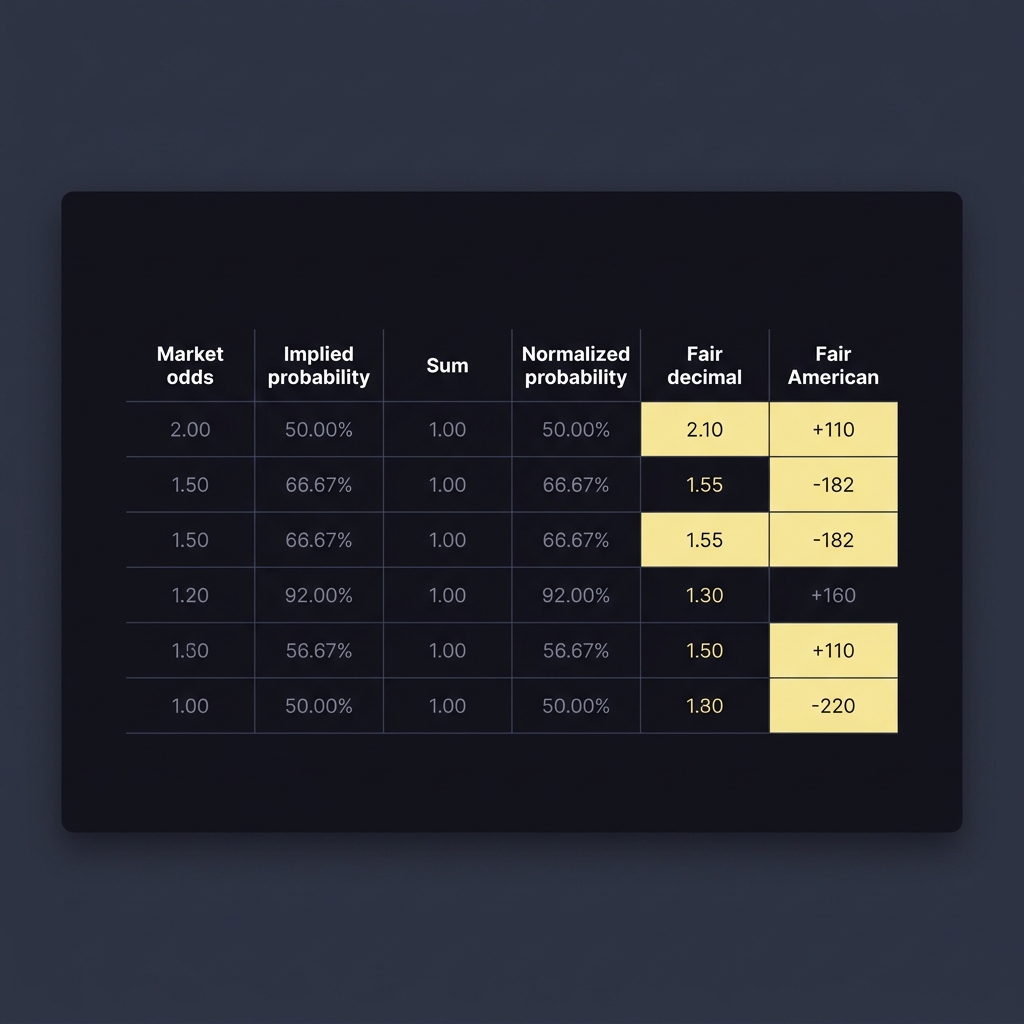
Suggested column layout for Excel or Google Sheets: Market odds, Implied probability, Sum of implied probabilities, Normalized probability, Fair decimal odds, Fair American odds. This order keeps each transformation visible and makes verification checks simple Pinnacle margin guide
Exact formula examples you can paste: for decimal odds in cell A2 use B2 = 1 / A2 to get implied probability. For positive American in A2 use B2 = 100 / (A2 + 100). For negative American in A2 use B2 = -A2 / (-A2 + 100). Compute the overround in a single cell as SUM(B2:B4) for a three-selection market and normalize each entry with C2 = B2 / SUM(B2:B4) Action Network implied probability guide
Example spreadsheet template column checklist for no vig normalization
Use this as a starting template
Common spreadsheet pitfalls include forgetting sign handling for American odds, referencing wrong ranges in the SUM formula, and failing to lock ranges with absolute references when copying formulas for many markets. Add simple unit tests such as comparing 1 over normalized probability to the fair decimal odds column and checking SUM of normalized probabilities equals 1 within a small tolerance CRAN implied vignette
Verification checks to include: SUM of normalized probabilities equals 1 within a chosen tolerance, no negative probabilities, and expected relative movement of prices when you remove the vig. Keep input validation in the sheet so malformed or zero inputs produce clear error messages rather than silent miscalculations Pinnacle margin guide
Building a no vig odds calculator in code: practical examples
Minimal pseudocode pattern: read market odds array, convert each odds value to implied probability using the decimal or American formulas, compute total = sum(implied probabilities), compute normalized = implied / total for each item, then produce fair_decimal = 1 / normalized and fair_american by applying the inverse American mapping. This sequence is the direct implementation of the normalization approach described earlier CRAN implied vignette

For R users, the implied package includes vignettes and functions that demonstrate these conversions and provide reproducible examples you can adapt. Open-source vignettes show how to vectorize the calculations and include simple checks so you can scale the same logic to many markets without rewriting the transformation code for each new dataset CRAN implied vignette
Numeric stability notes: use vectorized operations to process many markets quickly, handle zero or missing inputs explicitly, and choose a small epsilon for probability floors if you expect extreme lines. When integrating live price feeds, validate the feed schema and perform sanity checks on any incoming odds before running the normalization logic Pinnacle margin guide
When to use the Shin model instead of basic normalization
The Shin model adjusts the normalization to account for informed trading by estimating how much of the overround may be due to insider information or persistent price pressure rather than uniform margin. In markets where informed bets skew prices, Shin can change the allocation of probability mass compared to proportional normalization Shin model paper
Use cases favoring Shin include markets with clear evidence of informed betting, persistent one-sided liquidity, or when you have historical data to calibrate the model. Shin is not a default replacement for proportional normalization but an alternative when market structure suggests asymmetric information CRAN implied vignette
Caveat: the Shin model requires additional assumptions and sometimes external calibration points, so it increases model complexity and sensitivity. If you prioritize transparency and simplicity for a first-pass calculator, basic proportional normalization remains a robust baseline Shin model paper
Practical example: step-by-step de-vigging of a two-way market
Start with a two-way market example in decimal odds. Suppose the market shows decimal odds 1.80 for Team A and 2.10 for Team B. Convert to implied probabilities pA = 1 / 1.80 and pB = 1 / 2.10 to obtain the market implied probabilities, then sum them to find the overround and identify the vig Pinnacle margin guide
Normalize by dividing each implied probability by the total sum. The normalized probabilities are the no-vig probabilities and their inverses give the fair decimal odds. Compare original market odds to fair odds to see how much the vig inflated prices and to estimate the implied edge if you have a model or view that differs from the fair probabilities CRAN implied vignette
When working with American inputs, perform the same steps but convert American odds to probabilities first using the sign-aware formula; after normalization you can convert back to American format if needed. This approach works the same for moneyline style markets and keeps the transformation consistent across odd formats Action Network implied probability guide
Practical example: de-vigging a three-way market and soccer lines
For a three-way soccer market with home, draw, and away outcomes, convert each decimal price to an implied probability and then sum across all three. Three-way markets often show a larger overround because books build in extra margin to account for the draw option, which makes de-vigging especially useful in soccer analysis Smarkets overround guide
Apply the same normalization step across the three outcomes so the normalized probabilities sum to one. When working with totals and props, decide whether to de-vig each paired market separately or to aggregate related selections before normalization; the choice depends on how your downstream model consumes the probabilities Pinnacle margin guide
Practical caution: ties and market conventions can affect how you map outcomes to probabilities, so document how you treat each market type in your spreadsheet or code and keep consistent mappings when comparing historical lines or backtesting model performance CRAN implied vignette
Decision criteria: choose basic normalization or a Shin adjustment
Checklist of signals that favor Shin: evidence of informed betting, repeated one-sided price pressure, or discrepancies that persist after accounting for liquidity. If you see these patterns, Shin may allocate probability mass differently than proportional normalization and improve calibration Shin model paper
When proportional normalization is adequate: liquid markets with no clear insider signals, or when you need a transparent and reproducible baseline for many markets. Proportional normalization is easy to audit and usually sufficient for broad comparisons or initial model inputs Pinnacle margin guide
Practical note: weigh the added complexity of Shin against available data and your validation budget. Shin requires calibration and can be sensitive to assumptions, so reserve it for cases where you can test improvements with out-of-sample checks CRAN implied vignette
Common mistakes and how to avoid them when using a no vig odds calculator
Frequent error: incorrect sign handling for American odds which produces invalid probabilities. Validate American conversions against known examples and include unit tests to catch sign mistakes early in your implementation Action Network implied probability guide
Do not treat normalized probabilities as guaranteed forecasts. De-vigging removes the margin but does not replace model validation. Use backtests and calibration checks before relying on de-vigged outputs for staking or decision making CRAN implied vignette
Other checks: ensure the SUM of normalized probabilities equals 1 within tolerance, implement input validation for zero or malformed odds, and compare fair odds against an independent source or consensus when possible as a sanity check Pinnacle margin guide
Quick reference checklist and cheat sheet for your calculator
Minimum tests before trusting outputs: SUM(normalized probabilities) equals 1 within tolerance, no negative probabilities, correct American-decimal mappings, and documented rounding rules. These tests catch most implementation errors and provide a clear pass-fail signal for automation Pinnacle margin guide
Recommended defaults: use a tolerance such as 1e-6 for floating checks, adopt a minimal probability floor for extreme lines, and keep a clear log of assumptions if you apply Shin adjustments. Documenting these settings improves reproducibility CRAN implied vignette

Further reading, tools, and reproducible resources
Authoritative background reading includes industry explainers on vig and margin such as the Investopedia article on vigorish and Pinnacle's margin guide, both of which provide accessible introductions to why overrounds exist and how to compute them Investopedia vigorish definition
Reproducible resources: the implied package vignette on CRAN includes code examples and vignettes that implement the conversions and normalization steps so you can adapt them to your own workflow or verify notebook results CRAN implied vignette
Advanced reading: the original Shin model paper remains foundational if you plan to study adjustments for informed trading and price pressure; use it as a reference when deciding whether to implement Shin in your pipeline Shin model paper
Conclusion: practical next steps to build or use a no vig odds calculator
Recap the workflow: convert odds to implied probabilities, compute the overround, normalize probabilities to remove the vig, and reconvert to fair odds. Use proportional normalization as a baseline and consider Shin only when market signals and validation resources justify it Pinnacle margin guide
Next tasks: build a spreadsheet prototype using the column layout above, code a minimal vectorized implementation for batch markets, and run simple backtests to validate calibration. Document assumptions, tolerances, and any Shin calibration decisions so results remain reproducible and auditable CRAN implied vignette

No vig means odds have been adjusted to remove the bookmaker margin so the implied probabilities sum to one, producing fair probabilities for comparison or modeling.
De-vigged odds are useful inputs but are not guaranteed predictions; they should be validated with backtests and used with caution in models.
Consider Shin when you have evidence of informed betting or persistent price pressure and sufficient data to calibrate the model; otherwise use proportional normalization.
References
- https://www.investopedia.com/terms/v/vigorish.asp
- https://www.pinnacle.com/en/betting-resources/educational/how-to-calculate-margin
- https://cran.r-project.org/web/packages/implied/vignettes/implied.html
- https://www.actionnetwork.com/education/how-to-calculate-implied-probability
- https://smarkets.com/academy/betting-basics/understanding-betting-margin-and-overround
- https://doi.org/10.2307/2234529
- https://www.fundedplays.com/challenges
- https://www.fundedplays.com/blogs
- https://www.fundedplays.com/blogs/how-fundedplays-evaluations-work
- https://www.fundedplays.com
- https://unabated.com/betting-calculators/no-vig-fair-odds-calculator
- https://oddsjam.com/betting-calculators/no-vig-fair-odds
- https://www.dratings.com/a-summary-of-different-no-vig-methods/