
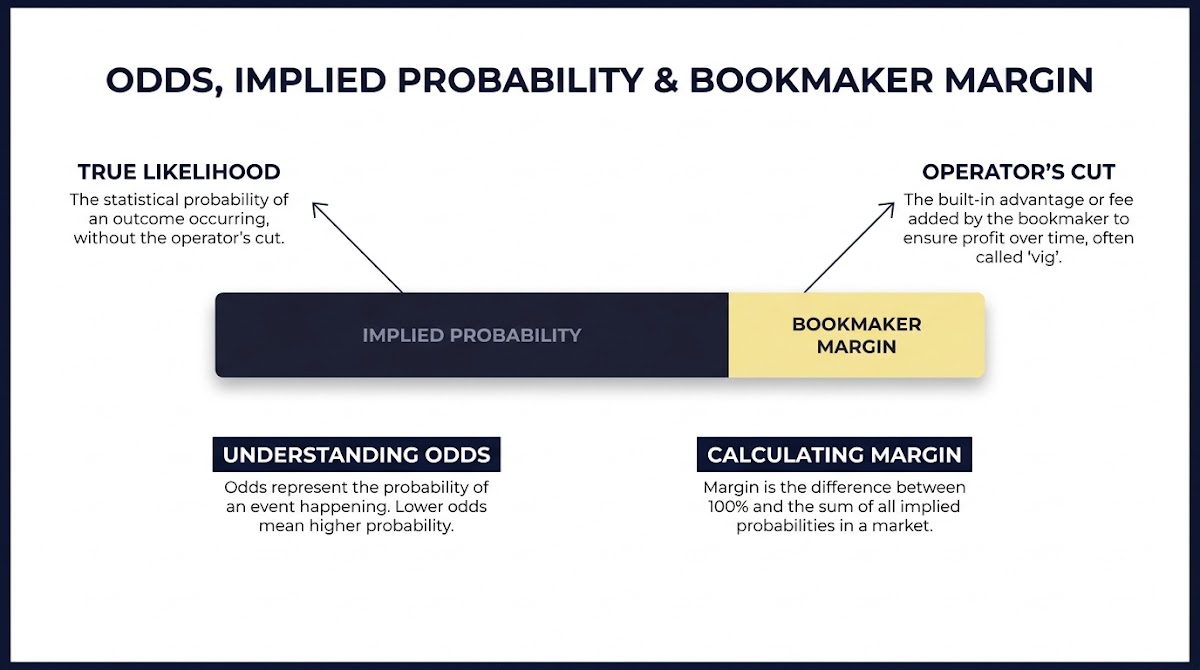
What no vig odds mean and why they matter
No vig odds are the adjusted market prices you get when a bookmaker margin is removed from posted quotes; the adjustment reveals implied probabilities that sum to 100% so traders and analysts compare fair betting odds more directly, and that comparison helps identify possible value. Investopedia vigorish definition
The distortion that bookmakers introduce is commonly described as vig, vigorish, or overround. Converting prices to implied probabilities shows how the overround inflates the summed probability above one, or 100 percent, and no vig odds rescale those probabilities back to a neutral baseline for comparison. Smarkets overround and book percentage guide
Practically, bettors and modelers use no vig odds as a benchmark rather than as a guarantee. A no vig price is a transparency tool: it clarifies how much of the posted price is the market view and how much is margin. That makes it useful for model calibration and comparing prices across venues without implying anything about an operator's payout reliability. Investopedia vigorish definition
Need a quick price-benchmark routine?
Decide whether you need a simple price-benchmark workflow to compare markets or whether licence and dispute checks should be your first step.
Short examples help: when two operators post similar outcomes with different margins, converting to no vig odds can reveal which market offers relatively cleaner implied probabilities and which embeds higher margin. Use that insight as a comparison metric, not as an assurance of payment or service quality.
How to calculate no vig odds: step-by-step method
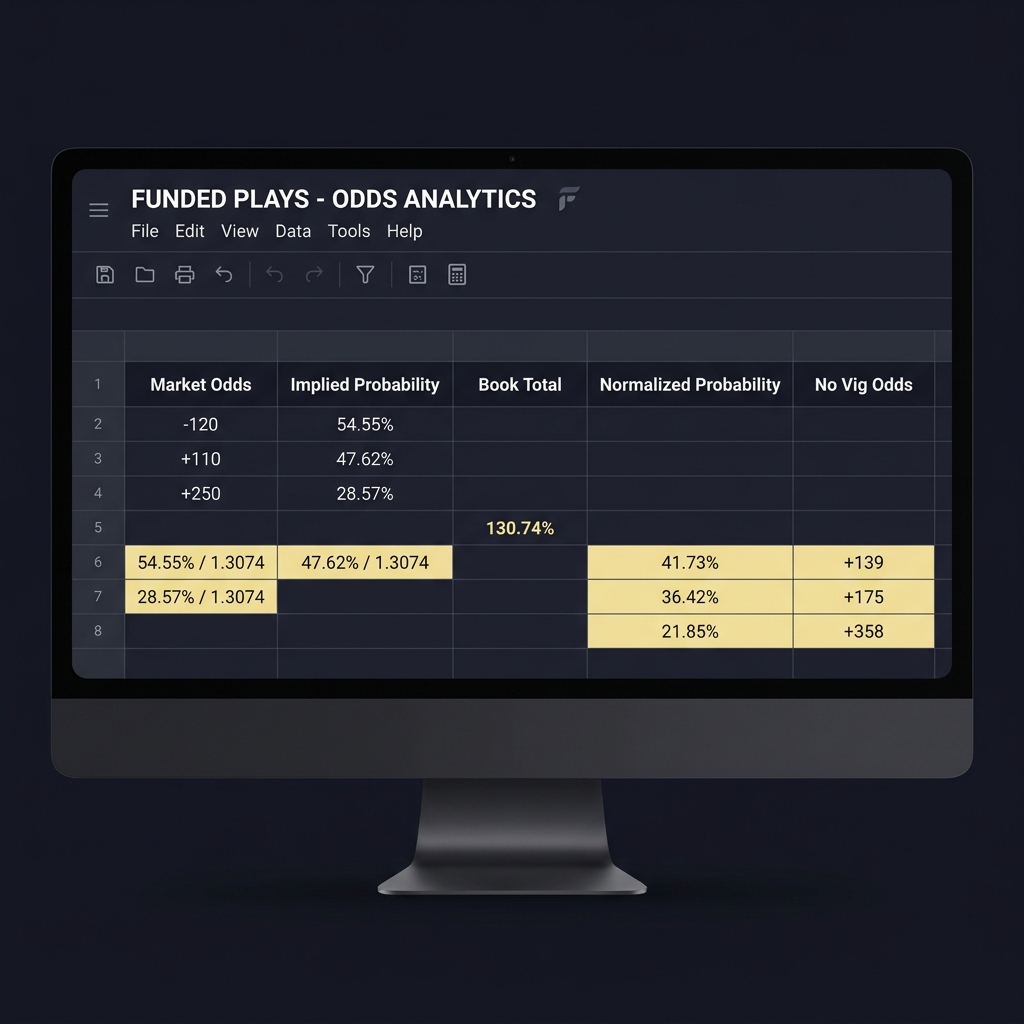
Follow a three-step approach to compute no vig odds. Step 1 is to convert each posted price into an implied probability using the standard formula for the price format you have. For decimal odds the implied probability is 1 divided by the decimal odd. For fractional or moneyline formats use the equivalent conversion. Therundown no-vig calculator
Step 2 is to compute the book percentage by summing all implied probabilities. The book percentage will usually be greater than 1 (or 100 percent) when the book includes a margin. Normalize each implied probability by dividing it by the book percentage so the set sums to 1. This proportional normalization is the standard market education method for removing vig. Smarkets overround and book percentage guide
Step 3 is to convert the normalized probabilities back into odds. For decimal-style no vig odds, compute 1 divided by the normalized probability. That yields the adjusted decimal price that represents the implied chance without the bookmaker margin. The process is reversible and replicable in spreadsheets or simple scripts.
Annotated example structure: list each market price, convert to implied probability, show the book total, normalize each probability, and then convert the normalized probabilities back to decimal or fractional odds. The math is simple and widely taught in market education materials, and it aims only to standardize pricing for comparison. Smarkets overround and book percentage guide

Different sources sometimes apply slightly different normalization approaches. The proportional normalization described earlier is common because it preserves the relative differences between implied probabilities while forcing their sum to 100 percent. Some analysts apply small adjustments for very large markets or apply smoothing to avoid extreme swings in thin markets. Smarkets overround and book percentage guide
These variations matter because in thin markets or where liquidity is limited, prices can be noisy and normalization may amplify that noise. No vig probabilities correct for how margin is distributed across outcomes but do not correct for information asymmetry, sudden liquidity drains, or model misspecification.
No. Removing the vig is a mathematical adjustment to reveal implied probabilities; payout safety depends on licensing, consumer protections, and dispute procedures.
Expect small differences across methods: two reasonable no vig procedures can yield slightly different fair prices and that variance is normal. Use no vig outputs as a comparative signal rather than a single-source truth.
Does removing the vig make payouts safer?
Removing the vig is strictly a mathematical step to reveal implied probabilities and it does not change an operator's legal obligations or how payouts are handled. Payout safety depends on licensing, regulatory oversight, and the operator's dispute procedures rather than on whether the market is advertised as no vig. UK Gambling Commission public register
Even if a market shows zero margin in its prices, the platform's terms and consumer protections determine practical payout reliability. Where a regulator provides clear patron dispute and mediation procedures, players have formal avenues to challenge unresolved issues; those protections are a separate consideration from price fairness. New Jersey Division of Gaming Enforcement patron dispute guidance
In short, treat no vig odds as a transparency metric for price, not as a certificate of safe payouts. Always check the operator's licensing and dispute mechanisms before relying on advertised pricing claims.
How to verify operator reliability and licenses before you trust no vig claims
Start at the public licence register maintained by the relevant regulator to confirm the business identity and active permissions. National or state regulators commonly publish searchable lists where you can match the operator name, corporate entity, and licence status. Verification on an official register is one of the strongest initial checks you can make. UK Gambling Commission public register
Next, read the platform's terms and conditions, payout rules, and any patron dispute or mediation procedures. Look for explicit contact paths, timeline commitments for resolving disputes, and clear rules about account holds or settlement adjustments. These procedural details determine how a dispute is handled if a payout question arises. New Jersey Division of Gaming Enforcement patron dispute guidance

As a practical step, note whether the operator is described as a skill-based prediction or sweepstakes platform rather than a sportsbook; that distinction can affect consumer protections and the applicable rules. Platforms that present clear challenge rules, transparent account progression, and explicit reward conditions make it easier to set expectations before you act.
Red flags include absence from the public register for the claimed jurisdiction, vague or missing dispute contact details, and terms that allow broad unilateral settlement changes without clear appeal paths. If you find any of those, pause and ask the platform for clarification before placing significant exposure.
Hidden costs and effective prices: commissions, fees and other terms
Markets advertised as no vig may still recover costs through commissions or other fees, so the effective price you pay can differ from the headline no vig number. Exchanges and some platforms offset a low or zero margin by collecting a commission on matched volume or by charging transaction fees. Smarkets commission explanation
To compute the effective price, take the no vig price and then apply any per-trade commission or percentage fee that the platform discloses. That adjusted return is the real net outcome you should compare across venues. Failing to include commissions and fees will overstate the value of a supposedly fair market. OddsJam no-vig calculator
Also check rules about minimums, maximums, and withdrawal conditions that can affect realized returns. Even small processing fees or withdrawal minimums change whether a perceived edge is tradable in practice. In the U.S. context, commercial market reporting shows a maturing regulatory environment, but rules differ by state and can affect how fees and protections are enforced. American Gaming Association state of the states 2025

When no vig pricing is most useful: use cases for bettors and analysts
No vig pricing is most useful when you need consistent price comparisons across several operators or when calibrating predictive models and backtests. Adjusting for vig removes a systematic bias so that a model trained on true implied probabilities is less likely to learn margin artifacts. Smarkets overround and book percentage guide
For market comparison, use no vig odds to identify candidates for further investigation rather than making an automatic selection. In thin markets or events with low liquidity, normalized prices can be misleading because a single matched trade can move the price substantially and normalization can exaggerate that movement. Combine price checks with liquidity and limits checks before acting.
Calculate no vig odds from implied probabilities using normalization
Enter probabilities as decimals like 0.45
In practical workflows a spreadsheet or small script that implements the three-step conversion will cover most needs. Use consistent input formats, record the raw and normalized probabilities, and log any fees separately to compute effective price. That approach keeps the analytical process transparent and repeatable. See a related example in our small script.
Do not treat no vig as a safety guarantee: it fixes margin allocation in prices but does not change an operator's legal obligations or solvency. Confusing price fairness with payout security is a common error that exposes a bettor to institutional risk. UK Gambling Commission public register
A frequent calculation error is failing to normalize probabilities correctly. Remember that normalization divides each implied probability by the book total; skipping that step or miscomputing the book total will produce invalid no vig odds. Double-check your conversions from odds to probability and back to avoid simple mistakes. Smarkets overround and book percentage guide
Another common issue is ignoring commissions and transaction fees when estimating effective returns. Always compute the net result after fees and compare net outcomes when looking for value. If licence verification and T and C checks are skipped, price-based decisions can lead to unexpected problems.
Practical scenarios and a short decision checklist
Scenario 1: comparing two markets. If two operators post different decimal prices for the same outcome, convert each set to no vig odds, compare normalized implied probabilities, then check fees and licence status before acting. Use the conversion as an initial filter rather than a final decision. How to calculate No Vig Odds
Scenario 2: evaluating an advertised no vig market. Confirm that the platform's documentation actually discloses zero margin rather than shifting costs to commission or processing fees. Then confirm regulator listing and read the dispute procedures so you understand how settlement questions are handled. Smarkets commission explanation
Checklist to decide whether to act: 1) Convert to no vig odds and compare, 2) Calculate net effective price after fees, 3) Verify licence on the public register, 4) Read payout and dispute procedures, 5) Check liquidity and available limits, 6) Apply personal risk limits. Treat the checklist as a routine pre-trade review rather than an optional step. UK Gambling Commission public register
Conclusion: balancing price transparency with operator trust
Key takeaways: no vig odds remove the bookmaker margin to expose implied probabilities, which is useful for model calibration and market comparison, but they do not make payouts safer by themselves. Verify an operator's licence and dispute framework independently before trusting advertised pricing. Investopedia vigorish definition
Next steps for readers: adopt a simple no vig conversion in your analytic toolkit, include fee adjustments when computing effective price, and make licence verification and dispute procedure checks a standard part of your workflow. Treat no vig as a transparency tool, not a proxy for institutional trust.
No vig odds are odds adjusted to remove the bookmaker margin so implied probabilities sum to 100 percent; they are a pricing benchmark, not a guarantee of payout.
No, removing vig only adjusts prices; payout safety depends on the operator's licence, regulatory protections, and dispute procedures.
Calculate the no vig price, then subtract or apply any platform commission or transaction fee to compute the effective net price you will receive.
References
- https://www.investopedia.com/terms/v/vigorish.asp
- https://help.smarkets.com/hc/en-gb/articles/208572005-Understanding-overround-and-book-percentage
- https://www.gamblingcommission.gov.uk/public-and-players/find-licensed-gambling-businesses
- https://www.njoag.gov/about/divisions-and-offices/division-of-gaming-enforcement-home/patron-dispute-mediation/
- https://www.fundedplays.com
- https://www.fundedplays.com/challenges
- https://help.smarkets.com/hc/en-gb/articles/214345025-Commission
- https://www.americangaming.org/resources/state-of-the-states-2025/
- https://therundown.io/betting-calculators/no-vig-calculator
- https://oddsjam.com/betting-calculators/no-vig-fair-odds
- https://www.bettingpros.com/no-vig-calculator/