
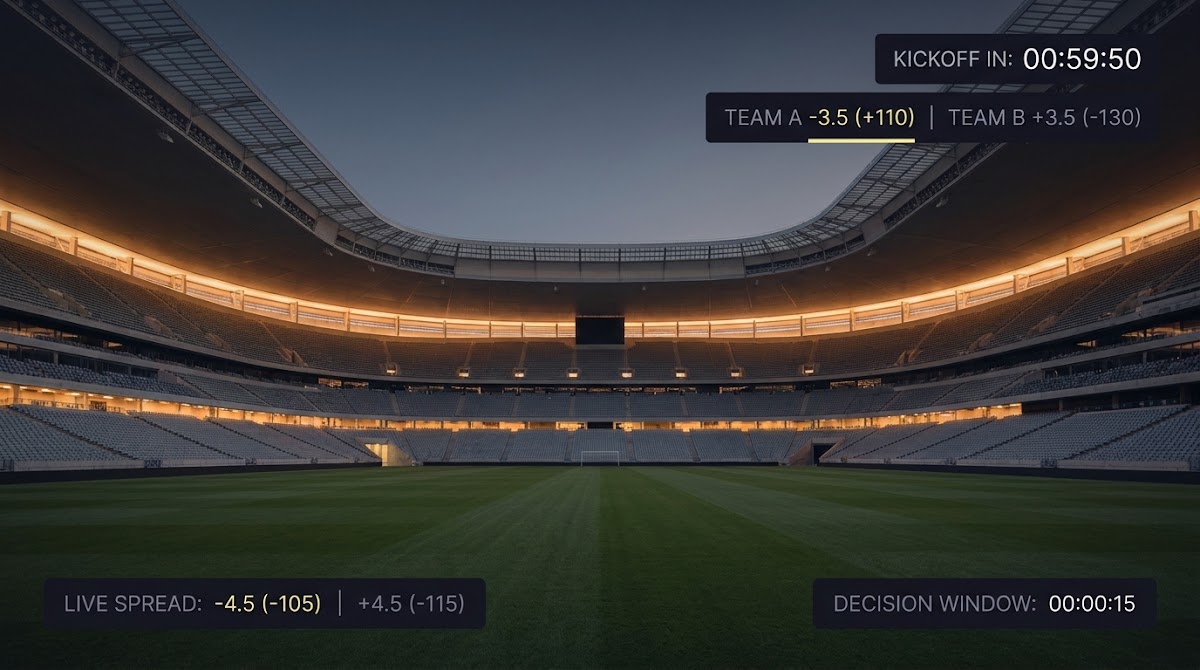
nfl spread tomorrow: what it means and why spreads move
When you read the term nfl spread tomorrow you are looking at a market price that translates two teams' expected point difference into a wagerable line. A point spread balances action by assigning the underdog a points cushion and the favorite a points handicap so payouts are symmetrical whether you back the favorite or the underdog. This is different from totals, which estimate combined scoring, and moneylines, which price win probabilities. The spread is the market's best single number for the margin of victory once bettors, sharps, and market makers interact.
Lines move for a few practical reasons. Public money can nudge a number when large retail bets flow to one side. Sharp bettors and professional books often move lines early when they detect edges or want to manage exposure. Finally, official information from teams, like practice reports and final game status designations, often triggers meaningful late changes to pricing.
Official injury reporting plays a particular role because the active and inactive process means verified lineup changes appear late and reliably. The NFL requires daily practice reports and a final game status announcement, and teams post inactives about 90 minutes before kickoff, so that late window is a common moment for price discovery as the market incorporates confirmed absences and status updates Policy on Reporting Player Injuries.
Combine verified official reports, model-market comparison, conservative adjustments for rule changes and diminished home-field advantage, and disciplined bankroll management; wait for the inactive list for critical late confirmations.
Beyond roster news, other sources of movement include weather forecasts, announced quarterback availability, and perceived market liquidity. Market participants watch both opening and closing lines and react to verified information; the closing line is often treated as the market consensus for an event. Knowing what moves the spread helps you prioritize what to monitor and when to delay a final decision.
What a spread represents in simple terms
Think of the spread as shorthand for expected margin. If you remove wagers and betting structure, the spread approximates how many points the market expects the favorite to win by on a neutral basis. It is not a pure forecast of points scored, but a risk-adjusted number that reflects where bettors and books will lay down money. This is why comparing model projections to market spreads is a common method to identify possible value.

Primary drivers of pregame line movement
Primary drivers include official roster and injury updates, especially the inactive list, public betting patterns, sharp action, and external conditions like weather or stadium changes. Because verified inactives are posted late, they often cause the most abrupt moves near the 90-minute mark before kickoff Roster Management (Active and Inactive Lists). How injuries affect betting lines.
Key data sources to check before locking an nfl spread tomorrow
Start with official NFL practice reports and final game-status announcements. These are primary because they are the baseline for confirmed player availability. A morning or midweek practice note is helpful but a final designation is the decisive update.
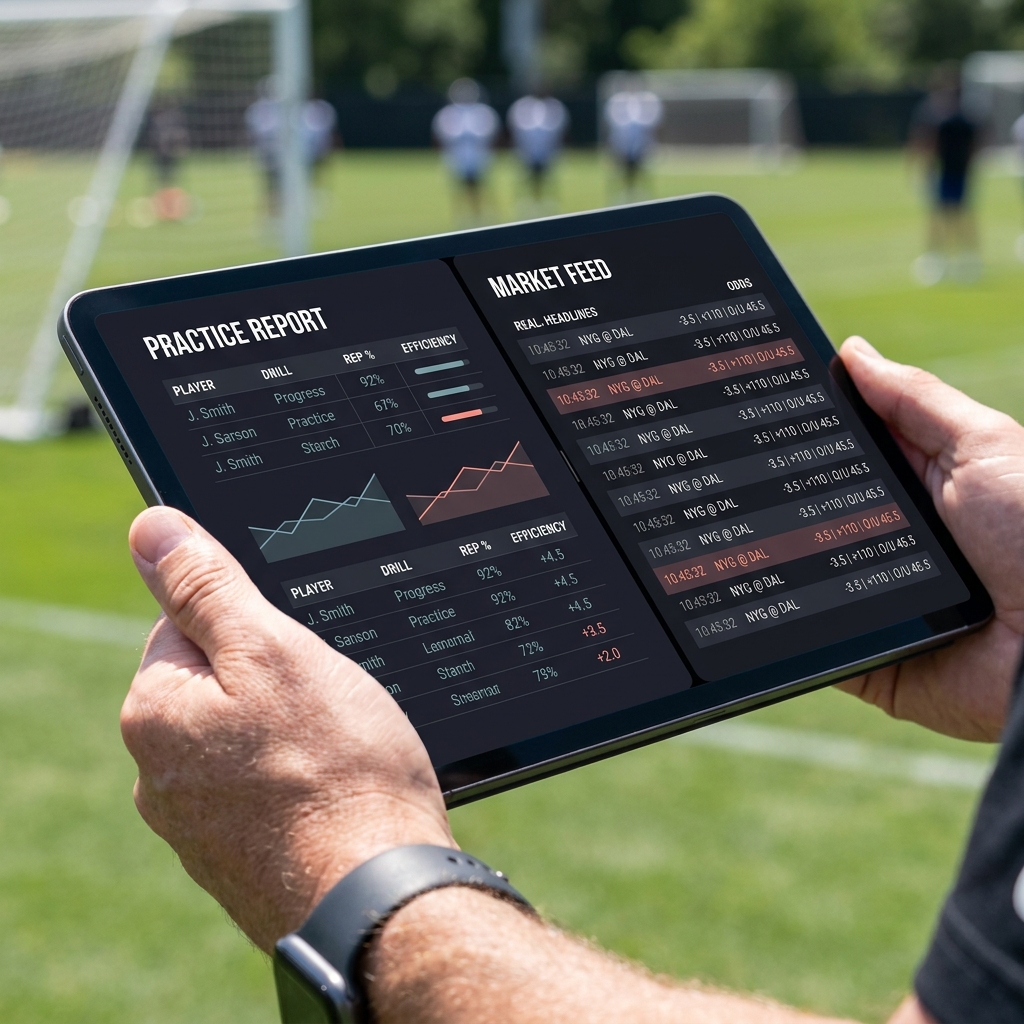
Second, track market feeds and archived closing lines. Archived closing spreads and totals are publicly available and useful for benchmarking your model versus how markets ultimately priced a game 2024 NFL Scores and Schedule.
Third, check weather and venue information. Wind, precipitation, or extreme temperatures can change the expected scoring environment and shift both spreads and totals in the hours before kickoff. Combine weather checks with roster status for a more complete pregame picture.
Official NFL reports and practice notes
Daily practice reports show participation and injury designations leading into game day. Use them as an early warning system for potential late scratches, but treat the final game-status list and the inactive announcement as the authoritative source for lineup confirmation Policy on Reporting Player Injuries. OddsTrader injury report.
Market feeds, opening and closing lines, and archived data
Opening numbers indicate initial market sentiment and where books want to attract action. Closing lines show where markets settled, and archives allow you to backtest whether your rules would have produced an edge against historical closers 2024 NFL Scores and Schedule.
Weather, venue, and late roster cues
Weather forecasts and venue circumstances matter because they influence field position and scoring expectations. Combine these with verified roster cues to judge whether a late market move is justified or likely noise.
A practical step-by-step framework to evaluate the nfl spread tomorrow
Step 1: gather official reports and market lines. Collect the daily practice notes, check the morning injury trackers, and note the opening market spread and public lines across market feeds. Record the current closing-line benchmark for your model comparison. Immediately flag quarterback status and any cluster injury reports that could materially alter game outcome probabilities.
Step 2: generate or fetch model projections and compare to the market. Use a transparent team strength model to produce an expected margin for the game and translate that expectation into a model spread. Compare the model spread to the market spread and note the gap along with an initial confidence level based on roster certainty and weather.
After you complete those steps, pause and assess whether the gap is large enough to justify action given costs and market liquidity. Apply conservative adjustments for any uncertainty you cannot quantify and check whether the historical closing-line archives suggest your model has beaten the market previously on similar signals.
Try the FundedPlays Challenges workflow
Try the stepwise workflow on upcoming games to see how official reports and model comparisons affect your evaluation, without assuming outcomes.
Step 3: apply conservative adjustments and decide whether to act. If the model-market gap persists after accounting for verified inactives, weather, and updated projections, consider a measured position and proper stake sizing. If the gap is small or driven by unconfirmed reports, it is often better to skip or reduce the stake.
These steps form a repeatable workflow you can use each week to turn raw information into disciplined decisions about single-game spread opportunities.
Step 1: gather official reports and market lines
Immediate checks include the latest practice reports, early injury notes, and the opening market lines. Mark any items that could trigger late movement, such as questionable quarterback participation or multiple injuries on one side. Keep a log of when each update appears so you can correlate later how the market responded.
Step 2: generate or fetch model projections and compare to market
Generate a model spread using a transparent team-strength model and compare its number to the current market spread. Reputable models provide a coherent team-strength estimate, which you can use as a baseline for identifying potential value. Keep in mind that differences are often small in efficient markets, so use backtesting to validate any recurring advantage NFL Football Power Index (FPI) - Rankings and methodology overview.
Step 3: apply conservative adjustments and decide whether to act
Conservative adjustments include reducing assumed home-field edge, discounting model output for 2026 rule-induced scoring shifts, and lowering confidence when roster statuses are unresolved. Only act when the adjusted model gap comfortably exceeds transaction costs and your risk tolerance.
How to incorporate 2026 rule changes into your spread and total projections
Some rules approved in the 2026 NFL rulebook alter kickoff handling and related field position mechanics, and these changes can influence average starting field position and scoring context. Because field position affects expected drives and scoring rates, totals and spread calibrations that rely on old baselines may require re-evaluation 2026 NFL Rulebook.
When a rule modification is likely to shift expected field position, adopt a conservative rebaselining approach. Adjust models incrementally, test their fit against early-season data, and avoid large one-time corrections until sufficient sample evidence accumulates. Markets and bookmakers will also update their priors over time, and during that transition period you may see temporary price inefficiencies.
Which 2026 rule changes matter for scoring context
Rule changes that affect kickoffs and other restart situations alter return rates, touchback frequency, and starting field position, all of which are inputs to drive-level scoring expectation. Pay attention to how those dynamics change in early games and adjust model components that estimate expected points per possession.
Rebaselining models for kickoff and field position effects
Recalibrate model baselines by incorporating observed post-change averages for starting field position and scoring. Use a cautious ramp where you blend historical priors with new-season empirical results until the sample is large enough to support a full update.
Using models versus the market: where small edges come from
Models, when transparent, provide consistent team strength and expectation frameworks that are useful for comparison to market spreads. Reputable models estimate team strengths and convert them to expected margins, which you then compare to public lines to look for persistent divergences. Keep in mind that in many NFL markets the differences between a good model and the closing spread are often modest, and persistent edges are rare without careful backtesting NFL Football Power Index (FPI) - Rankings and methodology overview.

Backtesting is the standard way to verify whether a model reliably beats the market. Use historical closing spreads and totals to simulate how your rule would have performed, remembering to account for transaction costs and market timing. Public archives provide the raw closing lines needed for a fair test 2024 NFL Scores and Schedule.
What reputable models provide and their limitations
Reputable models give transparent assumptions about team strength, home-field adjustments, and variability estimates. Their limitations include reliance on historical patterns that may not hold after structural changes, and sensitivity to input quality, especially late roster news.
Backtesting: comparing model outputs to archived closing spreads
Backtesting involves collecting historical closing spreads, applying your model's decision rules, and measuring hit rate and net simulated profit after realistic costs. A single outlier win is not sufficient; look for consistent performance out of sample before assuming an edge.
Timing and the 90-minute inactive window: when to act on nfl spread tomorrow
In the NFL, teams post inactives about 90 minutes before kickoff and these announcements often catalyze late market re-pricing. Because daily practice reports precede the final designations, the market tends to react more strongly to confirmed inactive lists than to early or unofficial reports Policy on Reporting Player Injuries.
When key players like quarterbacks are announced inactive within that late window, the expected outcome distribution can change materially and quickly. That is why many disciplined players either wait for the inactive list before placing a full-size position or size down until confirmation arrives.
How the inactive list announcement works
The inactive list is made public roughly 90 minutes before kickoff, and it specifies which players will not participate. Because it is an official and near-final roster update, it is the central timing cue for last-minute line movement Roster Management (Active and Inactive Lists). NFL Inactives.
Common catalysts for late line movement
Common catalysts include quarterback designations, cluster injuries that remove multiple starters, and late weather updates or stadium change announcements. Large, verified news in the late window tends to move market prices in a way that smaller, early rumors do not.
Decision criteria: choosing which teams to bet on tomorrow
Use a short checklist when deciding which teams to bet on tomorrow: confirm official reports, compare your model spread to the market spread, assess roster health and weather, consider market liquidity, and apply a conservative home-field adjustment. If those checks align and the adjusted model gap exceeds your threshold for action, consider a measured position.
quick decision checklist for spread evaluation
Use this before placing single-game stakes
Quantitative thresholds might include a required point gap after conservative adjustments and allowance for transaction costs. Qualitative checks should verify whether the roster news is official and whether the market is liquid enough to accept a reasonably sized wager without excessive slippage.
Quantitative thresholds and qualitative checks
Set prespecified thresholds for action based on historical backtests of your model versus closing lines. Complement those numbers with qualitative checks like confirmed quarterback availability and stable weather forecasts before placing a normal-sized play.
Adjusting for diminishing home-field advantage
Recent analyses indicate that home-field advantage has declined compared to earlier eras, so use a smaller default home-field adjustment unless your model and backtests justify a larger value. Conservatively reduce the prior home-edge and validate this adjustment with out-of-sample data The NFL’s home-field advantage keeps shrinking.
Typical mistakes that cost bettors on the nfl spread tomorrow
One common mistake is overreacting to unverified reports before the official inactive announcement. Early or unofficial claims can look decisive but may not survive official verification, leading to mispriced actions. Wait for the authoritative inactives when available Policy on Reporting Player Injuries.
Another frequent error is failing to backtest and misreading small model-market gaps as meaningful without considering costs and timing. Use archival closing lines to evaluate whether the signals you rely on produced consistent advantage historically 2024 NFL Scores and Schedule.
A third mistake is ignoring rule-change effects or home-field drift. When structural rules change, like kickoff handling, historical baselines may mislead unless you re-evaluate your model's assumptions 2026 NFL Rulebook.
Practical scenarios: worked examples for evaluating the nfl spread tomorrow
Scenario A, late QB scratch. If a starting quarterback is listed inactive within the 90-minute window, record the official inactive announcement, rerun your model with the backup's expected performance level, apply conservative home-field and weather adjustments, and re-evaluate the model-market gap. If the adjusted gap still looks meaningful and the market shows liquidity, a measured play is reasonable. Otherwise, reduce stake or pass.
Scenario B, model consistently forecasts a market gap. If your model repeatedly shows the same side across multiple weeks and backtests showed positive simulated returns versus archived closing lines, increase confidence only after verifying that the edge is persistent out of sample and not a short-term market inefficiency NFL Football Power Index (FPI) - Rankings and methodology overview.
Scenario C, weather-driven total and spread adjustment. If late weather forecasts predict heavy wind or rain, adjust both spread and total expectations by discounting passing efficiency and increasing variance. Apply a smaller stake if the roster status is also in flux, and monitor market moves through the late window for confirmation.
Scenario A: late QB scratch and how to adjust
Handle a late quarterback scratch by relying on the official inactive list, updating your expected-starting-quarterback assumption, and recalculating expected margin. Carefully watch market liquidity because sudden large moves can be expensive to trade against if the market is thin.
Scenario B: model consistently forecasts a market gap
Validate repeated advantages by backtesting against archived closing lines, ensuring you control for games where late verified news would have prevented you from acting at the original market price.
Scenario C: weather-driven total and spread adjustment
For weather-driven scenarios, adjust expectations for scoring and prefer conservative sizing when forecast uncertainty is high. Rely on verified weather sources and cross-check venue reports for last-minute changes.
Bankroll and risk management for single-game nfl spread bets tomorrow
Expect variance in single-game work. Use conservative unit sizing principles and avoid oversized positions based on a single model signal. Treat each wager as part of a longer evaluation process rather than a make-or-break event.
Reduce stake or skip plays when information is uncertain, such as before the inactive list is posted or when roster changes are unverified. No approach guarantees profit, so prioritize preservation of bankroll and consistent application of your rules.
Unit sizing and variance expectations
Adopt conservative unit sizing and accept that single-game outcomes will vary widely. Focus on process consistency and long-term evaluation rather than short-term outcome chasing.
When to reduce stake or skip a play
Reduce stake when major variables remain unresolved close to kickoff, or when market liquidity could force poor execution. Skipping is a valid outcome when the information environment or the expected edge falls below your threshold.
How to backtest your approach using historical closing spreads
Public archives such as Pro-Football-Reference provide historical closing spreads and totals that you can use to simulate how your rules would have fared. Collect past closers, apply your decision logic, and compute hit rate and simulated net profit after realistic trading costs 2024 NFL Scores and Schedule.
When backtesting, emphasize out-of-sample testing and beware of overfitting. Small historical edges can evaporate in live markets, so require consistency across multiple seasons and different market conditions before scaling stakes.

Where to find archived spreads and totals
Archived spreads, lines, and boxscores are available through public data services and allow you to reconstruct closing markets for backtesting your model and decision rules.
Basic backtest metrics to track
Track hit rate, average margin capture, simulated profit after costs, and drawdown. Use these metrics to decide whether your approach should be refined, scaled, or retired.
Monitoring markets during the lead-up to kickoff
Watch real-time feeds for line movement and liquidity, and interpret large moves near the inactive announcement as likely responses to verified roster news. Small, early moves may reflect low liquidity or early sharp action and should be treated with caution until verified.
Recommended indicators include magnitude of move, timing relative to official announcements, and changes in available market depth. Use these signals to decide whether the market has fully incorporated new information or if it is overreacting.
Tools and feeds to watch for movement
Track multiple books and market feeds to see where lines diverge, and monitor volume indicators to judge how much real money supports a move. Confirm roster changes against official NFL reports before acting.
Interpreting the size and direction of late moves
Large, confirmed moves close to the 90-minute inactive window typically indicate significant verified news, while small, early shifts often require verification and may not reflect a durable market consensus.
Conclusion: a disciplined checklist for deciding what teams to bet on tomorrow
Checklist: verify official practice reports and the inactive list, compare a transparent model to the market spread, apply conservative home-field and rule-change adjustments, account for weather and liquidity, and backtest any repeated signal against archived closing spreads. If uncertainty remains, reduce stake or skip the play.
Adjust your baselines for 2026 rule changes and be mindful that markets are often efficient; persistent edges are uncommon without careful validation. Use structured practice environments to refine your process and measure consistency over time.
FundedPlays offers a structured environment to practice prediction skills in challenges that emphasize consistency and disciplined evaluation rather than traditional wagering.
Wait for official inactives about 90 minutes before kickoff when key players are uncertain, and reduce stake if roster or weather information is unresolved.
Rule changes that alter kickoffs and field position can shift scoring baselines, so rebase models cautiously and validate with early-season data before making large adjustments.
Persistent edges are rare in NFL markets; use backtesting on archived closing lines and require out-of-sample consistency before assuming a model advantage.
References
- https://operations.nfl.com/the-players/health-and-safety/policy-on-reporting-player-injuries/
- https://operations.nfl.com/the-rules/roster-management/
- https://www.pro-football-reference.com/years/2024/games.htm
- https://www.espn.com/nfl/fpi
- https://operations.nfl.com/the-rules/2026-nfl-rulebook/
- https://www.theringer.com/nfl/2024/1/5/24025084/nfl-home-field-advantage-decline
- https://www.fundedplays.com/challenges
- https://www.rotowire.com/football/inactives.php
- https://www.actionnetwork.com/education/how-injuries-affect-betting-lines-a-guide-to-market-movement
- https://www.oddstrader.com/nfl/injuries/
- https://www.fundedplays.com
- https://www.fundedplays.com/blogs
- https://www.fundedplays.com/blogs/how-fundedplays-evaluations-work