

Quick answer and approach using nfl over under week 4 signals
Short verdict
Short verdict, in one paragraph: there is no guaranteed survivor pick; use a ranked shortlist based on no-vig probabilities, then apply popularity and injury filters to select a primary and one or two contingencies. This approach treats each Week 5 choice as probabilistic and performance dependent rather than certain, and it prioritizes documenting timestamps and triggers so you can justify switches if late information changes the window.
Concretely, convert live moneylines into implied and no-vig probabilities to build a baseline ranking, then layer on official NFL practice participation reports and public pick percentages to adjust for pool equity and exposure; converting and removing the sportsbook margin is the key technical step in the baseline process Pinnacle guide to implied probability.
Run the Week 5 baseline ranking before lock
Use the baseline ranking worksheet later in this guide to lock a primary only after you verify practice reports and quarterback status.
How this guide reaches that answer
This guide follows a simple market plus rules workflow: capture a snapshot of moneylines and spreads, convert moneylines to no-vig implied probabilities, compare those probabilities to public pick percentages, and set explicit triggers that move a pick to a backup when late information arrives. The workflow is designed for Week 5 timing when roster clarity and public exposure both matter.
Because quarterback availability and Friday practice or game-status designations often move lines close to kickoff, the guide reserves space for contingency picks and emphasizes rerunning the no-vig ranking after any significant injury report change NFL personnel report policy.

What is a survivor pool and why context matters for Week 5 choices
Basic survivor rules that affect risk
A survivor pool asks you to pick one team to win each week, and a single wrong selection eliminates you. That elimination mechanic makes each choice high leverage, because a single upset ends your participation. The format rewards consistency and situational judgment across many weeks rather than a single high-variance bet.
Because the cost of an incorrect pick is elimination, the decision should combine win probability and pool equity; a slightly lower win probability combined with much lower pick popularity can be the better long-term choice for deep pools PoolGenius survivor pool strategy.
How Week 5 differs from early season weeks
By Week 5 teams and depth charts are clearer than in the opening weeks, but late injuries and emerging quarterback questions still appear and can change a favorite's implied win chance quickly. This middle-season window increases the value of formally checking official practice participation and final game-status updates before you lock a pick.
Platform rules, substitution allowances, and the specific elimination format you play on can also change optimal play; always confirm the platform rules you use, because allowed substitutions or multiple lives alter when it makes sense to accept popularity risk.
Why nfl over under week 4 signals still matter for Week 5 picks
How Week 4 totals and market movement inform Week 5 risk
Totals from Week 4 reflect the market's recent view of scoring environments, and that view helps assess upset risk for Week 5 favorites because lower expected scoring games often reduce the margin-of-error a favorite needs to win. Use recent over under trends to flag matchups where a favorite might be more vulnerable even if the moneyline looks comfortable.
Use a ranked baseline from no-vig probabilities, then apply popularity and injury-based triggers; prioritize documented, repeatable decision rules and have one or two contingency picks ready.
Look for late-week line moves following Week 4: if a favorite's market price tightens while totals fall, the market may be pricing in a lower-scoring game that increases volatility. Use this signal as context, not a hard predictor, and be prepared to rerun your no-vig ranking when spreads or totals move meaningfully Pinnacle guide to implied probability.
Caution: totals are context signals rather than deterministic predictors. They help frame where upsets are more likely but do not replace a proper probability conversion and injury check.
Core workflow: convert lines to no-vig probabilities and rank options
Step 1: capture live moneylines
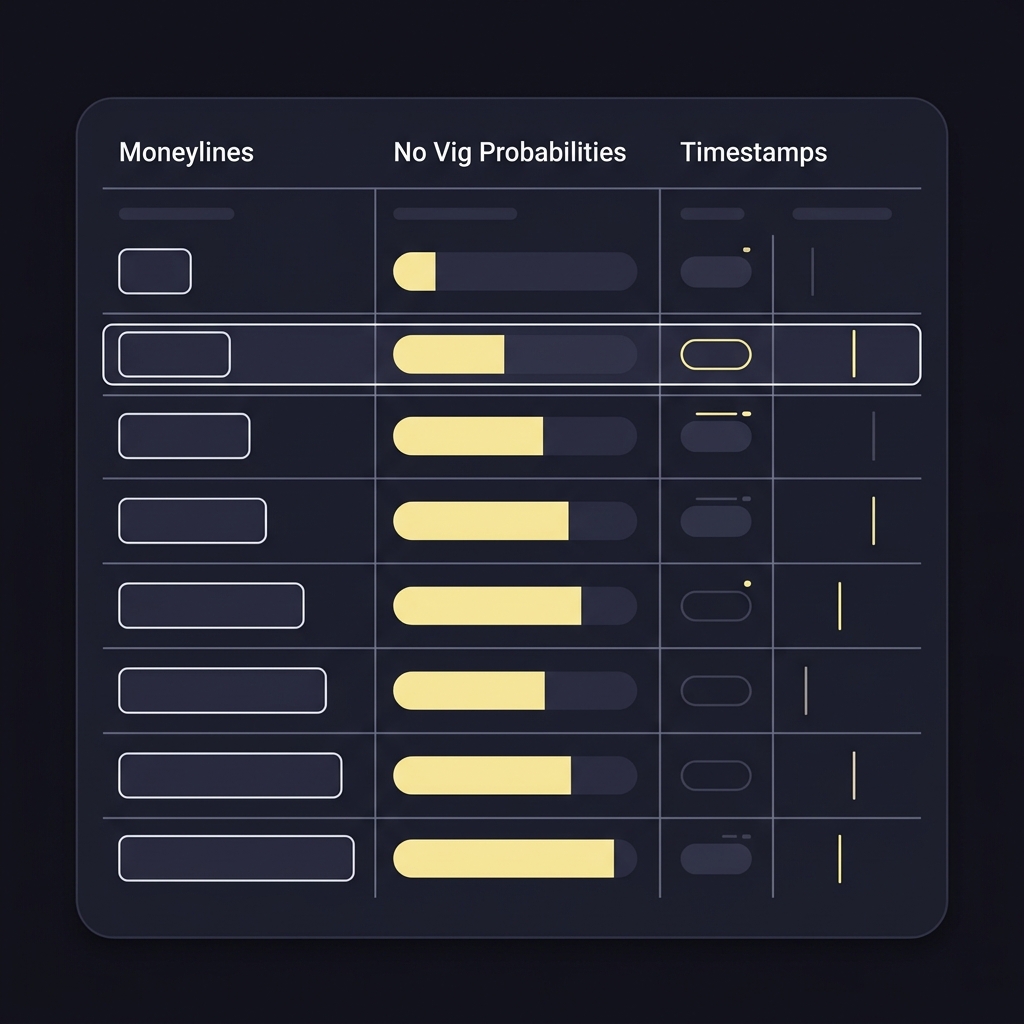
Start by capturing live moneylines from multiple books or a consensus feed, and note the timestamp and book source for each quote. Consistent snapshots let you detect late movement and ensure your baseline ranking is reproducible rather than a memory-driven guess.
Step 2: convert to implied and remove vig
Convert American moneylines to implied probability using the standard formula, then remove the bookmaker margin to produce a no-vig distribution across the matchup set. The no-vig conversion reduces bias introduced by book margins and yields probabilities that are comparable across games Action Network guide to implied probability and no-vig.
In practice, compute implied probability for each moneyline, sum the implied probabilities for both outcomes in a single game, calculate the overround, then divide each implied probability by the overround to get no-vig probabilities. This gives your market-based baseline for ranking safest teams to pick.
Step 3: create a baseline ranking
Turn no-vig win probabilities into a ranked list by sorting favorites from highest to lowest probability. That baseline ranks the market's safest choices before you apply popularity or injury filters and forms the starting point for primary and backup selection.
Use an average across two or three reputable books for the moneyline snapshot to reduce idiosyncratic pricing noise, and always log the timestamp to show when you built the baseline.
Using spreads, totals and public pick popularity to adjust the baseline
Why balance win odds and pick popularity
A pure win-odds maximization approach can concentrate your entry on a highly popular favorite and reduce pool equity. Research on survivor pool strategy shows that balancing win probability with public pick percentage improves long-term pool equity compared with always choosing the single biggest favorite PoolGenius survivor pool strategy.
Pick popularity is the share of the pool that chooses a team; a crowded favorite forces a pool tradeoff. If a favorite has marginally higher no-vig probability but an outsized public pick percentage, consider a lower-popularity alternative with only modestly lower probability to preserve equity.
How spreads and totals change perceived risk
Spreads provide a rough sense of expected margin while totals indicate scoring environment. Large spreads typically imply higher win probability for the favorite, while low totals suggest a tighter scoring game and increased upset risk even for favorites; use both signals to adjust the baseline ranking systematically Pinnacle guide to implied probability.
Rule of thumb: if a favorite's no-vig probability exceeds your internal cutoff by a narrow margin but the pick is above X percent public popularity, prefer a less popular team whose no-vig probability is only slightly lower. Document the exact cutoff and popularity threshold you used for transparency and later audit.
Practical tool: where to compute no-vig conversions and track market movement
Recommended signals to capture
Minimal dataset to record for each game: moneyline, spread, total, public pick percentage, key injury designations, book source and timestamp. These fields let you compute no-vig probabilities, detect late movement, and apply injury-based triggers.
Note timestamps and book source for each snapshot; capturing the same fields from two or three books reduces single-source noise and helps you see liquidity-driven moves.
compute no-vig probabilities and log market snapshots
Save one row per snapshot
How to log and compare snapshots
Use a simple spreadsheet with one row per game per snapshot. Compute implied probability from the captured moneyline, then normalize across the game to remove vig and produce your no-vig probability. Track the delta between snapshots to detect moves that exceed your switch threshold.
Basic online calculators can speed the conversion, but a reproducible spreadsheet ensures you can audit the calculation and refine thresholds over the season Action Network guide to implied probability and no-vig.
Monitoring injuries and quarterback availability for Week 5 decisions
Key practice and game status signals to watch
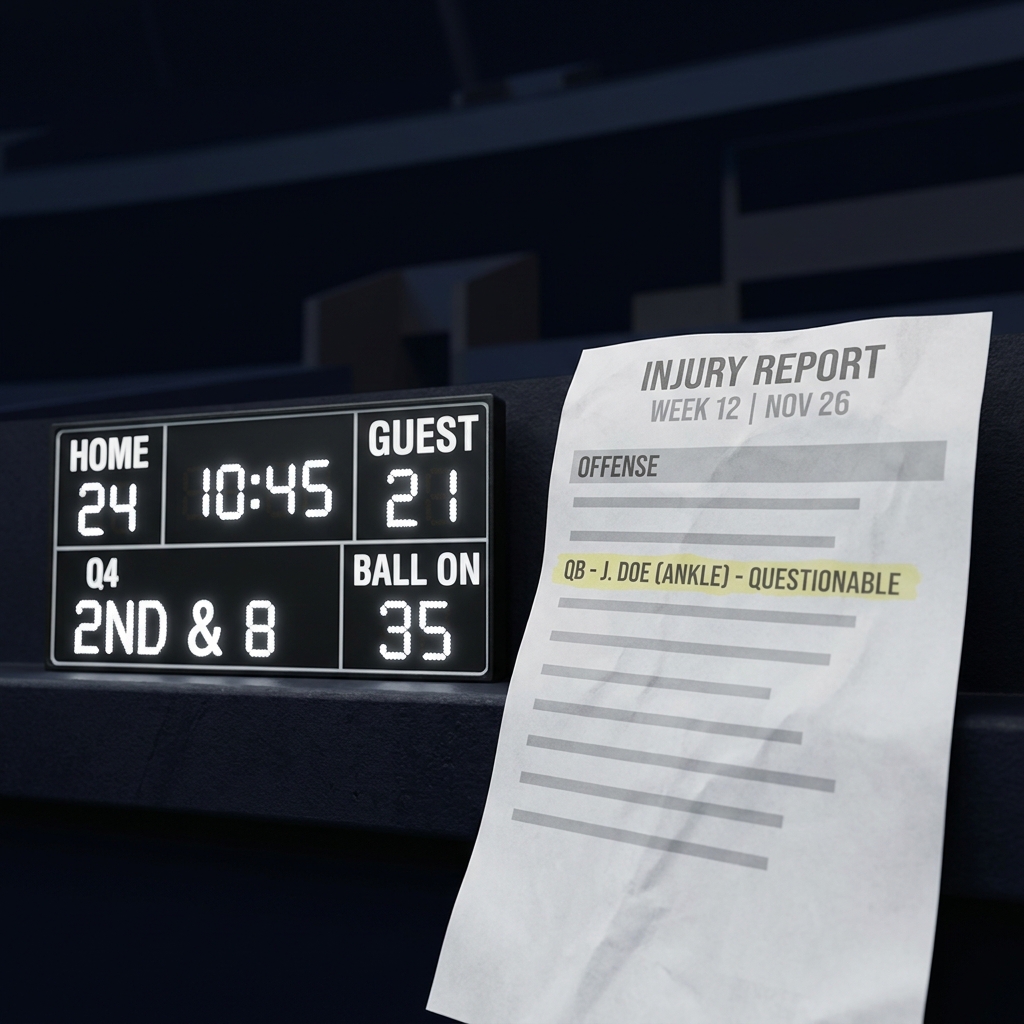
The NFL requires weekly practice participation reports and final game-status designations, so Friday designations and any Saturday updates are primary triggers to re-evaluate your baseline picks; changes to those fields are often the earliest official signal that a team will be without a starter or will be limited NFL personnel report policy, and you can also reference the official NFL injury center at NFL injury center.
Quarterback availability is frequently the most market-moving element; a late QB designation or sudden absence can shift spreads and moneylines substantially, so treat QB questions as high-priority triggers to rerun your no-vig ranking PFF on quarterback injuries and betting lines. Aggregated practice reports such as Rotowire practice reports can help consolidate team-level participation notes.
- Check Friday practice participation and final game-day status for listed starters
- Flag any QB listed as questionable, doubtful, or out
- Note injuries to key skill players that change game script risk

How to interpret Friday designations and Saturday reports
Friday practice reports condense a week of participation into an accessible signal; a player limited or ruled out on Friday increases the probability the market will move before lock. Use the official practice report and any club statements to determine whether to switch to a contingency.
Set alerts for QB status changes and re-run the no-vig ranking when the status of a starting quarterback or other major contributor changes between your baseline snapshot and lock time.
How to build primary and contingency picks for Week 5
Selecting a primary based on market, injuries and popularity
Choose a primary pick from the top of your no-vig baseline unless a high public pick percentage or injury risk materially increases elimination probability. Define a clear popularity threshold and document it in your notes before selecting a primary. This reproducible rule reduces hindsight bias when a popular favorite loses.
For example, set a rule that you will not pick a favorite that exceeds Y percent public popularity unless its no-vig probability exceeds Z percent. The exact values depend on pool size and your tolerance for risk, but document the rationale and timestamp the decision for later review.
Choosing backups if the primary becomes riskier
Pick one or two contingency options that you will switch to if defined triggers occur. Common triggers include a confirmed QB absence, a >5 point line move against your primary, or a sudden change in the official game-status report. These triggers should be explicit and applied consistently.
When a trigger fires, document the timestamp, the new market snapshot, and the reason for the switch. That documentation supports disciplined decisions under pressure and creates a post-week audit trail that improves future performance.
Checklist: decision criteria to use before locking your Week 5 pick
Pre-lock verification steps
Before you lock, complete this short checklist: verify the final practice participation and game-status reports, confirm quarterback availability, recalc no-vig probabilities from your latest snapshot, and check the public pick percentage to ensure you are not overexposed.
Confirm timestamps and sources for each step so you can later explain the decision path. If any of the veto conditions below are met, switch to a pre-designated contingency.
Quick veto conditions
Veto conditions to abort a primary pick include: a listed starting QB confirmed out, a line move greater than 5 points against your pick since your baseline snapshot, or a sudden weather or travel issue that materially alters game conditions. Any veto triggers a forced re-evaluation and possible use of your backup pick.
Common mistakes and traps that hurt survivor equity
Overreliance on favorites
Always picking the single biggest favorite is a common mistake because it concentrates risk when pools are influenced by popularity; long-term survivor equity often improves when you deliberately avoid overexposed favorites and accept slightly lower but still strong probabilities PoolGenius survivor pool strategy.
Another timing mistake is failing to re-evaluate after Friday injury reports; many selections are made too early and ignore decisive late-week roster news, which increases elimination risk.
Ignoring popularity and no-vig mismatch
Using raw moneyline implied odds without removing vig can overstate a favorite's edge. Always normalize to no-vig probabilities before comparing across games, because vig skews direct moneyline comparisons and can mislead you about relative win chances Action Network on no-vig conversion.
Finally, do not ignore public pick percentages; high popularity can turn a safe-looking favorite into a poor pool decision if the exposure concentration makes elimination costlier for your long-term equity.
Practical Week 5 scenarios: three example workflows
Scenario A: heavy favorite with high popularity
Scenario A: a heavy favorite shows the highest no-vig probability but is chosen by a large share of the pool. Start with the no-vig baseline, note the public pick percentage, and decide whether your pool size and laddering strategy justify following the crowd or fading to protect equity. If the favorite is overwhelmingly popular, consider a lower-popularity alternative with only slightly lower no-vig probability to preserve upside across rounds PoolGenius survivor pool strategy.
Set a contingency such as if the favorite's QB is downgraded on Friday or if the moneyline moves more than 3 points against them, switch to your backup.
Scenario B: mid favorite with late QB question
Scenario B: a mid favorite sits in the middle of your ranked list but the starting quarterback is listed as questionable on Friday. Treat the QB question as a high-priority trigger: if the QB is downgraded to out or inactive, switch to your backup and document the timestamp. If the QB is upgraded to probable and no other changes occur, the baseline pick remains reasonable but monitor public pick shifts into lock.
Quarterback availability often drives late market repricing, so predefine the exact QB statuses that force a switch to avoid emotional decisions PFF on quarterback injuries and betting lines.
Scenario C: underdog backup plan
Scenario C: pick a low-popularity underdog only as a planned backup when you expect public exposure to be concentrated on a different favorite. Use the underdog as a hedge when the favorite meets a veto condition, and document why the underdog qualified as a backup in your notes.
After results, review the decision in your audit log and adjust thresholds if the underdog performed differently than expected under similar conditions.
Tracking lines, public percentages and injury updates in real time
Where to watch and what alerts to set
Set alerts for official practice participation reports, final game-status updates, and quarterback designations. These alerts should come from the team reports or reliable aggregated injury feeds so you receive a consistent signal about late-week changes NFL injury report practice participation and updates, and you can also monitor broader trackers such as ESPN injury status.
Also set notifications for moneyline movement that exceed your threshold and for rapid shifts in public pick percentages; when any critical alert fires, re-run the no-vig snapshot and apply your contingency triggers.
How to timestamp and log changes
Logging best practices: one row per snapshot per game, fields for moneyline, spread, total, public pick percentage, injury designations, book source and timestamp. This structure makes it simple to recompute no-vig probabilities and identify the exact moment a trigger fired.
Maintain a small audit column describing the reason for any switch so you can calculate error rates by trigger type and refine thresholds across the season.
Measuring outcomes and learning for future survivor weeks
What to record after results
Post-week logs should include the pick you made, timestamp, final line at lock, the outcome, and the primary reason for the pick. These fields let you compute hit rate and examine which triggers produced the largest errors.
Review the audit trail weekly to detect biases such as favoring popularity too often or failing to react to Friday designations quickly enough PoolGenius survivor pool strategy. See the Funded Plays blog for general notes on documenting evaluation steps.
How to improve the model over time
Adjust thresholds for switching and popularity cutoffs based on error analysis. Small systematic tweaks, logged and tested over multiple weeks, reduce noise and improve your decision-making edge without introducing ad hoc changes.
Keep the process repeatable: the same dataset and normalization steps should be used each week to ensure comparability and reliable learning.
Quick reference: Week 5 decision cheatsheet
Top 5 pre-lock checks
Top five checks: confirm final practice participation, verify starting QB status, recalc no-vig probabilities on latest moneylines, check public pick percentage, and confirm weather or travel alerts that could alter game conditions.
Document each check with timestamp and source so you can justify any last-minute changes to your pick. For a quick entry point, see Funded Plays.
Emergency switches to consider
Two high-confidence emergency switches: switch if the starting quarterback is confirmed out, or switch if the moneyline moves more than 5 points against your primary since your baseline snapshot. Both triggers should be predefined and applied consistently.
Remember to record the exact trigger and the new snapshot when you make an emergency switch so you can measure trigger effectiveness later.
Conclusion: a repeatable, market-driven process for Week 5
Summary of the approach
Summary: capture moneylines and spreads, compute no-vig implied probabilities, adjust for public pick popularity and totals, monitor official practice reports and quarterback availability, and set explicit contingency triggers. This repeatable process prioritizes disciplined decision-making and clear documentation rather than guesses.
Outcomes depend on your execution of the workflow and compliance with your platform rules; treat the process as a learning system and refine thresholds over the season to improve survivor pool performance PoolGenius survivor pool strategy.
No-vig probability removes the bookmaker margin so you compare true market-implied chances across games, which helps rank safer survivor picks objectively.
Switch if a predefined trigger fires, such as a starting quarterback confirmed out or a significant line move beyond your threshold; document the timestamp and reason.
Review performance and thresholds after several weeks; adjust conservatively based on hit-rate and error analysis rather than single-week outcomes.
References
- https://www.pinnacle.com/en/betting-resources/educational/what-is-implied-probability
- https://operations.nfl.com/updates/football-operations/personnel-injury-report-policy/
- https://www.poolgenius.com/survivor-pool-strategy/
- https://www.actionnetwork.com/education/implied-probability-calculator
- https://www.pff.com/news/betting-how-quarterback-injuries-impact-betting-lines
- https://www.thelines.com/nfl-injury-report/
- https://www.fundedplays.com/challenges
- https://www.fundedplays.com/blogs/how-fundedplays-evaluations-work
- https://www.fundedplays.com/blogs
- https://www.fundedplays.com
- https://www.nfl.com/injuries/
- https://www.rotowire.com/football/practice-report.php
- https://www.espn.com/nfl/injuries