
Quick answer: has any player won the NBA Most Improved Player award more than once?
Short verdict: through the 2025 season no player has won the NBA Most Improved Player award more than once, and that historical pattern materially affects how people think about nba mip odds today.
That simple fact is the starting point for most conversations about repeat winners. The Most Improved Player, as recorded in the historical winners lists, has been handed out every season since 1985-86 and the roll of winners shows zero duplicates through the 2025 season, a pattern visible in comprehensive databases and league records Basketball-Reference MIP winners list.
What this means for readers and bettors is practical: markets tend to prioritize fresh, clear year-over-year jumps in role and production when pricing candidates, rather than betting on a past winner to re-emerge. The remainder of this article walks through the award definition, the voting mechanics, historical patterns and simple checks you can use when you look at nba mip odds.
See how structured challenges let you test improvement hypotheses
Read the voting-analysis section below to see how close races and vote totals shape realistic repeat chances.
What the Most Improved Player award is and how it is decided
The Most Improved Player, commonly called MIP, is an annual recognition for the player perceived to have shown the largest improvement from the prior regular season. Official league descriptions frame it as a media-voted honor focused on visible year-over-year progress.
The award dates to the 1985-86 season and has been presented every year since, and the league has also updated the physical trophy in recent seasons. For context on the award history and how it is described by the NBA, the league maintains an awards history page that lists winners and basic award descriptions NBA history award page.
Voters are a media panel that submits ballots each spring; guidance around what constitutes "improvement" is intentionally flexible because selectors weigh a mix of counting stats, efficiency, role change and narrative. That subjectivity is important: it makes the MIP both analytically approachable and sensitive to perception shifts across a season.
Since the 2022-23 season the physical honor for the award has been labeled the George Mikan Trophy, part of a broader refresh of league trophies. The renaming is a historical detail that does not change voting mechanics but matters when consulting modern references NBA communications on trophy lineup.

Historical record: repeat winners and what the data shows
The clearest single observation from year-by-year winners lists is that no player has won the MIP award more than once through 2025. That absence is consistent across league documents and independent databases used for historical checks.
There is no published NBA rule that bans repeat winners, but the historical record through 2025 shows no player has won the award more than once, making repeats historically unlikely and treated as long shots in market pricing.
Complete winners lists, maintained on public databases, make it straightforward to confirm this pattern and to scan for close runners-up over time; the public records are the evidence base for saying repeat winners have not occurred so far Basketball-Reference MIP winners list.
It is important to treat this as a historical observation rather than a rule: the record shows zero repeats, but that observation alone does not prove a formal prohibition. Still, the consistency of that pattern across four decades is a strong background factor when people estimate nba mip odds for a given season.
Rules check: does the NBA bar former winners from claiming MIP again?
Short answer: public NBA materials lay out the award purpose and voting process, but they do not publish a specific rule that forbids a former winner from winning MIP again. The official descriptions focus on the media vote and the concept of improvement from the prior season rather than on explicit eligibility prohibitions.
Because the league's public award pages emphasize criteria without listing a prohibition, analysts treat the absence of a written ban as a procedural gap rather than a commonly invoked reason to expect repeats. In practice, the weight of historical precedent and voter behavior matters more to market pricing than the lack of a written ban NBA history award page.
How markets and bookmakers treat nba mip odds for repeat candidates
Bookmakers and betting markets price MIP lines by estimating the probability voters will view a player as substantially improved. Because the historical record contains no repeat winners through 2025, prior recipients are usually assigned lower implied probabilities unless they present a fresh, measurable improvement case.
Market pricing tends to respond to observable, year-over-year signals: major usage increases, clear role elevation, or sudden efficiency improvements. These signals feed models and handicappers who set or take prices on nba mip odds, and the absence of historical repeats factors into the market on a qualitative level Basketball-Reference MIP winners list.

Practical market signals to watch include credible increases in minutes, sustained efficiency measured per possession, and independent reporting of a new role or starting opportunity. When several of these signals align, markets will typically shorten a player's price even if that player is a past winner.
A simple framework to evaluate a player's chance to repeat or win MIP
Below is an easy checklist you can copy to score candidates. Use it as a starting point for a quick, repeatable assessment rather than a definitive model.
Score a candidate on the core improvement signals
Assign simple 0-2 points per field for a quick score
Apply the checklist by giving each field a small point value and summing to create a 0 to 6 quick score. Weight usage change and role minutes slightly higher because voters often reward visible opportunity increases over subtle efficiency gains.
When you score a past winner, discount the final tally modestly to reflect historical inertia; that adjustment does not come from a written rule, but from the long record showing repeats have been rare. Use the checklist iteratively across preseason and early-season samples to see whether a candidate's case strengthens.
Voting mechanics and near-misses: what the ballots tell us
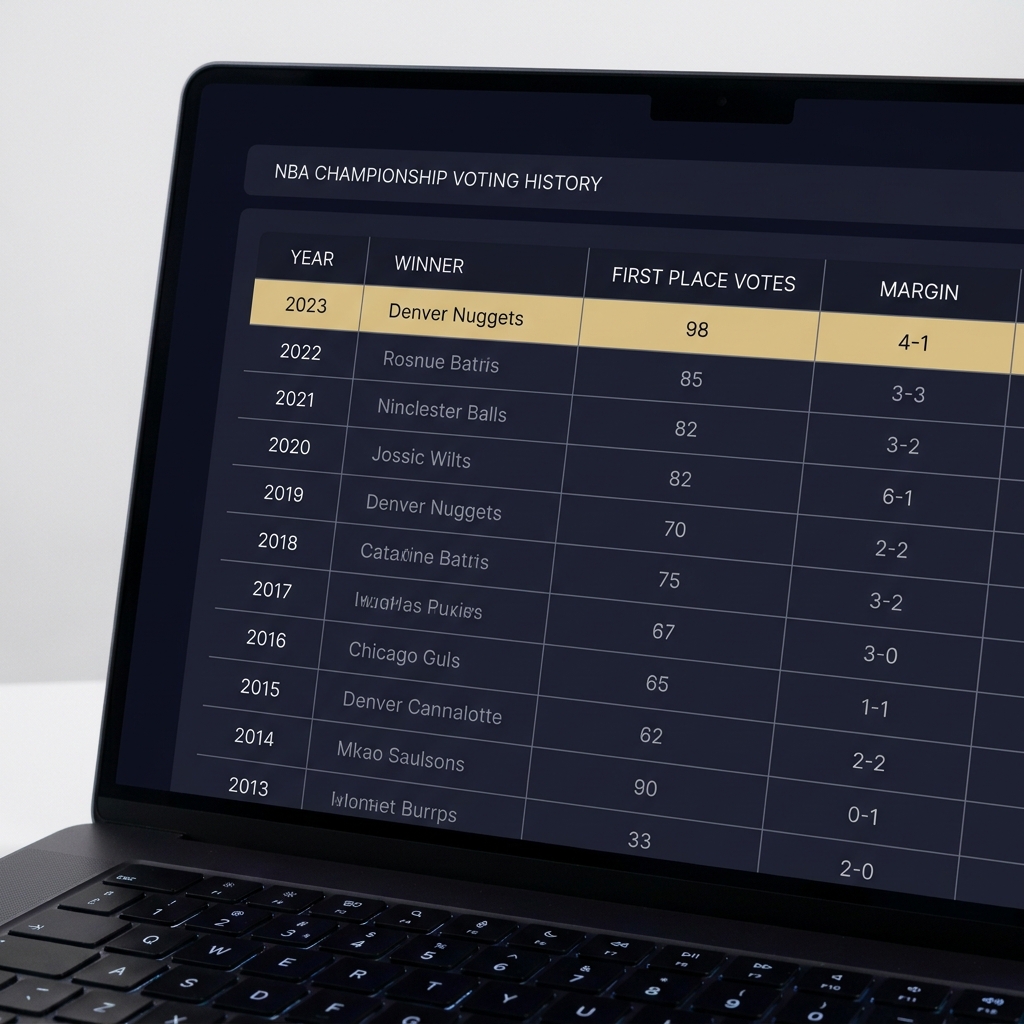
Understanding how ballots convert into points helps interpret how close races actually are. Voting pages list ballots and the aggregated point totals; a standard voting ledger shows how first-place votes, second-place votes and total points map into the final result.

The 2023-24 voting results, where Tyrese Maxey won the award, provide a concrete example of how margins and first-place vote shares reveal the scale of a candidate's support and where near-misses occurred. The official NBA announcement and voting totals for that year can be consulted to see margins and runner-up positions NBA announcement for 2023-24 MIP.
Reading ballots for pattern recognition is useful. Two practical tips: check the distribution of first-place votes to see whether support is broad or concentrated, and compare point margins to prior years to judge whether the observed gap is routine or unusually close. Close races show how small perception shifts can flip an outcome.
Common mistakes when predicting repeat winners or interpreting odds
A frequent error is overemphasizing a single-season counting stat spike without considering role context. A big counting-stat jump driven by a one-off minutes surge or an outlier shooting year can mislead both casual observers and models.
Another trap is recency bias: voters and bettors may overweight the most recent stretch of games when the award evaluates year-over-year change. That can produce false signals for repeat attempts unless the improvement demonstrates durability across a substantial sample and independent factors like role and team context are clear 2023-24 voting totals and context.
Practical examples: three scenarios applied to real winners
Case A, a recent winner seeking a repeat: imagine a hypothetical recent winner who remains on the same team with similar role and minutes. Historical patterns and the lack of precedent for repeats make a successful defense unlikely unless the player sees an objectively larger jump the following season.
Case B, a veteran with a late-career jump: a veteran who suddenly earns a starter's role and posts durable per-possession improvements can create a plausible MIP case. That scenario depends on more than narrative; voters typically look for measurable, sustainable changes in opportunity and efficiency over the entire regular season Basketball-Reference MIP winners list.
Case C, an injury-comeback candidate: players returning from injury sometimes show sharp improvements, but the MIP award focuses on improvement from the prior regular season. A comeback case needs clear minutes and usage data that show the player's new role persisted long enough to convince media voters.
A short strategy for bettors and analysts when using nba mip odds
If you use odds markets, size positions conservatively for repeat scenarios. Given the historical absence of repeat winners through 2025, speculative repeat bets should be small and justified by several independently verifiable signals, not just narrative or headline moments.
Trigger events that could justify a speculative position include a confirmed role promotion, reliable increases in usage rate documented over several weeks, and sustained touches in the offensive scheme. Always re-check usage and minutes mid-season because markets react quickly to early-season evidence Basketball-Reference MIP winners list. For additional discussion of evaluation methods, see the FundedPlays blog.
How to read and use voting pages and databases for deeper analysis
When you pull data from official voting pages and databases, capture these core fields: year, winner, vote totals, first-place votes and the margin to the runner-up. Those fields let you construct simple trend checks and identify years with unusually tight ballots.
Basketball-Reference and the league voting pages publish the necessary tables. Building a compact dataset with those columns allows quick checks like how often finalists appear in multiple seasons and whether first-place vote shares are widening or narrowing over time 2023-24 voting totals and data. For methods and examples, FundedPlays maintains a blog post on evaluations.
Where this matters beyond betting: fantasy, analysis, and challenge platforms
Improvement signals used for MIP analysis also matter in fantasy sports and in analytical scouting because they highlight sustainable role changes and per-possession gains that influence season-long projections. Those same signals help separate fluky spikes from durable performance shifts.
Skill-based, funded challenge platforms provide a low-friction environment to test prediction hypotheses without implying guaranteed outcomes. As an example, FundedPlays operates a suite of funded sports prediction challenges that let users practice structured forecasting and track improvement in a rules-driven setting while following the platform's published challenge details NBA history award page.
Conclusion: main takeaways about repeats and how to use nba mip odds responsibly
Core takeaway: through the 2025 season no player has won the NBA Most Improved Player award more than once, and while the NBA does not publish a formal prohibition on repeat winners, the historical pattern matters when evaluating nba mip odds.
When assessing repeat chances, combine data and context: clearly measurable usage and role changes, durable efficiency improvements, and early-season confirmation should outweigh narrative-driven reasoning. Keep position sizes small for repeat bets and rely on transparent trend checks rather than intuition.
Sources and further reading
Primary sources for winners and voting totals include the NBA's award history pages and the league announcement pages, which list winners and provide context for modern trophy naming.
For detailed vote tables and a season-by-season ledger of finalists and vote totals, Basketball-Reference maintains accessible pages that are ideal for building quick datasets and for checking the absence of repeat winners over time Basketball-Reference MIP winners list.
No. Through the 2025 season, no player has won the NBA Most Improved Player award more than once according to historical records.
Public NBA award descriptions outline the voting criteria but do not publish a specific rule that forbids a former winner from winning again.
Look for durable role elevation, sustained usage increases, and persistent efficiency gains; treat repeat bets as speculative and size them conservatively.
References
- https://www.basketball-reference.com/awards/mip.html
- https://www.nba.com/history/awards/most-improved-player
- https://pr.nba.com/nba-reveals-new-lineup-of-trophies-to-honor-legends/
- https://www.basketball-reference.com/awards/awards_2024.html#all_mip
- https://www.nba.com/news/76ers-tyrese-maxey-wins-2023-24-kia-most-improved-player
- https://www.fundedplays.com/challenges
- https://www.fundedplays.com
- https://www.fundedplays.com/blogs
- https://www.fundedplays.com/blogs/how-fundedplays-evaluations-work
- https://en.wikipedia.org/wiki/NBA_Most_Improved_Player