
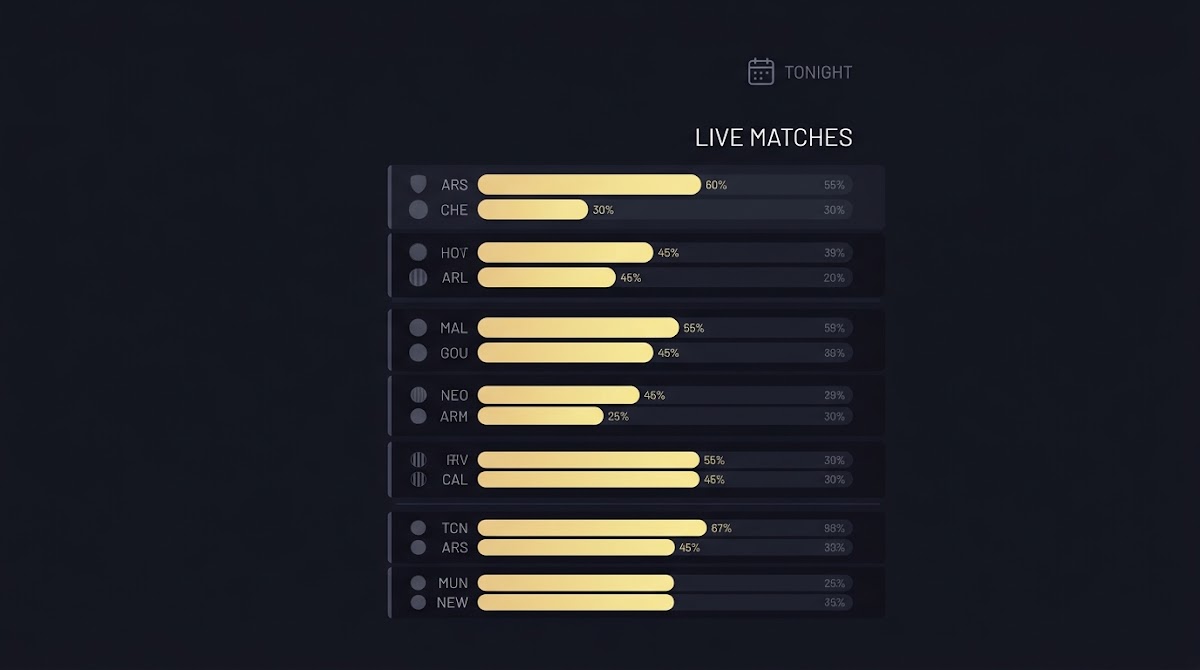
Short answer: who the market favors in nba games tonight predictions
When you want a quick read on who is favored tonight, focus on market-implied probabilities rather than gut feeling. Converting moneyline odds to implied win probability creates a standardized ranking across the slate that tells you which teams the market expects to win.
Check tonight's favorites in two minutes
Run the two-minute checklist below now: check official availability, look at near-closing lines, convert odds to implied probability, and cross-check net rating before you lock in a view.
In practice, the single most useful short answer is the ranked list you get after converting late moneyline prices to implied probabilities and confirming no late unpriced absences. That approach uses a common, book-agnostic method to identify favorites and is especially helpful for comparing games with very different moneyline formats.
In this short section we use the term implied probability to mean the chance the market assigns to a team winning after converting moneyline prices. For a plain-language primer on that conversion, see the explanation at Investopedia on implied probability Investopedia on implied probability.

Quick summary of the top favorites across the slate
Scan the late moneyline prices and list teams by their implied probability. Favorites are those with the largest implied win probability. When possible, prefer near-closing prices because they tend to incorporate the most information before tipoff.
Remember that last-minute status changes under the NBA Player Participation Policy can shift the market consensus quickly, so treat any pre-tipoff favorite list as contingent on confirmed availability updates for key players.
What 'favored' means in this context
Favored means the market assigns a higher implied win probability to one team than to its opponent after converting expressed moneyline prices into probabilities. This is a numeric, not a narrative, definition that avoids subjective language and makes comparisons consistent across games.
How nba games tonight predictions are formed: markets, news, and policy
Three core inputs form most nightly favorite calls: market pricing as reflected in closing or near-closing lines, official availability updates about player participation, and season-level performance context such as net rating. The market price aggregates many bettors and information sources, while official policy updates provide authoritative injury and rest information.

Closing lines are widely used as the market consensus because they reflect accumulated information and bettor sentiment leading up to tipoff, and pregame line movement often highlights new information that changes the balance of probability TheLines on closing line value.
Market signals: closing lines and line movement
When lines move significantly toward one side late, that movement frequently incorporates injury news, rest decisions, or heavy money on one side. Treat sharp late movement as a signal to recheck official availability and recent developments rather than a final verdict on value.
Because closing lines tend to be the most efficient single-market signal, many traders and handicappers treat them as the most reliable snapshot of consensus probability when available Action Network on closing line value. You can also compare published odds across outlets, for example at CBS Sports CBS Sports odds.
Newsflows: injuries and rest under the Player Participation Policy
The NBA Player Participation Policy formalizes how teams report availability for players, which improves transparency and helps markets move more efficiently around last-minute status updates. Checking the participation status early in your workflow reduces reliance on rumor and speeds up accurate adjustments NBA Player Participation Policy.
Combine these inputs rather than favor one exclusively. Markets price quickly, the participation policy provides the official status, and season metrics provide baseline context for whether the market view aligns with longer-term form.
A step-by-step workflow to rank favorites for nba games tonight predictions
Step 1, check official availability under the Player Participation Policy and note any listed probable, doubtful, or out statuses for key starters.
Step 2, monitor pregame line movement and record near-closing moneyline prices for each game. Prefer the most recent stable price when converting to implied probability.
The market favorite is the team with the higher implied win probability after converting near-closing moneyline prices; its reliability improves when the Player Participation Policy confirms availability and when net rating aligns with the market-implied expectation.
Step 3, convert the moneyline to implied win probability for each side so you can rank the slate numerically.
Step 4, cross-check the numerical ranking against team net rating to flag games where the market expectation looks notably higher or lower than season-level performance.
Checklist: order of operations from news check to probability conversion
Use a simple ordered checklist each night: 1) participation policy check, 2) near-closing line capture, 3) moneyline to implied probability conversion, 4) net rating cross-check, 5) document the decision and confidence level.
Start with the official participation status because a confirmed absence for a star player usually justifies immediate probability adjustments, and the policy is the authoritative source for that information NBA Player Participation Policy.
When to trust the market and when to dig deeper
Trust the market more when the closing line is stable, the participation policy shows no unexpected absences, and the implied probability aligns with net rating differences. Dig deeper when a late injury or rest announcement is unpriced, when unusual matchups create specific tactical edges, or when line movement seems disconnected from official information.
Market respect and independent analysis are complementary. The market is often efficient, but the most disciplined players use the market as a baseline and only diverge from it with clear, documented reasons.
How to convert odds into implied win probabilities (practical formulas)
Converting a moneyline into an implied win probability is straightforward and standardizes comparisons between games. For a positive moneyline, implied probability equals 100 divided by the sum of 100 plus the moneyline. For a negative moneyline, implied probability equals the absolute value of the moneyline divided by the absolute value plus 100. That simple conversion is the common method taught in many educational resources Investopedia on implied probability. You can also use an online implied probability calculator for quick checks Implied Probability Calculator.
Worked example: if a team is +150, the implied probability is 100 / (150 + 100) = 0.4 or 40 percent. If a team is -180, the implied probability is 180 / (180 + 100) = 0.6429 or about 64.3 percent. Use these numbers to rank favorites across the slate.
Convert a moneyline into an implied win probability
Use closing or current moneyline for best relative ranking
Note on vig: the simple conversion does not remove the bookmaker margin, so implied probabilities will sum to more than 100 across both sides. That does not prevent a clean ranking of favorites, but be aware that the raw number is the market-assigned probability including margin.
Prefer near-closing lines for conversion because these prices typically reflect the most updated information before tipoff, including late injuries or rest decisions that move the market TheLines on closing line value. You can compare current published odds across sources like ESPN ESPN odds to spot unusual discrepancies.
Checking player availability: using the NBA Player Participation Policy in your predictions
Always start with the official participation policy when a player status matters. The policy outlines how teams report availability and is the authoritative place to confirm that a starter is out, probable, or simply questionable for game day NBA Player Participation Policy.
Typical timing patterns show that many rest or injury updates occur in the hours before tipoff, and these updates frequently cause sharp late line movement as bettors and market makers reprice games based on confirmed absences.
Where to find official updates and how they differ from rumor
Official participation updates appear through the channels defined in the policy and should be considered the primary source. Unverified social reports or local beat-writer speculation can be useful tip-offs but always confirm changes against official policy releases before adjusting probabilities in a disciplined workflow.
When a report is unconfirmed, give it a lower weight and wait for the policy update. Acting prematurely on unverified information often leads to inconsistent entries and poor tracking of decision outcomes.
Common timing patterns and their market effects
Late confirmations of star rest or injury typically trigger the largest line moves because they change expected minutes for key contributors. Markets price these changes quickly, so check participation status before capturing near-closing lines to avoid misreading the consensus.
If you track decisions over time, you will see that accurate, timely checks against the Player Participation Policy reduce the number of times your reasoning is overturned by last-minute official changes.
Contextualizing the market with team net rating and performance metrics
Net rating, the point differential per 100 possessions, is a reliable season-level metric that helps you assess whether the market-favored team aligns with longer-term performance. A team with a noticeably better net rating is more likely to be a robust favorite, all else equal Basketball-Reference season summary.
Use net rating to flag outlier markets: when implied probabilities diverge sharply from what season metrics suggest, document why the market might be right. Possible explanations include rest, matchup-specific strategies, or recent form that season metrics do not fully capture.
Why net rating matters for single-game favorites
Season-level metrics smooth game-to-game noise and give a baseline expectation for how teams perform against a neutral opponent. When net rating and market probabilities align, you have greater confidence that the favorite status reflects underlying performance rather than temporary variance.
Net rating has limits; it does not capture matchup minutiae, sudden lineup changes, or game-time tactical adjustments. Use it as context, not as a stand-alone decision rule.
How to combine net rating with market probabilities
One practical way to combine inputs is to convert implied probabilities to an expected point differential equivalent and compare that against net rating differentials. If the market-implied differential is consistent with net rating gaps, the favorite call is easier to accept. When they diverge, dig into roster and matchup reasons.
Keep in mind that net rating is a season aggregate and that short-term trends can alter single-game expectations. Use recent net rating trends over the past several weeks as an extra check when available.
Decision criteria: when to accept the market favorite and when to dissent
Accept the market favorite when you see three supporting signals: a stable near-closing line, official availability confirming key players will play, and net rating alignment with the market probability. Those three together give a defensible, repeatable reason to accept the favorite.
Conversely, dissent when you spot red flags such as unpriced late injuries, matchup-specific weaknesses, or rest patterns that the market has yet to absorb. Document why you disagree and what information would change your view.
Checklist for siding with the market favorite
Use this short acceptance checklist: 1) closing line is stable, 2) Player Participation Policy shows confirmed availability, 3) net rating supports the market expectation, 4) no contrarian signals from matchup metrics. If these items check out, the market favorite is a reasonable baseline.
When all checklist items line up, give the market higher weight in your decision-making rather than imposing an independent override without clear cause.
Red flags that justify a different view
Red flags include late injury reports not yet priced, known strategic rest plans that reduce expected minutes for starters, or tactical matchups where a team with inferior net rating has an outsized advantage. These situations can justify a disciplined dissent when documented properly.
Practical traders balance market respect with selective contrarianism and keep records of both accepted and dissenting calls to measure long-term decision quality.
Common mistakes when using odds and metrics for nba games tonight predictions
One common mistake is overreacting to unverified reports. Rely on official participation policy updates rather than social media hearsay, because acting on rumor often leads to inconsistent outcomes and noisy record-keeping NBA Player Participation Policy.
Another frequent error is ignoring closing-line information and treating opening lines as final. The opening price is an initial market view, but closing lines are generally a more efficient consensus after information and money flow in Action Network on closing line value. You can also check broader odds listings like ESPN or CBS to see how prices compare across publishers.
Overreacting to unverified reports
Players and analysts sometimes rush to trade on early reports. That can be costly if the reports prove false or if official status changes in the hours before tipoff. A disciplined verification step reduces false moves and improves long-term tracking.
Wait for confirmation from the channels described in the participation policy before materially changing probability estimates in your logs.
Ignoring closing line information and market consensus
Neglecting the closing line removes a powerful consensus signal from your workflow. Even when you disagree, capture the closing price and the market-implied probability so you can compare outcomes against what the market expected.
Keeping a log that includes closing lines, your decision, and the result will reveal whether your independent judgments add value over time.
Practical examples: work through two real-night scenarios
Example A, alignment scenario: imagine a late evening slate where Team X is listed as available and the closing moneyline implies a 65 percent win probability. Team X also has a substantially higher net rating for the season. In that case, the market favorite aligns with season performance and confirmed availability, so accepting the market favorite is a reasonable position.
When documenting this scenario, note the time you checked the participation policy, the near-closing moneyline you used for conversion, and the net rating comparison so you can review the decision after the game.
Example B, last-minute rest scenario: suppose Team Y moves from probable to out for a star who normally plays 32 minutes, and the line shifts sharply as a result. That late change materially reduces Team Y's implied probability and may flip the favorite. Markets price late absences quickly, so reconciling the participation policy update with new implied probabilities is key to updating your ranking reliably TheLines on closing line value.

FundedPlays provides a structured environment where users can practice this disciplined workflow, track their prediction performance, and learn to document decisions, without implying guaranteed outcomes. Use practice challenges to refine how you weigh participation updates and market signals. Learn more on the blog overview Funded Plays blog.
For each example, capture the timeline: participation status at time T, closing or near-closing moneyline at time T plus a few minutes, converted implied probabilities, and the net rating check. That record helps you learn which inputs improved your decisions over many nights.
Wrapping up: a simple checklist for tonight's favorites and next steps
Two-minute checklist: 1) check the NBA Player Participation Policy for confirmed statuses, 2) record near-closing moneyline prices, 3) convert moneylines to implied probabilities, 4) cross-check with team net rating, 5) document the decision and confidence level.
Research shows markets are often efficient, so recording decisions and outcomes helps to measure whether you can consistently add value to the market view working paper on price efficiency in sports markets.
Where to learn more and practice the method
Practice the workflow in low-risk settings or simulation challenges where you can refine timing, documentation, and how much weight to allocate to late information. Keep your process consistent so you can evaluate it rigorously over time. Read a short explainer on how Funded Plays evaluations work here.
Respect platform rules and the limits of probabilistic estimates. A market-favored label means higher implied probability, not a guaranteed outcome, so keep tracking and refining your approach.
Use the standard conversion: for a positive moneyline, probability = 100 / (moneyline + 100); for a negative moneyline, probability = abs(moneyline) / (abs(moneyline) + 100). This gives a market-implied chance of winning.
The policy is the official source for player availability and rest information; confirmed status changes commonly trigger late line movement and materially change implied probabilities.
Not always. Accept the market favorite when closing lines are stable, official availability is confirmed, and net rating aligns. Dissent only with documented, strong, matchup-specific reasons.
References
- https://www.investopedia.com/terms/i/implied-probability.asp
- https://www.thelines.com/closing-line-value/
- https://www.actionnetwork.com/education/closing-line-value
- https://www.nba.com/news/player-participation-policy
- https://oddsjam.com/betting-calculators/implied-probability
- https://www.cbssports.com/nba/odds/
- https://www.basketball-reference.com/leagues/NBA_2025.html
- https://www.investopedia.com/terms/i/implied-probability.asp
- https://www.thelines.com/closing-line-value/
- https://www.fundedplays.com/challenges
- https://papers.ssrn.com/sol3/papers.cfm?abstract_id=4554012
- https://www.espn.com/nba/odds
- https://www.fundedplays.com
- https://www.fundedplays.com/blogs
- https://www.fundedplays.com/blogs/how-fundedplays-evaluations-work