
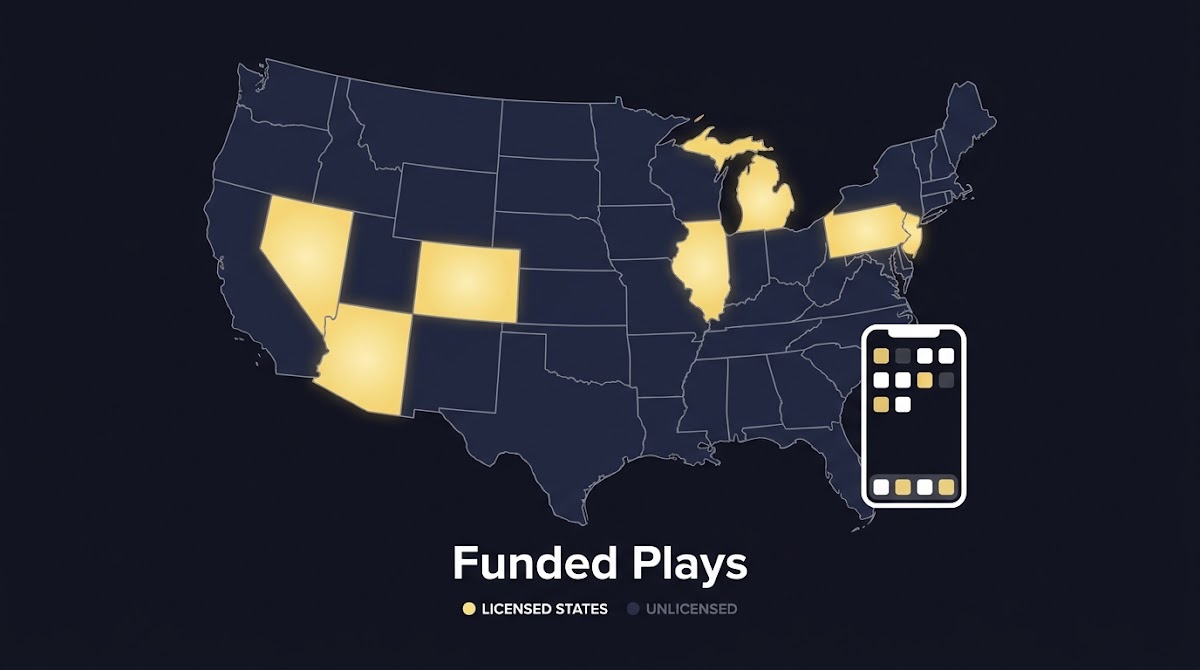
Quick answer: is the most bet app legal in the USA?
The short, practical answer is that the most bet app is legal in the United States only in the states where the operator holds a state license and complies with local rules; there is no single federal license that makes an offshore app lawful across all states, so you must confirm local authorization before using any wagering features NCSL sports betting overview.
Put another way, seeing an app online does not by itself mean it can legally accept wagers from every U.S. resident. Look to your state regulator and the app store listing for confirmation before depositing money or attempting to place wagers.
Verify licensing on the FundedPlays Challenges page and your state regulator
Please check your state gaming regulator list now to confirm whether the operator is licensed where you live.
Short summary
Only state-licensed operators can legally offer real-money sports wagering to residents of a given state, and app store distribution is typically limited to licensed operators in permitted jurisdictions.
One-sentence takeaway
If you want to know whether the most bet app is legal for you, start with your state regulator and the App Store or Google Play listing; if the operator is not licensed for your state, the app is not authorized for real-money use there.
How U.S. gambling law works: federal rules versus state licensing
Federal statutes shape the legal landscape for online wagering, but they do not replace state licensing. Rules like the Wire Act and related federal statutes set criminal and jurisdictional limits, while enforcement emphasis and interpretation can affect cross-border activity and payment flows; for an overview of the federal framework consult the Congressional Research Service analysis Congressional Research Service report.
Practically, most of the regulation and licensing that determines whether an app may accept wagers from a resident is handled by state law and state regulators. That means legality turns on whether the operator is licensed in that state and whether the app enforces intrastate rules such as geofencing.
Key federal statutes that affect online betting
Federal statutes establish prohibitions and define certain interstate activities, but they interact with state frameworks rather than creating a single national permission set. The primary effect for users is that federal law imposes background constraints while each state issues the specific license required for lawful operations.
How state licensing fits into the picture
Each state decides whether to legalize and regulate sports betting and how to license operators. When a state issues a license, that authorization typically covers conduct only within that state, so an operator must obtain separate approvals to operate legally in multiple states.
An app can be present on the internet but still be unauthorized for residents of many states unless the operator holds the appropriate state license; licensed operation in a state is the core determinant of whether residents may legally place wagers through an app or website NCSL sports betting overview.
Licensing matters because regulators set consumer protections, technical requirements such as geolocation, and enforcement consequences. When an operator lacks a needed license, residents should treat the service as unauthorized for wagering purposes.
The most bet app is legal in the United States only in states where the operator holds a valid state license and complies with local rules; confirm with your state regulator and the app store listing.
What should you check first to decide whether an app is legally available where you live? Use the state regulator list and the app store listing to confirm licensing and location controls before taking any action.
How to check whether the most bet app is authorized in your state
Start with a state-by-state overview source like NCSL and then consult your specific state gaming regulator for the official operator list; those regulator pages are the primary authoritative source for whether an operator is licensed to accept wagers from residents of that state NCSL sports betting overview and you can also consult the American Gaming Association state-of-play map for another high-level summary.
Step 1, find your state regulator page and search its operator list for the brand name. Step 2, look for licensing details, such as the type of license and any jurisdictional notes. If the regulator’s site does not list the operator, it is not authorized in that state.
Next, check the Apple App Store and Google Play while location services are enabled on your mobile device. App store distribution for real-money wagering is restricted to approved operators and to jurisdictions where such wagering is permitted, so the presence or absence of an app in your local store is a practical signal of availability App Store Review Guidelines.
When you view a listing, read the app description and developer information for jurisdiction notes and licensing disclosures. If the listing lacks clear licensing information or appears to target users outside of permitted states, do not rely on it as proof of authorization.

App store rules: how Apple and Google control distribution of gambling apps
Both the Apple App Store and Google Play restrict real-money gambling apps to authorized, licensed operators and limit distribution to jurisdictions where such wagering is allowed; Apple’s developer guidelines and Google Play’s gambling policy describe those requirements and explain that unlicensed operators are not permitted to offer real-money wagering through the official stores App Store Review Guidelines.
Practical signs that an app listing follows store rules include explicit jurisdiction notices, licensing disclosures, and developer contact information that references a licensed U.S. operator. Absence of those items or a listing that points to an offshore operation can be a red flag.

Keep in mind that store policies apply to distribution. A gambling app that does not meet store policy requirements will generally not appear in a U.S. store listing for users located in states where such apps are restricted.
Consumer risks when using offshore or unlicensed betting apps
Industry groups and regulators warn that using offshore or unlicensed betting apps can expose consumers to a range of risks, including limited oversight, weak dispute resolution options, and potential loss of funds; for industry guidance on illegal gambling and consumer risks consult the American Gaming Association materials Stop Illegal Gambling.
Those risks mean a user who encounters a problem with an offshore app may have little practical recourse. Licensed operators must comply with consumer protection rules and offer clear complaint channels, while unlicensed operators may not provide reliable processes for resolving disputes or returning funds.
Common problems reported by regulators and industry groups
Reported problems include delayed or blocked withdrawals, opaque account terms, and difficulty obtaining enforcement assistance. Because state regulators do not oversee offshore operators, enforcement options and remedies for consumers are limited when a problem arises.
Practical consequences for users
If a regulator orders an offshore operator to stop serving residents, affected users can lose access to the service and may have limited options to recover funds. Those enforcement steps illustrate why many consumer advocacy and industry groups encourage sticking to licensed options.
Alternatives for U.S. users: state-licensed sportsbooks and skill-based platforms
For U.S. users, state-licensed sportsbooks provide clear regulatory oversight, dispute mechanisms, and consumer protections that are not available with unlicensed offshore apps; regulators and industry groups recommend using licensed operators to reduce consumer risk Stop Illegal Gambling.
Another lawful alternative where available are skill-based sweepstakes and funded-challenge platforms that operate under different regulatory frameworks because they emphasize skill and structured challenges rather than real-money wagering. These platforms are not sportsbooks, and they do not guarantee earnings. Learn more about how funded-challenge evaluations work on our blog.
Quick regulator and app checks before downloading
Use before depositing funds
FundedPlays is an example of a skill-focused funded-challenge platform that uses virtual funded accounts and structured evaluation challenges rather than traditional sportsbook wagering. Such platforms can be informative alternatives for people who want to test forecasting skills without using state-licensed sportsbooks. Visit FundedPlays to learn more.
What enforcement looks like: regulator actions and real examples
State regulators take concrete enforcement steps against operators that serve residents without authorization, including cease-and-desist orders and referrals to payment processors or hosting providers; a recent example is the Michigan Gaming Control Board directing an offshore operator to cease serving Michigan residents, showing regulators will act when they detect unauthorized activity MGCB press release.
Enforcement actions can lead to blocked websites, frozen payment channels, and limits on recourse for affected users. Those outcomes highlight why users should prioritize licensed operators where consumer protections are clearer.
Common misunderstandings about legality and app downloads
A frequent mistake is assuming that an app download page or an app store listing equals legal authorization in every U.S. state. App availability can be restricted by jurisdiction and the store’s own distribution rules, so a global listing does not imply state-level legality App Store Review Guidelines.
Other common errors include relying on VPNs, overseas app stores, or third-party APKs to access an app. Those workarounds do not change legal status and can increase consumer risk, including violating the app’s terms of service and exposing users to fraud or loss.
How geolocation and geofencing work and why they matter for app users
Geolocation and geofencing are technical controls that licensed operators use to ensure wagering occurs only inside permitted jurisdictions; app stores and regulators expect operators to enforce those controls so that users outside a licensed state cannot place wagers Google Play gambling policy.
Users can perform simple checks themselves, such as enabling location services and confirming whether the app appears in their local store or whether the app displays jurisdictional messages when first opened. If the app does not enforce location checks clearly, treat that as a warning sign.
A step-by-step checklist before you try to download or use an app
Pre-download checks: consult the NCSL overview for a state-by-state map, then go to your state gaming regulator and search operator lists for the brand name. If the regulator does not list the operator, the app is not authorized to accept wagers from residents of that state NCSL sports betting overview. For additional high-level summaries see resources such as Paysafe’s state list.
At-download and in-app checks: view the app listing in App Store or Google Play with location enabled, read licensing and jurisdiction disclosures in the description, and verify the app’s responsible gaming and dispute processes. If those items are missing or unclear, do not deposit funds.
Before you ever provide payment details, confirm geolocation enforcement in the app, check developer contact information, and document any licensing claims so you can share them if you need to file a complaint with your state regulator.
If you find an unlicensed app: reporting and next steps
If you discover an app that appears to accept wagers without a state license, report it to your state gaming regulator and to the App Store or Google Play developer support so they can investigate. Regulators often provide online complaint forms or tip lines for reporting unauthorized operators MGCB press release.
Protect yourself by stopping deposits, documenting transactions and communications, and saving screenshots or receipts. If you have already deposited funds, raise the issue with your payment provider and preserve evidence for any dispute; regulators may be able to advise on next steps but recovery is not guaranteed.
Final takeaways: answering the question without shortcuts
To answer concisely, the most bet app is lawful in the United States only in the states where the operator holds a state license and complies with local rules and app store policies; confirm your state regulator’s official operator list and check the app listing before taking any action Congressional Research Service report.
If the app is not listed by your state regulator or is absent from your local App Store or Google Play listing, treat it as unauthorized for wagering and consider licensed alternatives or skill-based challenge platforms instead. For media summaries of where sports betting is legal, see resources such as Fox Sports.
Further reading and official resources
Start with the NCSL state-by-state overview and then consult your specific state gaming regulator for the official operator list; those pages are the most direct way to confirm whether an operator is licensed in your state NCSL sports betting overview.
For developer and distribution rules, refer to the App Store Review Guidelines and Google Play real-money gambling policy to understand how stores control which gambling apps appear to U.S. users App Store Review Guidelines.
Check your state gaming regulator's authorized operator list and the local App Store or Google Play listing with location services enabled before depositing funds.
No. Using VPNs or overseas app stores does not change legal status and may increase risk and violate terms of service.
Stop deposits, document transactions, and report the app to your state gaming regulator and the App Store or Google Play.
References
- https://www.ncsl.org/sports-betting
- https://crsreports.congress.gov/product/pdf/R/R42518
- https://developer.apple.com/app-store/review/guidelines/#gaming-gambling-and-lotteries
- https://www.americangaming.org/stop-illegal-gambling/
- https://www.fundedplays.com/challenges
- https://www.michigan.gov/mgcb/news/press-releases/2024/06/13/mgcb-directs-bovada-to-cease-illegal-operations-in-michigan
- https://play.google.com/about/developer-content-policy/real-money-gambling-games-contests/
- https://www.americangaming.org/research/state-of-play-map/
- https://www.fundedplays.com/blogs/how-fundedplays-evaluations-work
- https://www.fundedplays.com
- https://www.paysafe.com/us-en/resource-center/which-us-states-have-regulated-sports-betting/
- https://www.foxsports.com/stories/betting/where-is-sports-betting-legal