
Quick summary: what this article gives you and why it matters
This guide is designed to give a clear, practical snapshot you can use on Sunday to read point spreads and moneylines and decide which numbers deserve confidence. It focuses on assembling a live matchup board using aggregated odds, the NFL official injury report, and simple weather checks so you have a single workflow for the line on this week's nfl games within reach early and near kickoff.
Live prices come from multiple sportsbooks and update through the week and especially near kickoff, so aggregation is the practical default when you want a timely view; compare boards rather than relying on a single feed for your baseline odds aggregator overview.
Use an odds aggregator to collect current spreads and moneylines, verify player statuses on the NFL official injury report, check key weather signals like wind, compare operator variance, and use a short checklist before accepting a number.
Before finalizing any view, verify the official team injury report and any late practice participation notes, then confirm that a chosen price is available across at least one reliable live board.
What you will learn
You will learn how to read point spreads and moneylines, where to pull live lines, how to interpret official injury tags, and which weather signals tend to change totals and spreads. The guide gives a short decision checklist and a step-by-step example to build a Sunday slate you can use for research or practice.
How to use this page on Sunday
Use the step-by-step example in the Practical example section as your playbook: open an odds aggregator, pull the lines, check official injuries, and consult a weather source. Use the checklist later in the article to decide whether a number is reliable before you lock it in your notes.

How to read NFL lines: spreads, moneylines and American odds
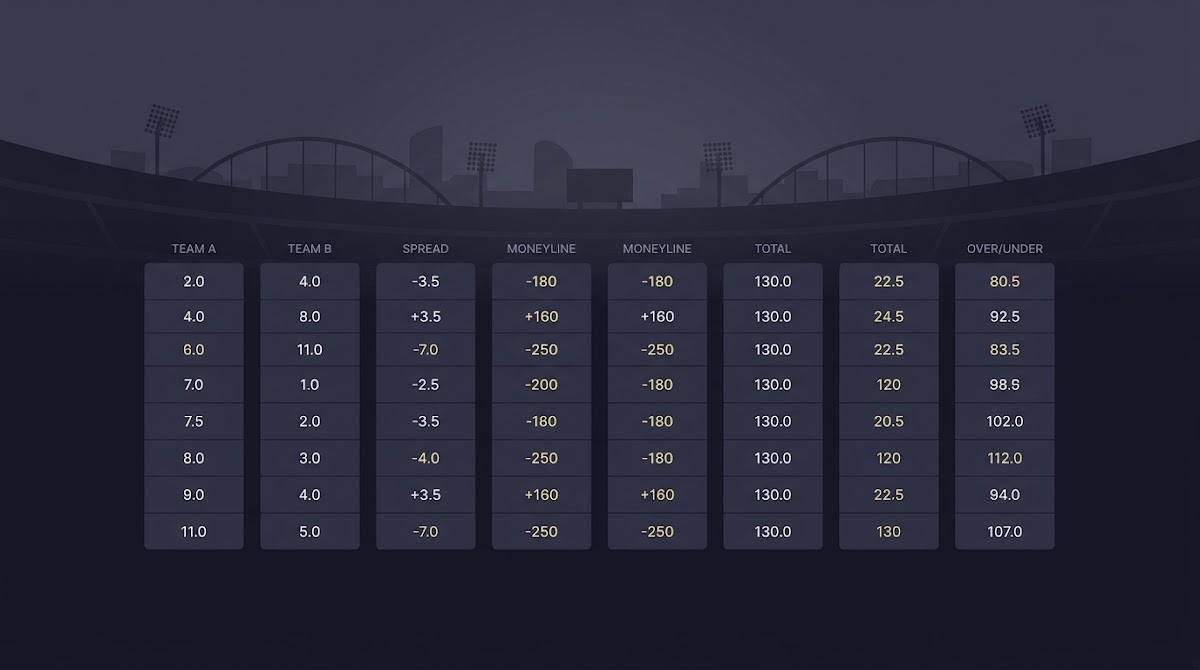
Start with the point spread. A spread denotes the expected margin between teams, with the favorite shown as a negative number and the underdog as a positive number. For example, reading a -3.5 spread means the favorite must win by four or more points for that number to be a winning bet on the favorite; the notation that favorites carry negative spreads is the standard convention used across industry documentation.
American moneyline notation reports payout relative to a 100 USD baseline. A negative moneyline shows how much you must stake to win 100 USD, while a positive moneyline shows how much you win on a 100 USD stake. For a practical mental check, remember that -110 means you would risk 110 USD to win 100 USD. This convention helps you compare implied probabilities across games when combined with the spread sports betting primer.

Read these together to get a fuller picture. A -3.5 spread paired with a -130 moneyline suggests a modestly favored team where payouts on the favorite are thinner. In contrast, a positive moneyline for an underdog indicates a higher payout if they win outright. Use quick arithmetic on the American odds baseline to convert payoffs into simple risk comparisons moneyline mechanics.
Keep two reading habits in mind. First, never interpret a spread alone without noting the associated moneyline, because the two together reveal how the market prices straight bets vs outright results. Second, practice quick mental conversions for moneylines so you can judge whether a price offers value relative to your view of the matchup.
Where to find live lines and how to read market boards

Live odds boards aggregate price feeds from multiple operators to show current point spreads and moneylines for every matchup on a single page. An aggregator is useful because prices update through the week and especially near kickoff, and it surfaces differences between operators so you can line shop rather than assume a single number is universal NFL odds boards.
There are two practical display modes to prefer. First, an aggregator that shows a consolidated median or consensus line next to a list of operator-specific numbers helps you see whether one book differs materially from the market. Second, a single-book screen is useful when you have an account with a provider you use regularly, such as ESPN, but remember single-book snapshots do not replace cross-checks against a feed that refreshes across operators odds display example.
When assessing a market board, use a short checklist: confirm the aggregator refresh cadence, ensure spreads and moneylines are clearly labeled, and check mobile and desktop readability so you can act quickly near kickoff. Prioritize boards that show timestamps and operator-level detail because those help you identify when a number first moved and who adjusted pricing. For an alternative live view, see the Action Network NFL odds page Action Network.
Using the NFL official injury report to interpret line movement
The NFL publishes a weekly injury report with standardized tags such as Questionable, Doubtful, and Out for each player; those categories are a primary non-model input for week-to-week line movement because they reflect team disclosures and practice reports NFL official injury reports.
Workflows that combine official injury updates with live market screens are widely used to build timely matchup summaries; the basic sequence is to note any key starters with Questionable or Out status, then watch the live board for immediate movement tied to those entries.

Practice participation notes during the week add context, but micro-injuries and late signals are often ambiguous. Verify final statuses on game day and treat late practice participation as a prompt to re-check the live lines before you finalize any decision.
Weather and situational factors that change lines
Weather affects NFL markets primarily through totals and passing efficiency variables. Wind, in particular, is the weather variable most consistently associated with depressed passing efficiency and lower totals, so outdoor games with significant wind advisories often see totals moved first and spreads adjusted second depending on team strengths wind and passing study.
When a game faces heavy wind or persistent rain, expect the market to reduce the projected total and to nudge spreads toward the side that better runs the ball or defends short-yardage situations. In practice, totals react faster because they directly reflect expected scoring levels, while spreads change after traders assess which team is better positioned to adapt to the conditions.
Keep in mind that much of the quantitative literature on weather effects is older, so use it as a foundational lens rather than a deterministic rule. Pair older findings with up-to-date forecasts for each venue, and prioritize wind advisories for passing-sensitive teams when forming your interpretation.
Line shopping, timing and basic market behavior
Line prices can differ across sportsbooks at the same time, so comparing operators is an evidence-based way to find better numbers and avoid paying an unfavorable price when the market offers variation aggregated odds feeds. You can also consult Oddschecker for an additional consolidated view.
Timing matters. Early-week numbers may reflect initial lines set by books, while the bulk of meaningful moves often happens midweek through the final hours before kickoff as injury news, public money, and pro money push prices. Understand that some of the largest short-term shifts can occur within hours of the game.
quick alerts and comparison steps to support line shopping
use these checks to decide if a board is reliable
Simple tactics improve execution: set alerts for lines you care about, monitor an aggregator for operator divergence, and maintain an account with at least one provider so you can capture a better price when it appears. Remember that retail flow and liquidity affect short-term movements; a sudden concentration of bets on one side can prompt rapid price shifts.
If you see substantial variance across operators for a single game, that variance is an invitation to dig deeper: confirm injury updates, check weather, and look for news that might explain why one book is out of step before you assume the outlying number is correct.
Decision checklist: when to trust a line and when to dig deeper
Use this five-item checklist to decide whether a visible line is a reliable baseline or needs further investigation: confirm source freshness, verify injury confirmations via the official report, check weather forecasts for the venue, compare variance across multiple operators, and evaluate matchup context including playing style and recent performance.
Trigger deeper research when thresholds are met. For example, multiple key starters listed Questionable or Out should prompt an immediate re-check of the live board; significant wind advisories should prompt a totals review; operator divergence beyond a point or two should prompt cross-verification with timestamps and news feeds.
Combine official injury statuses with live market screens rather than relying on a single bookmaker. That combined workflow reduces the chance of acting on unverified reports and helps you see how markets price confirmed information relative to rumors.
Common mistakes and pitfalls to avoid when reading the Sunday slate
One frequent error is overreacting to unconfirmed reports or social media chatter without checking the official NFL injury report. Acting on rumor can create the illusion of an edge while exposing you to avoidable losses if the report proves inaccurate, so always verify with the team-by-team disclosures.
Another mistake is relying on a single-book price instead of comparing aggregators. A single snapshot may be cheaper in the moment but can hide meaningful market context; use multiple operator views to see whether a price is truly available or an outlier.
Finally, do not assume weather stories always move spreads in the same direction. Totals typically move first; spreads may follow but often do so after traders assess which team can adjust to the conditions. Treat weather as a variable that affects your interpretation rather than a binary signal that guarantees a specific spread move.
Practical example: building a live Sunday slate (step-by-step)
Step 1: pull current spreads and moneylines from an odds aggregator and note any operator discrepancies. Record each game with the listed spread, the median moneyline, and any operator-level extremes so you can see whether one operator is out of step.
Step 2: cross-check each game's official injury report entries and mark players listed as Questionable, Doubtful, or Out. Treat Questionable tags as signals to watch late practice reports and game-day confirmations rather than as definitive absence until the team finalizes its inactive list NFL injury hub.
Practice reading live lines with FundedPlays Challenges
Save or print this step-by-step checklist to use on Sunday for quick reference when lines move late.
Step 3: check weather for outdoor venues with emphasis on wind. If a game has a notable wind advisory, mark totals for potential reduction and note which team benefits from a run-first approach. Wind tends to depress passing efficiency and scoring expectations in a way that markets price into totals first.
Step 4: combine the three layers. For each game create a short interpretation line: current spread and moneyline, key injury notes, and weather context. Use these three inputs to decide whether the market number reflects the available information or whether there is reason to wait for better clarity.
Finally, highlight two games and explain interpretation without inventing odds. For example, if Game A shows minor operator variance, no key injuries, and calm weather, it is a stable number for reference. If Game B has a key starter listed Questionable, a large operator divergence, and a strong wind advisory, it is a matchup that merits delay and deeper verification before adopting the listed spread.
Wrap-up: how to use this article on game day and next steps
Recap the recommended workflow: check a live odds aggregator for point spreads and moneylines, verify the NFL official injury report for key starter statuses, check wind and other weather signals for outdoor games, and compare operator variance before settling on a number.
For practice without wagering real money, consider using skill-focused simulation challenges to rehearse the process of reading lines and reacting to late news. Practice helps develop discipline and consistent decision frameworks without implying any guaranteed outcome for real events.
Use the short checklist earlier in this article on Sunday as your quick reference and remain disciplined in verification to avoid common pitfalls tied to rumors or single-book reliance.
A point spread sets the expected margin between teams; the favorite shows as negative and the underdog as positive. The favorite must win by more than the spread for that side to cash.
A negative moneyline shows how much you must risk to win 100 USD, while a positive moneyline shows how much you would win on a 100 USD stake.
Use the NFL official weekly injury report and cross-check late practice participation before finalizing any view on game day.
References
- https://www.thelines.com/nfl-odds/
- https://www.americangaming.org/knowledge-base/sports-betting-101/
- https://www.investopedia.com/terms/m/moneyline-bet.asp
- https://www.vegasinsider.com/nfl/odds/
- https://www.nfl.com/injuries/
- https://www.fundedplays.com/challenges
- https://fivethirtyeight.com/features/its-wind-not-cold-or-rain-that-really-affects-passing-in-the-nfl/
- https://www.actionnetwork.com/nfl/odds
- https://www.espn.com/nfl/odds
- https://www.oddschecker.com/us/football/nfl
- https://www.fundedplays.com
- https://www.fundedplays.com/blogs
- https://www.fundedplays.com/blogs/how-fundedplays-evaluations-work