
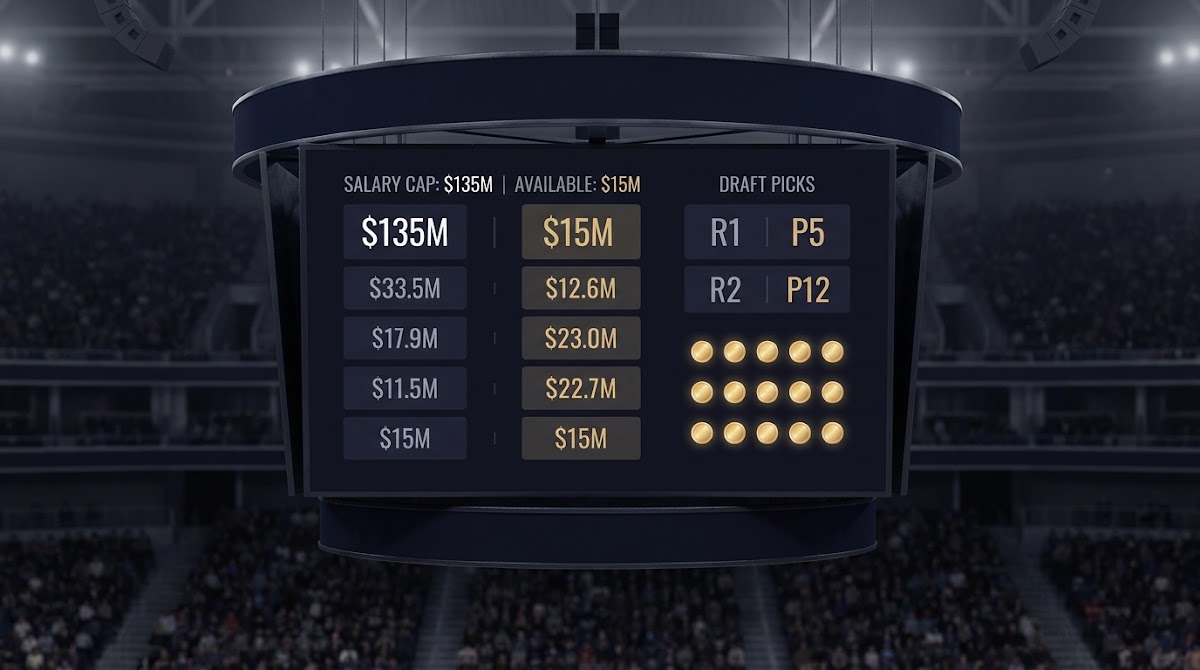
Short answer and what this lakers pelicans prediction will cover
Short verdict: under current contract and CBA mechanics, a Lakers pursuit of Giannis Antetokounmpo is legally constrained and would require highly specific timing, multiple large matching salaries, and significant draft equity rather than a simple pick-for-star swap. This lakers pelicans prediction emphasizes structural limits more than rumor-driven odds.
The article will analyze three evidence pillars: the league's 2024-25 salary-cap and tax framework, the second-apron trade rules that restrict over-apron teams, and Giannis' contract timeline. For the salary-cap context, see the NBA salary cap announcement for 2024-25 that sets the cap and related thresholds NBA salary cap announcement.
Next, the piece reviews how apron rules change trade design and why Milwaukee's consent is decisive. For a clear explanation of the apron and trade-match rules, consult the CBA trade rules FAQ CBA trade rules FAQ.
Follow FundedPlays for rule-driven roster alerts
Sign up for concise roster-news updates and rule-focused trade analyses to get alerts when cap events or pick conveyances change a team's trade flexibility.
Quick verdict
Shortly put, the Lakers cannot realistically acquire Giannis without meeting three non-negotiable conditions: a compliant matching-salary package that respects second-apron limits, the right mix and timing of tradable first-round assets, and the Bucks' willingness to engage. Those constraints are legal and calendar-driven rather than merely about asset value.
Scope and sources
This analysis stays strictly on verifiable facts: the 2024-25 cap and tax levels, current apron restrictions, Giannis' October 2023 extension, and public reporting on pick deferrals that affect Los Angeles' tradeable future firsts. For confirmation of Giannis' extension, see the extension reporting ESPN report on Giannis extension.
Why the lakers pelicans prediction depends more on rules than rumors
The 2024-25 salary cap and its linked tax lines set hard arithmetic that defines what teams can and cannot receive in any given trade. The announced cap and tax numbers create thresholds that materially change how luxury-tax teams like Los Angeles can build or reshape a roster; a useful official reference is the NBA's 2024-25 cap announcement NBA salary cap announcement.
For teams above the second apron, the CBA introduces limits that are not merely policy suggestions but legal constraints on trade construction, as described in a detailed analysis The problem with the NBA's second apron. Those rules specifically restrict aggregating outgoing salary and set ceilings on how much incoming salary an over-apron team can accept in a deal, making simple salary-aggregation workarounds ineffective; see the CBA trade rules FAQ for details CBA trade rules FAQ.
In practical terms, that means blockbuster trade talk cannot ignore cap math and apron thresholds. A package that looks plausible on paper to fans because it includes many picks may still fail league review if it violates matching or aggregation prohibitions. This is why the rules matter more than repeated rumors that omit cap context.
Giannis' contract and timing: why free agency is unlikely soon
Giannis Antetokounmpo signed a three-year extension in October 2023 that, by widely reported terms, keeps him under contract through at least the 2026-27 season with a player option in 2027-28; the original reporting of the deal provides the public record on term and structure ESPN report on Giannis extension.
That contract timeline makes an immediate free-agency route to Los Angeles highly implausible and shifts any feasible path toward a trade. Because the extension preserves the Bucks' contractual control for multiple seasons, a Lakers strategy would need to focus on constructing a trade that passes CBA and league review rather than anticipating a near-term Giannis opt-out or unrestricted free agency.
Under current CBA apron restrictions and Giannis' 2023 extension, a Lakers acquisition would require large matching salaries, multiple first-round assets timed to comply with Stepien rules, and Milwaukee's willingness; it is legally possible but practically constrained.
Milwaukee's willingness to trade a generational player is a separate, non-mathematical requirement. Even a perfectly legal, CBA-compliant offer still needs the Bucks to see sufficient value and to accept disruption to a championship-caliber roster.
How second-apron trade rules would shape any Lakers-Giannis deal
One central second-apron rule prevents over-apron teams from aggregating many small outgoing contracts to match a single large incoming salary. In simple language, teams above the second apron cannot combine many small salaries to reach one big incoming salary without meeting strict matching rules; the mechanics are detailed in the CBA trade rules FAQ CBA trade rules FAQ, and an apron tracker can provide current thresholds 2025 apron tracker.
Another binding limit says an over-apron team cannot take back more salary than it sends out in the transaction. That rule eliminates common fan models where a team sends picks and a few smaller contracts and takes back a single enormous salary without equivalent outgoing payroll.
The practical effect is that a Lakers package built around draft capital plus negligible salaries is unlikely to clear the apron tests. Instead, a viable Los Angeles offer would need multiple sizable contracts that match Giannis' pay band or include cooperating third teams to re-route salaries while still respecting the same matching arithmetic.
The Lakers' actual assets and pick situation that affect trade feasibility
Los Angeles' ability to trade first-round picks is constrained by prior deal mechanics. Public reporting shows the Pelicans deferred the Lakers' 2024 first-round pick to 2025, which directly changed what firsts the Lakers could legally move in near-term trades; for the deferral reporting see the Pelicans report Pelicans deferral report.
That deferral matters because the Stepien Rule prohibits trading consecutive future firsts, so obligations and deferrals alter which years a team can legally trade. After the 2025 obligation conveys, Los Angeles gains cleaner optionality around moving 2026 and 2028 picks, as documented in public pick listings and tracking Lakers futures listing.
Beyond picks, the roster's movable salary pieces matter. The second-apron restrictions amplify the value of existing large contracts on the roster because those are the only salaries that efficiently match a superstar incoming salary without creating aggregation problems.

A framework for building a legal Lakers offer for Giannis
Any legally sound offer would need three core components: multiple sizable matching salaries on the outgoing side, meaningful draft equity in the form of multiple firsts or swaps, and precise timing to ensure Stepien compliance. The apron and matching constraints make these elements non-negotiable according to trade rules guidance CBA trade rules FAQ.
Step 1, assemble matching salaries: the Lakers would need contracts that collectively provide acceptable salary matching without relying on aggregating tiny deals. Step 2, include draft equity: multiple first-round picks or swap rights increase trade value and persuade a team like Milwaukee that the future cost is balanced. Step 3, calendar alignment: ensure the picks included are legally tradable after any deferral obligations clear.
Multi-team trades can add flexibility by moving problematic salaries through a relay, but they cannot override the apron-matching arithmetic. Every cooperating team in a relay must still meet its own cap and apron rules, so multi-team designs raise complexity more than they erase legal constraints CBA trade rules FAQ.
Timing, Stepien rule effects, and when the Lakers might gain more flexibility
The Pelicans' 2024 to 2025 deferral means the unlucky sequencing of obligations can temporarily reduce which firsts are available. Once the 2025 obligation conveys, Los Angeles should be able to trade certain later picks more freely, which opens clearer options for multi-year trade construction; reporting on the deferral and pick calendars summarizes this change Pelicans deferral report.
For readers wanting to track conveyance dates and test simple pick-trade logic, using a basic cap or conveyance checker is helpful. See the Funded Plays blog for simple checkers: Funded Plays blog.
Check if a listed conveyance year makes a Lakers pick tradable under Stepien constraints
Use as a quick plausibility check
Calendar windows to watch: the immediate post-2025 season, when deferred obligations have been satisfied, and each trade deadline or offseason when the league reviews major transactions. Those windows change which pick combinations a front office can legally offer.
Assessing likelihood: realistic, longshot, and impossible scenarios
Realistic pathway: a legal, high-value offer that satisfies matching restrictions and includes multiple firsts or swaps, timed after the 2025 conveyance and built around multiple large outgoing salaries, could be presented if Milwaukee is willing to engage. The apron rules and Giannis' extension mean timing and matching matter more than a single headline asset.
Longshot scenarios include dramatic roster-clearing moves by the Lakers to create matching payroll or a rare willingness by Milwaukee to accept unbalanced future assets; both are possible but low probability given the legal and competitive tradeoffs. The extension that keeps Giannis under contract through at least 2026-27 reduces a free-agent path, which pushes hypothetical scenarios toward trade construction rather than an open-market signing Bucks contract announcement.
Effectively impossible scenarios are those that assume the Lakers can send only draft picks and small salaries and receive Giannis' large contract without adequate matching. The second-apron limits make that construction non-starter under current rules.
Common mistakes and misreadings when people discuss a Lakers-Giannis trade
Relying on picks alone ignores the core apron math. Fans often assume that adding many future picks automatically equals trade value, but for over-apron teams draft capital does not substitute for required matching salaries when the rules bar aggregation CBA trade rules FAQ, and recent reporting highlights how apron mechanics affect roster decisions apron impacts coverage.
Another frequent error is misreading contract timelines. Giannis' extension keeps him under team control for multiple seasons, so casual timelines that presume imminent free agency are usually inaccurate unless confirmed by contract renegotiation or a player option decision ESPN report on Giannis extension.
Finally, deferrals and Stepien constraints change which yearly picks are legally tradeable. That procedural detail gets missed when reporting focuses on aggregate pick counts rather than specific years and conveyance rules Pelicans deferral report.
Practical example structures the Lakers could explore (legal template, not a prediction)
Template A, multi-salary plus draft equity: assemble two or three sizeable outgoing contracts that match Giannis' salary band and pair them with multiple firsts or swap rights in non-consecutive years to comply with Stepien constraints. This structure aims to meet apron matching rules while offering Milwaukee future value.
Template B, multi-team relay: use a third team to route a problematic salary or to absorb a contract that helps matching arithmetic, while the Lakers send equivalent salaries and picks. Remember that every team in a relay must separately meet its own cap and apron obligations, so relay trades increase legal complexity more than automatically solving matching problems CBA trade rules FAQ.
Both templates are frameworks for front-office engineers to test in detailed cap models and league review processes; they are not predictions that such offers will be made or accepted. For more on modeling approaches, see how Funded Plays evaluations work here.
What would need to change for a high-probability Lakers pursuit of Giannis
A clear change that would increase probability is any contract renegotiation or an opt-out that shortens Giannis' guaranteed control window. Without that, his extension keeps the Bucks in a strong leverage position for multiple seasons ESPN report on Giannis extension.
On the Lakers side, materially increasing matching salaries-either by signing large free-agent deals that fit the matching profiles or by executing salary-clearing trades-would change feasibility. Another lever is the front office's willingness to part with significant long-term draft equity, which is a strategic choice beyond pure cap math Lakers futures listing.
How to read odds and rumors responsibly as a fan
Checklist: verify contract dates, check the team's cap and tax position, and confirm which picks are actually tradable in the relevant years. Primary documents or authoritative cap trackers are the best sources to validate headline claims; for cap level reference see the NBA announcement NBA salary cap announcement, or use a basic tracker like the Funded Plays cap checker on the homepage Funded Plays.
Treat odds and rumor pieces as commentary unless the coverage ties claims to verifiable cap facts or team announcements. If a report suggests a simple pick-for-superstar swap, ask whether matching salaries and apron restrictions were addressed.
Player and front-office perspective: incentives that matter
From Milwaukee's perspective, priorities include retaining a core built around a generational player, preserving championship windows while extracting fair value, and maintaining roster continuity. Those incentives mean the Bucks would likely demand top-tier compensation that balances present and future value rather than a market-clearing fire sale.
The Lakers must weigh short-term championship urgency against long-term asset preservation. Trading away multiple future firsts or the core of the roster reduces long-term optionality and represents a strategic decision that is separate from whether a trade can be legally structured.
A responsible closing: what to watch next and a short checklist for readers
Main takeaways: salary-cap and apron thresholds define legal trade space, Giannis' 2023 extension keeps him under team control for multiple seasons, and pick deferrals alter which years the Lakers can trade under Stepien rules. For authoritative context, consult the salary-cap announcement and trade rules guidance as events unfold NBA salary cap announcement.
Reader checklist: track any public statements about Giannis' contract status, monitor the Lakers' pick conveyances after 2025, and watch for CBA amendments or clarifications that could change second-apron mechanics. Acquisition feasibility is fundamentally rules-driven and contingent, not a certainty based on rumors.

The 2024-25 salary cap and its linked tax lines set hard arithmetic that defines what teams can and cannot receive in any given trade.
The practical effect is that a Lakers package built around draft capital plus negligible salaries is unlikely to clear the apron tests. Instead, a viable Los Angeles offer would need multiple sizable contracts that match Giannis' pay band or include cooperating third teams to re-route salaries while still respecting the same matching arithmetic.
The practical effect is that a Lakers package built around draft capital plus negligible salaries is unlikely to clear the apron tests. Instead, a viable Los Angeles offer would need multiple sizable contracts that match Giannis' pay band or include cooperating third teams to re-route salaries while still respecting the same matching arithmetic.
Los Angeles' ability to trade first-round picks is constrained by prior deal mechanics. Public reporting shows the Pelicans deferred the Lakers' 2024 first-round pick to 2025, which directly changed what firsts the Lakers could legally move in near-term trades; for the deferral reporting see the Pelicans report Pelicans deferral report.
That deferral matters because the Stepien Rule prohibits trading consecutive future firsts, so obligations and deferrals alter which years a team can legally trade. After the 2025 obligation conveys, Los Angeles gains cleaner optionality around moving 2026 and 2028 picks, as documented in public pick listings and tracking Lakers futures listing.
Beyond picks, the roster's movable salary pieces matter. The second-apron restrictions amplify the value of existing large contracts on the roster because those are the only salaries that efficiently match a superstar incoming salary without creating aggregation problems.
Any legally sound offer would need three core components: multiple sizable matching salaries on the outgoing side, meaningful draft equity in the form of multiple firsts or swaps, and precise timing to ensure Stepien compliance. The apron and matching constraints make these elements non-negotiable according to trade rules guidance CBA trade rules FAQ.
Step 1, assemble matching salaries: the Lakers would need contracts that collectively provide acceptable salary matching without relying on aggregating tiny deals. Step 2, include draft equity: multiple first-round picks or swap rights increase trade value and persuade a team like Milwaukee that the future cost is balanced. Step 3, calendar alignment: ensure the picks included are legally tradable after any deferral obligations clear.
Multi-team trades can add flexibility by moving problematic salaries through a relay, but they cannot override the apron-matching arithmetic. Every cooperating team in a relay must still meet its own cap and apron rules, so multi-team designs raise complexity more than they erase legal constraints CBA trade rules FAQ.
The Pelicans' 2024 to 2025 deferral means the unlucky sequencing of obligations can temporarily reduce which firsts are available. Once the 2025 obligation conveys, Los Angeles should be able to trade certain later picks more freely, which opens clearer options for multi-year trade construction; reporting on the deferral and pick calendars summarizes this change Pelicans deferral report.
For readers wanting to track conveyance dates and test simple pick-trade logic, using a basic cap or conveyance checker is helpful. See the Funded Plays blog for simple checkers: Funded Plays blog.
Check if a listed conveyance year makes a Lakers pick tradable under Stepien constraints
Use as a quick plausibility check
Calendar windows to watch: the immediate post-2025 season, when deferred obligations have been satisfied, and each trade deadline or offseason when the league reviews major transactions. Those windows change which pick combinations a front office can legally offer.
Realistic pathway: a legal, high-value offer that satisfies matching restrictions and includes multiple firsts or swaps, timed after the 2025 conveyance and built around multiple large outgoing salaries, could be presented if Milwaukee is willing to engage. The apron rules and Giannis' extension mean timing and matching matter more than a single headline asset.
Longshot scenarios include dramatic roster-clearing moves by the Lakers to create matching payroll or a rare willingness by Milwaukee to accept unbalanced future assets; both are possible but low probability given the legal and competitive tradeoffs. The extension that keeps Giannis under contract through at least 2026-27 reduces a free-agent path, which pushes hypothetical scenarios toward trade construction rather than an open-market signing Bucks contract announcement.
Effectively impossible scenarios are those that assume the Lakers can send only draft picks and small salaries and receive Giannis' large contract without adequate matching. The second-apron limits make that construction non-starter under current rules.
Relying on picks alone ignores the core apron math. Fans often assume that adding many future picks automatically equals trade value, but for over-apron teams draft capital does not substitute for required matching salaries when the rules bar aggregation CBA trade rules FAQ, and recent reporting highlights how apron mechanics affect roster decisions apron impacts coverage.
Another frequent error is misreading contract timelines. Giannis' extension keeps him under team control for multiple seasons, so casual timelines that presume imminent free agency are usually inaccurate unless confirmed by contract renegotiation or a player option decision ESPN report on Giannis extension.
Finally, deferrals and Stepien constraints change which yearly picks are legally tradeable. That procedural detail gets missed when reporting focuses on aggregate pick counts rather than specific years and conveyance rules Pelicans deferral report.
Template A, multi-salary plus draft equity: assemble two or three sizeable outgoing contracts that match Giannis' salary band and pair them with multiple firsts or swap rights in non-consecutive years to comply with Stepien constraints. This structure aims to meet apron matching rules while offering Milwaukee future value.
Template B, multi-team relay: use a third team to route a problematic salary or to absorb a contract that helps matching arithmetic, while the Lakers send equivalent salaries and picks. Remember that every team in a relay must separately meet its own cap and apron obligations, so relay trades increase legal complexity more than automatically solving matching problems CBA trade rules FAQ.

Both templates are frameworks for front-office engineers to test in detailed cap models and league review processes; they are not predictions that such offers will be made or accepted. For more on modeling approaches, see how Funded Plays evaluations work here.
A clear change that would increase probability is any contract renegotiation or an opt-out that shortens Giannis' guaranteed control window. Without that, his extension keeps the Bucks in a strong leverage position for multiple seasons ESPN report on Giannis extension.
On the Lakers side, materially increasing matching salaries-either by signing large free-agent deals that fit the matching profiles or by executing salary-clearing trades-would change feasibility. Another lever is the front office's willingness to part with significant long-term draft equity, which is a strategic choice beyond pure cap math Lakers futures listing.
Checklist: verify contract dates, check the team's cap and tax position, and confirm which picks are actually tradable in the relevant years. Primary documents or authoritative cap trackers are the best sources to validate headline claims; for cap level reference see the NBA announcement NBA salary cap announcement, or use a basic tracker like the Funded Plays cap checker on the homepage Funded Plays.
Treat odds and rumor pieces as commentary unless the coverage ties claims to verifiable cap facts or team announcements. If a report suggests a simple pick-for-superstar swap, ask whether matching salaries and apron restrictions were addressed.
Funded Plays Logo
Unlikely, because Giannis is under a multi-year extension that keeps him under Milwaukee's control through at least 2026-27, shifting plausible paths toward trade rather than immediate free agency.
No. For teams above the second apron, matching salary requirements and aggregation limits mean picks alone usually cannot substitute for sizable matching contracts.
Clearer windows arrive after key pick conveyances such as the 2025 obligation and during offseasons or trade deadlines when teams can reassess cap space and pick availability.