
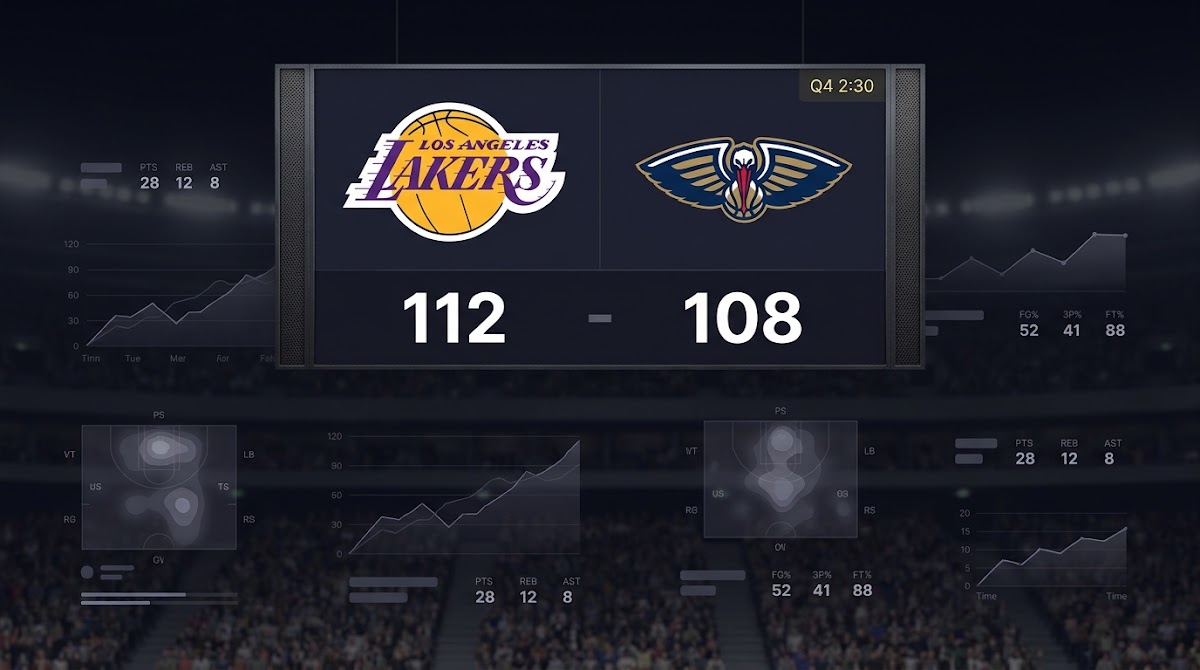
Quick pregame lakers pelicans prediction and who is favored
One-sentence market lean
As of the snapshot on the ESPN odds board, the market favorite should be taken from the posted lines and converted to an implied probability before placing a view, and readers must capture the ESPN timestamp to lock the quote ESPN odds board.
a three item quick odds-check procedure
Use this to confirm the core inputs
Why this snapshot matters now
In single-game forecasting the market line reflects liquidity and late information, so the ESPN odds quote is the primary read on who the public and books favor at the moment ESPN odds board, and check reporting such as Yahoo Sports for local injury context.
Before you finalize a lakers pelicans prediction, prioritize the NBA official injury report for the latest availability and minutes updates because last-minute changes can overturn the market lean NBA official injury report.

How to read the NBA injury report for this matchup
Game-day statuses and their meanings
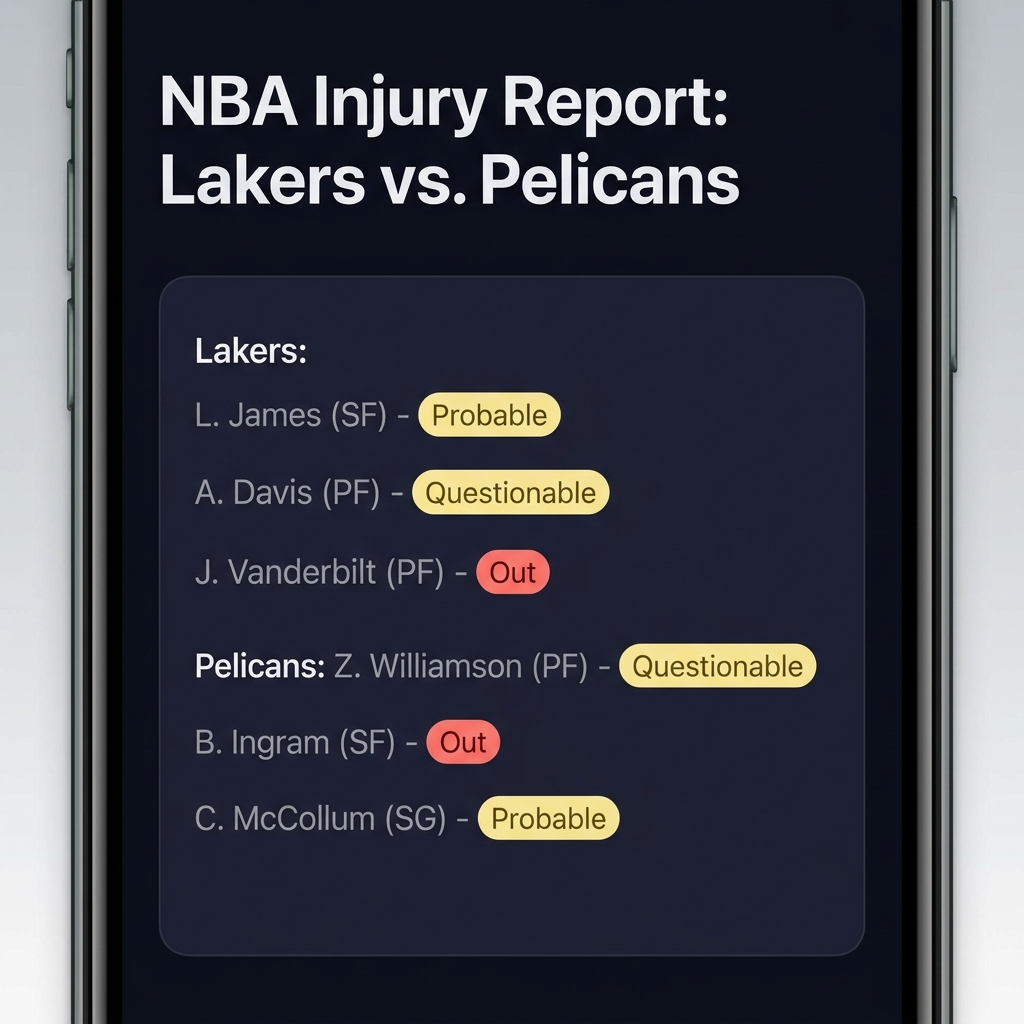
The NBA official injury report publishes standardized game-day statuses like out, questionable, and probable; use those exact tags to gauge availability and expected minutes for each player NBA official injury report.
When a starter is listed as out, the projection for lineup minutes and matchup coverage should be updated immediately because rotations and defensive assignments change with a confirmed absence NBA official injury report.
How minutes limits and questionable tags affect projections
Minutes limits and questionable tags are not binary; a listed minute restriction can lower a player s expected court time and force substitution patterns that materially change matchups and expected possessions NBA official injury report.
As a practical step, timestamp your injury check and re-run the core odds and metric checks if any starter status changes within the last hour before tipoff NBA official injury report.
Converting market lines to implied probability for a lakers pelicans prediction
How to convert moneyline and spread to implied win probability
Find the daily NBA lines on ESPN and note the moneyline and spread for the game, capturing the page timestamp so you can later reproduce the market quote ESPN odds board.
The simplest conversions are: moneyline implied probability equals 100 divided by (moneyline positive odds divided by 100 plus 1) for positive odds and similar algebra for negative lines; for spreads you can use historical calibration tables or convert the spread to an implied win probability with a normal approximation to margin using league standard deviation estimates ESPN odds board.
Capture the odds snapshot before you convert
Capture the ESPN odds timestamp before you convert the moneyline and spread to implied probability, then proceed step by step to avoid quoting stale lines.
Why you should capture the odds timestamp
Timestamps matter because the market can move quickly on late injury news or lineup confirmations, and documenting the exact ESPN snapshot supports learning and postgame review ESPN odds board.
Use TeamRankings as a secondary model check to compare your market-implied probability with a model probability and flag large gaps for further review TeamRankings power ratings and see Funded Plays blog for related walkthroughs.
Using advanced metrics to benchmark Lakers and Pelicans
OffRtg, DefRtg, and Net Rating explained
Offensive Rating, Defensive Rating, and Net Rating on the NBA team advanced pages provide a season-long baseline for how many points teams score and allow per 100 possessions; those metrics are the best single-source season-quality indicators before tipoff Team advanced stats.
Net Rating is simply OffRtg minus DefRtg and is useful because it combines both sides of the ball into a single comparative number to judge which team is stronger on balance Team advanced stats.
Pace and how it interacts with each team's profile
Pace changes the expected number of possessions and therefore amplifies or dampens scoring variance; when a fast team plays a slow opponent, expected point totals and margin calculations should incorporate the combined expected possessions from both teams Team advanced stats.
On the NBA team pages, note the OffRtg, DefRtg, Net Rating, and Pace columns as a compact set of baseline inputs to compare how a Lakers-Pelicans matchup should theoretically play out before accounting for injuries and recent form Team advanced stats.
Last-10 form: spotting short-term trends that matter for this lakers pelicans prediction
What last-10 splits tell you about shooting and rotations
Last-10 splits on the NBA team pages capture short-term shifts in shooting percentage, turnover rate, and rotation consistency that can justify adjusting a prediction away from season averages Team last-10 splits.
Look for sustained changes in OffRtg or a sustained change in three-point rate over several games as stronger signals than a single hot shooting night when assessing whether to move away from a market lean Team last-10 splits.
Use the ESPN odds board for the market favorite and the NBA official injury report to confirm availability; cross-check with NBA.com advanced metrics and last-10 splits before finalizing your lean.
When a rotation change is visible in the last-10 games and is confirmed in team notes or the injury report, that is a situation where short-term form can properly override season-long metrics Team last-10 splits.
When recent form should override season averages
Consider overriding season averages when last-10 metrics show a multi-game shift in Net Rating that coincides with a confirmed rotation change or a sustained shooting efficiency swing, because those patterns reflect structural change rather than noise Team last-10 splits.
Always combine last-10 observations with the injury report and rest checks before altering your lakers pelicans prediction, since health and minutes limits often explain apparent form changes NBA official injury report.
Situational factors: travel, rest, and rotations that shift the line
Back-to-backs and travel windows
Rest and travel commonly alter single-game probabilities; back-to-back scheduling and long travel windows tend to reduce expected effort and can lower a favored team s edge if the opponent is fresher Team last-10 splits.
Check the teams recent travel schedule and back-to-back status alongside the NBA injury report to see if planned rest or load management appears in the official availability listing NBA official injury report.
Confirmed rotation tweaks and coaching notes
Confirmed rotation tweaks, such as a starter being replaced by a small-ball lineup or a bench player seeing an increased role, should be recorded and weighted more heavily if they persist for multiple games in last-10 splits Team last-10 splits.
When rotations change due to a minutes limit or a new lineup that matches well or poorly against the opponent, update your expected margin calculations to reflect the personnel actually likely to play NBA official injury report.
Head-to-head and matchup edges to consider before finalizing a prediction
What head-to-head does and does not tell us
Basketball-Reference documents the Lakers-Pelicans head-to-head history, but head-to-head outcomes should be treated as narrative color and weighted less than current-season metrics and availability when projecting a single game Basketball-Reference head-to-head and related coverage on SI.com.
Head-to-head can highlight matchup tendencies that recur over a recent stretch, but it rarely outweighs a clear injury to a starter or a large season-long Net Rating difference on the NBA advanced pages Team advanced stats.

Specific matchup edges to watch
Look for matchup-level edges like interior defense versus opponent inside scoring or a team s ability to defend the perimeter on catch-and-shoot threes, and cross-check those edges with the advanced stat splits and recent lineup matchups on the team pages Team advanced stats.
Treat head-to-head patterns as supportive context that can tip a close call but avoid letting historical anecdotes replace the injury report and season metrics when they conflict Basketball-Reference head-to-head.
A simple checklist to produce your own lakers pelicans prediction
Step-by-step pregame checklist
1) Check the NBA official injury report and record player statuses and any minutes limits; timestamp this check for reproducibility NBA official injury report.
2) Capture the ESPN odds page with the timestamp, note moneyline and spread, and convert those to implied probability using the formulas described earlier ESPN odds board and compare with Funded Plays.

3) Pull OffRtg, DefRtg, Net Rating, and Pace from the NBA team advanced pages to establish a season-long baseline before adjusting for recent form Team advanced stats.
4) Review last-10 splits to check for sustained shooting variance, turnover trends, or rotation changes that may justify a deviation from the market Team last-10 splits.
5) Note situational factors like rest days, travel, and back-to-back status and reconcile any minutes limits from the injury report before finalizing your lean NBA official injury report.
6) Compare your market-implied probability to an independent power rating such as TeamRankings to identify gaps worth investigating TeamRankings power ratings.
How to weigh market vs model
Default to the market when odds are liquid and no clear, documented injury or rotation change exists to override the posted ESPN quote; prefer a model override only when you can point to a data-driven reason such as a confirmed starter absence or a persistent rotation shift visible in the last-10 splits ESPN odds board.
Record your timestamped odds and your own calculated probability so you can compare predicted vs actual outcomes and refine your process over time TeamRankings power ratings and see how we evaluate.
Common prediction mistakes and how to avoid them
Overreacting to single-game stats
One common error is overweighting a single hot or cold game; use last-10 splits to smooth volatility and reduce noise before altering a lakers pelicans prediction Team last-10 splits.
Ignoring the official injury report
Another mistake is relying on unverified social reports rather than the NBA official injury report, which is the authoritative source for game-day availability and minutes limits and should be checked before finalizing any lean NBA official injury report.
Additional line-management errors include failing to timestamp your odds quote and ignoring minutes limits, both of which make it hard to learn from past calls and can lead to avoidable mistakes ESPN odds board.
Two practical pregame walkthroughs: scenario-based lakers pelicans prediction examples
Scenario A: key Lakers starter questionable
Step 1, check the injury report and find the starter s questionable tag; treat a confirmed out as a structural change that requires rotating minutes and recalculating expected matchups and defensive assignments NBA official injury report.
Step 2, capture the ESPN odds timestamp and record the moneyline and spread, then convert those to implied probability and note the market s initial lean before your adjustments ESPN odds board.
Step 3, use OffRtg, DefRtg, and Net Rating to see how much baseline quality the Lakers lose when the starter is absent; if the starter is a primary defender or playmaker, adjust the expected margin to reflect replacement-level performance and rotation ripple effects Team advanced stats.
Step 4, check last-10 splits for signs that bench players have performed well in recent games and factor that into your recalculated projection, then compare your adjusted probability to TeamRankings to see whether the model also moves away from the market Team last-10 splits.
Scenario B: Pelicans on a short road trip and back-to-back
Step 1, confirm the Pelicans travel window and back-to-back status and note any rest advantages on the injury report and in the last-10 context Team last-10 splits.
Step 2, capture the ESPN odds timestamp and baseline market probability, then evaluate whether fatigue or travel plausibly reduces the Pelicans offensive efficiency relative to their season OffRtg ESPN odds board.
Step 3, compare the season Net Ratings and pace profiles to estimate how the matchup should play on a neutral court, then shrink the Pelicans expected advantage if rest and travel are likely to depress their performance Team advanced stats.
Step 4, if an independent model such as TeamRankings still favors the Pelicans strongly despite travel and rest concerns, document the gap and the reasons you chose to defer to or diverge from the market TeamRankings power ratings.
Combining market odds and independent power ratings into a final lean
When to favor the market
Favor the market when odds are liquid and no clear, data-backed injury or rotation reason exists to override the posted ESPN quote; market pricing typically internalizes late news and large public reactions quickly ESPN odds board.
When a model should override the public line
Use an independent model override when you have a documented, replicable reason such as a confirmed starter absence, an enduring rotation reshuffle visible in last-10 splits, or a persistent mismatch not reflected in the market; cross-check with TeamRankings before diverging TeamRankings power ratings.
When you override the market, record the timestamped market probability, your model probability, and the reason for divergence to enable future calibration and learning TeamRankings power ratings.
Decision criteria and responsible guidance before tipoff
Minimum checks to complete before finalizing your pick
Complete this final mini checklist: injury report timestamp, ESPN odds timestamp, OffRtg/DefRtg check, last-10 sanity check, and situational review; if any of these change within the final hour, revisit your lean and update the recorded probability NBA official injury report.
Responsible participation and uncertainty
Treat every prediction as probabilistic rather than certain, and maintain a log of timestamped market quotes and your model outputs so you can learn from outcomes without assuming guarantees.
Conclusion: final lakers pelicans prediction lean and how to update before tipoff
Summarize the best-practice steps
To summarize, start with the ESPN odds timestamp for the market lean, cross-check the NBA.com advanced metrics for season baseline OffRtg and DefRtg, review last-10 splits for short-term form, incorporate situational factors like rest and travel, and use TeamRankings as a model sanity check before finalizing your lakers pelicans prediction ESPN odds board.
Where to go for last-minute verification
For last-minute verification use the NBA official injury report for authoritative availability and the ESPN odds page for the timestamped market quote; update your recorded probability if either item changes close to tipoff NBA official injury report and media updates like USA Today.
Use the NBA official injury report as the authoritative game-day source for availability and minutes updates.
Capture the moneyline or spread from the odds page and apply the standard conversion formulas or a calibration table to get implied probabilities.
Consider overriding only when you have documented evidence such as a confirmed starter absence, persistent rotation change, or model-based signal that contradicts the market.
References
- https://www.espn.com/nba/odds
- https://official.nba.com/injury-report/
- https://www.teamrankings.com/nba/
- https://www.nba.com/stats/teams/advanced?Season=2025-26&SeasonType=Regular%20Season
- https://sports.yahoo.com/articles/lakers-release-injury-report-tuesdays-035442393.html
- https://www.fundedplays.com/blogs
- https://www.basketball-reference.com/teams/LAL/head2head.html?opp=NOP
- https://www.fundedplays.com/challenges
- https://www.nba.com/stats/teams/traditional?Season=2025-26&SeasonType=Regular%20Season&LastNGames=10
- https://www.fundedplays.com
- https://www.fundedplays.com/blogs/how-fundedplays-evaluations-work
- https://www.si.com/nba/pelicans/onsi/news/pelicans-injury-report-lakers-will-zion-williamson-stars-play-01kjt8ntwzx2
- https://www.usatoday.com/story/sports/nba/lakers/2026/03/03/lakers-pelicans-watch-channel-stream-nba-odds/88963321007/