

Quick answer and how to use this guide
Short answer - james harden player prop
Short answer, in one sentence: taken together, the NBA’s official 75th Anniversary selection plus Harden’s career honors and lasting cumulative impact make a credible case that he belongs in an all-time top-75 grouping.
This claim rests first on the league’s official recognition, then on Harden’s peak-season value and finally on cumulative advanced metrics that track career impact; the three evidence streams provide complementary validation rather than a single definitive ranking judgment, and they are explained below with supporting sources where appropriate NBA 75th Anniversary Team list.
Practice forecasting under structured challenges
If you want the short verdict and a clear path to translate it into prop projections, read the short answer and then jump to the player-prop checklist and the scenario sketches that follow.
How to use this article: skip to the parts you need. If you want the ranking argument, read the Quick answer and the Career r233sum233 sections. If you need metrics to feed a model, read Advanced metrics and the Practical framework for player-prop modeling section. If you are checking analytic traps, read Common mistakes and pitfalls. Find related analysis on the Funded Plays blog.
The rest of this piece builds from official honors to metrics to concrete forecasting steps so you can both form a defensible ranking opinion and apply that view to nightly projections.
What 'top 75' means: honors, selection, and context
The NBA 75th Anniversary Team is an official league recognition created to mark the league's first 75 seasons, and inclusion signals a level of historical standing recognized by the league and historians NBA 75th Anniversary Team list.
Official honors like an anniversary team selection are strong signals because they reflect cumulative reputation, peer and media judgment, and the league’s archival view of a career, but honors are not a single quantitative ranking; they combine measurable achievements with subjective assessments.
To translate an honor into a place on a numerical top-75 list, analysts commonly combine honors with counting stats and advanced metrics. Counting stats capture longevity and cumulative volume, while advanced metrics measure impact per possession or contributions relative to replacement level.
Put simply, honors matter but should be validated against objective measures such as career leaderboards and cumulative metrics before final placement, because era, role, and selection method can affect who appears on honors lists.
Official recognitions and their weight
Honors like All-Star and All-NBA nods, a league MVP, and an anniversary team selection are weighted heavily in most historical evaluations because they identify sustained recognition across peer and media voting cycles.
At the same time, honors depend on context: team success, market visibility, and voting composition can tilt selections in ways that merit cross-checking with statistical measures.
How historians, voters, and metrics differ
Historians and voters emphasize narratives and postseason legacy more than pure cumulative metrics. Metrics such as Win Shares and VORP quantify career contributions in ways that complement narrative judgment; using both helps reduce bias.

Harden's career r233sum233: awards, longevity, and cumulative impact
Harden's headline honors include the 2018 MVP award, three scoring titles, two assists titles, and multiple All-NBA and All-Star selections, which together form the core of his credentials for long-term standing James Harden player page.
Those awards establish Harden's peak value and seasons of elite production; an MVP season in particular is treated as a strong indicator of a top-tier peak when comparing across careers.
Counting stats and longevity matter because all-time lists tend to reward cumulative contribution. Harden has logged many seasons of high usage and production, and career leaderboards capture that steady output across years.
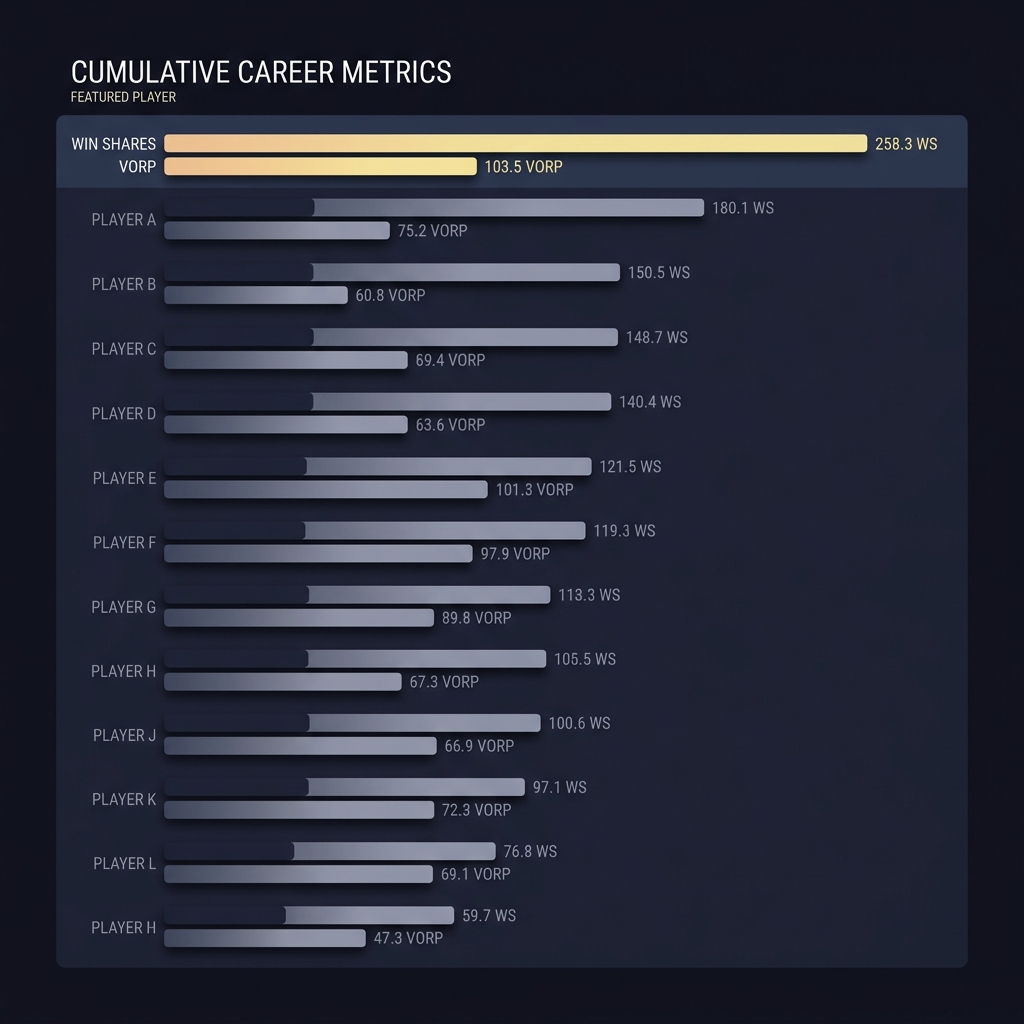
That cumulative weight is important: a player with a long period of above-average impact often overtakes peers with higher peaks but shorter careers when career totals are the evaluation basis.
Yes. The NBA 75th selection, Harden's peak awards, and his cumulative placement on career leaderboards collectively support a credible top-75 designation entering 2026.
An open, practical question for readers is how much weight to place on the anniversary selection versus the specifics of late-career performance, such as playoff value or recent declines; either can shift a player a few slots in an all-time ranking.
For Harden, the current balance of honors plus substantial career totals makes a reasonable case for top-75 placement, while future re-evaluations should track playoff contributions and durability as tiebreakers.
Advanced metrics and playstyle evolution: the numeric case for top-75
Two cumulative advanced metrics commonly used in all-time comparisons are Value Over Replacement Player and Win Shares, which estimate a player's contribution above a replacement-level alternate and aggregate value across seasons respectively Career VORP leaderboards. Additional advanced stat context is available at ESPN advanced stats.
VORP measures a player's estimated impact versus a replacement-level player adjusting for minutes and league scoring environment, while Win Shares allocate team wins proportionally to player contributions; both place emphasis on sustained production over time.
On those career leaderboards, Harden appears prominently among accumulated-impact lists, reinforcing that his long-term contributions add up in a way consistent with many players commonly slotted into historical top-75 lists Career Win Shares leaderboards.
That shift affects prop modeling because playmaking reliability supports steadier assist props, while scoring-based props may show more variance tied to usage and lineup context.
To summarize, cumulative metrics back Harden's top-75 case by showing career-level impact, and recent role evolution suggests a shift from pure scoring to more consistent creation, both of which are relevant for ranking and nightly forecasting.
A practical framework for player-prop modeling: how to forecast Harden night to night
Modeling Harden for player props benefits from a structured inputs checklist that starts with minutes, a role proxy such as usage rate, team pace, teammate availability, and matchup context.
Minutes are the single most important constraint for counting props. Adjust a baseline per-36 or per-100-possession projection by projected minutes and then tune for expected usage in that lineup and matchup.
Usage or a role proxy captures how much offense will run through Harden; when usage dips because another scorer or primary ball-handler is on the floor, scoring props should be lowered accordingly while assist props may be more stable James Harden EPM profile.

Lineup and teammate availability changes matter because Harden's assist and scoring opportunities are sensitive to who is on the perimeter to convert passes and who draws defensive focus; check injury reports and last-game rotations before lock.
Pace affects raw counting stats because higher pace increases total possessions and scoring chances. Adjust baseline projections by team pace factor and prefer opponent-adjusted pace when evaluating away games.
Matchup context is the final tuning input: defenses that take away drives or collapse into the paint can change shot distribution and assist opportunities. Use recent opponent defensive tendencies to nudge scoring and assist lines.
Checklist to apply before lock, in order: 1) Confirm projected minutes and role; 2) Check starting lineup and primary ball-handler presence; 3) Adjust for pace differential; 4) Review opponent defensive tendencies and rotation stability; 5) Apply volatility factor based on recent scoring variance and usage shifts.
When building a quick baseline, start from a recent per-36 or per-100-possession rate, scale by minutes, then apply multipliers for usage change and pace. See Funded Plays for tools. This keeps models transparent and easy to audit before placing a prop.
Decision criteria: how to weigh honors, peak value, and recent performance when ranking
Establish a simple ruleset for ranking that categorizes evidence into four buckets: official honors, peak-season value, career cumulative impact, and late-career influence.
Ruleset in brief: give strong weight to official honors and peak single-season value when both are present; use career cumulative metrics to break ties among players with similar peaks; and let sustained late-career decline or major new playoff achievements move a player down or up respectively.
Put another way, if a player has an MVP and long career accumulation on VORP and Win Shares, that combination typically secures a top-75 slot absent dramatic negative late-career evidence, because honors and career totals each validate different dimensions of contribution NBA 75th Anniversary Team list.
For Harden specifically, the combination of official selection, a clear MVP peak, and prominent placement on cumulative leaderboards fits multiple positive criteria in the ruleset; late-career playoff results could refine his exact slot but are unlikely to overturn the broad top-75 conclusion.
Signals that would prompt re-evaluation include a multi-season collapse in minutes and per-minute effectiveness, or conversely, a late-career surge in playoff impact that materially changes his legacy relative to peers.
Common mistakes and pitfalls when using stats or ranking late-career players
One common error is overweighting raw scoring volume without adjusting for usage and pace, which can make older high scorers look better than their per-minute or per-possession impact suggests; normalize to be sure you compare apples to apples James Harden player profile and stats. Additional breakdowns are available on Fox Sports advanced stats.
Another pitfall is ignoring minutes and teammate effects. A player's counting stats can decline because minutes are reduced or teammates change rather than because the player lost skill; always check lineup context and minutes projections before revising a ranking or prop line.
quick minutes-times-usage adjustment
use as a starting point
Small samples can mislead. A hot or cold five-game stretch should not overturn career-weighted judgments; use rolling windows and confidence intervals to judge whether a recent change is noise or a durable trend.
Practical corrections: normalize to per-36 or per-100 numbers when comparing seasons; use opponent-adjusted pace; and when projecting props, incorporate a volatility multiplier if usage has recently fluctuated, rather than replacing the baseline model entirely.
Practical scenarios and final takeaway
Conservative scenario: assume minutes decline and usage is capped by role sharing, set scoring props lower, and favor assist lines based on Harden's steadier recent creation rates; this is the cautious read that protects against volatility.
Neutral scenario: use projected minutes and recent per-36 rates scaled to pace, with moderate adjustments for teammate changes; this read treats Harden as a reliable playmaker with variable scoring upside.
Aggressive scenario: assume higher usage for scoring on a given night and scale per-36 scoring accordingly, useful when matchups and teammate absences point to Harden as the primary offensive focal point.
Immediate next steps before lock: check projected minutes, confirm starting lineup and primary ball-handler status, and adjust baseline projections for pace and opponent tendencies. Learn more about how Funded Plays evaluations work here.
No single honor is definitive, but the NBA 75th selection combined with his career awards and cumulative metrics makes a strong, defensible case for top-75 placement.
Start with minutes and a usage proxy, then adjust for pace and teammate availability; assists tend to be steadier than scoring recently.
Reassess after sustained playoff runs or multi-season changes in minutes and per-minute production, or when new evidence changes career totals significantly.
References
- https://www.nba.com/news/nba-75-final-76-list
- https://www.basketball-reference.com/players/h/hardeja01.html
- https://www.basketball-reference.com/leaders/ws_career.html
- https://www.basketball-reference.com/leaders/vorp_career.html
- https://www.nba.com/stats/player/201935/
- https://dunksandthrees.com/player/201935
- https://www.fundedplays.com/challenges
- https://www.fundedplays.com/blogs
- https://www.fundedplays.com
- https://www.fundedplays.com/blogs/how-fundedplays-evaluations-work
- https://www.nba.com/player/201935/james-harden
- https://www.espn.com/nba/player/advancedstats/_/id/3992/james-harden
- https://www.foxsports.com/nba/james-harden-player-stats?category=advanced&seasonType=post