
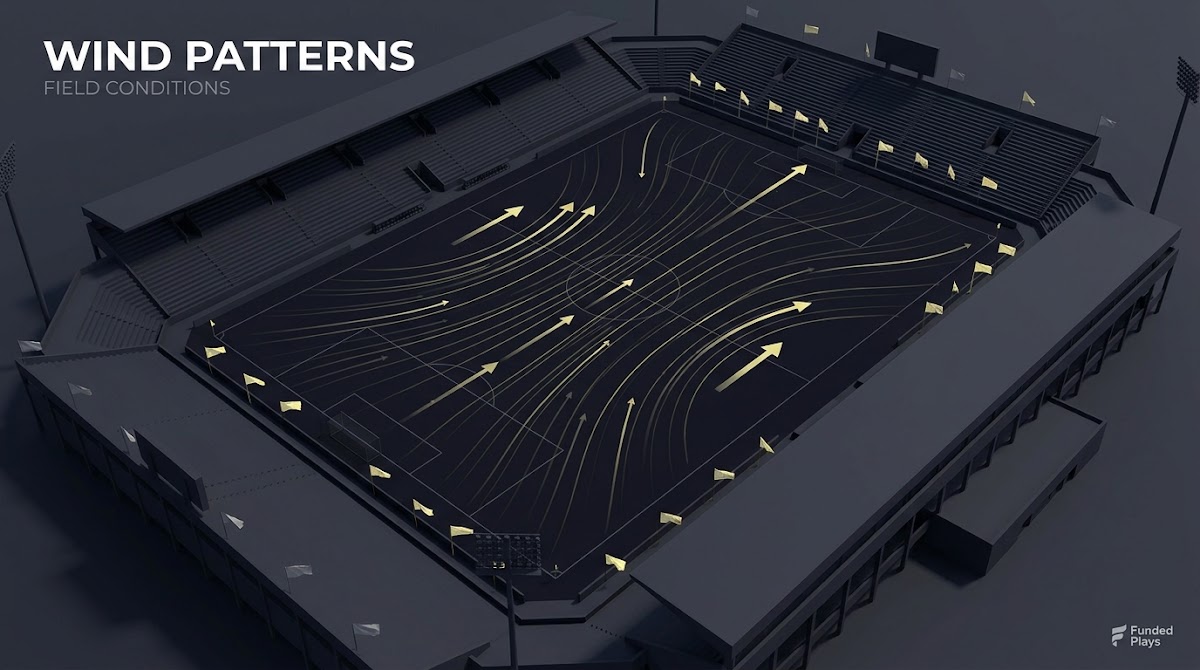
How Wind Changes Scoring Conditions: quick overview
Wind is one of the simplest and most overlooked variables that changes scoring conditions in outdoor sports. In plain language, wind is moving air that interacts with a moving ball or a player-operated implement, and those interactions can alter distance, accuracy, and the risk profile of certain plays.
For coaches and predictors, understanding how wind affects ball flight, player choices, and field dynamics helps convert observation into repeatable decisions rather than guesswork. This article focuses on the practical levers that shift when wind becomes significant, from play selection to in-play tactics and model adjustments.
Practice disciplined wind-aware decision-making with Funded Plays Challenges
Keep this guide handy and try the decision checklist later in the article to convert live wind readings into clear, repeatable choices.
Across sports the common effects are similar: changes in effective range, altered trajectories, and higher outcome variance on aerial plays. A disciplined, platform-style evaluation approach rewards making consistent adjustments based on measurable conditions rather than ad-hoc reactions.
This overview prepares you for the detailed sections that follow, where we cover meteorological basics, the physics behind ball behavior, sport-specific impacts, measurement sources, a three-step decision framework, and worked scenarios.
What wind is and the meteorological basics that matter for scoring
Wind speed and direction are the two headline numbers, but the story that matters for scoring also includes gustiness and local variability. Wind speed is the steady component; gusts are short bursts that add unpredictability and make accurate aiming harder.
Gusts change predictability more than steady breezes because they can alter the ball just before or during a crucial phase of flight. Think of a steady breeze as a consistent push and a gust as a sudden shove that is harder to correct for in real time.

Direction is equally important. A headwind opposes flight and tends to reduce carry and range. A tailwind assists flight and can increase carry. Crosswind shifts lateral placement and may require aiming adjustments or altered flight profiles.
Microclimates matter for stadium sports. A stadium bowl, nearby buildings, or terrain can channel, amplify, or shelter wind so that the official weather station reading may differ from the on-field experience. Expect some discrepancy and use local observations to adjust reported values.
How wind changes scoring conditions: the physics of ball flight
At a basic level, moving air changes the forces on a ball. Two aerodynamic forces play the main roles: drag, which slows the ball, and lift, which can change its vertical path. Together, these determine speed, carry, and where the ball lands. Research is available at Golf Science Journal.
Spin interacts with the moving air through the Magnus effect, so balls with significant spin will curve differently when wind is present. A spinning ball in a crosswind can see its break amplified or reduced depending on spin direction and wind vector.

Tailwinds effectively reduce relative airspeed and often increase carry distance for shots and kicks, while headwinds do the opposite by increasing air resistance. Crosswinds primarily alter lateral placement and make accuracy on long, airborne attempts less reliable.
When practical decisions are needed, think in terms of three outcomes: shorter range on headwind attempts, longer or carry-over risk on tailwind attempts, and lateral displacement in crosswind situations. Those differences translate directly into whether a deep pass, long kick, or high-arching shot is a high-value attempt.
How wind changes scoring conditions in football and soccer
Passing windows shrink when the air is unstable. In strong gusty wind, quarterbacks and playmakers face quicker decay in pass speed and more unpredictable ball movement, so timing and release windows matter more than absolute arm strength.
Kicking and long balls are especially sensitive. Kickers and free-kick takers must adjust aim and power: a tailwind increases range but can push the ball over the intended landing zone, while a headwind shortens kicks and may force teams to choose lower trajectory, ground-based options.
Crosswinds can turn a routine aerial target into a contested ball because lateral drift increases the chance of miscommunication and turnover. Teams often compensate with more ground play, shorter passing, and earlier release points to reduce the time the ball spends in the air.
From a game-management perspective, that means fewer high-risk long attempts when winds are strong and gusty, plus a bias toward plays that keep the ball on the ground to protect possession and control field position.
How wind changes scoring conditions in baseball, cricket, and golf
In games where carry and distance are central, wind changes the expected range of shots. Tailwinds raise carry and can turn routine long attempts into scoring opportunities or boundary hits. Headwinds lower carry and may make long attempts unrealistic. See practical guides such as the one at Oaks National Golf Club.
Crosswinds in these sports alter aiming strategy. A golf shot aimed at a pin or a baseball fly ball heading toward a fence can land significantly off-target when the wind has lateral components, and this can change club selection or swing intent.
Adjustments often include choosing a different club or implement, lowering launch angle to reduce time aloft, and selecting safer target zones. Conservatism pays when a mis-hit combined with strong wind can produce outsized negative outcomes.
live wind-reading workflow for carry and aim
Use as a quick pre-shot confirmation
Whether in cricket, baseball, or golf, the practical effect is the same: wind increases variance and forces players to choose between aggressive distance-seeking shots and safer placement-focused options.
When contesting boundaries or negotiating roof lines and stands, the risk of carry-over or unexpected drift is highest and should be a dominant factor in decision-making.

Reliable wind information comes from a mix of sensors and observation. On-site anemometers provide the best local reading when available. Nearby weather stations and short-term forecast models are useful but can differ from stadium-level conditions.
Compare multiple sources and look for agreement on magnitude and direction. If readings diverge, prioritize on-site or visually confirmed observations, and treat station-based numbers as a baseline rather than a definitive value.
Gusts require attention: a 10-minute average may look tame while 30 to 40 second gusts can still disrupt key plays. For in-game decisions, short-interval readings and trained observers reporting actual on-field gusts help reduce surprise.
Interpretation rules under time pressure include watching flags, testing a few controlled kicks or throws in warm-up, and establishing a conservative threshold where teams shift to safer tactics when sustained conditions exceed it.
How Wind Changes Scoring Conditions: a game-time decision framework
Use a simple three-step framework: assess, map, choose. First, assess magnitude and direction with the best local data and visual checks. Second, map that assessment to the scoring levers that matter in your sport, such as distance, accuracy, and turnover risk. Third, choose conservative or aggressive adjustments guided by qualitative thresholds you rehearsed before the game.
Decision thresholds should be qualitative and repeatable. For example, treat sustained winds above a level you define as a condition where long-range attempts become lower expected value, or where crosswind drift forces narrower target windows.
Use a three-step cycle: assess local wind magnitude and direction, map the most affected scoring levers, and choose from a short, rehearsed set of conservative or aggressive adjustments while logging the decision for later review.
Apply the framework in quick cycles. Reassess after significant gusts or halftime, map fresh observations to the same scoring levers, and pick adjustments from a small, practiced playbook so execution remains reliable rather than improvised.
Using this framework consistently reduces emotional overreaction and improves the chance that in-play choices follow a disciplined plan that you can review later.
Strategy adjustments for players and coaches when wind shifts scoring conditions
Coaches should favor plays that reduce time aloft and keep the ball under control when wind is a factor. That means more ground play, short passing, and schemes that limit long, high-risk opportunities.
Lineup and personnel changes are a tool when sustained conditions favor certain skill sets, such as quicker, more accurate short-pass receivers or kickers who excel at lower trajectory techniques. Make changes sparingly and with prior rehearsal to avoid disruptive mid-game confusion.
Target-zone adjustments matter. Shifting targets closer to sheltered areas of the field or choosing aim points that account for lateral drift are simple, high-value choices. Communicate these shifts clearly in pre-game and in-break briefings so players can execute without hesitation.
Rehearse wind-specific plays in practice so that the team’s adjusted plan is muscle memory. Teams that practice under varied conditions tend to make cleaner tactical shifts and reduce unforced errors when wind becomes a factor.
Implications for prediction models, analytics, and performance-based evaluation
Analysts should treat wind as a feature in models and test its interactions with play types. Include wind speed and direction as inputs and evaluate how they change predicted probabilities for long attempts versus short options. See the Funded Plays blog for related posts.
Wind increases outcome variance, so models and evaluation systems should widen confidence intervals when wind is material. This prevents overconfidence in predictions and better reflects the higher dispersion of possible results.
Measurement noise is real. When building models, back-test with stadium-level adjustments and consider differential weights for on-field sensors versus distant station reports. Keep features simple and avoid overfitting to small, windy samples.
For evaluation platforms that reward consistency, encourage rule-based adjustments rather than gambling on single extreme selections. Consider platforms such as Funded Plays.
Common mistakes and Stolperfallen when judging wind and scoring
Overreacting to a single gust is common. A single dramatic play under gusty conditions can bias subsequent calls, but probabilistic judgment requires aggregating readings and observing patterns rather than chasing a one-off event.
Relying solely on distant weather reports is another frequent error. The microclimate inside a stadium can differ meaningfully from station data, so couple reports with visual confirmation and short local tests when possible.
Small sample observations during a game mislead decisions. Avoid changing core strategy based on one or two plays; instead, use your pre-defined threshold rules so decisions remain consistent and defensible.
Mitigations include averaging readings over a few minutes, using on-field observers to confirm gusts, and keeping adjustments simple so execution quality does not decline under pressure.
Practical scenarios: worked examples showing how wind changes scoring conditions
Scenario A, soccer with a strong crosswind. Assessment: steady 12-15 mph wind with intermittent 25 mph gusts funneling across the field. Mapping: aerial passes and high crosses have increased lateral drift and a higher chance of miscommunication. Choice: prioritize short passes, early deliveries into space, and set piece routines that favor low-driven or short options rather than high crosses.
In that scenario, teams that reduce time in the air and simplify set piece targets tend to protect possession and create clearer scoring chances than teams that persist with high-risk aerial strategies.
Scenario B, golf final round with a tailwind on several holes. Assessment: consistent tail component down key fairways. Mapping: increased carry changes club selection and green approach strategy. Choice: players may choose lower-loft clubs or plan for more aggressive pin attacks where carry becomes an advantage, but they must also account for potential carry-over into hazards. See related coverage at GolfWRX.
Across both scenarios, the decision framework keeps choices systematic: assess with local observation, map to the scoring lever, and pick an adjustment from a rehearsed set of options while acknowledging uncertainty.
A simple decision checklist for game managers and analysts
Pre-game checks should include on-site wind readings, a short practice sequence to test ball behavior, a defined decision threshold for switching to conservative tactics, and a communication plan for quick in-game updates.

In-play quick checks are short items: confirm current wind vector with two independent observations, note recent gusts, decide whether to switch to a pre-defined conservative play set, and log the decision with reasoning for later review.
Use the checklist under time pressure by keeping items binary and outcome-focused. The core habit is to log decisions so future analysis can show whether a chosen adjustment reduced variance or preserved scoring opportunity.
When wind matters less: limitations and edge cases
Indoor sports and sheltered stadiums are obvious cases where wind has little effect. If a venue has a reliable roof, enclosed bowl, or consistent sheltering structures, aerial plays behave much like calm conditions.
Short-field formats and contests where shots are constrained by distance or require low trajectories reduce wind sensitivity. In formats where most attempts are low to the ground, wind typically has a muted effect on scoring outcomes.
Weather combinations can also change priorities: heavy rain or lightning can become the dominant factor, making wind a secondary concern. Use situational judgment and avoid rigid rules that ignore the broader context.
Conclusion: using wind-aware thinking to improve scoring outcomes and decisions
Key takeaways are straightforward: wind changes range, accuracy, and variance for aerial plays; crosswinds shift lateral placement; gusts reduce predictability. A simple, rehearsed decision framework helps convert live readings into consistent tactical choices.
Next steps are practice, logging, and cautious modeling. Run drills in varied conditions, add basic wind features to predictive systems, and keep records of in-game adjustments to learn what works at specific venues. Responsible use of these adjustments focuses on reducing variance and improving repeatable decision quality rather than promising better outcomes. Read about how Funded Plays evaluations work.
Teams should rely on pre-defined qualitative thresholds and confirm with at least two local observations before shifting tactics to avoid overreacting to single gusts.
Weather station data is useful as a baseline but should be adjusted for stadium microclimates and on-site readings to reduce measurement error.
Not always; tailwinds can increase scoring in distance-dependent situations, while headwinds and crosswinds typically reduce effectiveness of high, airborne attempts.
References
- https://www.golfsciencejournal.org/article/133669-wind-effect-in-short-range-putting
- https://oaksnationalgolfclub.com/how-weather-conditions-affect-ball-performance-at-a-golf-course-in-kissimmee/
- https://golfwrx.com/318416/how-the-wind-affects-your-golf-ball/
- https://www.fundedplays.com/blogs
- https://www.fundedplays.com
- https://www.fundedplays.com/blogs/how-fundedplays-evaluations-work
- https://www.fundedplays.com/challenges