
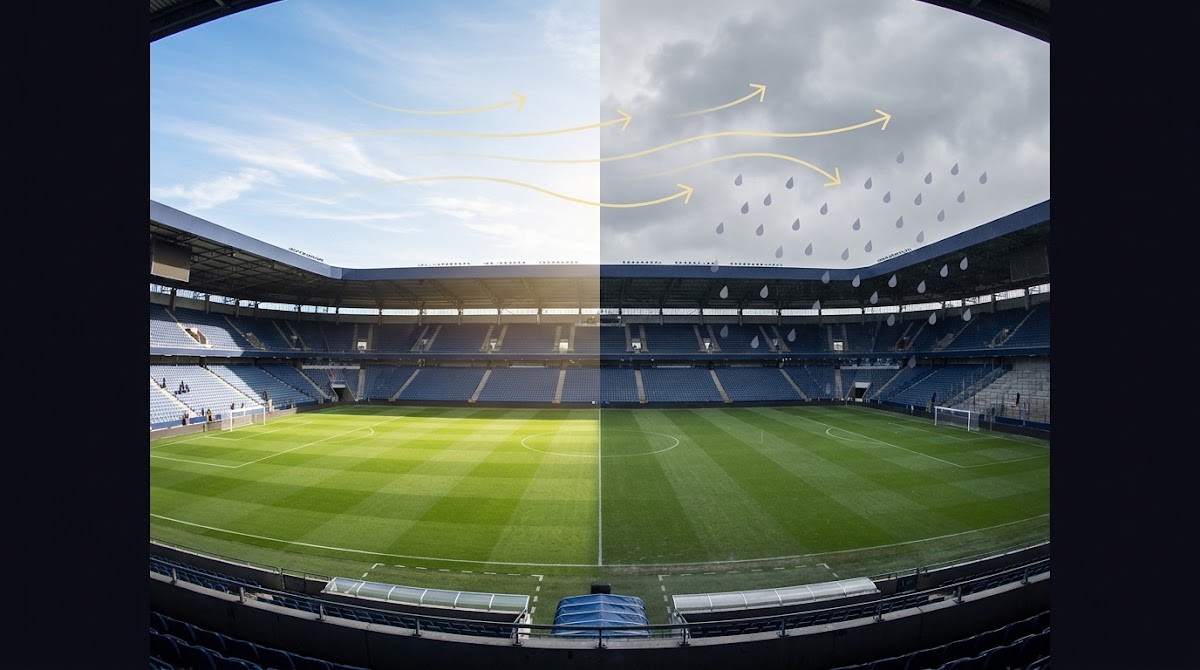
What analysts mean by weather in sports markets
How Weather Forecasts Move Sports Markets
In markets for outdoor sports, "weather" is a compact way to describe a set of meteorological inputs that can change the distribution of likely game outcomes. Analysts watch variables such as wind speed, precipitation, temperature, and humidity because each can alter play style, equipment performance, and the simple probabilities that drive scoring. Framing weather as a collection of measurable inputs helps separate observable effects from rumor or noise.
Think of weather as another fundamental that shifts payoff patterns rather than a deterministic force. For example, steady rain tends to increase handling errors and favor shorter passing windows, while strong wind can reduce effective kicking distance. That said, the same weather does not produce identical effects across stadiums or teams; microclimates and venue design matter, which is why analysts differentiate local conditions from the generalized official forecast used in market decisions.
Get timely game day weather alerts
Sign up for timely weather alerts or a concise newsletter so you get final game day conditions before making adjustments.
Analysts also separate forecast certainty from impact. A 10 percent chance of light rain is rarely worth changing a robust forecast, while a persistent forecast of strong wind that materially shifts expected scoring ranges is. Keeping this distinction explicit prevents overreaction and supports consistent decision making under uncertainty.
How sportsbooks and oddsmakers incorporate weather
Bookmakers use a mix of model inputs and human judgment to fold weather into lines. At scale, a bookmaker's pricing engine can take raw weather variables and run them through expected scoring models; those outputs create a baseline adjustment. Human oddsmakers then layer qualitative knowledge on top, including roster notes, kicker reliability, and how a team has historically adapted to adverse conditions.
Lines are typically adjusted when the expected change in outcomes crosses an internal threshold, when a forecast shifts materially, or when a venue issues an operational notice. Operators vary in how sensitive they are to weather: some allow automated model nudges in the hours before a game, while others wait for a clear consensus forecast before changing published odds. Remember weather is only one input among injuries, matchup dynamics, and liquidity concerns, so it often nudges rather than flips a line outright.

How weather affects different bet types and markets
Not all bet types respond to weather the same way. Totals, or over under markets, are usually the most sensitive because weather often changes expected scoring volume. Point spreads react too, but only when a weather-driven scoring shift is large enough to change expected margins. Player props can be highly exposed if the prop depends directly on conditions, for example long punts in wind or passing yard props in heavy rain. See this guide on totals for additional context.
Some markets are relatively insensitive. Futures and long-term markets typically absorb a single-game weather shock poorly because they price season level expectations rather than one match. Neutral-site indoor contests generally remove weather from the equation entirely. When deciding where weather matters, prioritize totals and direct in-game statistics tied to wind and precipitation, and deprioritize markets that are insulated by time horizon or venue control. For a discussion of how bad weather affects lines in the NFL, consult the Fox Sports analysis.
Adjust when the forecast consensus shifts sufficiently to change expected outcomes and when that change exceeds your pre-specified quantitative threshold, while scaling exposure down under high uncertainty.
Within totals and props, think probabilistically: a wet afternoon raises the chance of a low-scoring outcome, but it does not guarantee it. The right response is to quantify that shifted probability and compare it to the market price rather than rely on instinct alone.
A practical framework to fold weather into your forecasts
Start with a stepwise workflow to keep changes traceable. Step 1 is data capture: record the official forecast, ensemble spread, and any stadium-level sensor notes. Step 2 is a relevance filter: decide which variables matter for the sport and matchup. Step 3 is impact weighting: assign a conservative adjustment to expected scoring or a player stat conditioned on the variable. Step 4 is line comparison: check the market and decide whether the implied probability needs updating.
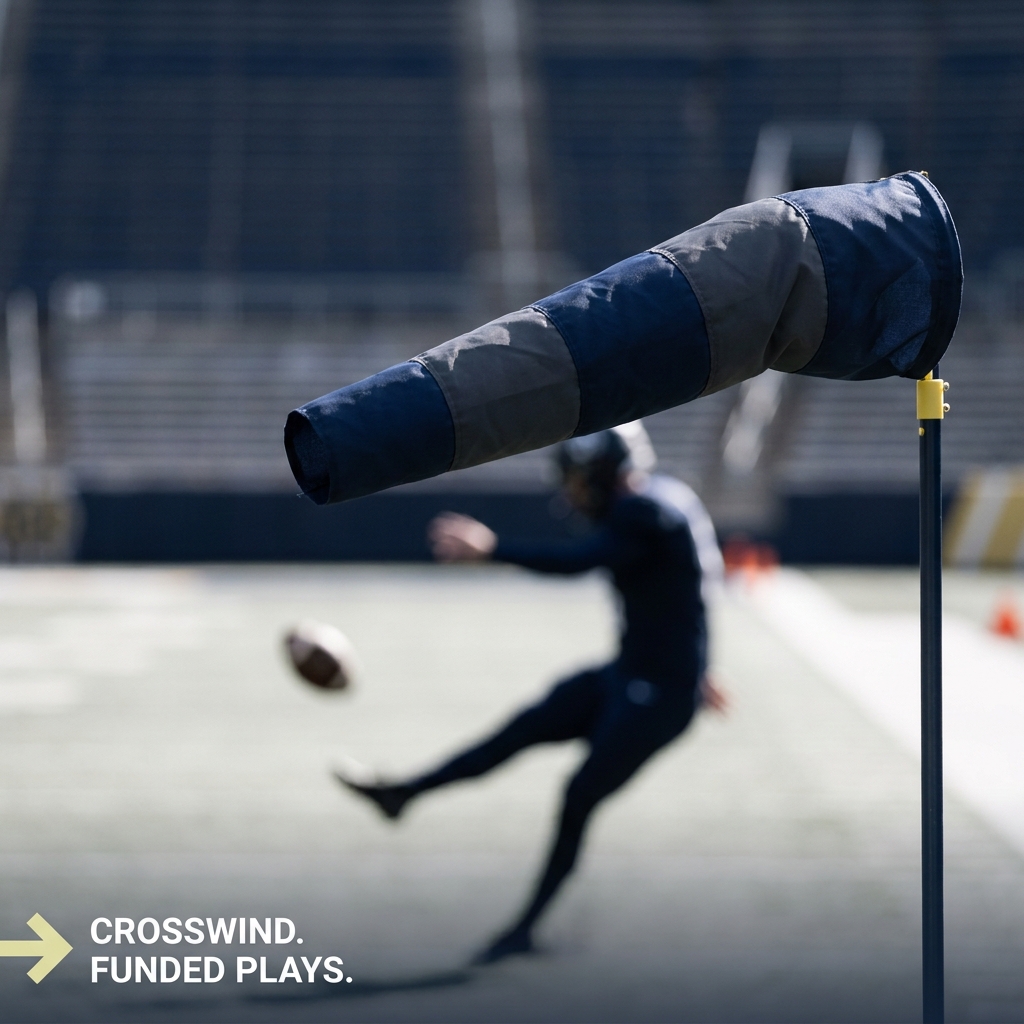
Be conservative when forecast uncertainty is high. Use ensemble medians rather than a single model run and document your assumptions. For example, if wind forecasts disagree, a reasonable rule is to delay a full adjustment until multiple runs converge or to apply a partial weight to the expected impact, recording the justification so you can evaluate it later.
Common signals that trigger market movement
Certain signals carry more weight than routine noise. A consensus shift across several forecast runs, an official venue notice about field drainage or roof operation, or a sudden change in kickoff timing are all high-signal events that can prompt rapid line movement. Liquidity matters too: when a market has thin action, even a small signal can cause larger price swings because there are fewer opposing bets to absorb the change.
Timing matters for amplification. Forecast changes close to game time often move markets more sharply because traders and the public have less time to respond and hedging costs are higher. Distinguish between low-signal model jitter and a clear forecast consensus change to avoid reacting to noise.
Decision criteria: when to adjust a prediction and by how much
Set quantitative thresholds alongside qualitative judgment. A typical threshold might be to consider an adjustment when sustained wind is forecast to exceed typical game tolerances for that sport or when expected precipitation shifts from intermittent to persistent. Pair that quantitative trigger with qualitative factors such as team style and roster adaptability to decide direction and magnitude of change.

Risk controls are essential. When you move a forecast because of weather, consider reducing position size or using partial hedges rather than full exposure changes. Document your position sizing and the rationale so that after the event you can review whether your threshold and sizing decisions produced the intended risk adjusted outcome.
Data sources and tools to monitor weather for game day
Focus on three categories: authoritative forecasts from meteorological services, ensemble forecast products that express uncertainty, and stadium or on-site sensor data that can provide microclimate detail. Ensemble products are especially useful because they show the range of plausible outcomes rather than a single deterministic path.
Automate alerts for threshold breaches rather than relying on continuous manual checks. When an ensemble spread narrows into a consensus, or when a forecast crosses a predefined threshold, an automated alert lets you take measured action without missing the window.
concise monitoring steps to track game day weather
set threshold alerts for major variables
Prefer tools that expose raw model output and ensemble statistics rather than single-value summaries. Raw outputs let you apply the same decision rules consistently and keep a log of why a change was made, which is critical for later testing.
Typical forecasting errors and cognitive traps
Two recurring mistakes are overreacting to a single model run and anchoring on the first published forecast or line. Single-run overfitting treats one output as truth instead of an uncertain estimate. Anchoring prevents updating when compelling evidence appears. Both errors reduce expected value when weather moves markets unpredictably.
Mitigate these traps with pre-specified rules, ensemble medians, and a decision log. When you make a weather-driven change, write a short justification including the data used and the size of the adjustment. That discipline reduces hindsight bias and helps you refine thresholds over time.
Scenario walkthroughs: three realistic game-day examples
Scenario one, a windy neutral-field football game: identify wind speed forecasts and how they affect kicking and passing. Compare those adjustments to the market total and decide whether to trim exposure to the favorite or to target props tied to ground plays. Use a conservative impact weight if ensemble runs diverge.
Scenario two, a rainy outdoor baseball afternoon: focus on the likelihood of a sloppy field, increased errors, and how rain could shorten an outing for a pitcher. Check venue drainage notes and consider reducing exposure to run totals or increasing emphasis on in-game betting where conditions clarify. Size hedges modestly when forecast confidence is medium. Further reading on totals for baseball is available from OddsJam.
Scenario three, a cold-weather soccer match where low temperature may slow play and increase muscle strain risk: evaluate whether teams trained in cold climates gain an edge and whether the expected decrease in pace affects goal expectations. As always, document assumptions and prefer smaller, testable position changes when uncertainty is high.
How in-play game weather updates can change markets
Live updates from on-site sensors and broadcast reports can alter live markets quickly. Real-time precipitation or wind shifts that begin within the first quarter or inning can change innings-level and quarter-level markets. Traders need a protocol to decide when to re-evaluate live bets, balancing information speed against execution cost.

Be aware of latency and price slippage. Acting on a live weather update without accounting for how quickly the market will incorporate that information risks poor fills. A disciplined approach is to predefine re-evaluation points and maintain tight size limits when trading the immediate aftermath of a sudden weather shift.
Testing and measuring the effect of weather on your model
Backtest by splitting historical matches by weather regime using ensemble or station observations, then compare model performance across those regimes. Conditional splits let you estimate effect size without assuming uniform impact. Report confidence intervals rather than single-point estimates to avoid overclaiming precision.
Before deploying changes live, run paper trading or simulated bankroll experiments to measure whether your weather adjustments improve realized returns net of transaction costs and timing friction. Read how Funded Plays evaluations work. Incremental deployment helps isolate effects and prevents widespread performance degradation from a poorly specified rule.
Operational checklist for game day weather monitoring
Use a compact pre-game checklist that you or a delegated teammate runs on the schedule tied to your alert triggers. Include final forecast check times, ensemble convergence checks, stadium operational status, and pre-specified sizing rules. Keep the checklist short so it is followed consistently under pressure.
Assign clear ownership for monitoring and decision rights. A single person should own the call to adjust exposures and another should record the change in a decision log. That separation reduces confusion and makes it easier to review choices after the game.
Assign clear ownership for monitoring and decision rights. A single person should own the call to adjust exposures and another should record the change in a decision log. That separation reduces confusion and makes it easier to review choices after the game.
When weather matters less: boundaries and counterexamples
Indoor venues largely remove weather from consideration because climate control eliminates the variables that change scoring distributions. Similarly, long-term markets such as season futures aggregate many games and so a single-game weather event typically has minimal effect. Focus your weather effort where it produces the biggest information gain.
Exceptions exist, such as venue cancellations or when a game is relocated outdoors unexpectedly. Those operational edge cases are high-impact and usually obvious well in advance, so treat them as special events that warrant direct attention rather than routine monitoring.
Conclusion: integrating weather awareness into disciplined forecasting
Weather moves markets because it changes the probabilistic inputs that underlie expected outcomes. The practical path for forecasters is to adopt a conservative, testable workflow: capture data, filter relevance, weight impact, compare to the market, and control exposure.
Start small, test with simulated bankrolls, and keep rules simple. Over time a disciplined approach will let you use weather as a repeatable signal rather than a source of impulsive adjustments. Visit Funded Plays.
Act when forecast consensus shifts clearly or an operational venue notice appears; for uncertain changes, delay or apply a partial adjustment.
Wind, precipitation, temperature, and humidity typically matter most, with wind and precipitation often affecting scoring directly.
Backtest using historical weather regimes and use simulated bankrolls or paper trading before applying changes in live markets.
References
- https://www.fundedplays.com/challenges
- https://www.fundedplays.com
- https://www.fundedplays.com/blogs
- https://www.fundedplays.com/blogs/how-fundedplays-evaluations-work
- https://oddsindex.com/guides/weather-impact-totals
- https://www.foxsports.com/stories/nfl/nfl-odds-weather
- https://oddsjam.com/betting-education/how-weather-impacts-total-betting-for-mlb