
how to win bet: what winning a bet really means
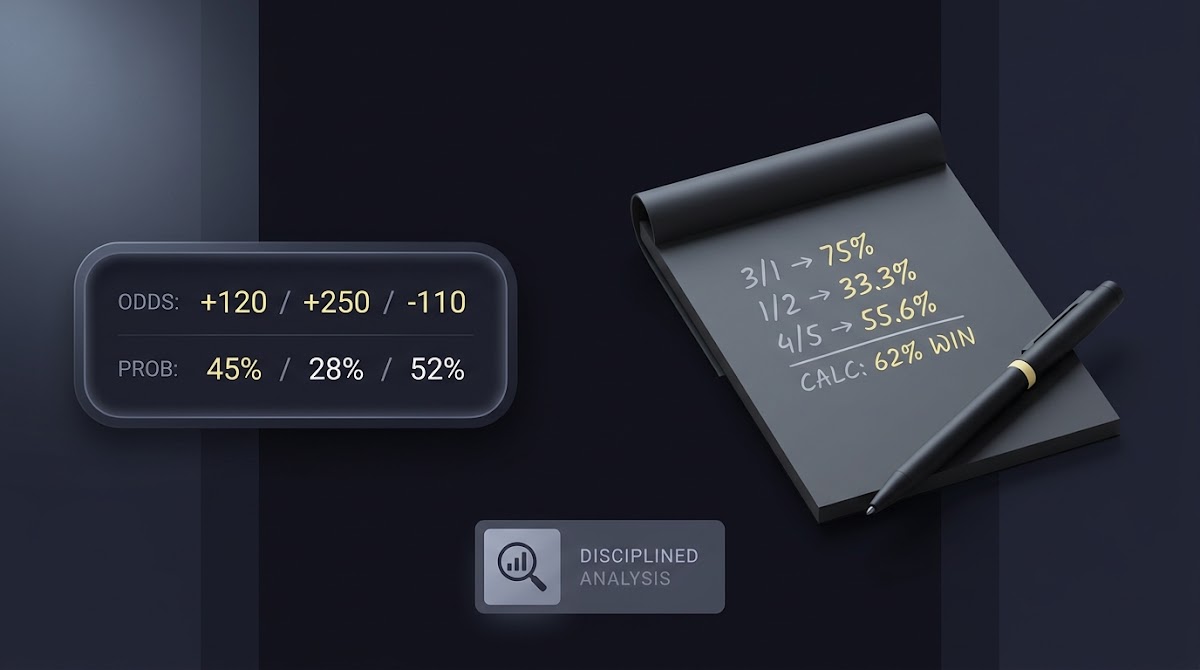
The phrase how to win bet often conjures images of single wagers that beat the odds, but for serious improvement the focus should be on producing a long-term edge that yields positive expected value rather than on every result; converting prices into implied probability is the first step to that comparison, and sources explain the conversion methods used by bettors and regulators alike Investopedia implied probability guide.
Focus on identifying positive expected value by converting odds to implied probabilities, using conservative stake sizing like fractional Kelly or fixed units, and tracking results systematically to validate any apparent edge.
Put simply, a successful betting approach is one where your estimates of outcome probability exceed the implied probability in the market often enough, and variance means you will still lose many individual bets even with a genuine edge.
To set realistic goals, separate short-term outcomes from long-term process goals: count correct probability estimates and track expected value per unit instead of treating each trade as proof of skill. This keeps expectations grounded and lets you measure progress against statistical noise.
Convert odds to implied probability so you can compare like for like
Before you can tell if a price is valuable you must translate decimal, fractional, or American odds into the same probability frame; consumer guides walk through the standard conversion steps and why they matter for comparing your estimate to the market UK Gambling Commission odds guide.

Use a short, repeatable approach: for decimal odds use implied probability = 1 / decimal odds; for fractional odds a/b convert to decimal as 1 + a/b then apply the same decimal formula; for American odds convert based on whether the line is positive or negative before finding the reciprocal. Keep the steps simple and practice them until they are routine; you can verify conversions with an odds converter.
Bookmakers usually price in a margin so the implied probabilities of all outcomes commonly sum to more than 100 percent; that margin, often called overround, can be estimated by summing raw implied probabilities and normalizing them to 100 percent so you compare your estimate to a fairer adjusted probability rather than the raw market-implied number.
Here is a quick inline example you can do on paper: decimal 3.00 implies 1/3.00 = 33.3 percent; fractional 5/1 becomes 6.00 decimal implying 16.7 percent; an American +200 converts to decimal 3.00 which again implies 33.3 percent. Practicing a few of these conversions helps you spot obvious mismatches quickly; you can also check results with an online calculator.

Calculate expected value and act only when you have a positive edge
Expected value (EV) is central to how to win bet because it formalizes the decision rule: place bets only when your estimated chance of an outcome is greater than the implied probability from the price, and accessible explainers provide the EV formula and examples to apply this test Investopedia expected value guide and tools such as OddsJam.
In practice, compute EV per unit staked as (your probability * decimal odds) - 1, and place the bet only when that value is positive; this rule keeps you focused on opportunities where your reasoning produces a theoretical expectation advantage rather than on coincidence or gut feeling.
Explore challenge-based testing and disciplined evaluation on the FundedPlays Challenges page
Try the pre-bet checklist on the next page: estimate probability, convert odds, calculate EV, then choose a conservative stake that fits your bankroll rules.
Remember the limitation: your EV calculation is only as good as your probability estimate. Markets can be efficient and your estimate may contain bias or overfit, so treat early apparent edges as hypotheses to test rather than as certainty.
Size your stake: Kelly, fractional Kelly, and practical alternatives
The Kelly criterion quantifies an optimal fraction of bankroll to stake when you have an edge, but it relies on correct probability estimates and certain assumptions about repeated independent bets; clear primers explain the formula and its theoretical role in maximizing long-run growth Investopedia Kelly criterion explanation.
Full Kelly can produce large volatility and deep drawdowns if your edge estimate is imperfect; that is why many practitioners use fractional Kelly, which divides the Kelly stake by a factor such as two or four to reduce risk and smooth results while retaining some of the growth advantages.
If a Kelly-style approach is too aggressive for your situation, use conservative alternatives: fixed fraction staking where you risk a small consistent percent of bankroll per bet, or unit staking where each bet uses a fixed unit size and you adjust units as bankroll changes. Both reduce the impact of occasional bad runs and make tracking performance simpler.
Whatever rule you pick, test it on historical examples or paper runs before committing real funds, and document assumptions so you can revisit them if outcomes differ from expectations.
A simple pre-bet checklist and post-bet tracking routine you can use
Make a compact pre-bet routine that you follow every time: (1) convert odds to implied probability, (2) state your estimated probability, (3) compute EV, and (4) choose stake size based on your staking rule; expected value primers show how this checklist connects math to decisions Investopedia expected value guide. See the Funded Plays blog for related posts.
For post-bet tracking, keep a minimal record per entry: event, market, decimal odds, implied probability, your estimated probability, stake, result, and net profit or loss. From these fields you can compute strike rate, ROI per unit staked, and average EV realized, which are the metrics that tell you whether your process produces a genuine edge over time.

With consistent record keeping you can test whether your model beats randomness or is consistent with biased estimation; small sample noise is normal, so use the records to build a longer-term picture rather than to confirm or reject your approach after a handful of bets. Learn more at Funded Plays.
Common mistakes, cognitive biases, and how they destroy edges
Behavioral traps like overconfidence and selection bias create apparent wins that disappear once tracking begins, and warnings about these human limits are central to realistic approaches to how to win bet Edward O. Thorp analysis of betting limits.
Chasing losses by increasing stake sizes after bad outcomes is a common error that amplifies drawdown and can convert a small edge into a ruin risk; the safer path is to hold stake rules constant and use recorded metrics to guide deliberate changes.
Also watch correlated bets: placing many wagers that depend on the same underlying event or factor magnifies risk and can make your realized variance much higher than expected; account for bookmaker margin and correlation when you plan portfolio-level exposure.
Three practical scenarios: backing an underdog, live betting, and futures
Scenario A, the underdog with a small positive edge: suppose you estimate a 25 percent chance while the market-implied probability is 20 percent; that gap suggests positive EV, but size the stake conservatively and check your assumptions before committing a large fraction of bankroll, using worked-examples of EV as guidance Investopedia expected value guide.
Scenario B, live betting, raises timing and slippage issues: odds move quickly and the market can incorporate new information faster than you can react, so account for execution risk and use faster, smaller stakes or skip opportunities where slippage erodes the margin.
Quick EV and stake suggestion for a single bet
Use as a sanity check not a guarantee
Scenario C, futures, require a much larger testing horizon because serial correlation and long wait times make sample sizes slow to accumulate; for long-term markets, reduce stake size and be prepared to wait for many outcomes before judging skill.
Responsible play: budgets, limits, and when to step away
Responsible-play advice recommends setting a fixed budget, defining a maximum stake ceiling, and sticking to consistent stakes so variance does not create harm, and reputable guidance highlights these practical safeguards for lower-risk participation Responsible Gambling Council safer play tips. For background on evaluations see how Funded Plays evaluations work.
Watch for behavioral warning signs such as chasing losses, hiding activity, or noticing that play substitutes for other priorities; if these occur, pause and review your limits or seek professional resources rather than increasing stakes to recover lost ground.
Practical rules include predefining session limits, using bankroll buckets for evaluation capital versus discretionary money, and setting cooling-off periods after a string of losses to prevent emotionally driven decisions.
Summary and next steps to test your own edge
Run a simple 30-bet test plan: record the market odds, your estimated probability, the computed EV, your stake, and the outcome for each bet; after 30 bets review average EV per unit, strike rate versus expected, and ROI to decide whether the edge appears stable Investopedia expected value guide. See how Funded Plays evaluations work for more on evaluation design.
If your tracked results show consistent positive EV and acceptable drawdowns, consider a cautious scale-up with reduced fractional Kelly or small increases to unit size; if results do not support the edge, revise your probability model and repeat a controlled experiment rather than escalating stakes.
Implied probability converts betting odds into a percentage chance; it lets you compare market prices directly to your own probability estimates to spot potential edges.
Kelly is mathematically optimal under specific assumptions but can produce high volatility; many users prefer fractional Kelly or fixed fraction staking to limit drawdown.
Give any approach a meaningful sample size, such as a structured 30-bet test, and focus on average EV per unit and consistent metrics rather than single outcomes.
References
- https://www.investopedia.com/terms/i/implied-probability.asp
- https://www.gamblingcommission.gov.uk/public-and-players/guide/how-betting-odds-work
- https://www.aceodds.com/bet-calculator/odds-converter.html
- https://www.omnicalculator.com/statistics/implied-probability
- https://www.investopedia.com/terms/e/expected-value.asp
- https://oddsjam.com/betting-calculators/implied-probability
- https://www.investopedia.com/terms/k/kelly-criterion.asp
- https://www.fundedplays.com/challenges
- https://www.fundedplays.com/blogs
- https://www.fundedplays.com
- https://papers.ssrn.com/sol3/papers.cfm?abstract_id=2042381
- https://www.responsiblegambling.org/safer-play/