
What live trading entry rules are and why they matter
How to Set Live Trading Entry Rules
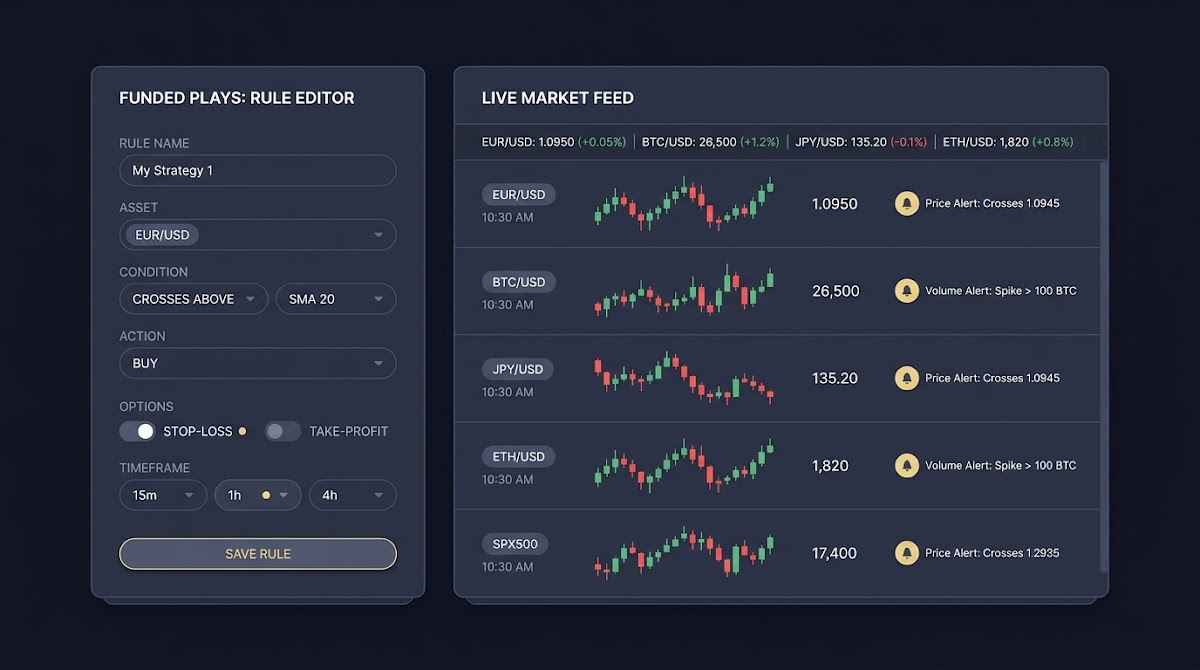
How to Set Live Trading Entry Rules begins with a simple idea: entry rules are the executable criteria that convert a strategy signal into a concrete order instruction. An entry rule specifies the signal input, the exact calculation or threshold, the chosen order type and the tolerances for price and size so that a trading system can act without human guesswork.
Formalizing live trading entry rules reduces operational, market and compliance risk by making behavior repeatable and testable and by clarifying fallbacks when things deviate. That means fewer mis-sized orders, fewer ambiguous instructions, and clearer handoffs between strategy, execution and risk teams.
Entry rules sit early in the order lifecycle but they are not isolated: a clean entry spec feeds into pre-trade checks, routing decisions, and post-trade records used in monitoring and audits. When your entry rules reference explicit pre-trade checks, downstream controls such as broker-level price and credit checks are easier to mirror in your workflows, which helps align internal controls with external expectations, especially for broker market access § 240.15c3-5 - Risk management controls (see Federal Register).
Review and test one entry rule this week
Review your current entry rules for ambiguous fields and missing fallbacks; clear specs help teams test and respond faster in production.
Concrete examples make the concept tangible: an entry rule might say, "When the 15-minute momentum oscillator crosses +2.0, send a limit buy for up to 500 shares at mid-price plus 0.15 with IOC time-in-force, block if aggregate exposure exceeds 50,000 in the account." That sentence shows how a signal, order instruction and a pre-trade limit combine into one actionable rule.
Regulatory and exchange expectations you must design around
Designing entry rules in 2026 should start by acknowledging the regulatory baseline: brokers with market access are required to maintain pre-trade risk controls such as order-size, credit and price checks, which practitioners should mirror in their own entry safeguards to reduce downstream friction and compliance risk § 240.15c3-5 - Risk management controls (see SEC final rule).
Supervisory guidance also emphasizes documented strategy development, pre-deployment testing, real-time monitoring and having incident response and kill-switch procedures in place. That expectation shapes how teams must validate and govern entry rules before they run live FINRA 2024 oversight report (see FINRA market-access guidance).
For firms operating or routing into EU venues, recent guidance similarly reiterates governance and control expectations for algorithmic activity, including testing and monitoring that apply when you operationalize entry criteria on those venues ESMA updates on market structure topics.
From a practical design perspective, exchange-level protections such as price protection, credit limits and kill-switch features illustrate the kinds of controls that your entry rules should assume or call out explicitly. You should design rule specs that allow consistent mirroring of those protections so the behavior you expect in simulation aligns with live execution realities.
A step-by-step framework to set live entry rules
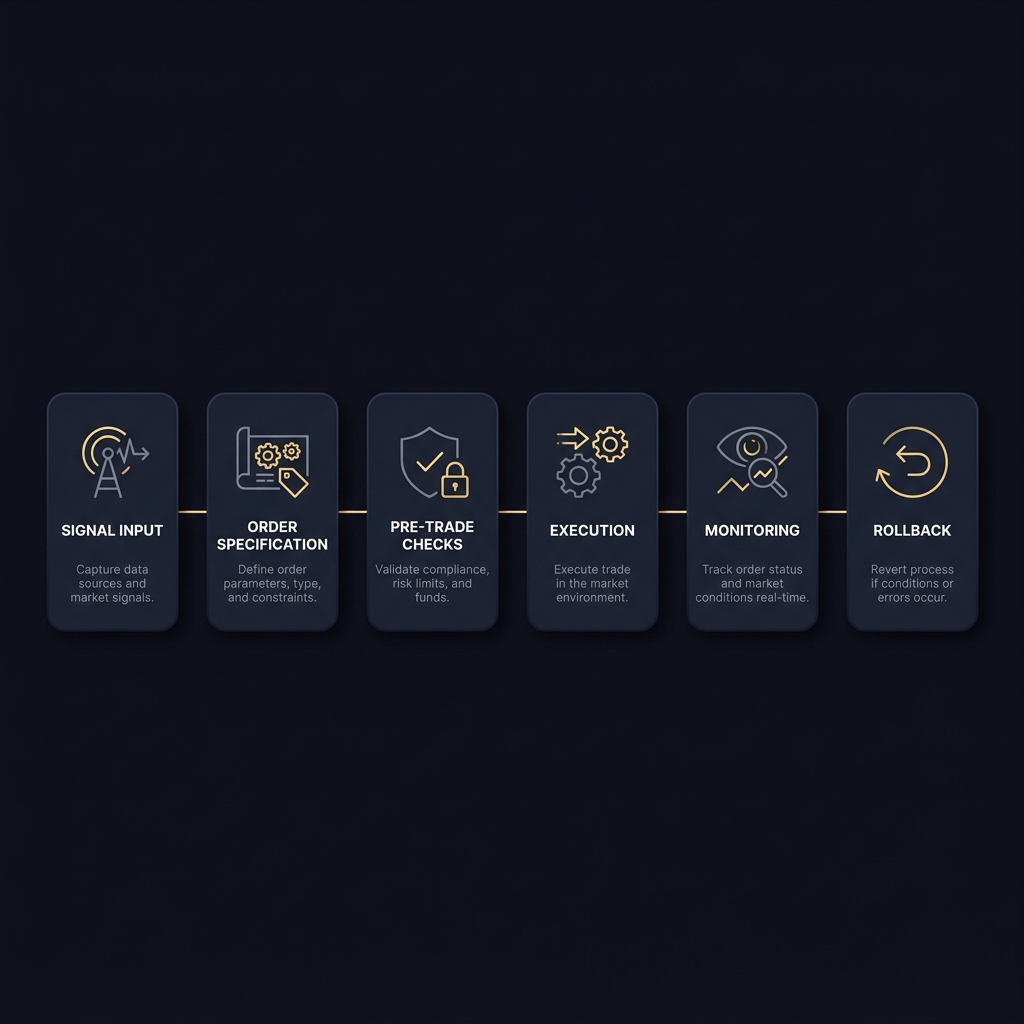
Teams can follow a four-step workflow to take a strategy idea to a production-ready entry rule: define objective signals and goals, map signals to order types and exact order instructions, add pre-trade limits and alerting, and validate with testing plus monitoring and controls. Each step should produce documentation that is testable and auditable.
By writing unambiguous signal specs, mapping them to an appropriate order type with clear tolerances, embedding pre-trade limits and alerts, and validating through unit, replay and paper-trading tests with documented approvals.
Start the workflow by translating qualitative ideas into observable signals, then capture the allowed order types and tolerances that meet your execution goals. Next, embed pre-trade risk checks that reflect broker and exchange expectations, and finish with clear monitoring and rollback behavior in case of incidents. This sequence aligns with supervisory calls for documented testing and real-time controls FINRA 2024 oversight report.
For teams, the value of a formal workflow is practical: it creates checkpoints where compliance and risk can review a draft rule, where engineers can write unit and replay tests, and where ops can agree on alert thresholds and escalation paths before anything reaches live markets.
How to define objective entry signals and decision logic
Objective signals are the foundation: they must list exact inputs, calculation windows, edge-case rules and any data normalization steps so the same signal produces the same output in paper tests and in production. A signal spec typically includes input feeds, lookback windows, sign direction and the numerical threshold that constitutes a trigger.
Specify decision thresholds and tie-breakers. For example, if two correlated signals trigger at the same time, the rule should state which signal has priority or whether the system aggregates them into a single entry. Include cooldown windows, instrument filters and a forbidden list so the rule knows when to pause or ignore a trigger. These traceable attributes support reproducible tests and clear post-trade reviews.
Documenting traceability - who authored the signal, the data version, and the timestamp of the last change - makes validation and incident review faster. Teams that cannot reproduce a signal in replay tests will struggle to debug post-trade issues, so aim for unambiguous definitions.
How to choose order types for live entries
Choosing order types requires balancing execution certainty against price control. Market orders maximize probability of execution but sacrifice price certainty; limit orders give price control but may not fill; stop and stop-limit orders add conditional triggers that can be useful for breakout or protective entries. Investor education materials summarize these trade-offs and are a practical reference when mapping signal objectives to specific order types Types of Orders.
Use rules of thumb: if the strategy prioritizes entry immediacy and can accept slippage within a known budget, a market order or aggressive limit near the touch may be appropriate. If the strategy requires a specific price to preserve expected edge, use a limit or stop-limit instruction and plan for partial fills and retry behavior.

Exchange-specific modifiers and order routing options can change execution behavior, so note venue differences in your rule spec. For example, venue price collars and hidden or midpoint order types may alter how a limit or marketable limit executes, which is why you should test your chosen order type against venue rules before deployment Cboe order types and modifiers.
When you select an order type for a signal, codify fallback behavior: if a limit fails to fill after N attempts, should the system escalate to a marketable limit, wait, or cancel? These decisions should be part of the rule rather than ad-hoc operational calls.
Translating signals into executable order instructions
A production-ready order spec lists required fields: order type, explicit price or offset rules, size, time-in-force, venue routing preference, and modifiers. Each field should be written so that an execution platform can parse it without ambiguity - for example, "size: min(100, available cash / mid-price)" rather than "size: small."
Capture tolerances for slippage, partial fills and retry logic. Specify how partial fills should be handled, whether the remainder should be canceled or re-priced, and how many retry attempts are allowed before human intervention is required. Include a default fall-back for connectivity or fill-signal loss.
Timing and routing decisions belong in the same spec: indicate acceptable latency windows, preferred venues, and whether the order may be routed through a broker or held for internal crossing. Good specs also describe what to log for audit trails, including original signal payload and final executed order details.
Pre-trade risk limits and protections to embed
Practical pre-trade controls mirror broker and exchange checks: set order-size limits, account-level credit caps and aggregate exposure thresholds that block or flag orders exceeding those values. Designing these so they are both protective and operationally usable requires collaboration with risk and execution teams and with your broker to understand their pre-trade constraints § 240.15c3-5 - Risk management controls.
Implement price protection such as collars and guard rails to prevent one-off outlier executions and to reduce slippage under stressed conditions. Specify checks that compare proposed order prices against recent trade prints or reference mid-price bands and block or reduce size when prices fall outside these bands. Exchange and clearing venues also document available pre-trade controls that can inform your configuration choices CME pre-trade risk controls.
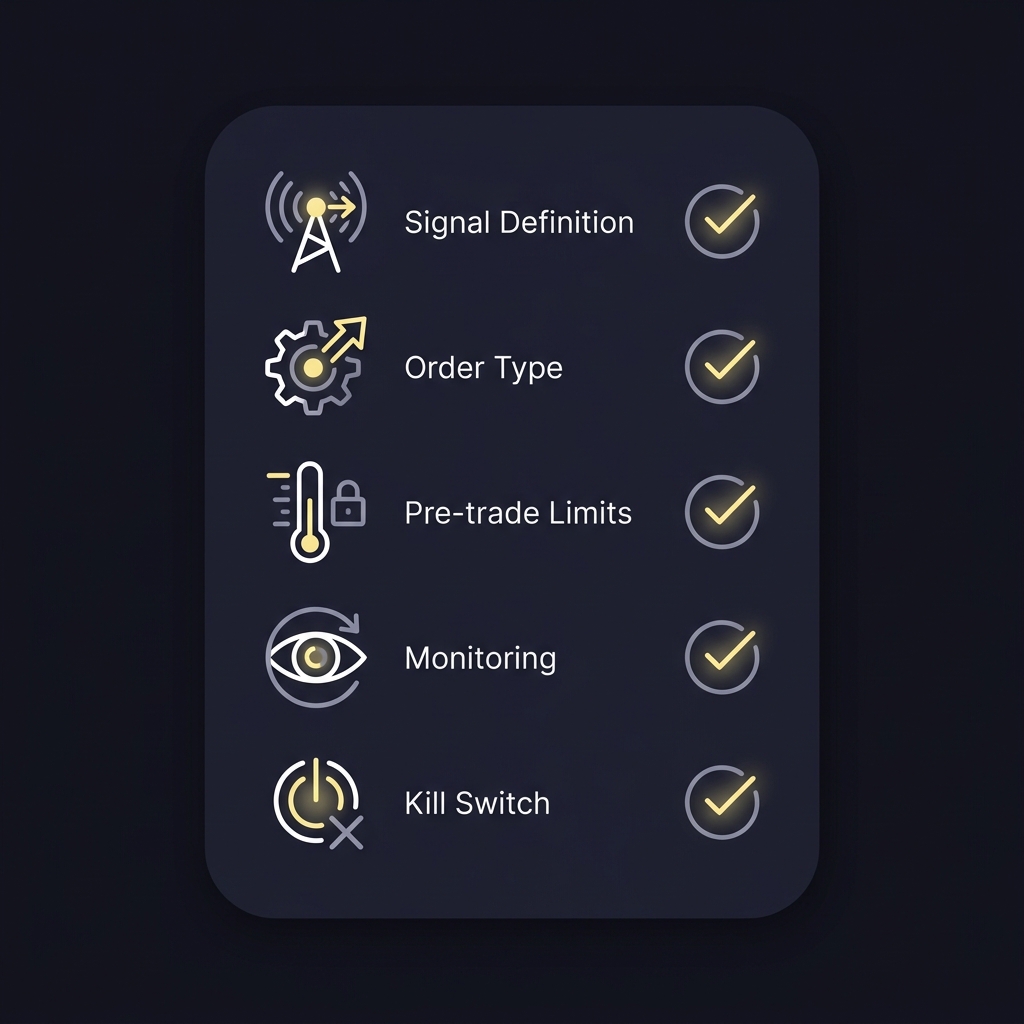
a compact pre-trade control checklist to apply to each entry rule
Use this checklist during rule approval
Automatic blocking and kill-switch triggers should be part of the same pre-trade layer: if aggregate limits are breached or a connectivity anomaly is detected, the system should either reject new entries or engage an automated pause that requires human review. That behavior protects the portfolio and satisfies common exchange and broker expectations for pre-trade controls.
Real-time monitoring, alerts and kill-switch procedures
Define what to monitor in real time: rejected orders, fills and fill rates, slippage relative to expected execution price, latency anomalies and unusual order cancellation ratios. These metrics help detect when an entry rule is producing unexpected outcomes or when market conditions change rapidly.
Design alert levels and escalation paths so that low-severity issues produce automated notifications while high-severity conditions trigger a human-in-the-loop or an automated rollback. For example, repeated rejections or fill-rate collapse across multiple venues should escalate to ops and risk within defined time windows to allow immediate mitigation. Supervisory guidance stresses the need for these capabilities as part of oversight for algorithmic activity FINRA 2024 oversight report.
Kill-switch procedures must be documented and tested: define which actors can trigger a global pause, which metrics auto-trigger a scoped pause, and how to safely restart. Clear runbooks reduce uncertainty during incidents and speed recovery while preserving audit trails of actions taken and the rationale for them.
Testing, validation and change control before deployment
Good governance requires multiple test types: unit tests for code-level correctness, replay tests that simulate historical market conditions, and paper trading or dry-run environments that confirm end-to-end behavior without live risk. These tests let teams validate assumptions about fills, slippage and execution timing before the rule sees real flow.
Document a versioning and approval workflow: every change to an entry rule should include a change ticket, test artifacts, risk sign-off and an approval timestamp. That record supports post-deployment audits and helps satisfy supervisory expectations for controlled deployment lifecycles. ESMA and supervisory reports emphasize testing and governance as central controls for algorithmic activity ESMA updates on market structure topics.
Post-deployment, run periodic revalidation schedules and maintain logs of performance against expected metrics. If performance drifts, use replay and paper trade cycles to re-evaluate and re-set rule parameters before making further live changes.
Common mistakes and operational pitfalls to avoid
A frequent error is ambiguous signal definitions that cannot be reproduced in tests, which leads to inconsistent live behavior and slow incident diagnosis. Make signal specs precise and include edge-case handling to avoid this problem. Exchange-specific modifiers and venue behaviors can expose ambiguity quickly if not specified.
Another common pitfall is overreliance on a single order type without considering market conditions. For instance, always using market orders can increase slippage in low-liquidity conditions; always using strict limits can cause missed opportunities. Define clear fallback behaviors to avoid ad-hoc operational decisions during stress.
Insufficient monitoring or missing rollback procedures amplifies small failures into larger incidents. Ensure that alert thresholds are sensible and that escalation paths are exercised in tabletop drills so teams respond quickly rather than figuring out process during a live issue.
Practical scenarios and worked examples
Example 1: Momentum entry with a limit order. Signal: the 5-minute momentum crosses +1.8 and average volume over the last 15 minutes exceeds 50k. Order choice: limit buy at mid-price plus 0.06, size capped at 1% of account equity, IOC time-in-force for immediacy. Pre-trade controls: order-size limit, daily exposure cap, and a price collar of 0.5% around mid-price. Monitoring: expect a high fill rate; alert if fill rate falls below 60% within 30 seconds. Test this with replay tests to confirm fill behavior under varying liquidity scenarios Cboe order types and modifiers.
Example 2: Volatility breakout with stop-limit rules. Signal: price moves outside the upper Bollinger band on 1-minute data and implied volatility rises above a threshold. Order choice: stop-limit to avoid execution at extreme prices with a stop trigger set at the breakout level and a limit that is the trigger plus a small offset. Pre-trade controls: reduce size during high spread regimes, and block entries if latency breaches a predefined threshold. Test this sequence in paper trading and replay markets so you can observe trigger behavior when markets gap or during microstructure shifts.
Adapt these templates across asset classes by tuning size caps, collar widths and venue-specific modifiers. Securities with lower liquidity need wider collars and smaller size caps; futures may have exchange-level price protection that changes expected trigger behavior and must be accounted for in tests CME pre-trade risk controls.
Decision checklist and templates to use
One-page checklist items: define signal inputs and thresholds, choose order type and time-in-force, set order and account limits, specify monitoring metrics and alerts, and document testing artifacts and approvals. Keep this checklist with each rule so reviewers can quickly confirm coverage.
Order-spec template fields to include: rule name, signal definition, order type, price or offset logic, size logic, time-in-force, routing preferences, modifiers, pre-trade limits, monitoring KPIs and rollback behavior. Provide recommended defaults for each field to speed consistent rule writing.
Log approvals and maintain version history in a controlled repository. Each rule version should include test summaries and a short rationale. That record supports audits and makes governance conversations straightforward when markets or venue behaviors change.
Summary and next steps for teams
Recap: a disciplined workflow links objective signal definitions to specific order instructions, embeds pre-trade limits and monitoring, and requires testing and change control before deployment. These steps reduce operational and regulatory risk and make live behavior predictable.
Where to focus first: prioritize clear signal definitions, basic pre-trade limits, and a tested rollback or kill-switch. Once those elements are stable, expand monitoring coverage and formalize a versioned approval process so changes can be deployed with confidence. Regularly align your internal checks with broker and exchange controls to avoid surprises when live behavior differs from test expectations.

Live trading entry rules are explicit, testable instructions that convert a strategy signal into an order, including order type, size, price tolerances and fallbacks.
Yes. Pre-trade checks such as order-size, credit and price protections reduce errors and help align with broker and exchange controls.
Teams should run unit tests, replay historical market conditions, and paper trade end-to-end behavior, plus document approvals and version history.