
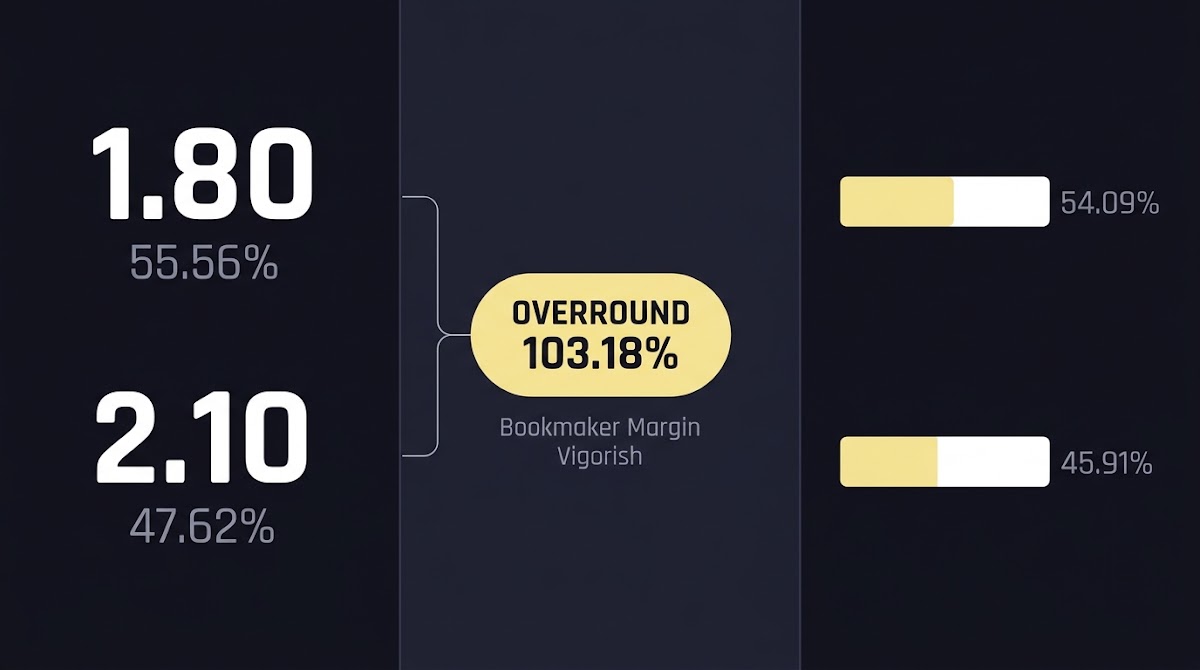
What the bookmaker vig (overround) means in two-way markets
Definition in plain language
The bookmaker vig, often called the overround, is the built-in margin that makes the sum of the market's implied probabilities exceed 100 percent; in simple terms it is the extra cushion an operator embeds in quoted prices to ensure a long-run edge. For a concise primer on how margin shows up in posted prices see the Pinnacle explanation of margin and how it is calculated Pinnacle article on margin.
Think of a two-way market as two numbers that together should represent all possible binary outcomes. When the implied probabilities derived from those quoted odds add up to more than 100 percent, the excess is the vig or overround and it measures the operator margin across the market. This description aligns with standard definitions used in market explainers Smarkets help article on overround.
Why the sum of implied probabilities exceeds 100%
Operators build a margin into both sides of a binary price so they can manage risk and realize a profit across many events; the practical effect is that implied probabilities for each side are pushed slightly away from a true 50-50 split and their sum exceeds 100 percent. For a compact discussion of implied probabilities and how they differ from true frequencies see the Investopedia explanation of implied probability Investopedia on implied probability.
Understanding and removing the vig matters because it gives a no-vig baseline you can use to compare your own probability estimate to the market, compute theoretical expected value, and assess whether a quoted price represents value after the operator margin is removed. Advanced adjustment models exist for markets with asymmetric information, but for routine two-way markets a simple normalization is usually sufficient Shin paper on information incidence.

How to convert quoted odds into implied probabilities
Decimal, American and fractional conversions
Decimal odds are the easiest format to convert because implied probability is simply 1 divided by the decimal price; for example a 2.50 decimal price implies probability 1 / 2.50 = 0.40 or 40 percent. This conversion and its equivalents across formats are described in accessible terms in Investopedia's implied probability guide Investopedia on implied probability.

American and fractional odds convert to implied probabilities through standard transformations, but converting them first to decimal odds and then applying 1/decimal is usually the quickest way to avoid mistakes. When you work numerically, keeping the decimal representation as a canonical intermediate reduces conversion errors and clarifies later scaling steps.
Common conversion pitfalls to watch for
Rounding too early or truncating decimal places will make the computed overround slightly wrong; carry at least three or four decimal places when computing implied probabilities, then round only the final no-vig prices to a presentation-friendly level. Public margin calculators can help verify manual results and provide the same conversions automatically Pinnacle article on margin and no-vig calculators such as OddsJam's no-vig calculator.
To illustrate, if a market posts decimal prices 1.80 and 2.20, convert to implied probabilities as 1/1.80 = 0.5556 and 1/2.20 = 0.4545, then sum them to find the overround. Keep intermediate values rather than rounding at each step to avoid drift and to preserve accuracy when you later normalize the probabilities.

Two equivalent methods to remove the vig in a two-way market
Probability normalization: rescale probabilities to sum to 100%
Probability normalization is direct: convert each quoted decimal price to implied probability, compute the sum of the two implied probabilities, then divide each implied probability by that sum to force their total to 100 percent. This method is the standard no-vig adjustment used in binary markets and is explained in betting help centers and educational resources Smarkets help article on overround.
For example, if the two implied probabilities are 0.56 and 0.44 and their sum is 1.10, the normalized probabilities are 0.56 / 1.10 = 0.5091 and 0.44 / 1.10 = 0.4009. After normalization these fair probabilities add to 1.000 and represent the binary market without the operator margin.
Proportional scaling of decimal odds: algebraic equivalence explained
Proportional scaling rescales the quoted decimal odds by the market overround so the adjusted prices correspond to a no-vig market; algebraically, for a two-outcome market this produces exactly the same fair probabilities as normalization. Practical explainers and reference material describe this equivalence and why decimal odds are convenient for the scaling operation Wikipedia overround article.
Viewed without heavy notation, both methods do the same thing: probability normalization rescales the implied probabilities to sum to 100 percent, while proportional scaling rescales decimal prices so their implied probabilities become the normalized values. For binary markets the two approaches are interchangeable, but the probability route is usually easier to understand and verify by recomputing the summed probabilities.
Step-by-step no-vig calculation workflow you can copy
Checklist: what inputs you need
Required inputs are the two quoted decimal odds, a stake convention for EV testing (commonly a unit stake of 1), and a chosen decimal precision for intermediate computations. Also capture the timestamp and the source of the odds so you can reproduce or audit your work later; recomputing the overround from live odds each time is essential because margins vary by sport and operator Pinnacle article on margin (see the Funded Plays blog for related content).
Keep intermediate values rather than rounding at each step; for typical hand calculation keep four to six decimal places during probability conversion and normalization, then round final no-vig prices to two or three decimals for presentation.
stepwise calculation checklist to remove vig and verify results
Carry intermediate decimals
Stepwise calculation and verification
Step 1, convert each decimal price to implied probability using 1 / decimal. Step 2, sum the two implied probabilities to compute the overround. Step 3, obtain no-vig probabilities by dividing each implied probability by the overround. Step 4, convert the normalized probabilities back to decimal form if you prefer decimal fair prices by using decimal = 1 / normalized_prob. Finally, recompute 1 / new_decimal for both sides to confirm the normalized probabilities sum to 1. This sequence is the standard operational workflow used by practitioners and educational resources Smarkets help article on overround.
As a verification step, after converting normalized probabilities back to decimals, convert those decimals back to implied probabilities and confirm their sum equals 1.000 within your rounding tolerance. If it does not, check for early rounding or transcription errors in the intermediate steps and recompute using the stored intermediate values.
How to use no-vig probabilities to compute expected value (EV)
EV formula and interpretation
Once you have the no-vig or fair probability for an outcome, compute expected value per unit stake using the formula EV = fair_prob * net_odds - (1 - fair_prob), where net_odds = decimal_odds - 1. This formula and its interpretation are the standard approach in expected value discussions Investopedia on expected value.
Net odds measure the profit per unit stake if the selection wins; using the fair probability in the EV formula gives a theoretical expectation versus the quoted payout and is useful when comparing offers or deciding whether an edge exists relative to your own probability model.
Applying EV to compare offers and find value
Use the no-vig probability as the baseline and plug in the posted decimal odds to check whether the operator offers positive theoretical value. For example, if the fair probability for outcome A is 0.52 and the posted decimal odds for A are 2.00, then net_odds = 1.00 and EV = 0.52 * 1.00 - 0.48 = 0.04 per unit stake, indicating a positive theoretical edge under the fair probability assumption. This arithmetic follows the conventional expected value set out in financial and betting references Investopedia expected value guide. For practical examples and site resources see Funded Plays.
Interpretation notes: a positive EV indicates theoretical value given the fair probability input, but real outcomes are subject to variance; positive EV does not guarantee short-term wins and is meaningful primarily over repeated independent decisions where the edge can realize.
Common mistakes and practical pitfalls when removing the vig
Rounding, format confusion, and using stale odds
A frequent error is converting between fractional, American, and decimal odds inconsistently or rounding intermediate values too early, which yields a slightly wrong overround and therefore incorrect normalized probabilities. To reduce errors, convert non-decimal formats to decimal first and preserve intermediate precision during computation. Educational explainers and calculators can be useful cross-checks when you are learning the workflow Pinnacle article on margin and tools such as BettorEdge's no-vig calculator.
Another common pitfall is assuming an operator uses a fixed margin; margins vary by sport, market, and operator, so always recompute the overround from the live posted odds rather than applying a presumed percent adjustment. Operator help centers and market explainers emphasize the need to recompute per market and per timestamp Smarkets help article on overround.
Practice the no-vig workflow with real market quotes
Try the step-by-step workflow on a recent market: capture the two decimal prices, convert to implied probabilities, compute the overround, normalize, and then calculate EV for a unit stake to see the theoretical edge.
Finally, be aware of format confusion when net odds are misread as decimal odds or vice versa; net odds equal decimal minus one and mixing these concepts can flip the EV sign. Keep clear labels for each intermediate quantity and log both the original and the normalized values so you can backcheck any calculations.
When advanced models like Shin matter
The Shin model and similar adjustments address cases where margin allocation is uneven or where asymmetric information could skew the implied probabilities; these approaches are advanced and usually unnecessary for routine two-way no-vig calculations, but they can matter if you suspect insider information or systematic non-uniform margins across outcomes Shin paper on information incidence.
If you regularly analyze many markets at high precision or detect persistent skew that simple normalization does not explain, consider studying the Shin adjustment and its empirical use cases. For most everyday decisions and EV checks on single binary markets, normalization or proportional scaling is sufficient.
Advanced adjustments and when to go beyond simple no-vig calculations
Limitations of proportional scaling in complex markets
Proportional scaling and probability normalization are algebraically equivalent for a two-outcome market, but that equivalence weakens in multi-outcome markets and in markets where the operator deliberately sets uneven margins across outcomes. Use simple methods only where the binary structure holds and where you do not suspect targeted margin allocation Wikipedia overround article.
When the goal is high-precision modeling across many correlated markets, or when you have reasons to believe the market reflects asymmetric information, proportional scaling can be a blunt instrument and more sophisticated models may be required to capture the true information-adjusted fair probability.
Overview of the Shin method and its purpose
The Shin method is designed to estimate how much of the overround is attributable to informed bettors versus the general margin, and it provides an adjusted set of implied probabilities under assumptions about insider presence. The model's intent and limitations are outlined in foundational research and remain relevant for specialized studies Shin paper on information incidence.
Use the Shin adjustment only if you have sufficiently large samples, an evidence-backed reason to suspect asymmetric information, or if you are doing professional, high-precision analysis; for routine two-way no-vig calculations, it is typically unnecessary.
Worked examples, scenarios, and next steps
Two numeric examples: straight two-way match
Example 1, low overround. Suppose a market posts decimal odds 1.90 and 2.05. Convert to implied probabilities: 1 / 1.90 = 0.526316 and 1 / 2.05 = 0.487805. Sum equals 1.014121, so the overround is about 1.4121 percent. Normalizing gives fair probabilities 0.526316 / 1.014121 = 0.5189 and 0.487805 / 1.014121 = 0.4811. Converting those normalized probabilities back to decimals yields fair decimal prices 1 / 0.5189 = 1.926 and 1 / 0.4811 = 2.079, which represent the no-vig decimals. The conversion steps follow the standard implied-probability methods Investopedia on implied probability.
Using the posted decimals, compute EV for outcome A with net_odds = 1.90 - 1 = 0.90 and fair_prob = 0.5189: EV = 0.5189 * 0.90 - (1 - 0.5189) = 0.46701 - 0.4811 = -0.01409 per unit stake, indicating a small theoretical loss if the fair probability is correct. That EV arithmetic adheres to conventional expected value formulas Investopedia expected value guide.
Convert each decimal price to implied probability, sum them to find the overround, normalize each implied probability by that sum to get no-vig probabilities, convert back to decimals if desired, then compute EV using EV = fair_prob * (decimal - 1) - (1 - fair_prob).
Example with a market with big overround
Example 2, higher overround. Suppose the decimal prices are 1.70 and 2.60. Implied probabilities are 1 / 1.70 = 0.588235 and 1 / 2.60 = 0.384615, summing to 0.97285? Check carefully: the correct sum is 0.588235 + 0.384615 = 0.97285, which actually indicates a market with underround in this hypothetical. To illustrate a big overround instead, use 1.65 and 2.30 which give implieds 0.606061 and 0.434783 summing to 1.040844, an overround of 4.0844 percent. Normalizing yields fair probabilities 0.606061 / 1.040844 = 0.5825 and 0.434783 / 1.040844 = 0.4175. Converted back to decimals the no-vig prices are about 1.716 and 2.395, showing how the side with relatively longer odds moves most in proportional terms. For context on how margins vary and why higher overrounds occur see operator margin discussors Pinnacle article on margin and free tools such as MongooseBets' calculator.
Compute EV for the favorite with posted decimal 1.65 and fair_prob 0.5825: net_odds = 0.65, EV = 0.5825 * 0.65 - 0.4175 = 0.378625 - 0.4175 = -0.038875 per unit stake, again stressing that a posted price can look unattractive once the fair baseline is applied and that larger overrounds materially change fair prices.
Practical checklist: capture the quote timestamp, preserve raw decimal prices, compute implieds without early rounding, normalize, convert back for presentation, and compute EV using the fair probabilities. Log the results and repeat for any market you plan to act on.
Final summary and practical next steps
Removing the vig in two-way markets is a straightforward exercise: convert decimals to implied probabilities, compute the market overround, normalize or proportionally scale to produce no-vig probabilities, and then use the fair probabilities to compute EV. The algebra and probability approach outlined here is the same workflow used by educational sources and margin explainers Smarkets help article on overround.
Remember that no-vig probabilities are a theoretical baseline; they are useful for comparing offers, computing EV, and doing disciplined analysis, but they do not guarantee outcomes. Recompute overround per market and timestamp, keep careful records of intermediate values to avoid rounding drift, and consider advanced models only when you have evidence of asymmetric information or you need high-precision adjustments. For an example of how Funded Plays evaluates market inputs see this blog post.
Finally, be aware of format confusion when net odds are misread as decimal odds or vice versa; net odds equal decimal minus one and mixing these concepts can flip the EV sign. Keep clear labels for each intermediate quantity and log both the original and the normalized values so you can backcheck any calculations.

The vig or overround is the amount by which the sum of the market's implied probabilities exceeds 100 percent; it represents the operator margin embedded in the prices.
Convert quoted prices to implied probabilities using 1/decimal, sum them to find the overround, then divide each implied probability by that sum to normalize to 100 percent.
Consider the Shin method only if you suspect asymmetric information or need high-precision modeling across many markets; for routine two-way adjustments simple normalization usually suffices.