
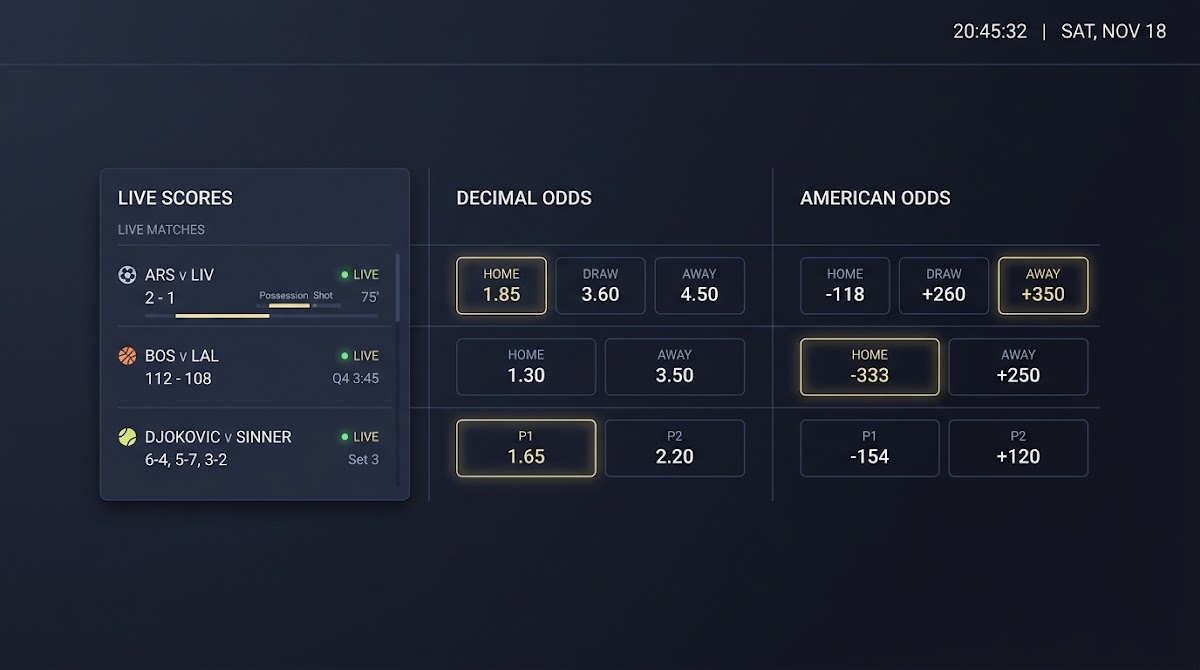
What live odds are and why they matter on FundedPlays
How to Read Live Odds on FundedPlays begins with a simple idea: live odds are on-screen prices that change as an event unfolds, and they signal the market view of short-term outcomes. On FundedPlays those prices are informational inputs users can use when completing structured prediction challenges; they are not offers to wager with real money and they do not guarantee results.
Live or in-play odds update continuously to reflect scoring events, time remaining, injuries, and public information, so being able to read them helps you assess short-term opportunities and manage a virtual bankroll within challenge rules. Operational pauses and quick line moves are routine in live markets and often reflect updates to the underlying event rather than certainty about the final outcome, as explained in industry overviews on in-play pricing Smarkets in-play guide.
Reading live odds accurately matters for challenge performance because small differences in implied probability can affect whether a prediction meets your edge criteria or violates a drawdown limit. Keep in mind that FundedPlays is a skill-based prediction platform using virtual funded accounts and evaluation objectives, not a sportsbook or financial investment product, so odds are a tool for disciplined choices, not a promise.
Practice conversions and review challenge rules
Before you place in-play predictions, review the specific challenge rules and practice conversions in demo or learning resources so you understand allowed actions and timing.
Quick regulatory and display standards to watch
Regulators require clear, accurate presentation of remote gambling information and status indicators so users can see current score, time, and any suspension flags; technical standards give platforms guidance on how to display that information UK Gambling Commission technical standards.
On any live board you should expect explicit labels for the odds format, a visible game clock or time marker, and clear suspension notices when markets are temporarily closed. If those elements are missing or unclear, you increase the risk of misreading a live price during an evaluation challenge.

Common odds formats you will see: Decimal and American
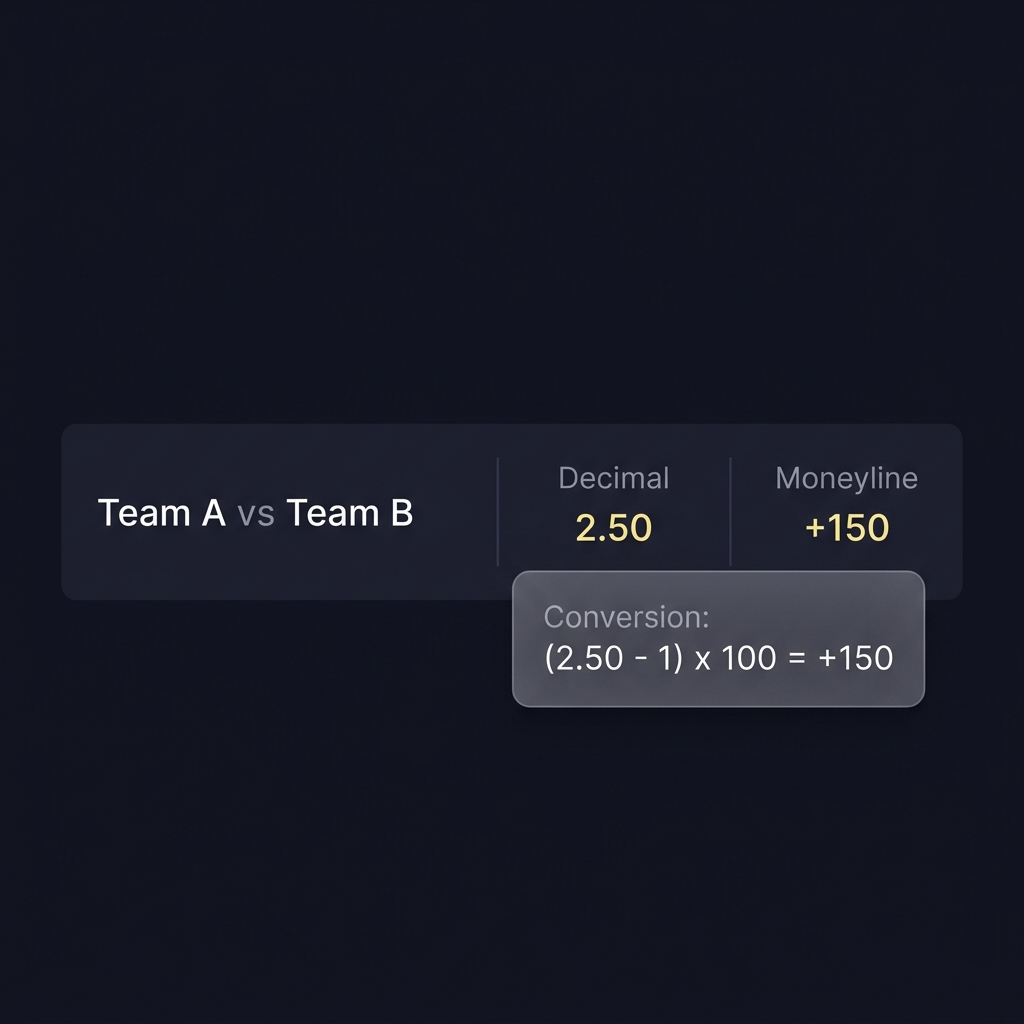
Decimal odds show how much a one-unit stake returns including the stake. For example, a decimal price of 2.50 means a 1 unit stake returns 2.50 units total, which is 1.50 units profit plus the original stake. Basic reading rules and examples for decimal odds are well described in standard references Investopedia implied probability.
Decimal prices are common in many interfaces because they make payout calculations direct. You compute total return by multiplying stake by the decimal price and subtract the stake to get profit when needed.
Treat rapid changes as signals to verify event state and platform notices; pause and confirm before acting, and follow your bankroll rules to avoid impulsive decisions.
American odds, often called moneyline odds, use positive and negative numbers. A negative number shows how much you must stake to win 100 units, while a positive number shows how much you win on a 100-unit stake. The standard rules and examples for moneyline interpretation are outlined in practical guides Investopedia moneyline guide.
On FundedPlays you may see either format depending on display settings. Check the label near the odds and practice converting mentally on our blog so you do not mix formats during fast-moving situations.
How to convert live odds into implied probability
Decimal to implied probability is the simplest conversion: implied probability equals 1 divided by the decimal price. For example, a decimal 2.50 corresponds to 1 / 2.50 = 0.40 or 40 percent implied probability; this conversion and examples are standard in educational resources Investopedia implied probability. You can also use converters such as AceOdds.
For American or moneyline odds the conversion differs by sign. For negative moneyline M, implied probability is M absolute divided by (M absolute plus 100). For positive moneyline M, implied probability is 100 divided by (M plus 100). Practitioners routinely use these formulas to translate prices into probabilities before sizing or comparing options Investopedia moneyline guide. Practical calculators like GamingToday offer quick conversions.
Quick mental shortcuts help in-play. For decimal odds close to 1.50, expect about 67 percent implied probability because 1 / 1.50 is about 0.666. For a -150 moneyline, expect roughly 60 percent because 150 / 250 equals 0.60. Round thoughtfully when decisions hinge on small margins.
Adjusting implied probability for bookmaker margin or overround
Market odds reflect a margin or overround so the sum of implied probabilities across mutually exclusive outcomes typically exceeds 100 percent; this is a market feature you should account for when assessing edge and comparing prices Pinnacle on overround.
To adjust, compute each unadjusted implied probability, sum them, then divide each unadjusted probability by the sum to produce proportional adjusted probabilities. For example, if your three-outcome market shows unadjusted probabilities summing to 106 percent, divide each probability by 1.06 to rescale them to a 100 percent base. Use adjusted probabilities when comparing markets or back-testing historical decision rules.

Using adjusted probabilities helps you avoid overstating your perceived advantage. When you log decisions for later review, record both the raw and adjusted probabilities so back-testing reflects the true market margin and how it affected past choices.
How FundedPlays presents live odds and challenge context
FundedPlays presents live odds within a challenge context where you operate with a virtual bankroll and must confirm rules before acting. Rules determine which in-play actions are allowed and how performance is judged, so always confirm rules before acting.
On typical live boards look for the odds format label, the current score and time marker, and any suspension or status flag that indicates markets are closed or updating. If the platform shows a suspension flag or delays updates, treat the market as under operational review rather than assuming the last price is stable; clear display elements are part of the platform guidance and regulatory expectations UK Gambling Commission technical standards.
Remember that a virtual bankroll on FundedPlays behaves like a risk budget within the challenge. Stake sizing and decision logging should reflect challenge objectives rather than real-money risk preferences.

What moves live odds: the mechanics behind in-play pricing
In-play prices react to concrete inputs such as scoring events, remaining time, injuries, and newly available information. Those inputs change the expected outcome in tight windows, and the market reprices continuously to reflect updated probabilities, as explained in operational guides to live markets Smarkets in-play guide.
Latency and market liquidity influence how quickly prices adjust. Less liquid markets can show wider jumps on small volumes, while highly liquid lines may move smoothly. Recognize that some moves are informational and others are operational responses from the platform or liquidity providers.
convert odds and adjust probabilities for live decisions
Fill one row per decision
Use simple models to separate real informational moves from noise. A scoring event that materially alters win expectancy is informational. A market suspension or a quick open-close cycle often signals an operational update rather than new insight about player performance.
How to read rapid line moves and market suspensions
Distinguish informational moves from operational responses by checking the event timeline and platform notices. If a line shifts immediately after a visible scoring event or an official substitution, treat the move as informational; if the market is suspended or the platform posts an update, treat the pause as an operational response and verify before acting Smarkets in-play guide.
Industry integrity monitoring reports flag unusual live-market patterns, so extreme or unexplained swings warrant caution and may merit reporting to platform support for review IBIA Integrity Report 2024.
When lines move fast, a disciplined response is: pause, confirm the format, check the score and time, consult any platform suspension notice, and avoid increasing stake size impulsively. Conserving your virtual bankroll during uncertain windows preserves evaluation metrics and reduces the risk of breaching challenge rules.
A decision framework: when to act on live odds during a challenge
Start each in-play decision with a pre-check list: confirm the odds format label, convert the price to implied probability, apply a margin adjustment, verify game status and any suspension, and check the challenge rule that governs allowed actions. These steps help you standardize decisions across sessions and make results easier to review.
Simple risk rules improve consistency. For example, limit any single in-play prediction to a fixed maximum percent of your virtual bankroll and impose a rule to skip markets during suspensions or unclear displays. Use conservative stake caps early in a challenge to protect progress while you calibrate your live-reading skills Investopedia implied probability.
Document each decision in a brief log entry: time, event state, price, converted probability, margin-adjusted probability, stake percent, and short rationale. Logging enables reliable back-testing and helps identify recurring biases that affect challenge performance. Tools such as OmniCalculator can help with conversions.
Common mistakes and how to avoid them
A frequent error is misreading the odds format and mixing decimal with moneyline calculations. Always check the format label before converting a price. Small mental slips in format recognition lead to incorrect implied probabilities and poor sizing choices, so add a visual habit to confirm format before any stake.
Another common mistake is ignoring the overround. Using raw implied probabilities without adjustment overstates your perceived edge, especially in tight markets. A proportional adjustment rescales probabilities to a 100 percent base and produces more realistic comparisons Pinnacle on overround.
Latency and unclear displays also cause errors. If the scoreboard, clock, or status flags are delayed or missing, pause and verify with official live feeds before committing a prediction. Do not assume rapid line moves always represent an unambiguous signal.
Practical examples and step-by-step scenarios
Example 1: decimal conversion and margin adjustment. Suppose a two-outcome event shows decimal odds 1.80 and 2.10. Convert each: 1 / 1.80 = 0.5556 or 55.56 percent; 1 / 2.10 = 0.4762 or 47.62 percent. Sum equals 103.18 percent. Proportionally adjust by dividing each by 1.0318 to get adjusted probabilities around 53.86 percent and 46.14 percent. This method reflects the market margin and is the basic proportional approach practitioners use Pinnacle on overround.
Example 2: American line swing after a score. Imagine a team had a moneyline of +120 before conceding a late goal and the line shifts to -110. Convert both to implied probability using moneyline rules: +120 implies 100 / (120 + 100) = 45.45 percent; -110 implies 110 / (110 + 100) = 52.38 percent. The swing signals a notable change in market view. Before acting, check game time, confirm the substitution or injury, and adjust stake sizing according to your bankroll rule Investopedia moneyline guide.
Decision log template. Record: event and time, displayed format, displayed price, converted implied probability, adjusted probability after margin, stake percent of virtual bankroll, rule applied, and brief rationale. This concise template keeps entries uniform and supports later back-testing and performance review.
Responsible participation and integrity signals to monitor
FundedPlays emphasizes responsible participation and structured evaluation objectives; success depends on consistent decision-making and compliance with challenge rules rather than short-term luck. Keep risk rules tight and document choices so you can learn from outcomes.
Integrity reports continue to highlight unusual live-market patterns as a risk area, so red flags such as unexplained rapid moves, repeated suspensions in the same market, or odds that diverge sharply from obvious event indicators should prompt verification and possibly reporting to platform support for review IBIA Integrity Report 2024.
If you spot suspicious behaviour, consult platform suspension notices, avoid trading during unclear windows, and use the reporting channels FundedPlays provides. Responsible participation protects both your evaluation progress and the wider community.
Conclusion: a checklist to take into every live session
Five quick checks: confirm odds format, convert to implied probability, adjust for market margin, verify game status and any suspensions, and apply your bankroll percent rule. These five steps form a habit you can apply each live session to stay disciplined and consistent.
Practice these steps in demo environments and document each decision for later review. Outcomes depend on skill and disciplined adherence to rules, not guarantees, so focus on process, not short-term results UK Gambling Commission technical standards.
Divide 1 by the decimal price to get the implied probability, then round as needed for decision thresholds.
A negative moneyline shows how much you must stake to win 100 units; convert it to probability using the standard moneyline formula.
Avoid acting during suspensions, unclear displays, or unexplained rapid swings; pause, verify the event state, and consult platform notices.
References
- https://help.smarkets.com/hc/en-gb/articles/360000395957-In-Play-betting-explained
- https://www.gamblingcommission.gov.uk/technical-standards/remote-gambling-and-software-technical-standards
- https://www.investopedia.com/terms/i/implied-probability.asp
- https://www.investopedia.com/terms/m/moneyline-bet.asp
- https://www.pinnacle.com/en/betting-articles/education/what-is-margin-and-overround/dfj2x3e9xgz2v7m6
- https://www.fundedplays.com/challenges
- https://ibia.bet/annual-integrity-report-2024/
- https://www.aceodds.com/bet-calculator/odds-converter.html
- https://www.gamingtoday.com/tools/implied-probability/
- https://www.omnicalculator.com/statistics/implied-probability
- https://www.fundedplays.com
- https://www.fundedplays.com/blogs
- https://www.fundedplays.com/blogs/how-fundedplays-evaluations-work